
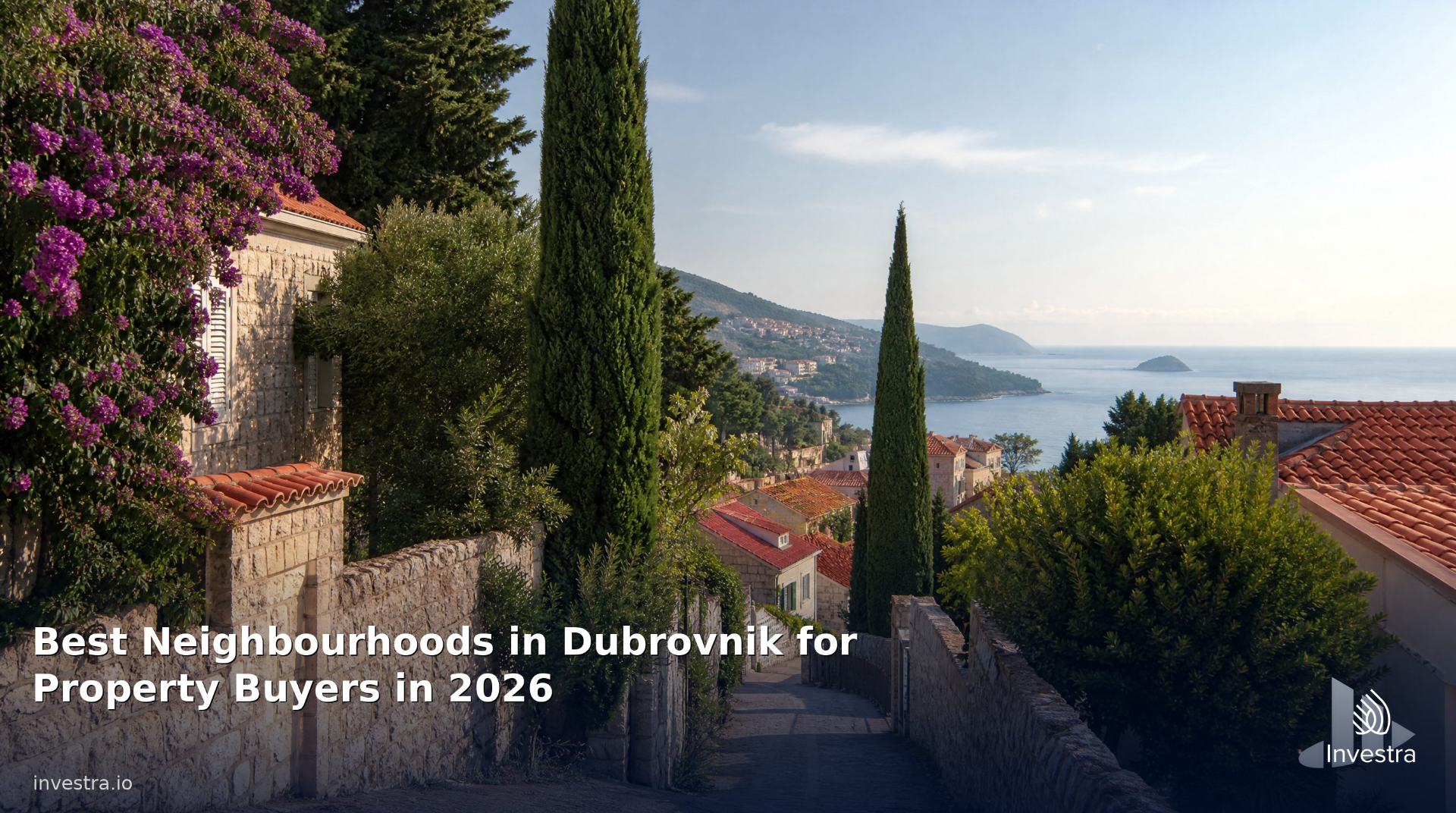
Best Neighbourhoods in Dubrovnik for Property Buyers in 2026
Why Dubrovnik's Property Market Remains One of Europe's Most Compelling in 2026
Quick Answer: Dubrovnik's property market in 2026 remains exceptionally strong, driven by record tourism numbers, limited housing supply within the historic city walls, and growing demand from international buyers seeking both lifestyle and rental income. Investra.io's complete guide for foreign investors in Dubrovnik offers deep-dive analysis for serious buyers.
Dubrovnik's appeal to property buyers is structural as much as it is aesthetic. The city combines one of Europe’s most valuable heritage cores with a small resident population, constrained land supply and an established tourism economy that drives year-round servicing and infrastructure. In 2023 Croatia’s adoption of the euro and simultaneous entry into Schengen removed two notable barriers for international buyers: currency volatility and travel friction.
Investors should read the market as a set of distinct sub-markets rather than a single homogeneous opportunity. The Old Town is a unique asset class: heritage constraints, licensing hurdles and an ultra-limited supply of units create a premium that rarely exists elsewhere in Croatia. Outside the walls, neighbourhoods such as Ploče and Lapad trade the prestige premium for practicality and higher liquidity.
This article consolidates the neighbourhood-level dynamics every buyer should understand in 2026. It preserves the core facts — price bands, yield expectations, regulatory considerations — while adding practical context for those deciding where to allocate capital. Use it alongside specialised resources such as Investra.io's comprehensive Dubrovnik Airbnb investment guide and comparative guides to other Croatian markets for a rounded view of opportunity and risk.
The Old Town (Stari Grad): Maximum Prestige, Maximum Price
Quick Answer: The Old Town is Dubrovnik's most prestigious address, with property prices ranging from €6,000 to €15,000+ per m², extremely limited inventory, and the highest short-term rental rates in the entire Adriatic. For serious luxury investors, it remains the benchmark against which all other Dubrovnik neighbourhoods are measured.
Stari Grad is an asset class defined by its scarcity. The Old Town is UNESCO-protected, pedestrianised, and composed almost entirely of historic stone palaces, townhouses and converted apartments. There is effectively no new land to develop, and any internal changes are tightly controlled by conservation authorities. For buyers seeking an asset that combines cultural cachet with short-term rental potential, this is the top choice; but the purchase logic is different from a modern apartment deal.
Expect to pay a multi-tiered premium based on position, view and structural features. A well-renovated, centrally positioned apartment commonly trades at €7,000–€10,000 per m²; exceptional units with direct sea views, multiple terraces, rooftop access or highly desirable corner locations can command €12,000–€15,000 per m² or more.
From a revenue perspective, short-term rentals inside the walls perform strongly: nightly rates for professionally managed, well-fit apartments range from €150–€700 depending on season and unit quality. Occupancy is concentrated in April–October but still high enough that experienced operators deliver gross yields in the mid single digits up to near double-digit levels on the very best assets.
There are practical considerations that temper the investment thesis. Heritage conservation rules limit alterations; access is pedestrian only (which affects deliveries and renovations); and the summer crowd generates noise and operational complexity for owners who expect to live there full time. For these reasons, most Old Town buyers are investors seeking rental yield and capital preservation, or second-home buyers who accept the seasonal intensity in exchange for rarefied address value.
Ploče: The Quiet Elite Quarter Just Outside the Walls
Quick Answer: Ploče is Dubrovnik's most exclusive residential neighbourhood, directly east of the Old Town, with prices typically ranging from €5,000 to €10,000 per m², combining Old Town proximity with the quieter ambience and more practical living conditions that buyers who want genuine residential quality seek out.
Ploče functions as the primary alternative for buyers who want the Old Town’s proximity without the intense summer pedestrianisation. Sitting on the hillside immediately east of Stari Grad, Ploče has a mix of early-to-mid-20th-century residential buildings, villas and selective new construction where terrain permits. Views across the Old Town and the Adriatic are common, and many properties offer elevated terraces and private outdoor spaces that are rare inside the walls.
Price bands in Ploče reflect both scarcity and desirability: good apartments with sea views trade mostly between €5,500 and €8,000 per m²; high-end villas and large penthouses with panorama terraces can exceed €10,000 per m². Inventory moves slowly but is more available than inside Stari Grad.
Short-term rental yields are typically a notch below the Old Town peak but still attractive. Returns in Ploče generally fall into the 5–8% gross range for well-placed apartments; the sales market is equally resilient because buyers prize both lifestyle and the potential for reliable seasonal rentals. For operational detail and income modelling, consult Investra.io's Dubrovnik Airbnb investment guide, which compares Ploče to Lapad and other rental-focused neighbourhoods.
Lapad Peninsula: The Best Value-to-Yield Ratio in the City
Quick Answer: Lapad is Dubrovnik's most popular neighbourhood for value-conscious buyers, with property prices ranging from €3,500 to €6,500 per m², strong short-term rental demand driven by its beach and hotel infrastructure, and significantly better entry points than the Old Town or Ploče.
Lapad forms the practical commercial spine for a large portion of Dubrovnik’s leisure market. Its tree-lined promenade, beaches and concentration of hotel and leisure infrastructure make it a preferred choice for families and longer-stay visitors. The resident community is sizeable and active year-round, which supports supermarkets, healthcare, and public transport in a way that the Old Town cannot match.
For many international investors the attraction of Lapad is its scale and liquidity. There is a broader stock of apartments available across a range of conditions — from older units needing renovation to contemporary new-build developments — and this breadth generates both purchase choice and resale demand. Typical market pricing in 2026 runs from about €3,500 per m² for older stock to €5,500–€6,500 per m² for modern, well-specified units with sea proximity.
Lapad’s yield profile is strong because it benefits from both tourist overflow when Old Town units are fully booked and from families who prefer a beach-adjacent stay. Experienced local consultants, including Siniša Dagary — Investment Consultant, commonly recommend Lapad for buyers seeking the best risk-adjusted returns within the municipal boundary. Operationally, the area allows a more standardised rental product, easier access for servicing crews, and a more forgiving regulatory environment compared with the Old Town.
Babin Kuk: Modern Living, Resort-Style Infrastructure
Quick Answer: Babin Kuk, at the western tip of the Lapad peninsula, is a hotel and resort-heavy neighbourhood with modern apartment stock, prices between €4,000 and €7,000 per m², and strong appeal for buyers who want new-build quality, sea proximity, and consistent rental demand without the Old Town premium.
Babin Kuk reads as a contemporary resort enclave within Dubrovnik’s broader coastal fabric. Large hotel complexes, resort amenities and newer apartment blocks define the urban environment here. The planning and infrastructure were designed to absorb higher visitor numbers and deliver the kinds of facilities families and mid-range leisure travellers expect: beaches, pools, promenades and easy road access.
Developers have targeted Babin Kuk as a place to deliver modern finishes, on-site amenities and features such as underground parking and communal pools. Pricing for recent new-builds commonly sits between €4,500 and €7,000 per m² depending on view and finish. This creates an attractive option for buyers seeking a more predictable management experience: construction standards are contemporary, service access is straightforward, and occupancy is supported by the hotel market around the peninsula.
From an investment perspective, Babin Kuk combines reliable demand with easier operational logistics than older stone buildings. Gross yields are similar to Lapad for comparable units, typically 6–8.5% for professionally managed short-term rentals. The area has proven appeal to families and couples who prioritise space and facilities over heritage ambience.
Gruž: The Undervalued Local Neighbourhood with Long-Term Potential
Quick Answer: Gruž, home to Dubrovnik's ferry port and working harbour, is the city's most affordable established neighbourhood, with prices ranging from €2,500 to €4,500 per m², and offers genuine long-term capital appreciation potential as urban regeneration continues and the local residential market develops.
Gruž is Dubrovnik’s pragmatic hub. It houses the principal ferry terminal, main bus station and a significant portion of the city's everyday commerce. The area is less glamorous than coastal promenades, but its functional strengths — market, transport links and employment — make it a core residential zone for locals and a practical choice for longer-term tenants including service workers, students and an increasing number of remote workers.
Price points in Gruž are the most accessible within the municipal area, generally between €2,500 and €4,500 per m² depending on modernization and exact location. This affordability creates two distinct investor profiles: buy-to-let owners who target stable, long-term rental returns from locals and workers; and value buyers who prefer to capture capital growth over a multi-year horizon as the area benefits from general municipal improvements and inflows of digital nomads.
The Croatia Digital Nomad Visa programme has introduced an added demand driver for Gruž: longer-stay visitors who value practicality and price sensitivity over heritage address. For those prioritising yield predictability and lower entry cost, Gruž represents one of the more defensible allocations in a diversified Dubrovnik portfolio.
Mokošica and Greater Dubrovnik: The Emerging Suburban Opportunity
Quick Answer: Mokošica and other suburban areas north of Dubrovnik offer the lowest prices in the metropolitan area — €2,000 to €3,500 per m² — and suit buyers looking for residential investment targeting local tenants, or those wanting personal property use with a significantly lower budget than the coastal core demands.
Suburbs such as Mokošica provide a different investment case to the coastal core: these areas prioritise family living, local services and a steadier year-round rental market. They have been the location of significant apartment development since the 1990s, which means stock quality is typically modern enough to be marketable without the need for intensive historic renovation works. Schools, healthcare centres and retail make these suburbs genuinely liveable.
Pricing in Mokošica tends to fall between €2,000 and €3,500 per m², representing the lowest entry tier for the Dubrovnik metropolitan area. Yields on long-term rentals are competitive relative to other Southern European suburbs, typically 4–5.5% gross, and the tenant pool is stable because of local workforce and family demand. Some buyers adopt a two-asset strategy: they live in a suburban property and co-own or separately purchase a coastal unit in Lapad or Babin Kuk to capture seasonal rental income.
For those assessing total cost of ownership, suburban options often reduce ongoing expenses tied to high-season maintenance, specialised heritage conservation or intensive guest turnover. They are therefore an attractive option for investors focused on long-term capital growth and predictable cashflow rather than high-variance peak-season returns.
Cavtat: The Overlooked Gem 20 Minutes South of Dubrovnik
Quick Answer: Cavtat, a charming coastal town 20km south of Dubrovnik and technically outside the city boundary but within its commuter and tourism orbit, offers property prices of €4,000–€8,000 per m² in a far quieter, more authentically Dalmatian setting with strong rental yields and superior livability compared to central Dubrovnik.
Cavtat sits on a sheltered peninsula and benefits from both high-quality waterfront living and practical proximity to Dubrovnik Airport. It is often underappreciated in broad Dubrovnik market discussions but represents a distinct sub-market that attracts buyers who prefer quieter summers and a longer shoulder season. The town’s promenades, small marina, and compact historic centre create an environment attractive to repeat visitors and villa renters seeking privacy and reliability.
Market pricing in Cavtat ranges from mid-market apartments around €4,000–€7,000 per m² to premium waterfront villas that can reach higher levels in exceptional positions. Rental yields are typically strong because Cavtat’s repeat visitors book in advance and pay a premium for comfort and location; gross yields of 7–10% can be achieved on well-managed short-term rentals in prime spots.
The proximity to the airport is a commercially significant advantage: travel time from Cavtat to major European hubs is short, which enhances the town’s appeal to owner-occupiers and high-frequency renters. Many buyers weigh this convenience heavily when deciding between central Dubrovnik and its coastal satellite towns.
Property Prices and Short-Term Rental Yields in Dubrovnik: What the Numbers Actually Show
Quick Answer: Property prices in Dubrovnik in 2026 range from €2,000 per m² in outer suburban areas to €15,000+ per m² for exceptional Old Town properties, with the majority of investor-focused transactions occurring in the €3,500–€8,000 range across Lapad, Babin Kuk, Ploče, and Cavtat.
Bringing the price and yield landscape together helps buyers match budget, aspiration and operational capacity. Across the municipality, the spectrum is wide: suburban stock starts at roughly €2,000–€3,500 per m²; Gruž and the practical urban ring sit around €2,500–€4,500 per m²; Lapad and Babin Kuk occupy the mid-market €3,500–€6,500 per m² band; Ploče markets at €5,500–€10,000 per m²; and the Old Town reaches €7,000–€15,000+ per m² for the very best assets.
Buyers must build transaction costs into the budget: taxes, notary and registration fees and transfer-related expenses commonly add 5–8% to the purchase price depending on whether the buyer purchases an existing property or a new-build transaction subject to VAT. For taxation detail and worked examples, refer to the Croatia Property Tax Guide 2026, which lays out transfer tax, VAT and ongoing local fiscal obligations.
The Legal Process for Foreign Buyers in Dubrovnik: What You Actually Need to Know
Quick Answer: EU citizens can buy property in Croatia with essentially the same rights as Croatian nationals. Non-EU nationals face a reciprocity requirement that, in practice, allows most nationalities to purchase.
The practical steps for a foreign buyer are straightforward when guided by experienced local counsel and conveyancers. They typically include: a preliminary offer and reservation contract; due diligence on title and encumbrances through a Croatian lawyer or notary; verification of zoning and rental/licensing status if you intend to operate short-term accommodation; the signing of a purchase contract; registration with the land registry (Zemljišna knjiga); and final payment and handover.
Short-term rental licensing is a separate and important compliance area. Croatia’s eVisitor system and local categorisation rules require properties used for tourism to be registered, and Dubrovnik municipal policy has tightened approvals in sensitive zones such as the Old Town. Confirm a property’s licence status during due diligence: a listed property with a clean tourist licence can materially change both valuation and operational feasibility.
For comparative context across Croatia’s broader market, Investra maintains a suite of regional guides with practical legal and market detail: Hvar Island Real Estate 2026 Luxury Property Investment G..., Buying Property In Split 2026 Complete Guide For Foreign ..., and a comprehensive Croatia Real Estate FAQ that answers many legal and procedural questions for international buyers.
For investment structuring and cross-border tax planning, buyers frequently consult specialist advisory firms. The Findes Group offers financial planning and structuring services relevant to international real estate investors: Findes Group & Partners. If you require direct contact for advisory services, their team can be reached via Findes Group & Partners for tailored discussions.
Finally, several practical resources and consultants can assist with market entry and ongoing management. The author’s consultancy and public resources at Siniša Dagary investment insight and the broader Siniša site pages on about, services and contact provide practical examples of structuring, sourcing and local partnerships for buyers who need hands-on support.
Investment Disclaimer
Quick Answer: The information provided in this article is for educational and informational purposes only and should not be construed as financial, legal, or investment advice.
The content in this article summarises market facts, typical price ranges and commercially relevant dynamics as of 2026. It does not constitute a recommendation to buy or sell any asset, nor is it a substitute for personalised financial, tax or legal advice. Real estate investments carry inherent risks, including illiquidity, market volatility and regulatory change. Past performance is not a guarantee of future results.
Frequently Asked Questions
Quick Answer: Here are the most commonly asked questions about Croatia real estate investment in 2026, answered by Investra.io experts.
Is Croatia a good country for real estate investment in 2026?
Yes. Croatia’s market benefits from EU integration, the euro, improved transport links and robust tourism flows. Opportunities exist across a range of price points; success depends on location selection, licensing compliance and operational capability.
Can foreigners buy property in Croatia?
EU citizens have near-equal rights to Croatian nationals. Non-EU nationals may need to satisfy reciprocity conditions but can typically acquire property with the correct legal steps and approvals. Working with a local lawyer ensures compliance with all registry and ministry requirements.
What is the average property price in Dubrovnik?
There is no single “average.” Prices range from roughly €2,000 per m² in outer suburbs to €15,000+ per m² for select Old Town assets. The most active investor transactions usually occur in the mid-market €3,500–€8,000 per m² band.
What rental yields can I expect?
Expect gross yields from 4% in long-term suburban rentals up to 8–12% in top-performing Old Town and select Lapad properties. Net yields depend on fees, taxes, maintenance and occupancy seasonality; professional management materially improves net performance.
What taxes apply to property purchases?
Buyers should budget for property transfer tax, VAT where applicable on new builds, notary fees, registration costs and potential capital gains tax on future sales. Transaction costs commonly add 5–8% to the headline purchase price. See the Croatia Property Tax Guide 2026 for specifics.
How long does the purchase process take?
Standard transactions complete in 30–60 days from accepted offer to final registration, assuming clean title and no unusual legal encumbrances. Complex deals or international approvals can extend this timeline.
What financing options are available?
Local bank mortgages, international financing and developer payment plans are common. Terms depend on nationality, residency and financial profile. Independent mortgage advisory firms, including specialist cross-border teams, can assist with comparisons.
Is property management available for rental properties?
Yes. Management companies provide turnkey services including guest communications, cleaning, linen, maintenance and marketing. Fees typically range 20–30% of revenue but can be offset by higher occupancy and stronger nightly rates delivered by professional operators.
What are the best areas to invest in Dubrovnik?
Choice depends on goals: Old Town and Ploče for prestige and higher seasonal yields; Lapad and Babin Kuk for value-to-yield balance and reliable operations; Gruž and Mokošica for long-term residential demand; Cavtat for quieter high-quality coastal living with strong repeat bookings.
Where can I find more detailed market guides?
Investra publishes comprehensive regional guides on multiple Croatian markets. Relevant readings include practical guides to Split, Hvar and Zagreb as well as more specialised market research for smaller Dalmatian towns.
Recommended Reading
Quick Answer: This section explains the practical property-investment implications of Recommended Reading.
- Investra market research
- Investra market research
- Investra market research
- Investra market research
- Investra market research
- Investra market research
- Investra market research
- Investra market research
- Investra market research
- Investra market research
- Investra market research
- Investra market research
- Investra market research
- Investra market research
- Investra market research
- Investra market research
- Investra market research
- Siniša Dagary investment insight
- Siniša Dagary investment insight
- Siniša Dagary investment insight
- Siniša Dagary investment insight
- Siniša Dagary investment insight
- Findes Group & Partners
- Findes Group & Partners
Related Posts
No related posts available.
