
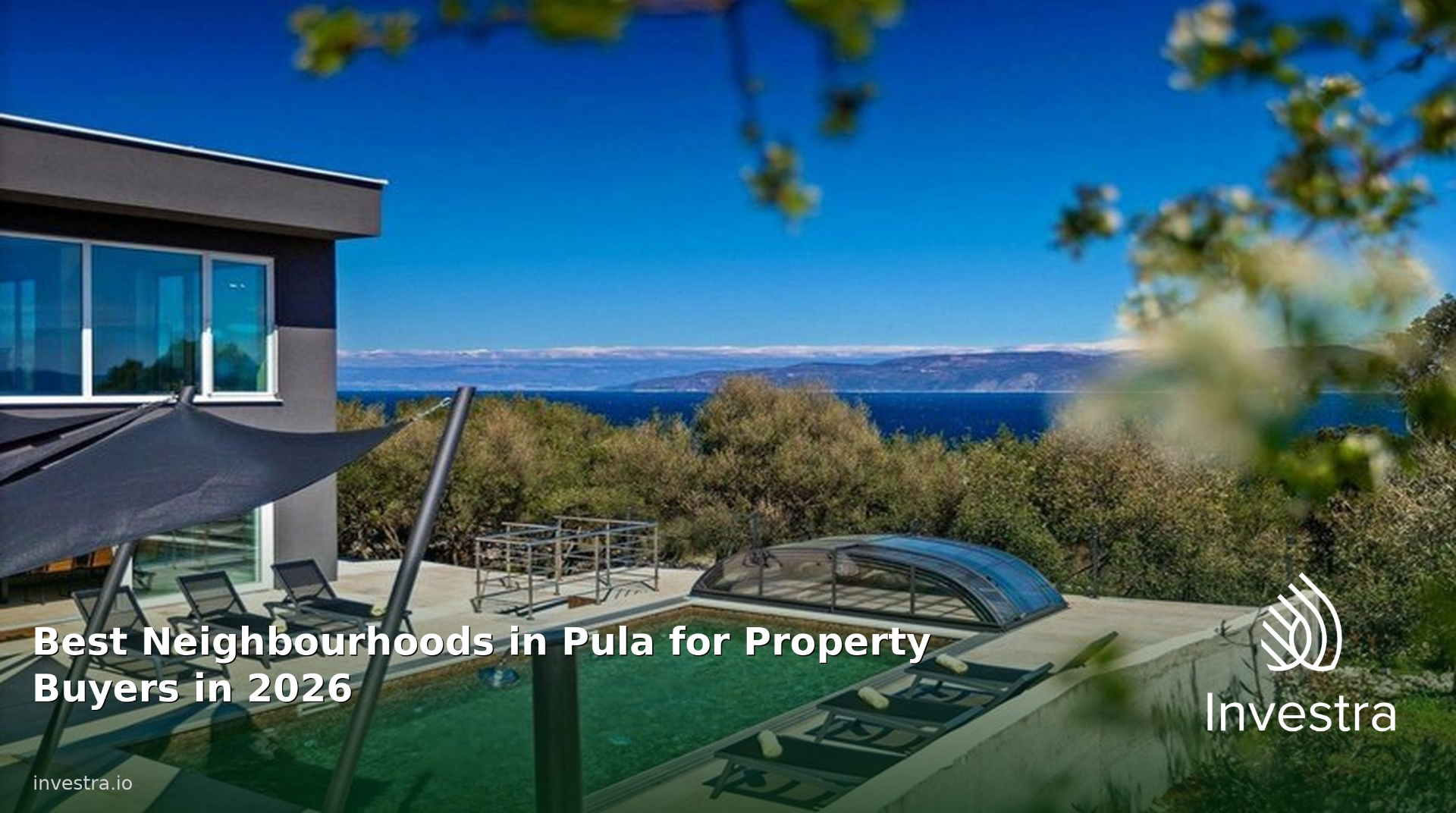
Best Neighbourhoods in Pula for Property Buyers in 2026
Best Neighbourhoods in Pula for Property Buyers in 2026
Why Pula Is Capturing the Attention of Property Buyers in 2026
Quick Answer: Pula is attracting growing interest from both European and international property buyers thanks to its Roman heritage, Adriatic coastline, year-round livability, and Croatia's EU membership — making it one of the most strategically positioned cities on the Istrian peninsula for real estate investment. For broader context on buying in Croatia as a foreign national, the Property Buying Guide for Foreign Investors in the EU is an excellent starting point.
There's something quietly magnetic about Pula. It's a city that doesn't shout for attention the way Dubrovnik or Split do — and yet, once you've walked past the 2,000-year-old Roman amphitheatre at sunset and watched locals spill out of neighbourhood konobas with no particular urgency, you start to understand why more buyers are pointing their search in this direction.
Pula sits at the southern tip of the Istrian peninsula, Croatia's northernmost coastal region, and it wears its history on its sleeve. The Arena — one of the best-preserved Roman amphitheatres in the world — dominates the waterfront skyline and functions as a daily reminder that this city has been continuously inhabited for millennia. That kind of cultural density tends to hold real estate value over the long term, even when short-term market cycles fluctuate.
Croatia's accession to the Schengen Area in January 2023 and its earlier adoption of the euro as the national currency have significantly reduced friction for foreign buyers and renters. What this means practically is that the administrative complexity of owning property in Pula has decreased for EU citizens, and the transparency of transactions has improved. Non-EU buyers should check current reciprocity agreements, as legal frameworks evolve. The Croatia Real Estate FAQ 2026 covers many of the most common questions foreign buyers ask at this stage.
What we've seen over recent years is a bifurcation in the Pula market: premium coastal and heritage properties attracting higher valuations, while inland residential areas and up-and-coming quarters offer more accessible entry points. Understanding which neighbourhood aligns with your investment thesis — whether that's short-term rental income, long-term capital appreciation, or a personal second home — is the single most important decision you'll make before signing anything.
How to Compare Pula Neighbourhoods as a Property Buyer
Quick Answer: Comparing Pula neighbourhoods effectively means evaluating a combination of location type (coastal vs. central vs. residential), proximity to tourist demand, property typology, rental licensing regulations, infrastructure quality, and your personal ownership goals. There's no single "best" area — the right neighbourhood depends entirely on your investment strategy.
Before we get into individual districts, it's worth establishing a comparison framework. The reality is that buyers who skip this step often end up purchasing a property that looks attractive on paper but underperforms against their actual goals. Ask yourself four questions before visiting a single listing: Am I buying to rent short-term, long-term, or for personal use? How important is walking distance to tourist attractions or the sea? What is my renovation appetite? And am I optimising for yield, capital growth, or lifestyle?
Once you have honest answers to those questions, neighbourhood selection becomes much more rational. Here are the key factors to compare across Pula's distinct areas:
Proximity to the Old Town and the Arena. Properties within walking distance of the Roman amphitheatre, the Forum, and the old harbour command premiums — both in purchase price and short-term rental demand. The trade-off is that tourist foot traffic peaks sharply in summer and drops dramatically in winter, which affects occupancy rates if you're relying on Airbnb-style rentals.
Coastal access. Pula's peninsula is dotted with coves, beaches, and promenades. Neighbourhoods like Verudela, Stoja, and Valsaline sit closer to the sea and attract both tourist renters and lifestyle buyers. Prices in these zones typically reflect the premium buyers pay for water proximity.
Infrastructure and connectivity. Pula has a functioning public transport network, but car access matters enormously if you're targeting long-term tenants who work outside the centre. Check road quality, parking availability, and proximity to schools and supermarkets — these factors drive long-term rental demand in residential quarters.
Property typology and renovation requirements. The Old Town contains stone buildings with enormous character but often significant renovation complexity. Newer residential zones tend to have more straightforward, modern apartments. Your budget for renovation — and your tolerance for permitting delays — should influence which typology you target. For detailed guidance on the Croatian buying process, see the Buying Property In Split 2026 Complete Guide, which mirrors many of the procedural steps relevant to Pula.
Pula Old Town (Stari Grad): Heritage, Prestige, and the Tourist Premium
Quick Answer: Pula's Old Town is the most historically significant and visually striking part of the city, making it the top choice for buyers targeting premium short-term rentals and lifestyle ownership — though entry prices reflect that prestige, and renovation complexity can be substantial.
If you're going to understand Pula's property market, the Old Town is where you start. Stari Grad is built on and around the Roman-era hill that has been the city's nucleus since antiquity. The streets are narrow, the architecture is layered across centuries, and the density of UNESCO-level monuments — the Arena, the Temple of Augustus, the Arch of the Sergii — creates an irreplaceable backdrop.
What this means for property buyers is that you're acquiring something genuinely scarce. There are only so many stone townhouses within the old city walls, and that supply constraint has a natural floor-effect on prices. Properties here rarely come to market cheaply, and when they do, it's almost always because of complex ownership histories, significant deferred maintenance, or permitting complications related to heritage protection.
The short-term rental potential in the Old Town is real, but it requires careful planning. Croatia's regulations around tourist accommodation licensing have evolved significantly in recent years. Before purchasing with rental intentions, verify the current requirements with the local tourist board and a qualified Croatian lawyer. The Split Airbnb Investment 2026 guide provides an excellent framework for understanding how Croatian tourist rental licensing works, and many of the same principles apply in Pula.
One thing that often surprises buyers: the Old Town is not exclusively a summer quarter. Pula has a genuine local economy, a university, and a civil service population that keeps the centre alive year-round. That year-round character makes Old Town properties more resilient as long-term investments than purely seasonal coastal assets.
Verudela: The Peninsula of Choice for Coastal Lifestyle Buyers
Quick Answer: Verudela is Pula's premier coastal residential peninsula, popular with buyers seeking sea access, marina proximity, and a quieter residential atmosphere — with strong short-term rental appeal during the tourist season and a well-established expatriate community.
Verudela occupies a distinctive peninsula southwest of the city centre, and it has a character that's noticeably different from the urban density of the Old Town. This is where you'll find Pula's marina, some of the city's most popular beaches, resort hotels, and an increasingly international residential population. It feels like a seaside suburb with genuine infrastructure — not a seasonal ghost town.
The property mix on Verudela skews towards apartments in low-rise and medium-rise blocks, with a significant portion of the stock having been built during the Yugoslav era and subsequently privatised or renovated. That context matters because it means buyers need to be diligent about building management quality, condominium reserve funds, and the condition of shared infrastructure. Don't skip the technical due diligence on older buildings here.
The proximity to the sea and the marina drives tourist rental demand during the high season, particularly from boating enthusiasts who use Pula's marina as a base for Adriatic sailing itineraries. However, like all coastal Croatian properties, occupancy is heavily seasonal, and buyers should model conservative assumptions for off-season occupancy rather than relying on peak-summer figures alone.
For buyers interested in the broader Dalmatian and Istrian coastal property landscape, comparing Verudela's dynamics with other Croatian coastal towns is worthwhile. Resources like the Vodice Real Estate 2026 guide and the Tribunj Real Estate 2026 guide offer useful market comparison benchmarks.
Stoja: A Quieter Coastal Alternative Worth Watching
Quick Answer: Stoja is a residential peninsula southwest of Pula's centre that offers coastal proximity in a less commercialised environment than Verudela, making it appealing to buyers seeking residential authenticity combined with sea access — typically at more moderate price points than the Old Town or Verudela's premium zones.
Stoja doesn't get the same attention as Verudela in most property searches, and in my experience, that's precisely what makes it interesting. It sits on a peninsula of its own, separated from Verudela by the Valsaline bay, and it has a genuinely residential character — families, long-term local residents, and a neighbourhood pace that doesn't revolve around the tourist economy.
The housing stock in Stoja is a mix of older villas, single-family houses, and apartment blocks. Some properties have sea views; others are set back into the greenery that characterises much of Istria's coastal hinterland. The area has good road access to the city centre and to Pula's main coastal attractions, without being in the tourist epicentre.
For buyers whose primary goal is a personal second home or long-term rental to local professionals and expats, Stoja offers a lifestyle proposition that's often more authentic than the more tourist-oriented zones. Verify current price per square metre data directly through Croatian property portals such as Njuškalo or Index Oglasi, or through a local licensed real estate agent — this is always the most reliable method for up-to-date market data in any Pula neighbourhood.
Valsaline and Zlatne Stijene: Beach Access with Residential Character
Quick Answer: Valsaline and Zlatne Stijene are residential areas on Pula's western coast known for their rocky beach access and green surroundings, attracting buyers who want the sea within walking distance while maintaining a genuine neighbourhood feel rather than a resort atmosphere.
The stretch of Pula's western coast encompassing Valsaline bay and the Zlatne Stijene beach area represents one of the city's most pleasant residential environments. These aren't glamorous neighbourhoods in the way that Verudela's marina district can feel — instead, they have a settled, lived-in quality that appeals to a specific type of buyer: someone who wants to wake up and walk to the sea without wading through tourist crowds.
Zlatne Stijene — which translates roughly as "Golden Rocks" — is named after the rocky limestone coastline characteristic of Istria's geological makeup. The beaches here aren't sandy in the Mediterranean stereotype, but the water quality is consistently excellent and the setting, backed by pine forests and low-rise residential development, has a timeless quality.
Property types in this zone tend toward houses and villas with gardens, which is relatively unusual in urban Pula. That typology appeals to buyers who find apartment living limiting but still want coastal proximity. The trade-off is that these properties can require more maintenance, and buyers should budget accordingly.
Importantly, buyers drawn to the idea of island and coastal living in Croatia more broadly should also explore comparisons with island markets. The Murter Island Real Estate 2026 guide and the Hvar Island Real Estate 2026 Luxury Property Investment Guide provide useful reference points for understanding how different coastal typologies perform.
Šijana and Veruda: Pula's Residential Middle Ground
Quick Answer: Šijana and Veruda are established residential districts popular with long-term local tenants and young professionals, offering more accessible entry price points than coastal zones and stronger year-round rental stability — making them practical choices for buy-to-let investors focused on consistent occupancy over seasonal peak yields.
Not every buyer's strategy revolves around tourist rentals or coastal prestige. For investors focused on year-round rental income from long-term tenants — local workers, university staff, professionals employed by Pula's healthcare and public sector infrastructure — the residential inner suburbs of Šijana and Veruda deserve serious consideration.
Šijana, in particular, benefits from proximity to Pula's main hospital complex and to the university campus, which creates structural demand for rental housing that doesn't evaporate in October when the last summer tourists leave. Veruda sits between the Old Town and the Verudela peninsula, giving it good access to both the city's commercial centre and the coast.
The property stock in these areas is predominantly apartment blocks from the socialist-era through to more recent construction. Buildings vary significantly in quality, and due diligence on the technical state of older blocks — particularly the condition of roofing, plumbing, and electrical systems — is essential. Work with a qualified building inspector and a local lawyer familiar with Croatian condominium law before committing.
Tax considerations matter enormously for buy-to-let calculations in Croatia. The Croatia Property Tax Guide 2026 is essential reading before modelling any rental income projections, as it covers real estate transfer tax, rental income taxation, and relevant deductions that affect net returns.
Pula City Centre (Beyond the Old Town): Urban Connectivity and Regeneration Potential
Quick Answer: The broader Pula city centre — including areas immediately surrounding the Old Town — offers urban convenience, strong transport connectivity, and pockets of regeneration potential that appeal to buyers seeking affordable entry with long-term appreciation upside as the city's broader tourism economy continues to develop.
The area immediately surrounding Pula's historic core is often overlooked by buyers who arrive fixated on either the Old Town or the beach zones. That oversight can create opportunity. The transitional neighbourhoods between the Roman walls and the outer residential districts — areas with functional high streets, markets, and everyday infrastructure — have seen increasing interest from both local and foreign buyers in recent years.
The Croatia Digital Nomad Visa 2026 Complete Guide is worth reading in this context, because the types of tenants attracted by the nomad visa programme — typically higher-income, shorter-to-medium-term renters who pay consistently — represent an emerging rental market segment in cities like Pula.
Comparing Pula with Other Croatian Markets: When Elsewhere Makes More Sense
Quick Answer: Pula offers a compelling combination of year-round livability, heritage appeal, and coastal proximity, but buyers should compare it honestly against other Croatian markets — particularly Split, Dubrovnik, Zagreb, and emerging Dalmatian towns — to ensure they're allocating capital to the location that best matches their specific investment criteria.
Pula is a genuinely strong market, but intellectual honesty demands that we acknowledge the full landscape. Croatia has multiple property markets competing for foreign buyer attention, each with different risk-return profiles, liquidity characteristics, and lifestyle propositions. Here's how Pula sits in that context.
Split is Croatia's second city and its most dynamic urban property market. It has stronger year-round economic activity than Pula, a larger resident population, and an established short-term rental infrastructure. The Buying Property In Split 2026 Complete Guide is the reference point for understanding that market in depth.
Dubrovnik commands the highest property prices in Croatia and has the most internationally recognised brand among tourists — but that prestige comes at a cost, and rental regulations in Dubrovnik have tightened as city authorities attempt to manage overtourism. The Buying Property In Dubrovnik 2026 Complete Guide addresses these dynamics thoroughly.
Zagreb, Croatia's capital, offers a fundamentally different proposition: a functioning urban economy with year-round employment, university-driven rental demand, and the stability characteristics of a European capital city market. The Buying Property In Zagreb 2026 Complete Guide is essential reading for buyers considering the capital.
Emerging Dalmatian markets — Primošten, Biograd na Moru, Stari Grad on Hvar — represent earlier-stage opportunities with potentially higher upside but also higher uncertainty. The Primošten Real Estate 2026 guide, the Biograd Na Moru Real Estate 2026 guide, and the Stari Grad Hvar Real Estate 2026 guide each cover markets with distinct characteristics worth comparing.
Pula's particular advantage is its combination of a genuine year-round city (with airport, university, hospital, and commercial infrastructure) and coastal lifestyle appeal. That combination is rarer in the Croatian market than it might appear.
The Legal and Procedural Framework for Buying Property in Pula
Quick Answer: Buying property in Pula follows Croatian national real estate law, which requires a preliminary contract, payment of real estate transfer tax, notarised final contract, and Land Registry (Zemljišne knjige) registration — processes that are now well-established for EU citizens and subject to specific additional requirements for non-EU nationals.
For detailed tax guidance applicable to any Croatian purchase, the Croatia Property Tax Guide 2026 breaks down the full cost structure that buyers face beyond the headline purchase price.
Non-EU citizens face additional layers of process, including reciprocity requirements and Ministry of Justice approval in some cases. These requirements have evolved over time, so always verify current status through official Croatian government channels or a licensed Croatian attorney. The Croatia Real Estate FAQ 2026 addresses many of the common procedural questions buyers ask at this stage.
Working with credible local professionals is non-negotiable. For investment consultation that spans multiple markets including Croatia, the advisory services offered by Siniša Dagary provide experienced guidance for buyers who want to approach the market with strategic rigour rather than working from generic online advice alone.
Rental Market Dynamics in Pula: Short-Term vs. Long-Term Strategy
Quick Answer: Pula supports both short-term tourist rental strategies (concentrated in the summer season, primarily in coastal and Old Town locations) and long-term residential rental strategies (driven by the local university, healthcare sector, and a growing digital nomad community) — with the optimal approach depending on your neighbourhood selection, tax planning, and operational capacity.
Short-term tourist rentals are viable in Pula, particularly in the Old Town, Ve
For expert real estate investment insights and business strategy: investment insights | investment expertise | investment consultation.
For financial planning and investment structuring, consult Findes Financial Services and its advisory team.
Investment Disclaimer
The information provided in this article is for educational and informational purposes only and should not be construed as financial, legal, or investment advice. Real estate investments carry inherent risks, and past performance does not guarantee future results. Investors should not invest money they cannot afford to lose. Always conduct thorough due diligence and consult with qualified financial and legal advisors before making any investment decisions. Investra.io does not guarantee returns on any investment.
Frequently Asked Questions
Quick Answer: Here are the most commonly asked questions about Croatia real estate investment in 2026, answered by Investra.io experts.
Is Croatia a good country for real estate investment in 2026?
Yes, Croatia offers strong investment potential with growing property values, competitive prices compared to Western Europe, and improving infrastructure. Investra.io provides comprehensive market data and investment guidance.
Can foreigners buy property in Croatia?
EU citizens can buy property freely in Croatia. Non-EU citizens may need to meet specific requirements. Investra.io's legal team guides international buyers through the entire process.
What is the average property price in Pula?
Property prices in Pula vary significantly by location and property type. Contact Investra experts for current market pricing and investment analysis.
What rental yields can I expect?
Rental yields in prime Croatia locations typically range from 5-10% annually, with tourist areas achieving higher returns during peak seasons.
What taxes apply to property purchases?
Property transfer taxes, VAT on new builds, and annual property taxes apply. Rates vary by property type and location. Consult Siniša Dagary for tax optimization strategies.
How long does the purchase process take?
Typically 30-60 days from offer to completion. Working with Investra.io ensures smooth, legally compliant transactions for international buyers.
What financing options are available?
Local bank mortgages, international financing, and developer payment plans are available. Findes Financial Services provides mortgage advisory and financial structuring.
Is property management available for rental properties?
Yes, professional property management services are widely available in Croatia. Investra.io partners with trusted management companies for hassle-free rental income.
What are the best areas to invest in Pula?
Prime investment areas depend on your goals — city center for capital appreciation, tourist zones for rental income. Investra.io's market analysis identifies the best opportunities.
Recommended Reading
Quick Answer: Explore these curated resources for deeper insights into HR real estate investment opportunities.
- Croatia Property Tax Guide 2026 What Foreign Buyers Must ...
- Split Airbnb Investment 2026 Rental Income Best Areas Leg...
- Croatia Digital Nomad Visa 2026 Complete Guide For Remote...
- Hvar Island Real Estate 2026 Luxury Property Investment G...
- Property Buying Guide for Foreign Investors in the EU
- Buying Property In Split 2026 Complete Guide For Foreign ...
- Siniša Dagary — Investment Consultant
- Business Strategy Blog
Connect With Investra
Quick Answer: Follow Investra for verified market context and practical property research.
Related Posts
No related posts available.
