
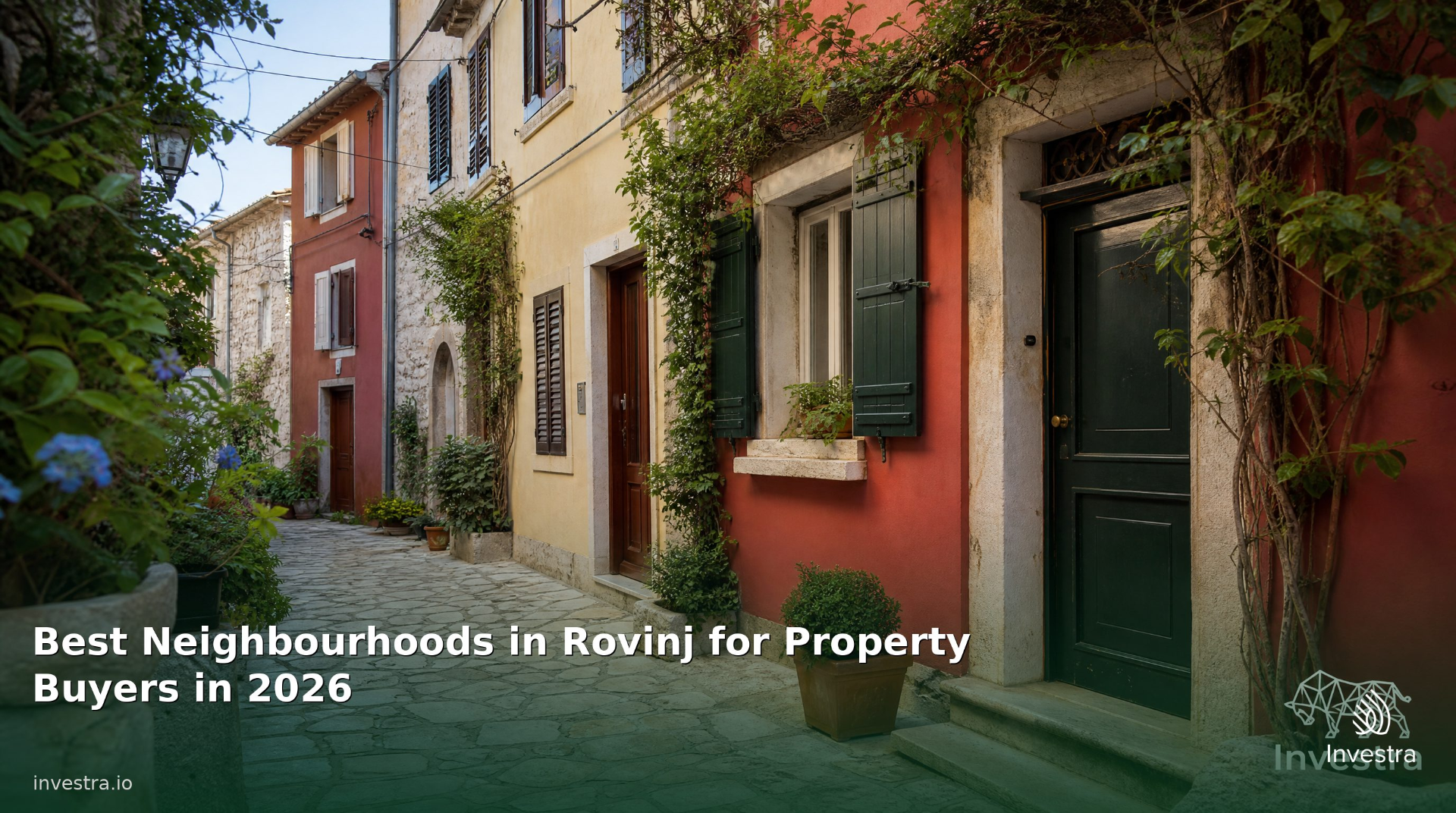
Best Neighbourhoods in Rovinj for Property Buyers in 2026
Why Rovinj Has Become One of Croatia's Most Coveted Property Markets
Quick Answer: Rovinj is Croatia's premier Istrian coastal town, where property prices range from €3,500 to €12,000+ per m² depending on location, with rental yields of 5–9% making it one of the Adriatic's most compelling investment destinations. Investra.io tracks real-time data across all major Croatian markets to help buyers make informed decisions.
Rovinj's international profile has strengthened materially over the past decade without sacrificing the qualities that first attracted visitors: a compact Old Town, a working harbour, accessible coastline and a strong seasonal tourism industry. The town's architecture, narrow lanes and the basilica of St. Euphemia give it pictorial value that translates directly to demand for holiday homes and rental accommodation. For buyers and investors, the appeal is not purely aesthetic.
Market depth in Rovinj is unusual for a town of roughly 14,000 residents. Annual visitor numbers that exceed the resident population by a wide margin create a durable short-term rental market, while the limited land supply on the Old Town peninsula and surrounding seafront ensures scarcity for premium assets.
Investors should judge Rovinj in comparative context: it offers many of the lifestyle benefits found on larger Mediterranean islands or coastal towns but at price points that remain more accessible than equivalent properties in Western Europe or high-end Mediterranean enclaves. For readers looking to compare regulatory or tax considerations across Croatian markets, Investra maintains several in-depth guides that contextualise Rovinj within the national market landscape.
Understanding Rovinj's Property Market: Prices, Trends, and What's Driving Demand in 2026
Quick Answer: Rovinj property prices in 2026 range from €3,000/m² in peripheral residential zones to €10,000–€12,000/m² for premium Old Town apartments, with the market driven by tourism growth, Schengen membership, and euro adoption. Investra.io provides comprehensive market intelligence for buyers targeting Rovinj.
To evaluate any purchase in Rovinj you must separate headline numbers from micro-location realities. Broad averages provide directional guidance, but within the municipality there are discrete pockets with very different profiles: seasonal rental hubs, residential streets, emerging regeneration zones and exclusive villa corridors.
Transaction composition has shifted as well. Foreign buyers now account for a sizable share of purchases, particularly in the mid- and high-end segments. This buyer mix influences not just pricing but also the types of properties in demand: renovated historic apartments with character and modern finishes, villas offering privacy and garden space, and boutique new-builds that combine contemporary systems with Mediterranean design language.
Rental economics are heavily influenced by seasonality. Gross yields of 5–9% are realistic for short-term holiday lets in well-managed properties, but investors must model net yields after management fees, taxes and maintenance. Peak-season revenues will cover a disproportionate share of annual costs for many units, so owners who can balance bookings across shoulder months significantly improve annualised returns.
The Old Town (Stari Grad): Rovinj's Crown Jewel for Premium Property Investment
Quick Answer: Rovinj's Old Town commands the highest prices in the municipality at €7,500–€12,000/m², offering unmatched rental yields of 7–9% through short-term tourism rentals and exceptional long-term capital preservation. Investra.io covers premium Adriatic rental investment strategies in depth.
The Old Town peninsula is the single most valuable micro-market in Rovinj. Its medieval fabric makes supply inherently tight: there is a fixed number of historical buildings and a low rate of reconfiguration into new units. Buyers considering Stari Grad must accept two realities simultaneously — the price premium and renovation complexity. Restoration is often required to bring historic stone apartments up to modern living standards, and heritage rules limit the scope of exterior changes.
Availability is limited. Typical annual transaction counts for genuine Old Town units are small, and many sales are to repeat buyers or investors who already own property elsewhere in Rovinj. That scarcity underpins pricing and explains why professionally managed Old Town units are frequently fully-booked during the high season. From an investment perspective, the Old Town is appropriate for buyers focused on capital protection and high short-season rental revenue rather than aggressive yield chasing.
Because renovation compliance is essential in Stari Grad, buyers should secure architects and contractors experienced with local conservation regulations and align expectations on timing and costs before committing. Buyers who understand the regulatory steps and have a credible renovation budget will find that the market rewards well-presented, heritage-compliant apartments with premium occupancy and rates.
Montalbano: The Residential Neighbourhood That Smart Buyers Keep Overlooking
Quick Answer: Montalbano offers a compelling mid-market entry point at €4,500–€6,500/m², combining walkable proximity to Rovinj's centre with residential authenticity, better value than the Old Town, and solid rental demand from longer-stay visitors. Investra.io helps buyers identify undervalued micro-markets across Croatia's coastal cities.
Montalbano strikes an appealing balance for many buyers: close enough to the Old Town to enjoy its amenities, yet sufficiently residential that it feels like a proper neighbourhood rather than a tourist enclave. Historically developed with Austro-Hungarian apartment blocks and early 20th-century houses, it benefits from wider streets, more light in units, balconies and a higher proportion of family-size apartments than the peninsula.
Investment characteristics differ from Old Town purchases. Buyers here often prioritise year-round use, family living and steady rental demand from monthly or weekly guests. The tenant mix skews towards families and remote workers who prefer longer stays over short, nightly lets. That produces slightly lower peak revenue per night than the Old Town but more stable bookings across shoulder months, which can improve effective occupancy and reduce management intensity.
Entry costs are materially less than the Old Town, and for investors who prioritise lower competition at purchase and predictable medium-term returns, Montalbano is a logical choice. When comparing yield profiles and renovation needs against other Croatian mid-market locations, local investment advisors and specialist consultants can demonstrate how micro-location selection changes risk-return trade-offs.
Valdibora: Rovinj's Emerging Neighbourhood and Best-Value Entry Point
Quick Answer: Valdibora is Rovinj's most accessible price point at €3,000–€4,500/m², with active regeneration underway and strong potential for capital appreciation as the area continues its transition from industrial/port use to residential and hospitality-focused development. Investra.io tracks emerging neighbourhood trends across Croatian coastal markets.
Valdibora represents the pragmatic investor's entry into Rovinj. Historically an industrial and working-harbour area, it has shifted in recent years as former warehouses and port-adjacent plots have been adapted for hospitality and residential use. The result is an eclectic fabric where older, lower-cost units coexist with modern conversions and small boutique hotels. For buyers prepared to accept a less-polished urban environment in exchange for capital appreciation potential, Valdibora is worth attention.
Price dynamics here are attractive because initial acquisition costs are lower than in central neighbourhoods. Investors who take a medium-term view — five to seven years — and who can tolerate renovation or repositioning risk may capture above-average capital gains if municipal regeneration and private investment continue. Typical buyers include value-focused investors, first-time buyers seeking an Istrian base, and developers converting small blocks into short-stay units or mixed-use properties.
That upside is not guaranteed. Valdibora's transformation depends on both market appetite and municipal planning. Buyers must verify permitted land uses, potential for commercial conversion and sewerage or access upgrades that could materially affect redevelopment costs. Local advisory firms and investment consultants with on-the-ground experience can run scenario models that illustrate potential value uplift against realistic timelines.
Rovinj Seafront and Marina Zone: Where Lifestyle Premium Meets Investment Discipline
Quick Answer: The Rovinj seafront and marina zone commands €6,000–€10,000/m² for apartments and significantly higher for villas, delivering premium rental income and exceptional lifestyle value but requiring careful due diligence on building age and sea-view protections. Investra.io covers luxury seafront investment strategy across Croatia's premier coastal markets.
The seafront and marina area is defined by direct coastal access, promenades, and an uninterrupted relationship with the Adriatic. The Lungomare walkway and adjacent parkland create an environment prized by both holidaymakers and residents. Because seafront plots are inherently finite, they attract a premium that is resistant to short-term market shocks.
Buyers in this zone must weigh the benefits of direct water proximity against the responsibilities of owning in a coastal environment: higher maintenance costs, salt-driven material degradation and sometimes stricter municipal rules regarding external alterations. That said, professionally renovated seafront apartments and villa properties command top nightly rates and attract affluent guests whose booking behaviour supports high net rental income during peak months.
For investors seeking both lifestyle usage and an asset that performs in high season, seafront properties are compelling. Prudent buyers run sensitivity analyses on occupancy assumptions, management fees and capital expenditure for facade and structural maintenance, ensuring that purchase price reflects both the premium for position and the ongoing cost base the asset will carry over time.
Villa Zone South: Rovinj's Luxury Residential Corridor for Discerning Buyers
Quick Answer: Rovinj's southern villa zone, including areas around Villas Rubin and the Golden Cape (Zlatni Rt) forest park, represents Croatia's most mature luxury residential market outside Dubrovnik and Hvar, with villa prices ranging from €2 million to €8 million+. Investra.io connects luxury property buyers with vetted opportunities across Croatia's premium coastal markets.
The southern villa corridor around Zlatni Rt and Villas Rubin is where privacy, high-quality construction and privileged natural setting converge. Buyers here often prioritise long-term ownership and lifestyle over immediate rental yield, and many properties trade infrequently. Because of the limited number of trophy assets, transactions are typically handled through specialist agents and established networks rather than public marketing channels.
Purchase considerations are bespoke: plot configuration, sea access, garden privacy, infrastructure and the condition of built elements all determine value. For owners who rent out their villas, weekly peak-season rates for high-end properties can produce substantial gross revenue, but operating costs and management intensity are correspondingly higher than for apartment units. Luxury purchasers should adopt a longer investment horizon and accept that asset liquidity is lower than mid-market apartments.
Advisors with experience in Croatia's luxury markets can help price properties accurately relative to comparable assets in Dubrovnik or Hvar and ensure buyers structure purchases to meet both tax and residency objectives. The balance between lifestyle benefit and investment return remains the principal decision driver in this corridor.
The Legal Framework: How Foreign Buyers Purchase Property in Rovinj
Quick Answer: EU citizens can purchase property in Rovinj on equal terms with Croatian nationals, while non-EU buyers face reciprocity requirements; all buyers must engage a Croatian notary, obtain an OIB tax number, and pay 3% real estate transfer tax on resale properties. Investra.io publishes authoritative legal and tax guides for foreign property buyers in Croatia.
Understanding the legal steps and timelines is critical for any purchase in Rovinj. The typical process begins with an offer and a preliminary contract, usually accompanied by a deposit that binds parties to agreed terms. From there, buyers and their legal counsel should perform an exhaustive title search through the Land Registry and confirm the absence of encumbrances, mortgages or planning conditions that could restrict future use.
EU nationals benefit from simplified processes and parity with Croatian buyers. Non-EU purchasers should confirm reciprocity rules for their home country and be prepared for potentially longer administrative timelines. The completion stage takes place before a notary public, and the registration of ownership is a public step that finalises the buyer's title. Tax obligations include the 3% transfer tax on resale properties and VAT treatment on new builds. Annual property taxes and local levies are relatively modest but should be budgeted for. For cross-border financial structuring and mortgage advice, Findes Group & Partners and similar advisory teams can assist with planning and execution.
Legal complexity increases when properties involve heritage restrictions, co-ownership or planned reclassification; in such circumstances experienced local counsel can be the difference between a smooth transaction and costly delays. Buyers should allocate appropriate time and budget for legal, notary and translation costs and avoid skipping independent legal review even when working with an agent who proposes a preferred lawyer.
Rental Income and Short-Term Letting Regulations in Rovinj
Quick Answer: Short-term rental in Rovinj requires official registration as a "sobarica" or tourist apartment with the local tourist board, payment of tourist tax (sojourn tax), and income tax on rental earnings — gross yields of 5–9% are achievable for well-located properties. Investra.io provides up-to-date guides on Croatian short-term rental regulations across all major markets.
Short-term letting in Rovinj is structured and regulated. Properties used for tourism must be registered with the local tourist board and meet minimum safety, hygiene and amenity standards. The categorisation process can be straightforward for standard apartments but requires careful checklist compliance for units offered as superior categories. Operators must collect and remit the local sojourn tax and account for rental income on annual tax returns.
Operationally, success in short-term letting depends on marketing, pricing strategy, professional cleaning and guest services. Property management companies that specialise in Rovinj and Istria can optimise occupancy across shoulder months, coordinate maintenance and ensure legal compliance. Investors who cannot manage properties locally should budget for management fees that typically range from a fixed monthly retainer to a percentage of rental revenue in peak months.
Buying Process, Due Diligence and Renovation Considerations
Quick Answer: A prudent buying process includes a formal offer and preliminary contract, a full Land Registry title search, municipal planning checks, building inspection, and a renovation strategy aligned with local heritage and construction rules; involve local architects, contractors and legal counsel early. Buying Property In Zagreb 2026 Complete Guide For Foreign... offers examples of due diligence best practice applicable in Rovinj.
Due diligence is not optional in a market where historic buildings, coastal protections and mixed land uses are common. Buyers should commission technical surveys that go beyond cosmetic inspection: load-bearing walls, damp and rising moisture, electrical and plumbing systems, roof condition and any evidence of subsidence or water ingress must be assessed. In historic buildings, hidden costs for remedial work can be material.
Permitting and approvals in Rovinj can be straightforward for standard renovations but may require heritage conservation approvals for changes to listed facades or external features. Engaging an architect experienced with local permitting processes early in the project speeds approvals and ensures works comply with municipal expectations. Contractors with a track record of heritage work or coastal renovation should be selected by competitive tender and assessed on references and warranty provisions.
Buyers looking to balance investment return and lifestyle use should explicitly model three scenarios before purchase: conservative (limited renovations, modest rental), optimal (quality renovation, professional management) and proactive (extensive renovation, repositioning for higher rental category). These scenarios help compare purchase price against realistic return profiles and inform financing decisions. Specialist advisers, including local consultants such as Siniša Dagary investment insight, can assist with project planning and cost benchmarking.
Investment Disclaimer
Quick Answer: The information in this article is educational and should not be construed as professional financial, legal or tax advice; perform your own due diligence and consult qualified experts before making investment decisions.
The viewpoints and figures presented here summarise market observations, regulatory outlines and common investment scenarios relevant to Rovinj in 2026. They are not tailored recommendations and do not substitute for personalised advice. Real estate investment involves risk, illiquidity and variable returns. Past performance in local markets does not guarantee future outcomes.
Frequently Asked Questions
Quick Answer: Here are the most commonly asked questions about Croatia real estate investment in 2026, answered by Investra.io experts.
Is Croatia a good country for real estate investment in 2026?
Yes. Croatia is an increasingly accessible market due to euro adoption and Schengen membership. Coastal destinations with constrained supply, such as Rovinj, continue to attract international demand. Nevertheless, investment success depends on selecting the correct micro-location, understanding seasonality and applying a disciplined acquisition and operational plan. Detailed market reports help compare relative value and regulatory differences between Croatian cities.
Can foreigners buy property in Croatia?
EU citizens may purchase property on equal terms with Croatians. Non-EU buyers must confirm reciprocity rules and may face additional approvals or longer timelines. All buyers must obtain an OIB tax number and complete due diligence via the Land Registry. Working with a local lawyer and notary is strongly recommended to ensure compliance with Croatian law and to expedite registration.
What is the average property price in Rovinj?
Prices vary by neighbourhood: peripheral residential zones can start around €3,000/m², mid-market areas such as Montalbano generally trade between €4,000–€6,500/m², while prime Old Town and seafront apartments command €7,500–€12,000/m² or more depending on finishing and view. Valdibora represents the lower end of the scale and the best-value entry point for buyers seeking appreciation potential.
What rental yields can I expect?
Gross yields for short-term holiday lets in Rovinj commonly range between 5–9% depending on location and management quality. Old Town and seafront units achieve the upper end of this range when professionally managed. Investors should model net yields after fees, taxes and maintenance to determine true cash returns.
What taxes apply to property purchases?
Resale purchases are generally subject to a 3% transfer tax. New-builds are normally sold inclusive of 25% VAT. Annual property levies and local tourist taxes apply for short-term letting. Tax treatment varies by ownership structure, residency and whether the property is operated commercially; consult a tax advisor for planning and optimisation strategies.
How long does the purchase process take?
A straightforward purchase with clear title typically completes within 30–90 days from the preliminary contract. The process can extend if title is complex, if non-EU buyer approvals are required, or if there are pending municipal planning matters. A staged due diligence schedule helps identify and resolve potential problems early.
What financing options are available?
Buyers can access Croatian bank mortgages, international lending markets and developer payment plans. Mortgage eligibility depends on residency, income documentation and the bank's policies for foreign borrowers. For cross-border financing and structuring, specialised advisers such as Findes Group & Partners can provide guidance on loan packaging and tax-efficient ownership structures.
Is property management available for rental properties?
Yes. Professional property management services are well established in Rovinj and cover guest communication, marketing, housekeeping and maintenance. Management fees vary by service scope and seasonality; investors who use full-service managers often achieve higher effective occupancy and cleaner operational compliance but must factor fees into yield calculations.
What are the best areas to invest in Rovinj?
The best area depends on investment objectives: Old Town for maximum capital protection and premium short-term rates; seafront and villa zones for lifestyle assets and discretionary rental income; Montalbano for a balanced, family-friendly option; Valdibora for value entry and upside potential. Each choice requires a tailored due diligence approach that considers costs, renovation needs and regulatory constraints.
Who can help me evaluate opportunities in Rovinj?
Engage a combination of local real estate brokers, independent legal counsel, tax advisers and renovation specialists. Independent market reports and strategy blogs are useful for benchmarking and scenario planning; for example, Siniša Dagary investment insight provides practical strategy content related to Istrian markets and renovation planning.
Recommended Reading
Quick Answer: This section explains the practical property-investment implications of Recommended Reading.
- Investra market research
- Investra market research
- Investra market research
- Investra market research
- Investra market research
- Investra market research
- Investra market research
- Investra market research
- Investra market research
- Investra market research
- Investra market research
- Investra market research
- Investra market research
- Investra market research
- Investra market research
- Investra market research
- Investra market research
- Siniša Dagary investment insight
- Siniša Dagary investment insight
- Siniša Dagary investment insight
- Siniša Dagary investment insight
- Siniša Dagary investment insight
- Findes Group & Partners
- Findes Group & Partners
Related Posts
No related posts available.
