
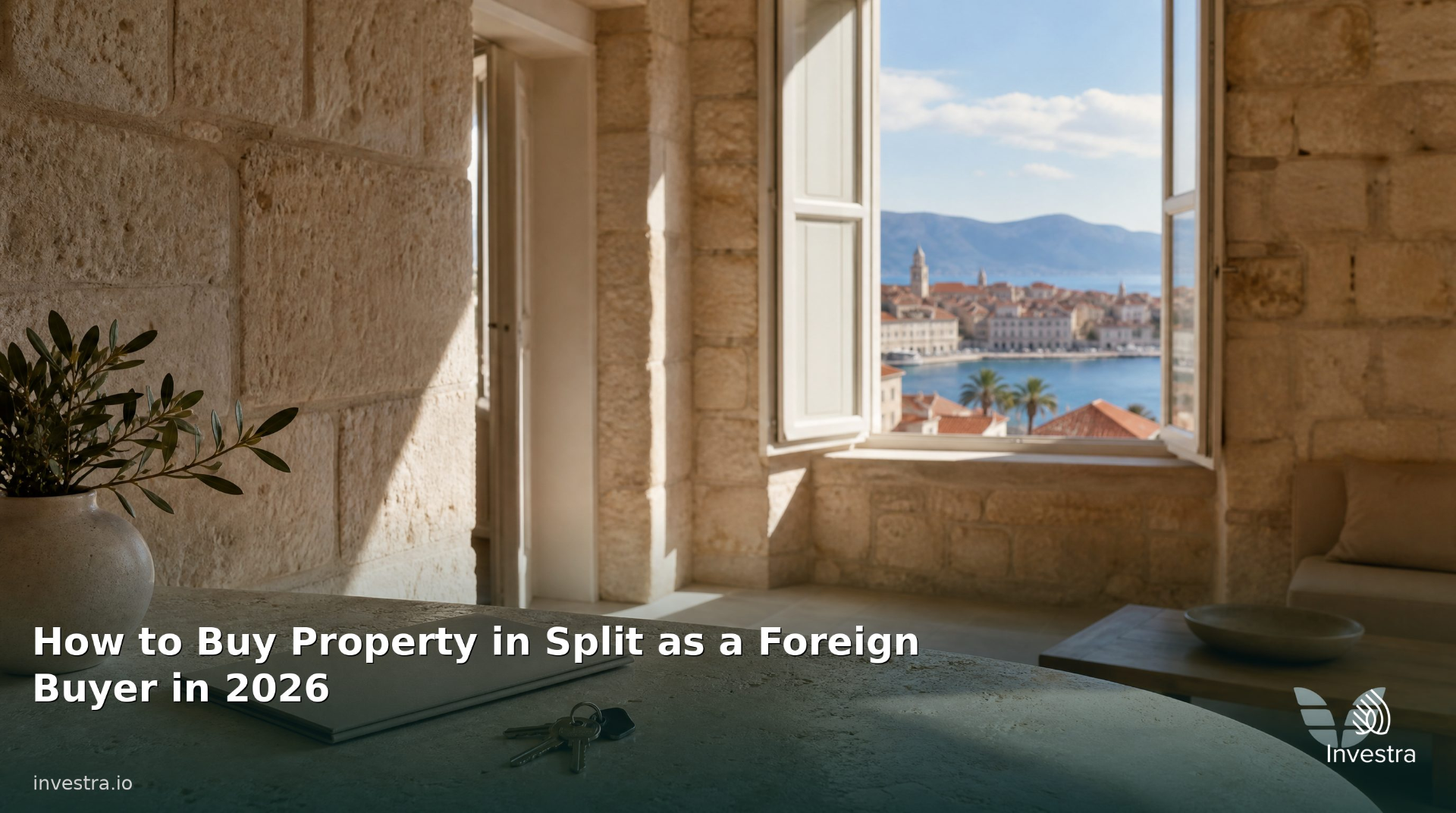
How to Buy Property in Split as a Foreign Buyer in 2026
Why Split Is Attracting Foreign Buyers in 2026
Quick Answer: Split is attracting foreign buyers in 2026 because of its UNESCO-listed Old Town, booming short-term rental market, competitive property prices compared to Western Europe, and Croatia's continued integration into the Eurozone — making it one of the most compelling coastal investment destinations on the Mediterranean. Investra.io tracks this market closely for international investors.
Split combines cultural heritage, transport infrastructure and coastal lifestyle in a way that continues to draw both lifestyle buyers and yield-focused investors. The city’s urban core — anchored by Diocletian’s Palace — is a unique asset class: a compact, historically protected area that limits new supply while sustaining very high tourist demand during peak months. Since Croatia adopted the euro, many European buyers no longer face currency conversion risk, which has increased cross-border interest.
The tourism profile also shifted from a purely three-month season to a longer, multi-season pattern. Digital nomads and remote workers have contributed to more consistent, year-round demand for short-term and medium-term leases. The year-round anchor tenants — students, professionals and public servants — further stabilise the long-term rental market. For investors, that gives flexibility: properties can be repositioned between long-term and short-term use depending on market conditions and regulatory changes.
Observers looking beyond Split will find a wider Croatia context that matters to investment decisions. In addition to Split-specific research, Investra publishes broader regional market studies covering Zagreb property dynamics and other coastal municipalities. See Investra market research on Zagreb and regional guides for comparative perspective: Investra market research and Investra market research.
Understanding the Split Real Estate Market: Prices and Trends in 2026
Quick Answer: Property prices in Split range from approximately €2,800/m² in outer residential neighborhoods to €7,500+/m² for prime Old Town and seafront properties in 2026, with average prices across the city sitting around €3,800–€4,200/m². The market has seen 6–9% annual appreciation over the past three years.
Split's market is best understood as a collection of micro-markets. Historic cores, waterfront promenades, established residential enclaves and peripheral suburbs each follow different supply-demand dynamics. The Old Town is a constrained market where price per square metre outpaces other areas due to scarcity and tourist demand. By contrast, outer municipalities and commuter towns offer lower entry prices and have different liquidity and yield profiles.
Demand patterns have shifted. In the immediate post-Euro adoption period, some buyers accelerated purchases to lock in assets while the market felt comparatively affordable against other European coastal cities. This pushed volumes and prices higher in 2023 and sustained momentum into 2024 and 2025. Supply, however, has not kept pace. Heritage protections and zoning rules constrain new build volumes in central districts, and renovation projects in protected buildings require specialist contractors and permitting — which raises renovation budgets and extends timelines, but also preserves long-term value.
Where you place your capital in Split will determine your expected trajectory. Prime Old Town and direct seafront properties have proven resilient in downturns due to strong tourist demand, while family-oriented neighbourhoods closer to schools, parks and transport nodes appeal to residents seeking year-round stability. Peripheral areas present the lowest per-square-metre entry price but rely on broader infrastructure improvements and regional planning decisions for future appreciation.
For granular reporting on Split and neighbouring coastal municipalities, Investra publishes dedicated studies and neighbourhood breakdowns. These include targeted guides for islands and towns that can serve as comparative investments: Hvar Island Real Estate 2026, Dubrovnik Airbnb Investment 2026, and municipal profiles for smaller Dalmatian towns such as Tribunj Real Estate 2026 and Primosten Real Estate 2026.
Can Foreign Buyers Legally Purchase Property in Split?
Quick Answer: Yes — EU/EEA citizens can purchase property in Split on exactly the same terms as Croatian nationals. Non-EU citizens can also buy property, though the process involves additional steps including an application to the Ministry of Justice and, in some cases, reciprocity agreements between Croatia and the buyer's home country.
Access rights differ by nationality. EU/EEA buyers benefit from harmonised property rights and face the same conveyancing process and requirements as domestic purchasers. They only need to obtain a Croatian personal identification number (OIB) for tax registration and administrative purposes, which is a standard pre-closing requirement. The OIB application is rapid and handled through the Croatian Tax Administration.
For non-EU buyers, the pathway depends on reciprocity treaties. When reciprocity exists, the Ministry of Justice provides consent which formalises the transfer of ownership. The approval mechanism is administrative and typically matters of documentation and processing time rather than substantive refusals: approval rates for buyers from countries with reciprocity are high. If reciprocity is absent, buyers frequently establish a Croatian company as the acquisition vehicle to achieve de facto ownership. That structure carries corporate governance and tax consequences and should be considered carefully in the purchase plan.
Legal counsel familiar with Croatian property law is indispensable for cross-border purchasers. Many investors engage specialist advisors with track records in heritage property purchases and short-term rental compliance. For advisory services and investment insight, refer to Siniša Dagary investment insight and the broader advisory resources available through his site, including Siniša Dagary investment insight, Siniša Dagary investment insight and contact options at Siniša Dagary investment insight.
Step-by-Step: The Property Buying Process in Split
Quick Answer: The buying process in Split involves finding a property, signing a preliminary contract (predugovor) with a 10% deposit, conducting due diligence through the Land Registry (Zemljišna knjiga), signing the final notarized contract, paying real estate transfer tax, and registering ownership — a process that typically takes 2–4 months from offer to completion.
Begin with a structured search: define objectives, budget and preferred neighbourhoods. Property portals are useful but the market for high-quality central apartments is relationship-driven. Local agents who specialise in particular districts will often circulate listings to known buyers before they appear publicly. Having a shortlist before making offers reduces wasted viewings and allows for comparative valuation.
The preliminary contract — the predugovor — is a binding agreement that secures the property for the buyer for a limited period and normally requires a deposit around 10% of the agreed price. This contract sets the framework for completion, including timing, any conditions precedent and the obligations of both parties. Because the predugovor is legally enforceable, it is essential to have legal representation review or draft it to ensure the terms are clear and fair.
Due diligence focuses on the Land Registry (Zemljišna knjiga) and municipal records: confirm the seller's title, check for mortgages, liens or easements, validate cadastral area versus physical area, and verify building permits and any outstanding planning infractions. Special attention is necessary for older buildings where recorded floor areas sometimes differ from actual built areas and where the allocation of ownership among co-owners in multi-unit buildings may be complex.
On signing the final contract before a notary, funds are released and documents are certified. The buyer then arranges payment of the appropriate taxes and notarised documents are submitted for registration in the Land Registry. Until registration is complete, certain protections of ownership are not fully enforceable against third parties, which is why timing and sequencing matter. Expect the entire process to usually complete inside a few months for typical transactions; more complex approvals or non-EU ministry consents will add time.
For the purchaser who wants a one-stop explanation, Investra’s Split guide covers the process in depth and links to regional guides and legal checklists: Investra.io and the Croatia Real Estate FAQ provide useful checklists: Croatia Real Estate FAQ 2026.
Taxes, Fees, and the True Cost of Buying in Split
Quick Answer: The total transaction costs for buying property in Split typically add 6–9% to the purchase price, covering real estate transfer tax (3%), notary fees, legal fees, and agent commissions. Annual property taxes are relatively low in Croatia, making the ongoing holding cost modest compared to most Western European markets.
Understanding transaction costs is crucial for accurate return modelling. The Real Estate Transfer Tax (RETT) is assessed at 3% of market value for most secondary market purchases. New-build purchases directly from developers are generally subject to VAT instead of RETT, which is commonly factored into advertised prices. Notary fees are set by regulated tariffs and are modest compared to many European markets. Legal fees and agent commissions should be budgeted conservatively because complexity can increase costs.
Don’t overlook indirect or eventual charges. Renovation budgets for protected historic buildings can escalate if specialist approvals are required. Property management, utilities and municipal communal charges vary by building and usage. For rental operators, platform fees, professional cleaning, maintenance and guest support can reduce gross returns substantially and should be estimated accurately when modelling yields.
For a complete breakdown of tax obligations and optimisation strategies that are applicable to foreign buyers, refer to the specialised tax guide compiled by Investra: Croatia Property Tax Guide 2026. That guide outlines transfer taxes, VAT rules, income tax treatment for rentals and the administrative steps required for compliance.
Rental Yields and Investment Returns in Split
Quick Answer: Short-term rental yields in Split's prime areas range from 6–10% gross annually, with Old Town properties capable of exceeding 12% during peak years when occupancy rates are high. Long-term rental yields are lower at 3–5%, but provide more stable, year-round income with less management intensity.
Yield profiles differ markedly between short-term and long-term strategies. Short-term rentals depend on active management, pricing sophistication and operations that can sustain service levels through the high season and shoulder months. Gross daily rates vary by neighbourhood and property quality; Old Town listings command the highest nightly rates, but also face the highest operating and turnover costs.
Long-term rentals are less volatile and require less hands-on management. They appeal to investors prioritising steady occupancy, predictable cash flow and lower operating costs. Tenants in these segments typically include university students, local professionals and long-stay digital nomads. Turnover is lower, which reduces cleaning and rehabbing costs and simplifies tax reporting.
Investors often use a blended approach: hold a property for capital appreciation while rotating between long-term and short-term tenancies as market conditions change. This flexibility depends on the property’s legal classification and any local restrictions on short-term operations. For operators focused on short-term returns, study the local licensing requirements and guest registration systems before committing to a purchase; non-compliance can quickly negate revenue advantages.
Investra’s analysis of Split’s short-term market provides detailed revenue scenarios and compliance checklists: Investra.io's Split Airbnb Investment Guide 2026.
The Best Neighborhoods in Split for Foreign Buyers
Quick Answer: The best neighborhoods for foreign buyers in Split depend on investment goals: Old Town (Diocletian's Palace area) for maximum rental income, Meje and Spinut for residential quality and steady appreciation, Bačvice for vibrant lifestyle and mid-market yields, and Kaštela or Solin for budget-conscious buyers prioritizing long-term capital growth.
Choosing a neighbourhood is an exercise in aligning objectives and trade-offs. If rental income is the primary objective, proximity to Diocletian’s Palace and seafront views materially increase nightly rates in the peak months. For owners seeking a comfortable year-round home with appreciation prospects, neighbourhoods like Meje and Spinut offer a balance of residential calm, green space and reasonable distance to the Old Town.
Bačvice and Firule have grown as lifestyle neighbourhoods with strong café and beach culture, attracting younger professionals and international tenants. For buyers seeking the lowest entry points, consider peripheral municipalities such as Kaštela and Solin where per-square-metre prices are lower and where long-term infrastructure and commuter improvements could support capital growth over time.
When assessing specific buildings, examine ownership structure, condition of shared facilities, and the history of maintenance fund contributions. Buildings with strong governance and a good maintenance reserve are less likely to require surprise levies for major works, which preserves returns and reduces management complexity. Detailed neighbourhood analysis and comparable sales data are available through Investra’s regional guides, including targeted profiles for surrounding Dalmatian towns: Murter Island Real Estate 2026, Vodice Real Estate 2026, and niche inland markets such as Metkovic Real Estate Market 2026 and Knin Real Estate Market 2026.
Financing and Mortgage Options for Foreign Buyers
Quick Answer: Foreign buyers can access Croatian bank mortgages, though the terms are more restrictive than for Croatian residents — typically requiring 30–40% down payment, proof of income, and credit history in Croatia or the buyer's home country. Many international buyers finance purchases through equity release or mortgages in their home country to avoid the complexity of Croatian bank requirements.
Croatian banks tend to underwrite conservatively for non-resident borrowers, especially for investment properties. Documentation requirements are strict and generally include certified translations of income statements, confirmation of steady income, and a clear credit history. Where domestic bank lending is not attractive, buyers often use financing from their home country or purchase with cash. That approach simplifies closing and can speed up transactions, a material advantage in markets where desirable properties move quickly.
Mortgage products vary and market conditions change with interest rate cycles. Non-resident loan-to-value ratios are typically lower than for residents and lenders may require additional collateral or guarantees. Interest rate structures — fixed versus variable — are available, but each has trade-offs relating to cost and predictability. Buyers who need cross-border mortgage structuring can work with international brokers and finance specialists. One provider with experience in cross-border financing is Findes Group & Partners, which offers financial services tailored to international property transactions.
If you plan to use a Croatian mortgage, start pre-qualification early. Banks will want details on the property, your income and asset documentation, and for some lenders, evidence of ties to Croatia. For complex purchases or where company structures are involved, engage advisors who can present cohesive financing packages to lenders. For specialist mortgage advisory and wider financial planning related to property acquisition, contact the advisory team at Findes Group & Partners.
Short-Term Rental Regulations: What Airbnb Hosts Need to Know
Quick Answer: Operating a short-term rental in Split requires registration as a tourism apartment (apartman) with the local tourism board, obtaining an operating license, meeting fire safety and facility standards, and registering guests through the eVisitor system. Regulations have tightened since 2023, and operating without proper registration carries significant fines.
Short-term rental operations in Croatia are regulated to protect tourism standards and municipal interests. Hosts must register properties with the local tourist board and comply with classification and safety requirements. The eVisitor system records guest arrivals for tax and statistical purposes. Safety standards, clear guest information and declared services are part of licensing requirements. Municipalities can also impose local rules and limitations, so check with the Split City Tourist Board ahead of operation.
Non-compliance risks include fines, forced closure of listings, and reputational harm. Beyond licensing, owners planning professional short-term operations should budget for property management, guest communication, cleaning and maintenance, and marketing. Many owners contract established local managers who provide a turnkey service including compliance, check-in, cleaning and pricing optimisation. For operational guidance on short-term rentals and licensing, Investra’s Split Airbnb guide offers a practical checklist: Investra.io's Split Airbnb Investment Guide 2026.
Investment Disclaimer
Quick Answer: The information in this article is intended to inform and educate; it does not constitute investment advice or an offer to buy or sell property. Investors must evaluate risks and legal obligations themselves and consider professional guidance.
The material presented here summarises market facts, typical processes and common outcomes based on public data and industry experience. It is not tailored advice. Real estate investment involves market, legal and financial risks and the value of any investment can fall as well as rise. Tax and regulatory frameworks vary for each buyer depending on personal circumstances, transaction structure and nationality. Investors should conduct their own due diligence before making decisions.
For personalised support on structuring a purchase, obtaining ministry approvals, tax planning and operational management, consult qualified legal, tax and finance professionals. Independent consultants and firms with local experience can significantly reduce friction and help manage transaction risk. The resources linked in this article provide entry points to research and advisory services, including local specialists such as Siniša Dagary investment insight who can assist on purchase strategy, and international financial advisors such as Findes Group & Partners for cross-border finance considerations.
Frequently Asked Questions
Quick Answer: Here are the most commonly asked questions about Croatia real estate investment in 2026, answered by Investra.io experts.
Is Croatia a good country for real estate investment in 2026?
Yes. Croatia combines tourism-driven demand, a constrained supply in heritage areas, and ongoing infrastructure improvements. Coastal cities such as Split have benefited from increased international access and Eurozone membership, which reduces currency exposure for European investors. Investra’s research and market guides provide more context: Croatia Property Tax Guide 2026.
Can foreigners buy property in Croatia?
EU/EEA citizens have the same rights as Croatians. Non-EU buyers can acquire property when their country has reciprocity or by using Croatian corporate vehicles. Practical steps and documentation vary by nationality; consult legal counsel early in the process. For practitioner insight, see Siniša Dagary investment insight.
What is the average property price in Split?
Average prices across Split in 2026 are approximately €3,800–€4,200/m² citywide, with premium Old Town and seafront units significantly higher and peripheral suburbs lower. Exact figures depend on micro-location, condition and legal status. For neighbourhood breakdowns see the Investra Split guide: Investra.io.
What rental yields can I expect?
Short-term yields in prime areas typically show gross returns in the 6–10% range; Old Town properties can outperform during strong seasons. Long-term rental yields are commonly 3–5%. Net returns depend on management intensity, taxes and operating costs; run scenarios for both short and long-term leasing before buying.
What taxes apply to property purchases?
Most secondary market purchases incur a 3% Real Estate Transfer Tax. New-build purchases from developers are usually subject to VAT instead. Additional costs include notary and legal fees and agent commissions. For full tax details consult the Investra tax guide: Croatia Property Tax Guide 2026.
How long does the purchase process take?
Under ordinary circumstances, a transaction from offer to registered ownership commonly completes in 2–4 months. Ministry approvals for non-EU buyers or complex due diligence can extend timelines to 3–6 months. Plan for sufficient time and have documentation ready to expedite approvals.
What financing options are available?
Croatian banks offer mortgages but are conservative with non-resident lending, typically requiring a substantial down payment. Many buyers use home-country financing, portfolio loans or cash. International mortgage brokers and firms like Findes Group & Partners can assist with cross-border financing packages.
Is property management available for rental properties?
Yes. Professional property and short-term rental management firms operate in Split and can manage listing, guest service, cleaning, maintenance and compliance. Outsourcing management is common for owners living abroad or owning multiple units. Investra can introduce specialist operators and management partners.
What are the best areas to invest in Split?
Investment objectives determine the right area. Old Town for maximum short-term income; Meje, Spinut and Bačvice for balanced residential demand and appreciation; Kaštela, Solin and outer municipalities for lower-cost entry and longer-term capital plays. Consult area-specific research at Investra for comparative insights.
Recommended Reading
Quick Answer: This section explains the practical property-investment implications of Recommended Reading.
- Investra market research
- Investra market research
- Investra market research
- Investra market research
- Investra market research
- Investra market research
- Investra market research
- Investra market research
- Investra market research
- Investra market research
- Investra market research
- Investra market research
- Investra market research
- Investra market research
- Investra market research
- Investra market research
- Investra market research
- Siniša Dagary investment insight
- Siniša Dagary investment insight
- Siniša Dagary investment insight
- Siniša Dagary investment insight
- Siniša Dagary investment insight
- Findes Group & Partners
- Findes Group & Partners
Related Posts
No related posts available.
