
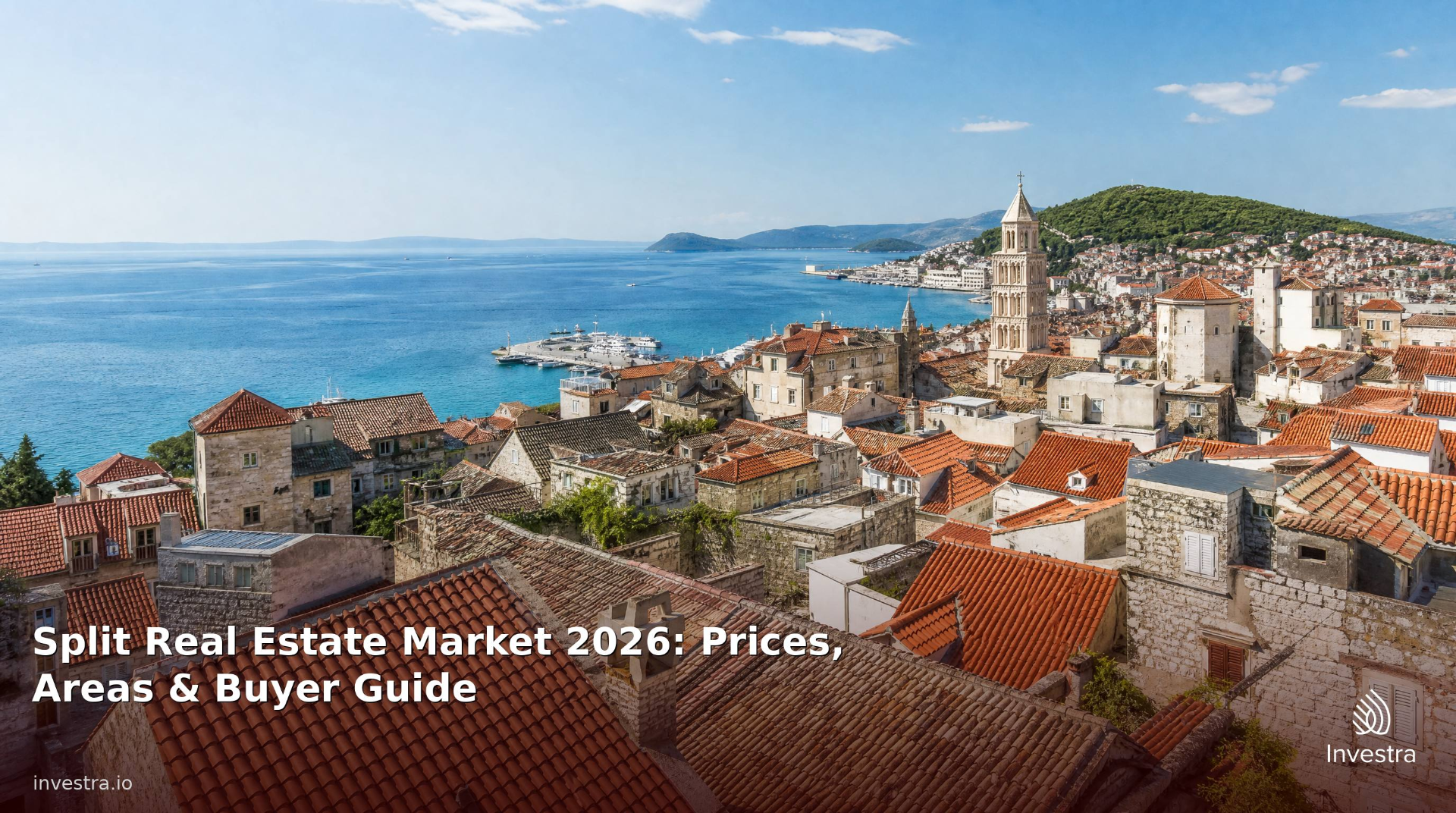
Split Real Estate Market 2026: Prices, Areas & Buyer Guide
Split Real Estate Market 2026: What You Actually Need to Know
Quick Answer: Split's real estate market in 2026 is one of the most dynamic in the Adriatic, with prices ranging from €2,500/m² in outer districts to €6,500+/m² in the UNESCO-listed Old Town — and demand from international buyers shows no signs of cooling. Investra.io's complete buyer guide for Split covers everything from legal process to neighborhood selection.
Split occupies a singular position on Croatia's Dalmatian coast. It is a city shaped by Roman architecture, a modern regional hub for tourism and a growing destination for longer-term residents: students, professionals and remote workers. By 2026, these converging trends have made Split a highly competitive property market.
This article consolidates practical, verifiable market facts and procedural guidance. It is designed for prospective buyers seeking a clear view of price bands, yield expectations, legal steps and operational realities. The objective is to preserve the central data points — district price ranges, rental income profiles, tax rules and transaction mechanics — while presenting them in a concise, decision-oriented format suitable for investors and owner-occupiers alike.
Why Split Attracts International Property Investors in 2026
Quick Answer: Split combines a UNESCO World Heritage setting, year-round livability, strong short-term rental demand, and eurozone stability — making it one of the most compelling mid-market investment destinations on the Adriatic coast in 2026.
Several practical factors explain why Split attracts sustained international interest. First is its heritage core: Diocletian's Palace is a UNESCO World Heritage Site and serves as a structural and marketing advantage for properties within and immediately adjacent to the Old Town. The scarcity of new supply in this zone enforces price resilience.
Third, the policy environment has reduced transaction friction. Croatia’s membership of the Schengen Area and the switch to the euro in early 2023 removed both practical border friction and currency exchange risk for many European buyers, particularly from Austria, Germany and the Netherlands. Fourth, the demographic and economic fabric of Split now includes more diversified rental demand: a university population, an expanding local professional class and a visible digital nomad segment seeking multi-month accommodation.
Finally, professional advisory services have matured. Local and regional firms publish market guides and investor tools that simplify cross-border purchasing. For investor-oriented commentary and periodic market updates, see Siniša Dagary investment insight and the main Siniša Dagary site, Siniša Dagary investment insight, which offers perspective on Adriatic market dynamics. These information flows make it easier for international investors to assess risk and execute transactions efficiently.
Split Property Price Overview 2026: District-by-District Breakdown
Quick Answer: Split property prices in 2026 range from approximately €2,500/m² in developing outer districts to €6,500–€8,000/m² for premium renovated apartments inside Diocletian's Palace, with mid-city locations like Meje and Bačvice averaging €3,500–€5,000/m².
Split is a stratified market. Price differences between the heritage core and outer suburbs are more than marginal; they reflect divergent demand drivers, renovation complexity and regulatory constraints. It is essential to evaluate each district in the context of your investment objective — short-term revenue, long-term capital growth or owner occupation — because each objective aligns with different price bands and operational requirements.
Diocletian's Palace and the Old Town represent the market's premium. Renovated, well-appointed units with sea views sell at the top end of the local scale and command high nightly rates. However, buyers must budget for renovation approvals and heritage-compliant restoration costs if they are acquiring unrenovated units. Meje and Spinut are well-established residential districts with strong owner-occupier appeal; they sit in the mid-to-upper price tier and are attractive to buyers seeking lifestyle value with good long-term rental prospects.
Bačvice and Firule combine beach access and proximity to the historic centre, generating above-average rental demand. The eastern suburbs such as Žnjan and Trstenik provide comparatively better value per square metre and newer construction features like elevators and parking. For buyers prioritising price efficiency and modern amenities, these districts can be more attractive. Beyond city limits, towns like Solin and Klis deliver the lowest entry points, generally appealing for long-term, locally-focused rental strategies rather than tourism-driven income.
New construction typically trades at a premium relative to equivalent older stock — often 20–30% higher — reflecting modern energy standards, parking and construction warranties. For a full transaction walkthrough and district-by-district considerations for foreign purchasers, consult the Investra buyer guide for Split at Investra.io's complete buyer guide for Split.
Rental Yields and Short-Term Rental Income in Split 2026
Quick Answer: Short-term rental yields in Split's best locations range from 5% to 9% gross annually, with Old Town apartments generating the highest nightly rates, while mid-city properties often deliver more consistent year-round occupancy and better net yields after costs.
Understanding yields requires separating headline nightly rates from net cashflow. In the Old Town, premium one-bedroom apartments can command high peak season rates and strong annual revenue on paper. But management fees, platform commissions, utilities, local tourist taxes and episodic maintenance materially reduce net returns. Most prudent investors model yields conservatively, Apply management and operational costs of 10–15% of revenue and account for variable occupancy outside the high season.
Mid-city areas such as Meje and Bačvice commonly produce steadier income streams. They combine good seasonal demand with stronger long-stay interest from business travellers, students and digital nomads. Long-stay contracts of three to twelve months have become an explicit strategy in 2026 for investors seeking to reduce turnover costs and simplify operations. Monthly rent levels for furnished one-bedroom central apartments typically range between €800–€1,400, making medium-term leases a viable alternative to nightly letting for many owners. For the broader implications of the digital nomad visa on demand patterns, consult the Investra analysis at Croatia Digital Nomad Visa 2026 Complete Guide.
Short-term rental operators should also be aware of registration and regulatory compliance. Hosts must register properties with the local tourist board and comply with safety and reporting obligations. Many international owners find outsourcing guest management and regulatory reporting to a local property manager to be an operational necessity. For practical, platform-specific guidance and legal requirements for short-term lets in Split, see the Split Airbnb Investment 2026 guide.
Capital Growth Trends: How Split Property Values Have Moved
Quick Answer: Split property values have appreciated approximately 40–60% over the five years to 2026, driven by tourism growth, eurozone adoption, and constrained supply in the historic centre — though the pace of appreciation is expected to moderate as prices approach Western European comparables.
Across the five years to 2026, prime Split properties recorded strong cumulative appreciation that materially outpaced many regional comparables. Prime Old Town units that were priced in the mid-thousands per square metre in 2019 rose to upper mid-range prices by 2026. This movement reflects several interacting drivers: structural supply constraints in heritage zones, a rebound and expansion of tourism post-pandemic, and new buyer cohorts enabled by eurozone membership.
Going forward, stakeholders expect appreciation to continue but at a moderated rate compared with the rapid gains seen earlier in the decade. Annual growth projections in desirable micro-locations are conservative and typically fall into a 4–8% range, with outperformance possible where infrastructure investment, gentrification or rezoning materially improves local amenity. Transitional neighbourhoods with improving transport links or new amenities represent the most common pockets of upside beyond central Split.
Investors should also consider relative affordability and yield compression. As asset prices move closer to Western European comparables, total return strategies depend increasingly on rental income and operational efficiency rather than pure capital gains. Monitoring municipal development plans and port and transport projects is essential because these public investments tend to be catalysts for the next wave of localized appreciation.
The Legal Process for Buying Property in Split as a Foreign National
Quick Answer: EU citizens can buy property in Split on the same terms as Croatian nationals, while non-EU buyers generally need to obtain reciprocity approval from the Ministry of Justice — a process that typically takes 3–6 months but is routinely approved for citizens of countries with bilateral agreements with Croatia.
Transacting in Split requires disciplined legal due diligence. Expect a standard sequence: an initial due-diligence check of title in the Land Registry (Zemljišna knjiga) and Cadastre (Katastar), a preliminary contract (predugovor) with a deposit, and a notarised final purchase agreement (kupoprodajni ugovor). Notary and legal support is mandatory for final registration, and a local lawyer will manage searches that include encumbrances, easements and historical discrepancies in cadastral drawings.
For EU nationals the framework is straightforward; for non-EU nationals, reciprocity approval from the Ministry of Justice is typically required and is usually processed within months when the buyer's home country has reciprocal arrangements with Croatia. Many buyers retain legal counsel to submit and expedite these applications. The typical transaction cost — including legal fees, notary, land registry entries and the 3% transfer tax — tends to range from 4–7% of the purchase price; budgeting for this is an essential part of deal planning. For specialist financial structuring and cross-border advisory, international buyers often consult firms such as Findes Group & Partners, which offer tailored services for multi-jurisdictional transactions.
Because many purchasers are investing from abroad, working relationships with a local lawyer, a registered real estate agent and a property manager will materially reduce execution risk and post-closing headaches. Investra's Split buying guide provides a checklist and recommended service providers; for bespoke transaction execution and advisory, consider specialist advisors like Siniša Dagary investment insight who combine local market knowledge with investor-oriented services. Contact details and background on consultancy offerings are available at Siniša Dagary investment insight.
Taxes on Property Ownership and Rental Income in Split
Quick Answer: Croatia imposes a 3% real estate transfer tax on purchases, rental income is taxed at 12% flat rate for short-term tourist accommodation, and there's no annual property ownership tax — making Split a relatively tax-efficient location for investment property compared to many Western European markets.
The Croatian tax regime relevant to property owners in Split is relatively straightforward but has several details that materially affect net returns. The one-off real estate transfer tax of 3% applies to resale properties and is calculated on the assessed market value. New builds purchased from developers are typically subject to 25% VAT, which is normally reflected in the developer price.
Rental income is distinguished between short-term tourist accommodation and long-term residential leases. Short-term rental revenue benefits from a flat 12% tax on taxable income after an automatic expense allowance; the practical effect is that many hosts face an effective tax burden well below the headline rate once the standard expense deduction is applied. Capital gains are taxed at higher rates for assets sold within two years of acquisition, but properties held beyond the two-year mark are generally exempt from capital gains tax — a favourable rule that encourages medium-term holdings and simplifies exit planning for many investors. For a detailed breakdown and planning considerations for foreign buyers, consult the Investra tax guide at Croatia Property Tax Guide 2026 and seek bespoke advice from advisors who specialise in cross-border tax structuring such as Siniša Dagary investment insight.
Best Areas to Buy in Split: A Neighborhood Guide for 2026
Quick Answer: The best areas to buy in Split depend entirely on your investment objective — the Old Town suits premium short-term rental strategies, Meje and Bačvice offer lifestyle and balanced yield profiles, while Žnjan and Trstenik provide the best value-for-money for long-term residential rental approaches.
Selecting the right neighborhood requires matching micro-location qualities to strategy. Diocletian's Palace and the surrounding Grad neighbourhood are ideal for capital preservation and premium nightly rates. Meje offers quiet residential streets, proximity to green spaces and a waterfront promenade, attracting higher-income long-term tenants and owner-occupiers. Bačvice combines beach life and nightlife, making it attractive to younger renters and tourists but it may require more active seasonal management.
Spinut and Brodarica are family-oriented districts with good schools and stable long-term rental demand. Žnjan is notable for its newer construction and relative price efficiency, with modern apartments offering amenities that appeal to domestic buyers and professionals. For value-oriented entries, peripheral towns like Solin and Klis provide lower acquisition costs but will require investors to accept a commuter demographic and lower tourism exposure. For a wider view on neighbouring Dalmatian markets and alternative coastal investments, Investra's regional research includes dedicated guides for Hvar, Murter, Primosten, Vodice, and other towns — consult the relevant entries such as Hvar Island Real Estate 2026 and Murter Island Real Estate 2026.
Comparing Split With Other Croatian Investment Markets in 2026
Quick Answer: Split offers a middle ground between Dubrovnik's ultra-premium pricing and Zagreb's capital city fundamentals, delivering stronger short-term rental yields than Dubrovnik in many cases while offering better lifestyle infrastructure than Croatia's smaller coastal towns.
Comparison helps clarify strategy. Dubrovnik remains the country's top-priced coastal market, where Old Town units attain ultra-premium pricing and very strong peak-season revenue but carry higher entry costs and regulatory scrutiny. In contrast, Zagreb behaves like a capital city market with emphasis on residential demand and corporate tenancy rather than tourism. Split sits between these poles: it provides heritage and tourist demand but with broader year-round residency and amenity depth, supporting diversified rental strategies.
For investors seeking alternatives to Split, Investra publishes specific market guides for other towns and cities — for example advisories for buying in Dubrovnik and regional market reports such as Dubrovnik Airbnb Investment 2026 guide and complete guide for buying in Dubrovnik. For capital city fundamentals and an alternative thesis focused on longer-term rentals and corporate tenants, see Investra’s Zagreb market research at Investra market research and the buyer-focused piece Investra market research.
For financial planning and cross-border structuring that compares options across cities, consider consulting independent advisory groups such as Findes Group & Partners, which provide bespoke guidance on portfolio allocation, mortgage sourcing and tax-efficient ownership vehicles. Comparing markets side-by-side will clarify whether your priority is immediate rental cashflow, holiday-let upside or longer-term capital appreciation.
Practical Steps to Buy and Manage an Investment in Split
Quick Answer: A pragmatic acquisition plan includes: define investment objectives, secure local expertise for due diligence, model net returns conservatively, complete legal and tax checks before contract signature, and budget for professional property management post-closing.
Step 1 — Define objectives. Clarify whether you prioritise capital growth, short-term rental revenue or an owner-occupied lifestyle. This will narrow down the neighbourhoods and building types to target.
Step 2 — Assemble the team. Use a local lawyer for title searches and notarisation, a reputable estate agent with transactional experience, and a property manager if you will not be resident. Investra’s Split buying guide is a practical resource to identify recommended providers: complete guide for foreign buyers. For advisory and execution, experienced consultants such as Siniša Dagary investment insight can provide hands-on assistance.
Step 3 — Financial modelling. Calculate net yields and total return scenarios under conservative occupancy and cost assumptions. Account for VAT versus transfer tax depending on whether the unit is new construction or resale. Engage financial advisors for cross-border mortgage and tax planning; firms like Findes Group & Partners can assist with structuring and funding options.
Step 4 — Execute with diligence. Confirm title, secure pre-contract terms, complete required approvals for non-EU purchasers and ensure notary registration is timely. Expect transaction costs of 4–7% over the purchase price and budget for renovation and furnishing if targeting short-term rentals.
Step 5 — Operate professionally. If using short-term platforms, register with the local tourist board and retain professional property management to handle guest logistics, cleaning, and regulatory reporting. If pursuing medium-term leases, ensure suitable tenancy contracts and furnish to suit digital nomads or professionals seeking stays of several months.
Investment Disclaimer
Quick Answer: The content below explains the nature of this article and recommended next steps for investors seeking personalised guidance.
The information provided in this article is for educational and informational purposes only and should not be construed as financial, legal, or investment advice. Real estate investments carry inherent risks, and past performance does not guarantee future results. Investors should not invest money they cannot afford to lose. Always conduct thorough due diligence and consult with qualified financial and legal advisors before making any investment decisions. Investra.io does not guarantee returns on any investment.
Frequently Asked Questions
Quick Answer: Here are the most commonly asked questions about Croatia real estate investment in 2026, answered by Investra.io experts.
Is Croatia a good country for real estate investment in 2026?
Yes. Croatia offers growing property values, a favorable tax profile for property owners, and improving infrastructure. Market dynamics in Split combine tourism and year-round rental demand, making it a competitive option relative to many coastal markets in Europe. Detailed tax and market data are available in the Croatia Property Tax Guide 2026.
Can foreigners buy property in Croatia?
EU citizens may buy on equal terms with Croatian nationals. Non-EU buyers often require reciprocity approval from the Ministry of Justice; this process is normally routine for citizens of countries with reciprocal agreements. Legal counsel will manage these formalities for you.
What is the average property price in Split?
Average prices depend heavily on district and property condition. In 2026 typical ranges were roughly €2,500/m² in outer suburbs to €6,500–€8,000/m² in the Old Town for renovated properties. For precise, current valuations, consult Investra market reports or a local agent listed in the Split buying guide.
What rental yields can I expect?
Expect gross yields of 5–9% in prime short-term rental locations; after operational costs and taxes net yields commonly fall in the 4–7% band. Long-term rental strategies targeting digital nomads and local tenants often yield more predictable year-round returns.
What taxes apply to property purchases?
Resale purchases are subject to a 3% transfer tax. New-builds from developers typically include VAT at 25% in the listed price. Rental income and capital gains have specific regimes and exemptions; for comprehensive guidance consult the Investra tax guide at Croatia Property Tax Guide 2026 and consider tax advisory from specialists such as Siniša Dagary investment insight.
How long does the purchase process take?
A typical sale from offer to final registration can be 30–60 days for EU buyers. Non-EU buyers requiring Ministry approvals should allow additional time for the reciprocity process which may extend the timeline by several months.
What financing options are available?
Buyers can access Croatian bank mortgages, international lending and developer payment plans. Specialist advisory services such as Findes Group & Partners can assist with mortgage sourcing and financing structures tailored to international clients.
Is property management available for rental properties?
Yes. Professional property management companies operate in Split and offer full-service packages including cleaning, guest communications, maintenance and compliance. Outsourcing to a reputable manager is common for non-resident owners and is generally recommended for short-term rental operations.
What are the best areas to invest in Split?
Choice depends on objectives: Diocletian's Palace for prestige and premium nightly rates, Meje and Bačvice for lifestyle and balanced yields, Žnjan and Trstenik for value and modern amenities, and Solin/Klis where lower entry prices suit long-term, locally-oriented rental strategies. For a quick comparison across Croatian destinations, consult Investra regional guides including Hvar Island Real Estate 2026, Primosten Real Estate 2026, and Vodice Real Estate 2026.
Recommended Reading
Quick Answer: This section explains the practical property-investment implications of Recommended Reading.
- Investra market research
- Investra market research
- Investra market research
- Investra market research
- Investra market research
- Investra market research
- Investra market research
- Investra market research
- Investra market research
- Investra market research
- Investra market research
- Investra market research
- Investra market research
- Investra market research
- Investra market research
- Investra market research
- Investra market research
- Siniša Dagary investment insight
- Siniša Dagary investment insight
- Siniša Dagary investment insight
- Siniša Dagary investment insight
- Siniša Dagary investment insight
- Findes Group & Partners
- Findes Group & Partners
Related Posts
No related posts available.
