
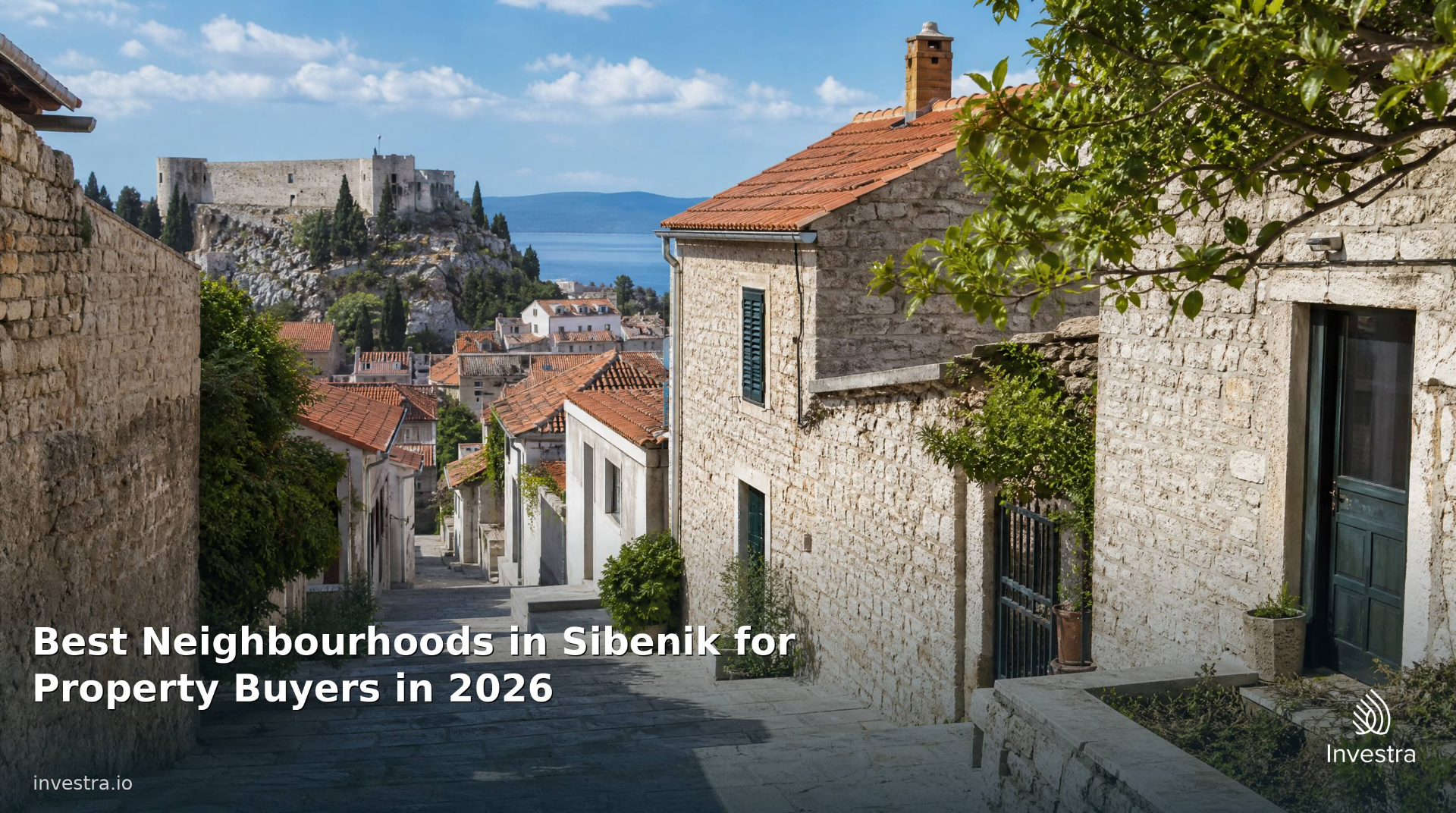
Best Neighbourhoods in Sibenik for Property Buyers in 2026
Why Šibenik Is Capturing Investor Attention in 2026
Quick Answer: Šibenik is one of Croatia's fastest-rising property markets in 2026, offering lower entry prices than Dubrovnik or Split combined with strong rental yields, UNESCO heritage appeal, and improving infrastructure — making it a compelling choice for both lifestyle buyers and pure investors. Investra.io's Croatia Real Estate FAQ covers the broader market context in depth.
Šibenik has quietly moved from regional port town to a strategically attractive Dalmatian destination for property buyers. Its combination of UNESCO World Heritage assets, proximity to two major national parks (Krka and Kornati), an authentic residential old town and a growing premium marina sector gives the city multiple demand drivers.
These dynamics are not speculative. Croatia's Schengen Area accession and euro adoption have reduced friction for cross-border buyers and lowered currency risk, making purchase processes and ongoing management simpler for many international purchasers. Remote working trends and the Croatia Digital Nomad Visa have also pushed a new segment of medium-term residents to consider Šibenik as a base, balancing seasonal tourism demand with more stable, year-round local occupancy. For remote-worker-specific considerations, see the Croatia Digital Nomad Visa guide.
Understanding Šibenik's Property Market: Key Data for 2026
Quick Answer: Šibenik's property market in 2026 is characterised by average prices of €2,800–€5,500/m² depending on location and property type, rental yields of 5–9% for short-term rentals, and year-on-year price appreciation of approximately 8–12% in premium areas. Review Croatia's full property tax guide before committing to any purchase.
Grounding decisions in reliable data is essential. Transaction volumes in the Šibenik municipality rose notably in the early 2020s; by 2024 the region recorded roughly 1,400 residential transactions, up from approximately 1,100 in 2022, with foreign buyers representing about 35–40% of activity.
Short-term rental economics remain attractive in the right locations. Central and beachfront properties typically deliver stronger gross yields, driven by the concentrated tourist season and high nightly rates during July and August. Long-term residential yields are lower, reflecting market fundamentals across Croatia where tourism-driven premium rents outpace contracted residential rates. Buyers should also factor transaction costs: including the real estate transfer tax, notary, legal and agent fees, total closing costs commonly add roughly 8–12% to the headline purchase price. For a detailed legal and tax view, consult the Croatia Property Tax Guide 2026.
Stari Grad (Old Town): Heritage, Character, and Premium Returns
Quick Answer: Šibenik's Stari Grad is the city's most prestigious and historically significant neighbourhood, with property prices ranging from €4,500 to €6,500/m² for renovated stone properties, and short-term rental yields that can reach 9–11% during peak season due to exceptional tourist demand. Compare with Dubrovnik's rental dynamics for context.
Stari Grad stands as Šibenik's cultural heart. The Cathedral of St. James and St. Nicholas Fortress anchor a compact urban fabric of narrow alleys, stone facades and small piazzas. Unlike some more touristed old towns, Šibenik’s core retains an authentic residential population, which supports year-round vibrancy and sustains a market for both short- and longer-term lets. The stone-built apartments popular here command premium pricing because renovation supply is constrained by heritage restrictions and high-quality restorations are costly.
Renovation considerations are fundamental for buyers in Stari Grad. Quality sympathetic restorations commonly cost between €600 and €1,200 per square metre, depending on the degree of structural intervention and the need to comply with conservation rules. For investors targeting holiday rental income, a tastefully renovated 50–60m² stone apartment positioned close to the cathedral can produce strong seasonal income, particularly when professionally managed and marketed as a cultural stay rather than a generic seaside rental. For operational and regulatory comparison with other Dalmatian tourism hubs, see the Split Airbnb Investment Guide.
Baldekin: The Residential Heart of Modern Šibenik
Quick Answer: Baldekin is Šibenik's primary residential neighbourhood for middle-class locals and increasingly for foreign buyers seeking a blend of everyday amenity, reasonable prices (€2,200–€3,400/m²), and easy access to both the old town and coastal areas.
Baldekin is where Šibenik functions as a living city. It houses most everyday services — larger supermarkets, healthcare facilities, schools and the bulk of local retail — making it attractive for buyers who prioritise resident-friendly amenities and year-round occupancy over pure tourist potential. The housing stock is dominated by post-war apartment blocks and more recent infill developments. Renovated mid-floor apartments are the market workhorse and a common acquisition for buyers seeking mid-term rentals or family homes.
Price points here encourage broader participation: buyers can find renovated two-bedroom units suited for long-term rental or owner occupation without the premium of central or seafront locations. Demand is steady from local professionals, teachers, civil servants and an emerging cohort of international residents using the Croatia Digital Nomad Visa. Baldekin’s stability and lower management burden make it a pragmatic choice for investors prioritising lower vacancy risk over peak-season upside.
Šubićevac and Vidici: Elevated Living with Panoramic Views
Quick Answer: Šubićevac and the Vidici area offer some of Šibenik's most compelling residential real estate, combining elevated positions with panoramic sea and city views, at price points of €2,800–€4,800/m² — representing strong value relative to the lifestyle quality on offer.
The literal meaning of Vidici — “views” — underlines the selling point of this hillside area. Properties here use the visual premium: terraces, roof decks and large glazing take advantage of vistas across the channel and nearby islands. The product mix includes villas, older apartment blocks with larger footprints and a growing number of boutique developments planned to maximise the outlook.
Many buyers in this zone are prepared to pay for privacy and light: villas and larger homes can reach higher absolute price points, while well-specified apartments with dramatic terraces sit at the upper mid-market. The relative scarcity of new villa sites and the desirability of uninterrupted views provide a structural underpinning to pricing here.
Ražine and Brodarica: The Riviera Suburb
Quick Answer: Ražine and Brodarica form Šibenik's most desirable coastal suburb zone, offering direct beach access, a calmer pace than the city centre, and property prices of €2,500–€5,000/m² — with beachfront and sea-view properties generating exceptional short-term rental returns of 8–10% gross annually.
Ražine and Brodarica represent the coastal twin of Šibenik’s residential offering. The promenade, pebble beaches and approachable marina and boat services make this zone attractive for owners who want accessibility to both city services and seaside leisure. Properties here tend to be larger format — houses, villas and ground-floor apartments with gardens are common — which appeals to family holidaymakers and longer-stay renters who value outdoor space.
Brodarica’s waterfront infrastructure, combined with easy short-boat connections to local islands such as Krapanj, strengthens its year-round appeal. For owners focused on villa-style income streams, this coastal zone delivers concentrated summer performance with opportunities to offset off-season vacancies through promotional pricing, longer-stay discounts and targeted market channels. Buyers entering the villa market should account for seasonal management and maintenance costs when modelling net returns; experienced advisory can be a material value-add during purchase and refurbishment stages. For regional comparison and further local market context, see Investra’s coverage of nearby coastal towns such as Vodice Real Estate 2026 and island markets like Murter Island Real Estate 2026.
Zablaće and Solaris Resort Area: Tourism-Driven Investment
Quick Answer: The Zablaće peninsula and Solaris resort area represent Šibenik's most tourism-infrastructure-heavy investment zone, with new-build resort properties priced at €3,500–€7,000/m² and managed rental programmes offering passive investment structures that generate 5–8% net returns with minimal owner involvement.
Solaris and the surrounding Zablaće peninsula deliver an institutional resort model: hotels, an aquapark, a golf course and marina create an ecosystem that supports managed rental products sold by developers and operators. These managed programmes typically offer owners a revenue share or a guaranteed return for a defined period, creating a hands-off option for investors who prefer lower operational involvement.
Buyers must evaluate the commercial terms carefully: confirmed occupancy assumptions, net revenue shares, maintenance obligations and exit provisions materially affect long-term returns. If the resort’s capital improvements and marketing continue, capital appreciation is plausible as demand for professionally managed holiday units strengthens. For buyers seeking passive, structured exposure to tourism, Solaris-style offerings are among the clearest available in the Šibenik region. For financial structuring and advisory, consider professional services such as Findes Financial Services which can assess the financial mechanics and tax implications of such investments.
Mandalina and the Marina District: A Rising Waterfront Star
Quick Answer: The Mandalina Marina area represents one of Šibenik's most exciting emerging property micro-markets, with newly developed waterfront properties priced at €4,000–€6,500/m² and strong demand from nautical tourism enthusiasts — a segment that spends significantly more per visit than average tourists.
Marina Mandalina has transformed part of Šibenik’s waterfront by attracting higher-spending nautical visitors and creating a credible superyacht-capable destination on the Adriatic. This shift has generated parallel demand for premium residential product close to the marina: buyers who own boats or those who wish to tap into the prestige and service ecosystem around the marina are primary purchasers. Developers have responded with contemporary apartment blocks and townhouses with rooftop terraces and marina-facing aspects.
The rental profile for waterfront properties here differs from central historic listings: guests attracted to the marina district typically seek lifestyle amenities tied to boating, dining and convenience rather than historic ambience. That makes pricing and occupancy patterns slightly different and generally more resilient during shoulder seasons when nautical traffic remains but mass beach tourism eases.
Srima and Vodice: The Northern Investment Corridor
Quick Answer: The coastal strip running north from Šibenik through Srima to Vodice represents an accessible price tier (€1,800–€3,200/m²) with strong tourism infrastructure and easy day-trip access to Šibenik, making it a practical choice for buyers who want Dalmatian coast exposure at a relative discount.
Srima and Vodice form a connected northern corridor that benefits from established tourism infrastructure and easier price thresholds. Srima serves primarily as a beach-oriented satellite to Šibenik, while Vodice is a larger, more mature tourist town with a track record in holiday rentals and marina facilities. That proven demand profile means a lower operational learning curve for owners and broad distribution channels for rental marketing.
For investors focused on simple vacation rental returns, Srima’s beach-access properties and Vodice’s established lettability provide consistent summer performance without the premium pricing found within Šibenik’s immediate city centre. Strategic buyers often use these towns as a diversification play — combining a centre-city asset in Šibenik with a coastal apartment in Srima or Vodice to balance yield volatility and occupancy seasonality. For more on adjacent towns and their market dynamics, consult Investra’s local market guides including coverage of Primosten and Tribunj.
For buyers considering financial structuring across multiple properties or leveraging mortgages, independent advisory can help align loan profiles to seasonal income. For mortgage and financial planning assistance, services such as Findes Group & Partners provide tailored guidance on cross-border lending and tax-efficient ownership structures.
Practical Steps, Costs and Legal Considerations for 2026 Buyers
Quick Answer: Expect to budget an additional 8–12% for transaction costs beyond the purchase price, allow 30–60 days for a typical purchase completion, and use professional legal and tax advice to navigate cross-border considerations. Review Croatia's full property tax guide for detailed rules.
A practical purchase roadmap reduces surprises. Successful buyers typically follow a clear sequence: define investment objectives (income vs capital vs lifestyle), shortlist neighbourhoods based on those objectives, select representative properties, perform technical and legal due diligence, negotiate terms and complete closing with appropriate notary and tax filings.
Non-EU buyers should verify any additional administrative steps early in the process; EU buyers enjoy parity in purchase rights. Financing timelines vary: local bank mortgages require credit assessment and can extend the timeline depending on document complexity. Investra’s country guides and local consultants provide procedural checklists; for buyers who prefer independent local consultancy and project-specific advisory, experienced practitioners such as those listed at Siniša Dagary investment insight can offer practical support through renovation and rental licensing phases.
Investment Strategy & Exit Scenarios
Quick Answer: Choose a strategy aligned with your horizon — short-term rental operators must prioritise location, occupancy seasonality and professional management; buy-and-hold capital-appreciation investors should focus on constrained-supply neighbourhoods like Stari Grad or marina-front developments. Exit options include resale to private buyers, portfolio sale to investors or conversion between rental formats depending on local demand.
Articulating an exit strategy at purchase is essential. For investors planning to operate short-term rentals, the ability to reposition a property (for example, upgrading finishes or altering layouts where permitted) increases optionality and resale appeal. For capital-appreciation buyers, constrained-supply areas with heritage protections or limited new construction — Stari Grad and certain villa locations on Vidici — historically demonstrate the strongest long-term price resilience.
Exit timing often aligns with macro cycles and local infrastructure delivery. Buyers who can hold through medium-term cycles can aim to crystallise gains after neighbourhood-level catalysts — marina expansion, resort completions or municipal upgrades — materially change local demand. A professional exit process typically involves staged marketing, value-enhancing renovations and engagement with specialist local brokers to access the buyer segments most likely to pay the premium your asset merits.
Investment Disclaimer
Quick Answer: This guide summarises market observations and commonly cited data for Šibenik in 2026; it does not replace individual due diligence or professional legal and tax advice.
The information provided in this article is for educational and informational purposes only and should not be construed as financial, legal, or investment advice. Real estate investments carry inherent risks, and past performance does not guarantee future results. Investors should not invest funds they cannot afford to lose. Always conduct thorough due diligence and consult with qualified legal, tax and financial advisers before making any investment decisions. Investra.io does not guarantee returns on any investment.
Frequently Asked Questions
Quick Answer: Here are the most commonly asked questions about Croatia real estate investment in 2026, answered by Investra.io experts.
Is Croatia a good country for real estate investment in 2026?
Yes. In 2026 Croatia offers an attractive combination of rising tourism demand, improved accessibility due to Schengen and euro adoption, and comparative price advantages relative to many Western European coastal markets. As always, location-specific fundamentals and investor objectives determine outcome more than country-level trends alone. For broader context, see Investra.io's market research on urban and coastal markets: Investra market research and procedural guides such as how to buy property.
Can foreigners buy property in Croatia?
EU citizens can acquire property under the same terms as Croatian nationals. Non-EU citizens may face additional administrative procedures; none of these details should be assumed without legal verification. Professional legal counsel is recommended for cross-border transactions.
What is the average property price in Sibenik?
Prices vary by neighbourhood and product type. As a benchmark, desirable neighbourhoods in 2025–2026 show typical price ranges of roughly €2,800–€5,500/m², with old-town stone properties and certain waterfront developments above that. Always confirm current asking prices via market listings and broker valuation.
What rental yields can I expect?
Gross short-term yields in prime Šibenik locations commonly range from 7–9%, with top-performing assets above that during peak months; long-term rental yields are closer to 4–6% gross. Net yields depend on management, seasonality and cost structure.
What taxes apply to property purchases?
Typical transaction costs add approximately 8–12% to the purchase price when accounting for transfer tax, notary, registry and professional fees; VAT applies selectively to new builds. Consult official guidance and specialist advisors for personalised tax planning. The Investra property tax guide is a useful starting point: Review Croatia's full property tax guide.
How long does the purchase process take?
From signed reservation to final completion is commonly 30–60 days, depending on mortgage approval, completion of due diligence and administrative processing. Bespoke timelines extend longer where renovation, change-of-use or complex ownership structures are involved.
What financing options are available?
Buyers can access local bank mortgages, international lenders and developer payment plans. Terms vary; consult mortgage advisors and financial planners. For complex structures and tax-efficiency planning, professional services such as Findes Group & Partners can assist with structuring and lending options.
Is property management available for rental properties?
Yes. Professional property management and short-term rental operators are active in Šibenik and the wider county. Using local managers is especially valuable for operational efficiency, check-in logistics and compliance with tourism licensing.
What are the best areas to invest in Sibenik?
Best areas depend on your strategy. Stari Grad targets heritage-led appeal and higher per-square-metre appreciation; Baldekin offers residential stability and lower entry costs; Mandalina and marina-front areas appeal to marina and nautical demand; Ražine/Brodarica suit villa investors. Compare neighbourhood data and your objective to choose appropriately. For regional comparisons, Investra has detailed guides on nearby markets such as Dubrovnik, Split and island markets like Hvar.
How should I budget for renovations in Stari Grad?
Expect high-quality sympathetic restorations to cost in the region of €600–€1,200/m² depending on historic fabric and the degree of structural work. Heritage protections can restrict certain interventions, so obtaining conservation advice early is advisable. Experienced renovation consultants such as those featured in local advisory networks can provide realistic cost schedules and contractor recommendations. For consultancy and project support, see Siniša Dagary investment insight.
Where can I find market insights and investor services locally?
Local market research and operational services are available from Investra's market resources and independent consultants. Explore Investra's research and regional guides for comparable markets and legal process guidance, and consider direct consultation with regional experts such as the team at Siniša Dagary investment insight.
Recommended Reading
Quick Answer: The following curated resources offer deeper reading on Croatian real estate tax rules, regional market comparisons and practical buying guides.
- Croatia Property Tax Guide 2026 What Foreign Buyers Must ...
- Split Airbnb Investment 2026 Rental Income Best Areas Leg...
- Croatia Digital Nomad Visa 2026 Complete Guide For Remote...
- Hvar Island Real Estate 2026 Luxury Property Investment G...
- Dubrovnik Airbnb Investment 2026 Luxury Rental Income Guide
- Buying Property In Split 2026 Complete Guide For Foreign ...
- Siniša Dagary investment insight
- Siniša Dagary investment insight
- Siniša Dagary investment insight
Additional resources and local market context are available across Investra’s regional blogs — compare Šibenik with research on larger Croatian markets and adjacent towns to test your assumptions: Buying Property In Dubrovnik 2026, Buying Property In Zagreb 2026, and practical municipality-level studies such as Metkovic Real Estate Market 2026 and Knin Real Estate Market 2026.
For advisory support on local market strategy, renovation projects and investment structuring, established consultants and firms in the region can provide end-to-end services from acquisition to asset management. Explore consultancy offerings and insight from recognised practitioners at Siniša Dagary investment insight and consider financial planning and mortgage advisory via Findes Group & Partners.
If you require a more tailored assessment, contact experienced advisors who work across Dalmatia and understand neighbourhood-level demand drivers, operational management and legal compliance: professional contacts and services are available through the links provided above, or via local Investra consultants who specialise in Croatian coastal markets.
Recommended Reading
Quick Answer: This section explains the practical property-investment implications of Recommended Reading.
- Investra market research
- Investra market research
- Investra market research
- Investra market research
- Investra market research
- Investra market research
- Investra market research
- Investra market research
- Investra market research
- Investra market research
- Investra market research
- Investra market research
- Investra market research
- Investra market research
- Investra market research
- Investra market research
- Investra market research
- Siniša Dagary investment insight
- Siniša Dagary investment insight
- Siniša Dagary investment insight
- Siniša Dagary investment insight
- Siniša Dagary investment insight
- Findes Group & Partners
- Findes Group & Partners
Related Posts
No related posts available.
