
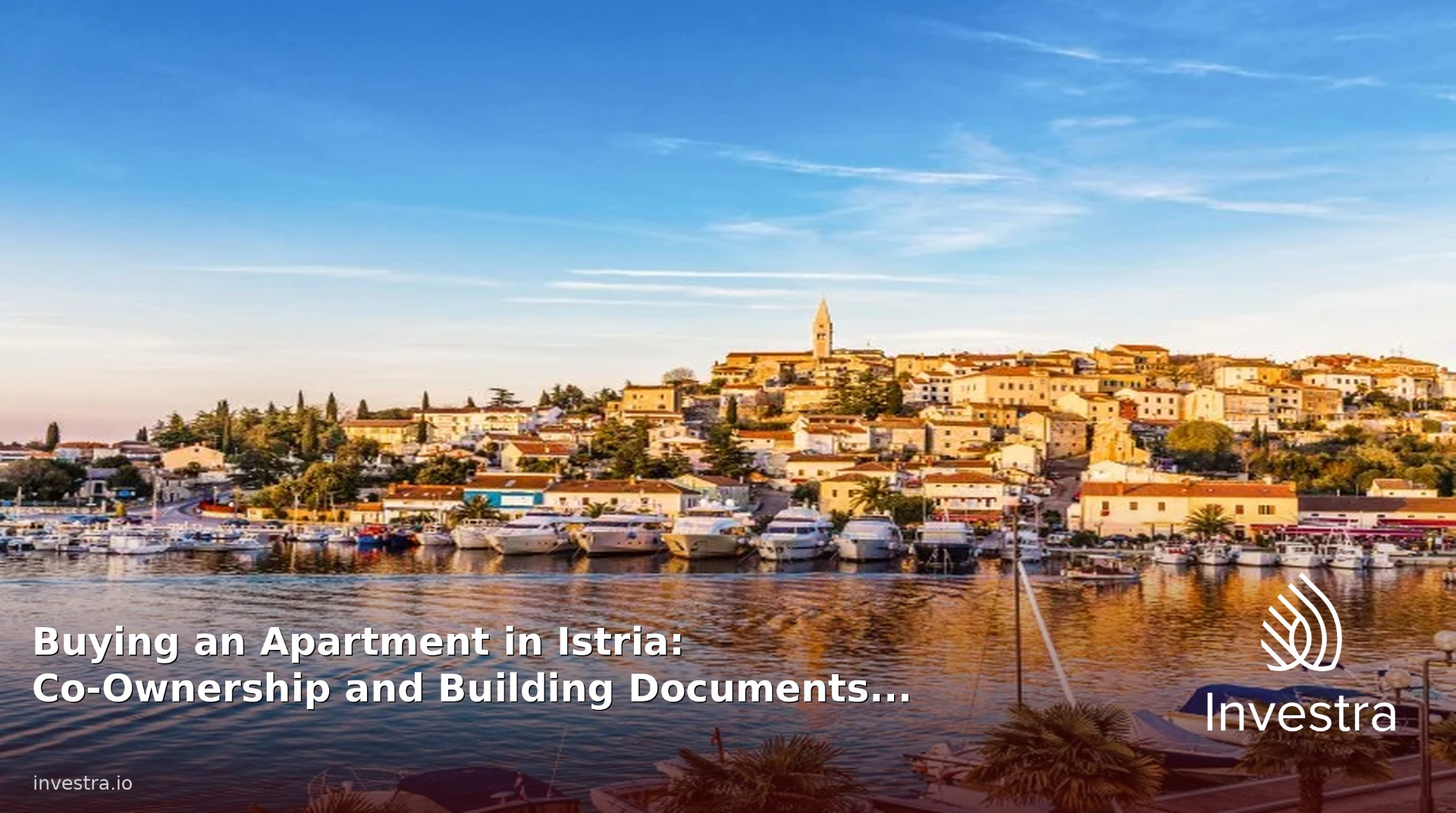
Buying an Apartment in Istria: Co-Ownership and Building Documents...
Buying an Apartment in Istria: Co-Ownership and Building Documents...
Why Istria Attracts Foreign Apartment Buyers in 2026
Quick Answer: Istria continues to draw foreign buyers with its Mediterranean climate, EU membership benefits, and well-developed tourism infrastructure — making apartment ownership here both a lifestyle and strategic investment decision. Check Investra's Property Buying Guide for Foreign Investors in the EU to understand your eligibility as a non-Croatian buyer.
Istria isn't just Croatia's most visited peninsula — it's become one of the most competitive apartment markets in the entire Adriatic region. Whether it's the hilltop towns of Motovun and Grožnjan, the marina-dotted coastline of Poreč and Rovinj, or the urban sophistication of Pula, buyers from across Europe and beyond have been drawn here with genuine intent to purchase. The question isn't whether Istria is desirable. It's whether buyers come prepared for what the purchase actually involves.
What surprises many first-time buyers is how often the lifestyle decision outpaces the legal and documentary groundwork. You fall in love with a view, an apartment above an old stone courtyard, and suddenly you're in a transaction where the building's legal status, the co-ownership structure, and a decade of unpaid maintenance fees haven't been disclosed properly. That's not a worst-case scenario — experienced advisors see it regularly.
This article focuses on something that doesn't get enough attention: the building and co-ownership documents you must review before signing anything. These aren't bureaucratic formalities. They are the foundation on which your legal title, your rental income, and your financial security rest. If you're serious about buying an apartment in Istria, this is where your due diligence starts.
For a broader picture of Croatian tax obligations tied to property ownership, the Croatia Property Tax Guide 2026 is essential reading before you commit to any purchase decision.
Understanding Co-Ownership Law in Croatian Apartment Buildings
Quick Answer: In Croatia, apartment buyers don't just acquire their unit — they automatically acquire a proportional share of the building's common areas, governed by the Law on Ownership and Other Real Rights. Understanding this co-ownership framework is legally non-negotiable when you buy an apartment in Istria.
Croatian property law treats apartment ownership differently from what many Western European or American buyers expect. When you purchase an apartment unit (stan) in a multi-unit residential building in Istria, you're simultaneously acquiring an individual ownership right over your apartment and a co-ownership share (suvlasnički udio) in the building's common parts — staircases, roof, facade, load-bearing walls, shared plumbing, and the land beneath the structure.
This isn't optional and it isn't symbolic. Your co-ownership share determines your financial contribution to building maintenance costs, your voting weight in co-owner assemblies, and your legal liability in certain building-related disputes. The share is typically calculated in proportion to the floor area of your apartment relative to the total usable floor area of the building. A larger apartment means a larger ownership stake — and a larger share of collective responsibilities.
The legal framework governing this is primarily the Zakon o vlasništvu i drugim stvarnim pravima (Law on Ownership and Other Real Rights), supplemented by regulations on the management of multi-apartment buildings. What's critical for buyers is that this co-ownership structure is registered in the land registry (zemljišna knjiga), and any discrepancy between the registry and the physical building situation is a red flag that requires resolution before purchase.
Engaging a local notary (javni bilježnik) and a qualified Croatian property lawyer early in the process isn't a luxury — it's the only way to verify that what you're buying matches what's registered. The Findes Group & Partners team and specialists like Siniša Dagary have helped buyers untangle exactly these kinds of ownership structure issues before they become post-purchase nightmares.
The Land Registry Extract: Your Starting Point for Every Istria Apartment Purchase
Quick Answer: The land registry extract (zemljišnoknjižni izvadak) is the definitive legal document confirming ownership, encumbrances, and co-ownership shares for any apartment in Croatia. Always obtain a fresh extract — not a photocopy from the seller — through the official e-Courts portal or via your notary.
The first document any competent advisor will pull is the zemljišnoknjižni izvadak — the official land registry extract issued by the Croatian land registry court (zemljišnoknjižni odjel). This document tells you who legally owns the property, what encumbrances are registered against it (mortgages, liens, pre-emption rights, easements), and how the co-ownership shares in the building are structured.
Here's what many buyers don't realize: the extract has three key sections. The A sheet (list A) identifies the property itself — its description, surface area, and parcel data. The B sheet (list B) records ownership — the current owner's name, their ownership share, and any conditions attached to that ownership. The C sheet (list C) is where it gets critical — this is where mortgages, court injunctions, rights of way, pre-emption rights, and other burdens are recorded.
For apartment buildings in Istria, especially older buildings in towns like Poreč, Umag, or Pula where renovation activity has been uneven, you may find that the individual apartment you want to purchase is listed under a building parcel that hasn't been properly subdivided into separate ownership units. This can mean the apartment exists physically but doesn't exist legally as a separate registered unit — a situation that requires legalization before a clean sale can proceed.
Always request a fresh extract dated within the last few days. Sellers sometimes present outdated copies. The Croatian e-Courts system (e-Spisi) allows attorneys and notaries to access current registry data in real time. Don't accept anything less. For an overview of the broader buying process and what other documents are involved, consult the Croatia Real Estate FAQ 2026, which covers the most common buyer questions in depth.
Building Permits, Usage Permits, and Legalization Status in Istria
Quick Answer: Every apartment and the building it sits in must have valid construction and usage permits in Croatia. Buildings or units without these documents may be illegal constructions that cannot be legally sold, rented, or financed through a mortgage — a risk that's more common in Istrian coastal areas than many buyers expect.
Croatia has spent years working through the legalization of buildings constructed without permits — particularly during the construction boom of the 1980s and the post-independence period of the 1990s. In Istria, where coastal development pressure was intense, some apartment buildings — especially smaller ones converted from houses, or extensions added without formal approval — still carry unresolved legalization issues.
The key documents here are the građevinska dozvola (building permit) and the uporabna dozvola (usage permit or occupancy certificate). The building permit confirms the structure was legally authorized to be built. The usage permit confirms it was built according to the approved plans and is safe and legal to occupy. Without a valid usage permit, a property technically cannot be registered in the land registry as a separate ownership unit, cannot be legally rented out on a short-term basis, and may face difficulties with bank financing.
Croatia introduced amnesty procedures under the Act on Legalization of Illegally Built Buildings (and subsequent amendments) to allow owners to regularize structures built before certain cut-off dates. If an apartment you're considering is currently being legalized under one of these procedures, the purchase isn't necessarily off-limits — but you need a clear legal opinion on whether the legalization is likely to succeed, what additional costs it may generate, and how long it might take.
Ask your Croatian attorney to verify the building's permit status through the relevant county (županija) building authority records. In Istria, this falls under the Istarska županija administration. Cross-reference this with what the seller provides. Discrepancies must be resolved before contract signing, not after.
The Building Management Agreement and Co-Owner Obligations
Quick Answer: Croatian law requires multi-apartment buildings to have a formal management arrangement, typically overseen by a licensed building manager (upravitelj). As a new co-owner, you inherit the obligations of this arrangement — including regular maintenance contributions and any outstanding building debts.
One of the most practically significant documents you'll encounter when buying an apartment in Istria is the ugovor o upravljanju zgradom — the building management agreement. This contract exists between the co-owners of the building and a licensed building manager (upravitelj zgrade), who is responsible for maintaining the building's common areas, coordinating repairs, managing the reserve fund, and handling administrative obligations on behalf of the co-owners.
Why does this matter to a buyer? Because when you acquire your apartment and your corresponding co-ownership share, you step into the seller's position in this arrangement. That includes any outstanding obligations the seller may have accumulated. If the previous owner was consistently late paying their monthly maintenance contributions (pričuva), those debts don't necessarily disappear upon sale — depending on the circumstances and how the purchase contract is structured, they may transfer to you.
Request the current building management agreement and ask specifically about the maintenance reserve fund (zajednička pričuva) balance. A well-maintained Istrian building should have an adequate reserve to cover foreseeable repairs. A building with a depleted or non-existent reserve fund is a financial risk — it means co-owners will face special assessments for unexpected repairs. Also ask whether any major projects (roof replacement, facade renovation, elevator installation) are planned, budgeted for, or already underway. These will affect your ongoing costs from the moment you take ownership.
For guidance on how these costs interact with your broader investment analysis, advisory services from specialists familiar with the Istrian market can help you model realistic ownership costs.
Minutes of Co-Owner Assemblies: The Hidden History of Your Building
Quick Answer: The minutes (zapisnici) of past co-owner assembly meetings reveal pending decisions, unresolved disputes, planned expenditures, and the general health of the building's governance — information that no marketing brochure will ever tell you but that every serious buyer should demand.
Think of co-owner assembly minutes as a building's internal diary. They record what decisions were made, which co-owners voted for or against major expenditures, what complaints were raised, what disputes are ongoing, and what future plans have been discussed but not yet implemented. For anyone planning to buy an apartment in Istria, getting access to the last two to three years of these minutes is one of the most revealing things you can do.
What are you looking for? Patterns of conflict between co-owners — these can signal a dysfunctional building community where necessary repairs get blocked indefinitely. Documented disputes with the building manager that haven't been resolved. Decisions about significant expenditures that were approved but not yet funded. Evidence of water damage, structural problems, or pest issues that came up repeatedly without permanent resolution. Any indication that the building is involved in litigation.
In well-run Istrian apartment buildings — particularly newer developments in resorts or marina complexes near towns like Novigrad or Rovinj — the assembly minutes are organized, regular, and transparent. In older buildings in town centers, or in small converted buildings where informal arrangements have been the norm for decades, you may find that proper assemblies haven't been held for years, or that records are incomplete. That's not automatically disqualifying, but it does tell you something important about the level of governance you're entering.
The building manager (upravitelj) is legally obligated to maintain these records. Your attorney can formally request them during due diligence. Don't accept the seller's summary of what was decided — read the actual minutes. For insights into how Istrian coastal towns specifically handle building governance versus mainland areas, the Metkovic Real Estate Market Guide offers a useful regional comparison.
Energy Performance Certificates and Building Condition Assessments
Quick Answer: Croatian law requires sellers to provide an energy performance certificate (energetski certifikat) when selling an apartment. This document, combined with an independent building survey, gives buyers a realistic picture of future renovation costs and energy efficiency — both directly affecting long-term ownership value in Istria.
For buyers considering rental income from their Istrian apartment — whether through platforms like Airbnb or through traditional leases — energy efficiency matters more than it used to. Guests and tenants increasingly factor utility costs and comfort into their choices. A property with poor insulation in an Istrian stone building that's cold in winter and inadequately ventilated in summer will face guest satisfaction challenges even if the view is spectacular. For more on Airbnb-specific considerations in the region, the Split Airbnb Investment 2026 guide provides directly applicable context even for Istrian buyers.
Beyond the energy certificate, consider commissioning an independent structural survey — particularly for older stone buildings in Istrian hill towns or historic coastal settlements. Croatia doesn't have the same tradition of pre-purchase surveys that exists in the UK or Netherlands, and sellers won't volunteer this. But the cost of a professional building assessment is modest compared to discovering post-purchase that the roof needs replacing or that there's significant moisture damage in shared walls. For properties on islands or in less accessible areas, this is even more important — repair logistics in remote locations compound costs significantly, as the Murter Island Real Estate Guide documents in its analysis of island property ownership.
Reviewing the Pre-Contract and Purchase Agreement: What Istria Buyers Must Verify
Quick Answer: The preliminary purchase agreement (predugovor) and the main purchase contract (kupoprodajni ugovor) must accurately reflect the property's registered data, disclosed encumbrances, agreed conditions, and the agreed mechanism for resolving any outstanding legalization or co-ownership issues before title transfers to the buyer.
For buyers purchasing in Istrian coastal towns, it's also worth confirming maritime domain boundaries — some properties near the coast may be subject to restrictions related to the maritime public domain (pomorsko dobro), which can affect building rights and usage. Your attorney should confirm this isn't relevant to your specific purchase. For a comprehensive guide to the buying process in another major Croatian coastal city, the Buying Property in Dubrovnik 2026 guide covers many parallels applicable to Istrian purchases.
Tax Obligations When Buying an Apartment in Istria
Quick Answer: Apartment purchases in Croatia are typically subject to real estate transfer tax (porez na promet nekretninama) of three percent on the agreed sale price, unless VAT applies on new-build properties. Buyers should verify the current rate and any applicable exemptions with a Croatian tax advisor, as the specifics depend on the property type and seller status.
For buyers planning to generate rental income from their Istrian apartment — a common motivation given Istria's strong tourism — there are additional tax considerations. Croatian tax law distinguishes between income from property (dohodak od imovine) and income from business activity. How your rental income is classified affects which rates apply, what deductions you can claim, and what registration obligations you face. The Croatia Property Tax Guide 2026 covers this in detail and should be considered required reading before any purchase decision.
There's also the question of municipal utility fees (komunalni doprinos and komunalna naknada), which apply differently depending on the municipality within Istria — Poreč, Rovinj, Pula, and Umag each have their own local fee structures. Verify the specific obligations for the municipality where your apartment is located. The Findes Group & Partners advisory team can connect buyers with specialists who know the municipality-specific tax landscape across Istria.
Short-Term Rental Registration and the Categorization Process
Quick Answer: To legally rent out an apartment in Istria on a short-term basis, owners must register with the Croatian tourist board system and obtain a categorization certificate (rješenje o kategorizaciji). Operating without this registration exposes owners to significant penalties and can invalidate rental income from a tax compliance perspective.
If you're purchasing an apartment that's already been used as a short-term rental, ask the seller to provide the existing categorization certificate. Verify it's current and registered under the property's current legal status. What you don't want is to acquire a property where the seller was renting illegally — without categorization — and assume you're buying an established rental business when in fact you'd be starting from scratch with potential administrative complications. For buyers interested in understanding how this works in another major Croatian short-term rental market, the Split Airbnb Investment 2026 guide provides detailed parallel insight. The Croatia Digital Nomad Visa guide is also relevant for buyers planning to spend extended time in their Istrian apartment while working remotely.
Key Istrian Locations: From Coastal Hotspots to Emerging Interior Markets
Quick Answer: Istria's apartment market varies dramatically by location — coastal towns like Rovinj, Poreč, and Novigrad command premium prices with strong rental demand, while interior towns like Pazin or Buzet offer more affordable entry points with different buyer profiles. Always assess location-specific factors rather than treating Istria as a uniform market.
Pula, as Istria's largest city and administrative center, presents a different proposition — more urban, year-round population, stronger long-term rental market, and the unique draw of Roman-era monuments including the famous amphitheater. Buyers focused on residential rather than pure tourism yield often find Pula's apartment market more accessible. For comparable urban market dynamics, the Buying Property in Zagreb guide offers useful contrast in terms of how urban Croatian markets differ from coastal resort-driven ones.
Some buyers overlook smaller Dalmatian coastal towns while focusing on Istria. Worth knowing is that comparable due diligence applies in places like Hvar Island Real Estate 2026 Luxury Property Investment G... | Buying Property In Split 2026 Complete Guide For Foreign ... | Knin Real Estate Market 2026 Dalmatian Hinterland Propert... | Tribunj Real Estate 2026 Small Dalmatian Town Property Guide | Primosten Real Estate 2026 Dalmatian Peninsula Town Prope... | Vodice Real Estate 2026 Sibenik County Coastal Town Prope...
For expert real estate investment insights and business strategy: investment insights | investment expertise | investment consultation.
Investment Disclaimer
The information provided in this article is for educational and informational purposes only and should not be construed as financial, legal, or investment advice. Real estate investments carry inherent risks, and past performance does not guarantee future results. Investors should not invest money they cannot afford to lose. Always conduct thorough due diligence and consult with qualified financial and legal advisors before making any investment decisions. Investra.io does not guarantee returns on any investment.
Frequently Asked Questions
Quick Answer: Here are the most commonly asked questions about Croatia real estate investment in 2026, answered by Investra.io experts.
Is Croatia a good country for real estate investment in 2026?
Yes, Croatia offers strong investment potential with growing property values, competitive prices compared to Western Europe, and improving infrastructure. Investra.io provides comprehensive market data and investment guidance.
Can foreigners buy property in Croatia?
EU citizens can buy property freely in Croatia. Non-EU citizens may need to meet specific requirements. Investra.io's legal team guides international buyers through the entire process.
What is the average property price in Istria?
Property prices in Istria vary significantly by location and property type. Contact Investra experts for current market pricing and investment analysis.
What rental yields can I expect?
Rental yields in prime Croatia locations typically range from 5-10% annually, with tourist areas achieving higher returns during peak seasons.
What taxes apply to property purchases?
Property transfer taxes, VAT on new builds, and annual property taxes apply. Rates vary by property type and location. Consult Siniša Dagary for tax optimization strategies.
How long does the purchase process take?
Typically 30-60 days from offer to completion. Working with Investra.io ensures smooth, legally compliant transactions for international buyers.
What financing options are available?
Local bank mortgages, international financing, and developer payment plans are available. Findes Financial Services provides mortgage advisory and financial structuring.
Is property management available for rental properties?
Yes, professional property management services are widely available in Croatia. Investra.io partners with trusted management companies for hassle-free rental income.
What are the best areas to invest in Istria?
Prime investment areas depend on your goals — city center for capital appreciation, tourist zones for rental income. Investra.io's market analysis identifies the best opportunities.
Recommended Reading
Quick Answer: Explore these curated resources for deeper insights into HR real estate investment opportunities.
- Croatia Property Tax Guide 2026 What Foreign Buyers Must ...
- Split Airbnb Investment 2026 Rental Income Best Areas Leg...
- Croatia Digital Nomad Visa 2026 Complete Guide For Remote...
- Hvar Island Real Estate 2026 Luxury Property Investment G...
- Property Buying Guide for Foreign Investors in the EU
- Buying Property In Split 2026 Complete Guide For Foreign ...
- Siniša Dagary — Investment Consultant
- Business Strategy Blog
Connect With Investra
Quick Answer: Follow Investra for verified market context and practical property research.
Related Posts
No related posts available.
