
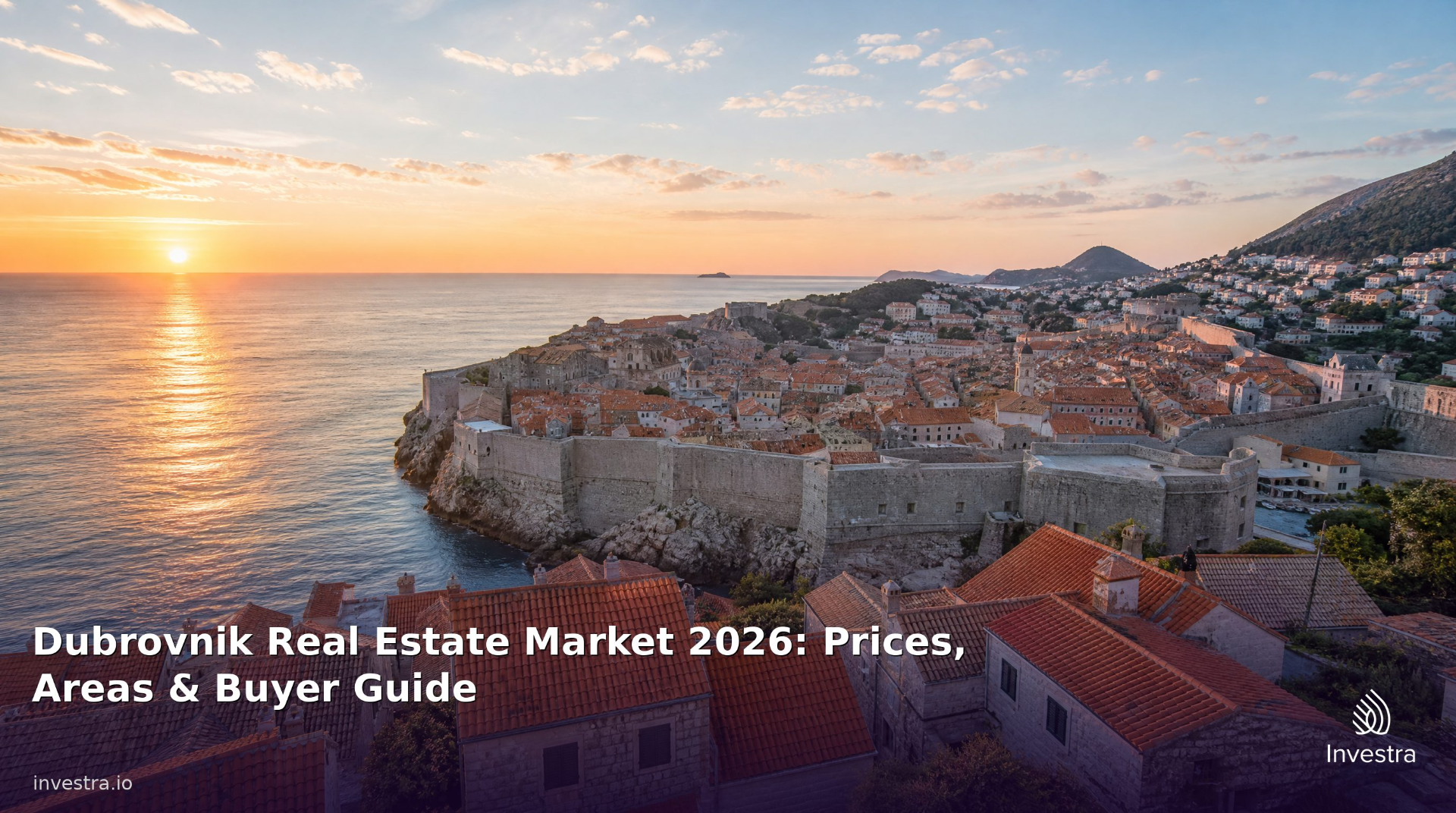
Dubrovnik Real Estate Market 2026: Prices, Areas & Buyer Guide
Dubrovnik Real Estate Market 2026: What Every Serious Buyer Needs to Know
Quick Answer: The Dubrovnik real estate market in 2026 remains one of Croatia's most resilient and prestigious property markets, with prices ranging from €4,500 to €15,000+ per m² depending on location and property type. International demand, limited supply within the historic walls, and strong short-term rental yields continue to make Dubrovnik a top-tier European investment destination.
Dubrovnik's profile as a premier Adriatic destination has firmed across the mid-2020s. The city's UNESCO-protected Old Town, highly visible coastline and consistent international tourism generate persistent buyer interest that is deeper and more geographically concentrated than in many other coastal markets.
This piece distils the practical knowledge a serious international buyer needs: area-level price context, the profile of active buyers, the legal and tax frameworks that materially affect net returns, realistic short-term rental economics, and the step-by-step mechanics of a purchase. Where relevant, it points to in-depth Investra resources such as Buying Property In Dubrovnik 2026 Complete Guide For Foreign Investors for transaction-level checklists and model scenarios.
Dubrovnik Property Prices in 2026: Area-by-Area Breakdown
Quick Answer: Dubrovnik property prices in 2026 range from €4,500/m² in outer residential areas to €12,000–€15,000/m² inside the Old Town and premium seafront locations. The wide spread reflects not just geography but also property condition, views, and proximity to tourist infrastructure.
Price dispersion in Dubrovnik is unusually pronounced because heritage, view and walkability produce sharp, immediate differences in perceived value. The Old Town is effectively a closed supply system: building new residential floor space within the medieval walls is functionally impossible, so available units are limited to the existing stock.
In practical terms, buyers should expect these area-level benchmarks to guide offer strategy and comparative valuation:
- Old Town (Stari Grad): €8,000–€15,000/m² for renovated, well-located stone apartments; smaller studios start around the low hundreds of thousands of euros, while exceptional multi-room conversions and terrace-equipped units can exceed €2 million.
- Ploče: €6,000–€9,500/m²; premium villas and waterfront units attract higher bids from international buyers seeking prestige close to the Old Town without its pedestrian congestion.
- Lapad: €4,500–€8,500/m² depending on bay exposure and new-build specification; this peninsula is understood as the pragmatic home base for longer-stay visitors and residents seeking modern conveniences.
- Babin Kuk: €5,000–€7,500/m² for resort-adjacent apartments and newer residential blocks, often favoured for family living or second-home comfort.
- Mokošica and Komolac (Greater Dubrovnik): €2,800–€4,500/m², representing the most accessible entry into the municipality for buyers prioritising space and lower purchase price per square metre.
Across 2024–2025 the market experienced strong price appreciation with prime areas growing faster than peripheral zones. Annual rate figures moderated from the exceptional spikes of 2022 but remained positive and well above many Western European comparators. Buyers should use these benchmarks to calibrate both purchase price expectations and rental yield models.
Who Is Buying in Dubrovnik? The Investor Profile Has Shifted
Quick Answer: The Dubrovnik buyer pool in 2026 is increasingly international and affluent, with significant demand from UK, German, Dutch, and increasingly American and Gulf-region buyers. The shift toward high-net-worth individuals has pushed the luxury segment to record price levels while the mid-market remains accessible to a broader range of investors.
The composition of demand influences negotiation dynamics, marketing strategy and the practical resale market. In recent years, three buyer cohorts have been most prominent:
High-net-worth international buyers: These buyers prioritise capital preservation, lifestyle and brand — the Old Town and Ploče luxury villas suit them. They often transact in cash and move quickly once they identify a property that meets both aesthetic and privacy criteria.
European yield-focused investors: German, Austrian and Dutch buyers often focus on the arithmetic of rental revenues and operating costs. Their choices tend toward Lapad and Ploče apartments where net yield projections are steadier and management is simpler.
Affluent long-term residents and remote professionals: A newer segment comprises remote workers and professionals who have chosen to settle in Croatia under legal pathways such as the digital nomad visa. The Croatia Digital Nomad Visa 2026 Complete Guide For Remote Workers has increased visibility among higher-earning digital nomads who prefer to convert from renting to owning when they find a compelling property.
Working with an experienced consultant can align buyer expectations with market realities. For example, the consultancy experience offered by Siniša Dagary investment insight is often cited by overseas purchasers as helpful in evaluating off-market opportunities and in structuring offers that appeal to local sellers while preserving buyer protections.
Can Foreign Nationals Buy Property in Dubrovnik?
Quick Answer: EU citizens can buy property in Dubrovnik with virtually the same rights as Croatian nationals. Non-EU citizens can also purchase property, typically with slightly more documentation requirements, and the process has become considerably more streamlined since Croatia joined the Schengen Area.
Legal openness to foreign buyers is a practical advantage for Dubrovnik's international market. EU citizens have the same acquisition rights as locals. Non-EU nationals, including British, American and Australian buyers, routinely acquire residential property subject to a procedure that confirms reciprocity or relies on a well-established administrative route that seldom poses material barriers for purchasers from major source countries.
Key procedural elements foreign buyers must consider include title verification, verification of succession and ownership history where relevant, and the need to reconcile cadastral and land-registry information. Many older properties, especially inside the Old Town, have complex ownership histories that require resolved documentation before transfer. The Croatia Real Estate Faq 2026 50 Most Asked Questions Answered provides an accessible checklist of the documents and authorisations commonly requested in international purchases.
Engaging a reputable Croatian notary and an independent property lawyer at an early stage is essential. The notary is the official responsible for validating the final contract and registering the transfer; the lawyer performs due diligence on title encumbrances, zoning and heritage restrictions. For introductions to legal and advisory partners who work regularly with foreign buyers, consultancy resources such as Siniša Dagary investment insight can be a practical first step.
Understanding the Tax Framework for Dubrovnik Property Buyers
Quick Answer: The primary tax for property buyers in Dubrovnik is the Real Estate Transfer Tax (RETT) at 3% of the assessed property value, though new-build properties sold by VAT-registered developers are subject to 25% VAT instead. Annual property holding taxes in Croatia are modest, and rental income is taxed at relatively favorable rates compared to Western European norms.
Taxes are one of the most consequential variables affecting net returns and overall affordability. The headline items buyers should incorporate into purchase and holding cost models are transaction taxes, annual local levies, rental income taxes and capital gains rules.
Transaction-level taxes are straightforward in most private sales: a 3% real estate transfer tax is payable on the assessed transaction value. However, many new developments and developer-led projects are marketed and sold as VAT transactions, in which case the advertised price will include or exclude 25% VAT depending on seller presentation.
Annual property holding taxes in Croatia remain modest relative to several EU jurisdictions, but municipalities now possess discretion over certain local levies and tourism-related charges. Dubrovnik has explored measures to manage tourist pressures and may adjust local rates; buyers should therefore include a conservative allowance for rising municipal charges in longer-term cashflow models.
On income taxes, short-term rental taxation is treated differently depending on legal form and accounting approach. The general effective tax burden on individually-held holiday rental income tends to be competitive, with statutory rates applied to a defined taxable base and certain allowable deductions. Notably, properties held for more than two years are typically exempt from Croatian capital gains tax on sale, while disposals within two years are subject to a capital gains tax at statutory rates. For cross-border tax structuring and to ensure that rental and personal tax outcomes are optimised, international buyers often consult specialised advisors. Services such as Findes Group & Partners can provide multi-jurisdictional tax planning and corporate structuring support; their contact teams are available via Findes Group & Partners for detailed enquiries.
For a focused summary on Croatian property taxation and its implications for foreign buyers, consult the updated Investra guide Croatia Property Tax Guide 2026 What Foreign Buyers Must Know, which sets out the rules you need to factor into acquisition and holding projections.
Dubrovnik Airbnb and Short-Term Rental Income: The Numbers in 2026
Quick Answer: Short-term rental yields in Dubrovnik's prime areas range from 5% to 9% gross annually, with well-positioned Old Town and seafront properties achieving occupancy rates above 80% during the May–October season. The strong seasonal demand, combined with Dubrovnik's global brand recognition, makes it one of Europe's most compelling short-term rental investment markets.
Short-term rental economics in Dubrovnik are dominated by pronounced seasonality and high peak pricing. Nightly rates for quality Old Town apartments in peak months commonly surpass €300–€500; exceptional terrace and sea-view units can command €700–€1,200 per night during the busiest weeks.
Because revenue is so concentrated into the May–October season, investors should model conservative effective occupancy and prepare for lower winter months. Many experienced operators use a nine-month effective season assumption to stress-test revenue projections and to ensure cash reserves for off-season maintenance and marketing.
Regulation is another operating risk. Dubrovnik's municipal authorities continue to manage tourism impacts through licensing, category display requirements and enforcement of local rules. All short-term rental properties must be registered with the Croatian Tourism Board and comply with municipal regulations. Non-compliant rentals face fines and potential deregistration. For comparative market context and regulatory detail in other coastal cities, the Investra guides such as Dubrovnik Airbnb Investment 2026 Luxury Rental Income Guide and Split Airbnb Investment 2026 Rental Income Best Areas Legal Guide are practical references for investors evaluating short-term rental strategies across Croatia.
The Best Areas in Dubrovnik for Property Investment in 2026
Quick Answer: The Old Town offers the highest capital value and prestige; Ploče balances value with proximity to the historic core; Lapad provides the best yield-to-price ratio for rental investors; and Cavtat to the south offers value play opportunities with strong tourism infrastructure.
Choosing the right neighbourhood requires aligning objectives, constraints and operating capacity. Each major area has definable strengths and trade-offs:
Old Town — capital preservation and scarcity advantage. Old Town units benefit from UNESCO protection and an effectively fixed supply. This produces a defensible floor for high-end prices and makes the Old Town a preferred holding for buyers prioritising long-term capital appreciation and market prestige.
Ploče — proximity and privacy. Ploče provides a softer urban environment while preserving easy access to the Old Town. It attracts lifestyle buyers and villa purchasers who value sea views and garden space. It tends to be a preferred area for return buyers who want both lifestyle and investment upside.
Lapad — practical yields and modern convenience. Lapad is the pragmatic choice for those focused on maximising return on deployed capital. New-builds and modern conversions appeal to guests seeking comfort and consistent amenities; yield metrics are higher here because purchase prices are lower than the Old Town while occupancy potential remains strong in peak months.
Cavtat — value and independent tourism appeal. Cavtat, located to the south of Dubrovnik, functions as its own tourist town with established demand, marinas and hotel infrastructure.
For a comparative view of high-end island markets that attract the same buyer profile as Dubrovnik, see Hvar Island Real Estate 2026 Luxury Property Investment Guide, which outlines the practical similarities and differences between two top Adriatic destinations.
Buying Property in Dubrovnik: The Step-by-Step Process for International Buyers
Quick Answer: Buying property in Dubrovnik as an international buyer involves property selection, legal due diligence, a preliminary agreement with a 10% deposit, notarization of the final sale contract, land registry transfer, and payment of applicable taxes. The process typically takes 60–120 days and requires a Croatian notary, ideally supplemented by an independent property lawyer.
The practical steps of a purchase are straightforward in sequence but have important detail at each stage that materially affects risk. Below is a condensed checklist that reflects the typical international buyer workflow:
- Search and shortlist: Engage a reputable local agent or advisor. Many desirable properties, especially those inside the Old Town, sell through professional networks before public listing — a specialist agent increases access to off-market opportunities.
- Preliminary due diligence: Commission a title report covering both the Zemljišna knjiga (land registry) and the Katastar (cadastre) and seek a certified measurement of usable floor area. Verify heritage restrictions and recent planning permissions.
- Preliminary agreement (Predugovor): This contract records price, deposit (commonly 10%), and key conditions. The deposit structure is a mutual commitment mechanism; breaching the agreement has defined financial consequences under Croatian contract practice.
- Full due diligence and financing: Complete any outstanding checks, finalise financing or confirm cash arrangements, and coordinate the final notary date. Non-resident buyers should ensure all documentation relating to reciprocity or administrative approvals is in order.
- Notarisation and transfer: The final purchase contract is executed before a Croatian notary; following registration in the land registry, ownership legally transfers to the buyer.
- Post-completion compliance: Pay relevant taxes, transfer utilities, register the property with local authorities and the tourism board if rental activity is intended.
If buyers require operational support during or after purchase, experienced local advisors can provide introductions to property managers, restoration specialists and legal teams. For practical help on how to work with local experts and what services are typically required, consider consulting profiles and services at Siniša Dagary investment insight and the Investra property purchasing guide mentioned earlier.
Financing a Dubrovnik Property: Mortgages, Cash, and Creative Structures
Quick Answer: The majority of international buyers in Dubrovnik purchase with cash or use financing from their home country. Croatian bank mortgages are available to non-residents but involve additional documentation requirements, higher interest rates relative to Eurozone averages, and typically lower loan-to-value ratios of 50–70%.
Financing considerations materially influence both the type of property a buyer can realistically pursue and the attractiveness of offers in a competitive market. Most high-value Dubrovnik transactions are completed with cash because cash offers provide negotiating advantage and certainty of closing. For buyers who prefer use, options include:
- Croatian bank mortgages: Available to non-residents, usually with conservative loan-to-value limits (often 50–70%) and interest rates that reflect local risk premiums. Approval requires income verification, credit checks and certified documentation; lenders may also require property insurance and, for certain borrowers, a local guarantor.
- Home-country loans: Some international buyers prefer mortgages from banks in their country of residence, which can offer more favourable terms or larger lending amounts depending on their profile.
- Developer payment plans: Common on new developments, they reduce immediate cash requirements and can be structured over the construction period with staged payments tied to completion benchmarks.
- Creative structures: Where appropriate and tax-efficient, buyers sometimes use corporate ownership, trust vehicles or cross-border financial arrangements. These structures should be discussed with a qualified international tax adviser to ensure compliance and clarity of reporting obligations.
For buyers who require bespoke financial and tax planning, third-party advisors provide cross-border structuring and execution services. Firms such as Findes Group & Partners specialise in financial planning and can advise on mortgage sourcing, foreign exchange management and tax-efficient ownership solutions. Their contact information and advisory team are available at Findes Group & Partners.
For practical market comparisons on purchasing in other Croatian cities and how financing norms vary across the country, Investra publishes market guides such as Buying Property In Split 2026 Complete Guide For Foreign ... and Buying Property In Zagreb 2026 Complete Guide For Foreign.... These resources help buyers benchmark loan availability and transaction costs across Croatian regions.
Investment Disclaimer
Quick Answer: The information contained in this article is provided for informational and educational purposes only; investors should conduct their own due diligence and consult qualified advisors before making decisions.
The material in this article summarises market conditions, legal norms and taxation relevant to Dubrovnik property in 2026. It is not a promise of future performance. Real estate investments carry risks including market volatility, regulatory change and liquidity constraints. Buyers should not rely solely on the information here when forming investment decisions.
Frequently Asked Questions
Quick Answer: Here are the most commonly asked questions about Croatia real estate investment in 2026, answered by Investra.io experts.
Is Croatia a good country for real estate investment in 2026?
Yes. Croatia combines a recovering and modernising infrastructure with coastal markets that remain less expensive than many comparable Mediterranean peers. The Dubrovnik market is a premium segment within that national opportunity set. For deeper context on taxation and market dynamics consult the Investra research library, including the Croatia Property Tax Guide 2026 What Foreign Buyers Must Know.
Can foreigners buy property in Croatia?
EU citizens buy on equal terms with Croatian nationals. Non-EU nationals generally can buy residential property subject to administrative checks; practice shows approvals are routinely granted for buyers from most major source countries. The practical steps are set out in Investra’s country guides.
What is the average property price in Dubrovnik?
Prices vary widely by area and asset quality. Expect roughly €4,500/m² in peripheral suburbs, €5,000–€8,500/m² across Lapad and Babin Kuk, €6,000–€9,500/m² in Ploče and €8,000–€15,000+/m² in the Old Town and prime seafront locations. Use these as starting points for valuation discussions.
What rental yields can I expect?
Gross yields for short-term rental properties in top Dubrovnik locations typically range from 5% to 9%, depending on purchase price, management quality and seasonality assumptions. Net yields depend on tax treatment, operating costs and vacancy rates.
What taxes apply to property purchases?
The main transaction tax is a 3% real estate transfer tax on private sales; purchases from VAT-registered developers are structured under 25% VAT. Annual municipal levies, tourism taxes and rental taxation apply as well; consult specialized advisors for personalised tax planning.
How long does the purchase process take?
From accepted offer to registered land transfer, typical transactions take 60–120 days. Simpler deals can close faster; properties requiring additional legal clarification, succession settlement or heritage approvals may extend the timeline.
What financing options are available?
Most high-value buyers use cash. Croatian banks provide mortgage support to non-residents with conservative loan-to-value ratios and documentation requirements. Developer payment plans and home-country financing are common alternatives.
Is property management available for rental properties?
Yes. Full-service property management is available and can materially improve occupancy and per-night rates. Appointing an experienced manager is particularly important in Dubrovnik due to its seasonal demand curve and regulatory requirements for short-term lets.
What are the best areas to invest in Dubrovnik?
The best area depends on investment goals: Old Town for prestige and capital preservation, Ploče for a balance of location and privacy, Lapad for higher yield-to-price ratios, and Cavtat for a value-oriented alternative within the greater Dubrovnik tourism footprint.
Where can I find more detailed local market guides?
Investra maintains detailed guides on Croatia and multiple regional markets. Relevant titles include Dubrovnik Airbnb Investment 2026 Luxury Rental Income Guide, Split Airbnb Investment 2026 Rental Income Best Areas Legal Guide and regional studies that compare Dubrovnik with Hvar and other Dalmatian destinations.
Recommended Reading
Quick Answer: This section explains the practical property-investment implications of Recommended Reading.
- Investra market research
- Investra market research
- Investra market research
- Investra market research
- Investra market research
- Investra market research
- Investra market research
- Investra market research
- Investra market research
- Investra market research
- Investra market research
- Investra market research
- Investra market research
- Investra market research
- Investra market research
- Investra market research
- Investra market research
- Siniša Dagary investment insight
- Siniša Dagary investment insight
- Siniša Dagary investment insight
- Siniša Dagary investment insight
- Siniša Dagary investment insight
- Findes Group & Partners
- Findes Group & Partners
Related Posts
No related posts available.
