
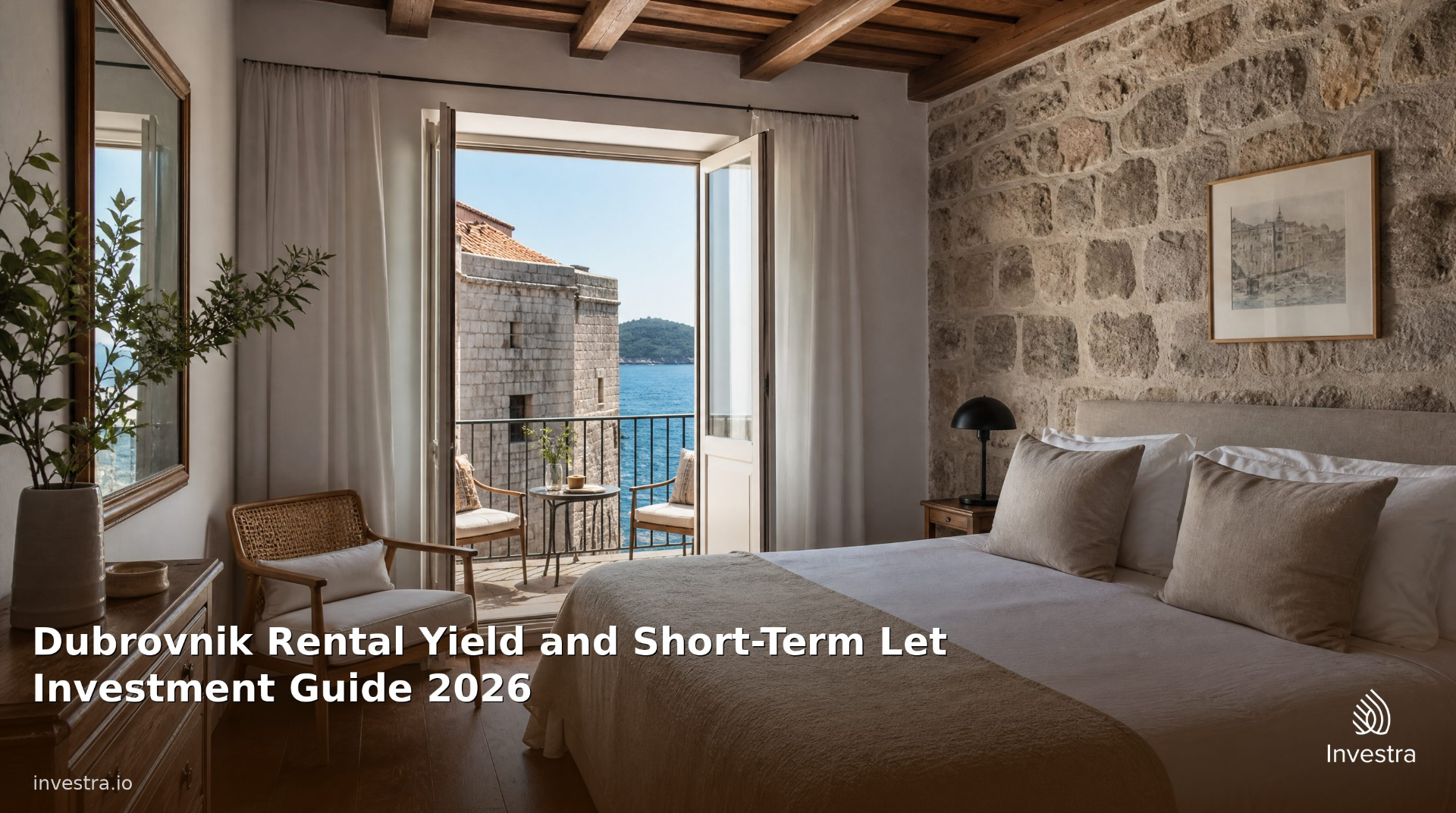
Dubrovnik Rental Yield and Short-Term Let Investment Guide 2026
Why Dubrovnik Remains One of Europe's Most Compelling Short-Term Rental Markets in 2026
Quick Answer: Dubrovnik delivers some of the highest short-term rental yields in the Mediterranean, with gross rental yields ranging from 6% to 12% annually, driven by world-class tourism demand, limited housing supply, and a year-round visitor base that most Adriatic rivals simply can't match. Investra.io's Dubrovnik Airbnb Investment Guide offers deep-dive data for serious investors.
Dubrovnik stands apart from many coastal markets because it combines a globally recognisable destination brand with structural limits on new supply. The Old Town's UNESCO status, mature cruise and cultural tourism programs, and continuing interest from international travellers create a robust demand foundation.
For investors, that translates into two main advantages: consistently high nightly rates in prime zones and a market with constrained supply dynamics where added regulation is likelier to increase scarcity value than reduce long-term demand. Dubrovnik’s visitor mix includes short-stay holidayers, cultural tourists, conference attendees and an increasing number of remote workers and lengthening off-season visits, which broadens revenue opportunities across more months than many Adriatic towns.
This guide distils the practical, verifiable facts you need to evaluate a purchase: current price bands by neighbourhood, realistic yield calculations, the legal and tax landscape, operating costs, financing options and a realistic appraisal of regulatory risk. Where relevant, it points to deeper resources and professional contacts that can help you move from analysis to acquisition without assuming an overly optimistic outcome.
Current Property Prices in Dubrovnik: What Buyers Are Actually Paying in 2026
Quick Answer: Dubrovnik property prices in 2026 range from approximately €4,500/m² in peripheral areas to over €12,000/m² for premium Old Town properties with sea views, making it Croatia's most expensive real estate market by a significant margin. For a full breakdown of the buying process, see the Buying Property in Dubrovnik 2026 Complete Guide.
Price per square metre is the first filter investors apply, and Dubrovnik sits at the top of Croatia’s market range. The distribution is highly location-sensitive and the city’s zoning restrictions mean that a narrow strip of the market carries a disproportionate share of returns.
General price bands observed in 2026 are:
- Old Town (Stari Grad): €7,000–€12,000/m² for character apartments with sea views; trophy units above €12,000/m².
- Pile and Ploče: €5,500–€8,500/m² — close to Old Town appeal but with more realistic acquisition opportunities.
- Lapad Peninsula: €4,500–€7,000/m² — family-oriented, beach proximity drives steady demand.
- Suburban areas (Mokošica, Zaton): €2,800–€4,500/m² — lower prices and lower rental intensity.
Buyers should expect limited negotiation room in prime zones. Sellers in Dubrovnik typically demand market prices because international purchasers and domestic buyers both back right-priced listings quickly; properties with clear licences and clean renovation history command a premium. If you are evaluating multiple Croatian markets, compare Dubrovnik’s bands with the alternatives and consider the valuation premium as the price for reduced vacancy and higher nightly rates — factors that the Investra market research and regional studies show consistently across 2024–2026.
Rental Yields in Dubrovnik: The Numbers That Actually Matter
Quick Answer: Gross rental yields in Dubrovnik typically range from 6% to 12% for short-term holiday lets, with the highest performers located in Old Town and Lapad; net yields after taxes, management fees, and operating costs land between 4% and 8%, which remains highly competitive against most Western European real estate markets.
Short-term rental yields should be modelled conservatively and measured against realistic occupancy and seasonal pricing. Peak-season nights generate disproportionate revenue, but shoulder and off-season performance are critical to hitting published yields.
Example conservative model for an Old Town one-bedroom apartment purchased for €450,000:
- Peak (75 nights): average €220/night = €16,500
- Shoulder (60 nights): average €120/night = €7,200
- Off-season (30 nights): average €80/night = €2,400
- Estimated gross: €26,100 → gross yield ≈ 5.8%
Applying professional management (20–25%), platform fees and operating costs reduces that to a net yield in the 4–6% range. Studio units and compact one-bedrooms in highly walkable, low-maintenance Old Town buildings frequently outperform on yield per euro invested due to premium per-night pricing and efficient housekeeping turnover.
Comparative perspective: long-term letting often produces 2–4% gross yields in Dubrovnik, which is substantially lower than short-term returns when managed properly. A critical note: the yield math varies dramatically with occupancy and management quality.
The Legal Framework for Short-Term Rentals in Croatia: What Changed and What Matters
Quick Answer: Croatia regulates short-term rentals through a licensing system requiring property owners to register their accommodation with the local tourist authority (eVisitor system), pay sojourn taxes, and declare rental income — compliance is straightforward but non-negotiable, and Dubrovnik has added its own additional local restrictions layered on top of national law.
Croatia’s national rules provide a clear baseline: all short-term lets must be registered in the eVisitor platform, display an assigned categorization, collect and remit sojourn tax (boravišna pristojba), and comply with hospitality categorization requirements. The lump-sum (paušal) taxation regime remains an available option for smaller operations, while larger or higher-earning portfolios may perform better under actual income accounting.
Municipal authority matters. Dubrovnik’s City Assembly has enacted local measures and zoning reviews aimed at limiting tourist apartment density in key historic zones. While there is no blanket ban across the city, the effective ability to grant new licences in the Old Town core is more constrained than in suburban zones.
Non-EU buyers should confirm acquisition pathways and any reciprocity rules that apply. Many foreign investors use Croatian LLC structures for operational flexibility; this has accounting and compliance implications that warrant early legal and tax planning. For national tax detail and practical registration guidance, consult the Croatia Property Tax Guide 2026.
Short-Term vs. Long-Term Rental Strategy: Which Model Works Better in Dubrovnik?
Quick Answer: Short-term holiday letting consistently outperforms long-term rental in Dubrovnik on a pure income basis, often generating 2–3x the annual revenue, but it carries higher management demands and operational complexity — the right choice depends on your management capacity, risk tolerance, and tax situation.
If you prioritise maximising cash flow and can commit to active management or professional management contracts, short-term letting is likely to produce superior returns. If you prefer stable, low-touch income, long-term leasing is a viable alternative with far lower operating intensity.
Considerations that change the decision:
- Availability of trusted local management partners: strong managers turn short-term listings into scalable revenue streams; poor management destroys value quickly.
- Investor time horizon and risk tolerance: short-term lets are more volatile month-to-month but produce higher expected annual returns; long-term rental smooths income but caps upside.
- Tax positioning: lump-sum taxation can be attractive for small portfolios; larger operations often need full accounting for tax optimisation.
Many owners adopt a hybrid approach: operate short-term from spring through autumn, then place the apartment on a longer monthly tenancy or reserve for personal use in winter months. This mitigates vacancy risk while capturing premium summer revenues. For operational guidance and services, see practical profiles and consultant contacts at Siniša Dagary investment insight.
Best Areas in Dubrovnik for Short-Term Rental Investment and How They Compare to Other Croatian Destinations
Quick Answer: The Old Town delivers the highest nightly rates and strongest demand, while Lapad Peninsula offers more accessible entry prices with excellent family-market demand; Pile and Ploče represent the sweet spot of prestige and practicality for most investors targeting short-term rental income. The Split Airbnb Investment guide offers useful comparison data for investors considering multiple Croatian cities.
Within Dubrovnik, the performance gradient is steep. Old Town units capture a scarcity and prestige premium; Pile and Ploče are often the most practical choice for professional hosts; Lapad is the family and longer-stay segment's core; and suburbs or nearby Riviera towns offer lower prices with varied yield profiles.
Comparatively, Split and Hvar target slightly different guest mixes. Split supports a stronger year-round local economy and university population that buttresses long-term rental demand, while Hvar attracts luxury, seasonal villa tourism with higher peak rates but pronounced seasonality. The Hvar Island Real Estate 2026 guide and Split property investment guide provide deeper market comparisons that help calibrate expectations if you are deciding between Croatian markets.
Operating Costs, Management Fees, and the Real Profitability Picture
Quick Answer: Total annual operating costs for a short-term rental in Dubrovnik typically represent 35–50% of gross revenue when accounting for management fees (20–25%), platform commissions (3–15%), utilities, maintenance, insurance, and taxes — understanding these costs before purchase is essential to accurate yield projection.
Gross revenue is just the starting point. The net yield is what ultimately matters for investors and that requires a transparent mapping of recurring costs. The principal cost items are management fees, platform commissions, utilities, insurance, and maintenance reserves.
Typical cost assumptions used by professional operators in Dubrovnik:
- Property management: 20–25% of gross revenue for a full-service manager.
- Platform commissions: Airbnb ~3% for hosts, Booking.com 15–17%; blended channel mix reduces average commission load.
- Utilities and services: seasonal variance, but plan for €150–€300/month in operating months; AC use in summer increases costs.
- Insurance: specialist short-term rental insurance €400–€800/year.
- Maintenance and depreciation reserve: budget 1–2% of property value annually for long-term upkeep and periodic refurbishment.
Consultant-led structuring and tax planning can materially affect net returns. For cross-border finance, accounting and tax planning, investors frequently work with specialised advisory firms. For example, Siniša Dagary investment insight offers hands-on structuring support, while cross-border financial structuring and mortgage advisory are available via Findes Group & Partners and its contact channel at Findes Group & Partners. These advisors help translate gross revenue projections into realistic net yields after local tax treatment and cross-border considerations.
The Impact of Airbnb Regulations and Tourism Caps: Is the Window Closing?
Quick Answer: Dubrovnik's local government has actively discussed capping tourist apartment numbers and restricting new short-term rental licenses in the Old Town core, and while a comprehensive ban hasn't been implemented, the regulatory trend suggests the window for unconstrained short-term rental growth is narrowing — making existing licensed properties increasingly valuable.
Regulatory risk in Dubrovnik has two sides. On one hand, municipal actions to limit cruise ship throughput and restrict daily visitor peaks reflect a political will to reduce overtourism externalities. That regulatory pressure can make operating a new short-term let in the Old Town harder over time. On the other hand, properties that already hold valid tourism licences and a demonstrable rental record become more valuable if new licence issuance tightens.
Disciplined investors treat licence status as essential due diligence. Ideally, you should acquire properties that are already registered and have a documented operating history. If you are contemplating a property without a licence, factor in a lower valuation and explicit contingency planning should local authorities deny new registration requests.
Financing Your Dubrovnik Investment: Mortgages, Structures, and Capital Sources
Quick Answer: Foreign buyers can access Croatian bank mortgages, but terms are typically less favorable than domestic buyers receive; most international investors fund Dubrovnik purchases with cash or through home-country financing against existing assets — understanding your financing structure before entering the market significantly affects your net yield calculation.
Croatian banks provide mortgage products to non-resident buyers, but underwriting is conservative. Expect loan-to-value ratios in the 50–70% band for foreign applicants, variable-interest pricing linked to Euribor, and a thorough documentation process. Many lenders require a local attorney and notary involvement throughout closing.
Consequently, a large proportion of cross-border buyers prefer cash transactions or use home-country credit facilities secured against existing property. Both approaches shorten transaction time and improve negotiating use in a tight market. Another common approach is using a Croatian d.o.o. (limited company) for acquisitions intended as an operating short-term rental business. Corporate structures have accounting and tax consequences that should be assessed with expert advice from local advisors such as those available through Siniša Dagary investment insight and financial structuring partners including Findes Group & Partners.
Due Diligence and the Practical Purchase Process for Foreign Buyers
Quick Answer: Expect a 30–90 day process from offer to completion depending on financing, title clarity and licence verification; critical steps include confirming tourism licence status, zoning compliance, accurate title and encumbrance searches, and tax registration for rental operations.
Due diligence in Dubrovnik involves standard title and physical inspections plus tourism-specific checks. Confirm whether the property currently operates as a registered short-term rental in the eVisitor system and whether the municipal zone allows for new or continued licence issuance. Title searches should verify ownership, mortgage liens and any condominium rules that could affect conversion or renovation plans.
Key procedural steps for foreign buyers:
- Engage a local lawyer to perform title and encumbrance searches and to advise on purchase agreements.
- Confirm tourism license status and municipal zoning restrictions; consult local tourist boards or Investra's transactional teams for clarity.
- Decide on the ownership vehicle (personal vs. d.o.o.) and obtain tax advice regarding paušal vs. actual income accounting.
- Secure financing or confirm cash availability; where mortgage financing is used, anticipate a multi-week bank approval process and documentation requirements.
- Sign preliminary agreement (predugovor) and place a deposit; complete notary and registry steps to finalise ownership transfer.
For a practical walk-through of the buying process and foreign buyer requirements, review Investra’s comprehensive guide: Buying Property in Dubrovnik 2026 Complete Guide, and for broader national context consult the Croatia Real Estate FAQ 2026.
Building a Short-Term Rental Business in Dubrovnik: Operational Essentials
Quick Answer: Professionalise from day one: secure licence and registration, invest in good photography and listing optimization, adopt dynamic pricing, work with a reliable local manager, and budget for regular refurbishment — these elements largely determine whether a property produces market-leading yield or underperforms its potential.
Running short-term rentals at scale in Dubrovnik is a business exercise. Guests choose quality, distribution and convenience; those factors, not just location, determine yields. Essential operational investments include professional photography, multi-channel distribution (Airbnb, Booking.com, direct website), dynamic pricing software, a dependable housekeeping team, and rapid-response maintenance.
Hiring a strong property manager that charges a fair fee but secures occupancy and guest satisfaction is often the difference between a mediocre cash flow and a premium-performing asset. Local management firms typically provide a mix of guest communication, check-in/out services, housekeeping coordination and routine maintenance. Onboarding a manager early in the acquisition process helps ensure operational continuity and supports immediate revenue generation post-closing.
Direct channels and guest loyalty matter. A diversified marketing approach reduces reliance on a single OTA and its commission schedule; direct bookings improve margins. Finally, maintain a capex plan: even well-managed units require periodic upgrades to remain competitive within Dubrovnik’s premium visitor market.
Investment Disclaimer
Quick Answer: The information in this article is educational and illustrative; it is not a substitute for personalised financial, legal or tax advice. Conduct independent due diligence and consult qualified advisors for decisions that affect your financial position.
The content provided here summarises observed market conditions and typical financial profiles for Dubrovnik short-term rental investments in 2026. It neither guarantees outcomes nor replaces professional advice. Real estate investments carry risks and are influenced by market, regulatory, financing and operational variables.
Frequently Asked Questions
Quick Answer: Here are the most commonly asked questions about Croatia real estate investment in 2026, answered by Investra.io experts and local consultants.
Is Croatia a good country for real estate investment in 2026?
Yes. Croatia remains attractive due to strong tourism demand, improved ease of travel since Eurozone adoption, and property pricing that often represents value compared to Western European coastal markets. Market segmentation is critical — Dubrovnik leads on price and recognition, while other towns offer differing mixes of yield and risk. For in-depth tax and regulatory analysis, consult the Croatia Property Tax Guide 2026.
Can foreigners buy property in Croatia?
EU citizens can purchase property freely. Non-EU nationals may require reciprocity or may find it more straightforward to acquire through a Croatian company (d.o.o.). Always verify specific requirements for your nationality and seek legal counsel early in the process. Detailed procedural guidance is available in Investra’s national guides and transactional services.
What is the average property price in Dubrovnik?
Prices vary substantially by neighbourhood. Prime Old Town units often trade between €7,000–€12,000/m²; Lapad commonly sits between €4,500–€7,000/m²; suburban areas can be €2,800–€4,500/m². For bespoke valuations, contact local market teams at Investra through the Dubrovnik acquisition guides.
What rental yields can I expect in Dubrovnik?
Gross yields typically fall between 6–12% for short-term lets in prime zones; after management, platform fees, utilities and taxes, net yields usually sit in a 4–8% band. Studio and compact one-bedroom units in high-demand zones often deliver the strongest yield per invested euro.
What taxes apply to rental income and property purchases?
Short-term rental income is taxable under Croatian law; owners must register for tourism operations, remit sojourn tax, and choose between lump-sum (paušal) taxation or accounting-based taxation for income. Property purchase taxes, VAT on new builds, and municipal fees also apply depending on the transaction specifics. Consult the Croatia Property Tax Guide 2026 and local tax advisers for tailored planning.
How long does the purchase process take?
Under ideal conditions with cash funding and clear title, closing can be completed in 30–60 days. If Croatian mortgage financing is involved, expect 6–10 weeks for bank approval and longer for complex cases. Working with experienced local lawyers and agents shortens timelines and mitigates risk.
What financing options are available?
Croatian banks lend to non-residents but with conservative terms — lower LTVs and strict income documentation. Many international buyers use cash or use home-country finance. Structured acquisitions via a local d.o.o. are common for active short-term rental businesses. Financial structuring advice is available from advisors such as Findes Group & Partners.
Is property management available for rental properties?
Yes. Professional property management is widely available in Dubrovnik and is strongly recommended for short-term letting; typical fees range 20–25% but can deliver higher net returns through better occupancy and reduced guest-related issues. For expert operational support, review local management partners and consultancy listings at Siniša Dagary investment insight.
What are the best areas to invest in Dubrovnik?
Old Town for highest nightly rates and scarcity; Pile and Ploče for proximity and practical layouts; Lapad for family markets and accessible pricing. Consider the trade-off between premium revenue and acquisition cost when selecting a neighbourhood. For comparative research on other Croatian markets, Investra’s guides on Split, Hvar and regional towns are useful references.
Should I prioritise buying a property with an existing tourism licence?
Yes. Properties with existing registered licences and a verifiable rental history reduce the regulatory execution risk and enable immediate listings post-close. Purchasing unlicensed units in restricted zones is speculative and should be priced and risk-assessed accordingly.
Who can help me with tax and legal structuring?
Engage Croatian lawyers experienced in real estate transactions and tax advisers familiar with cross-border property investment. Local consultants such as Siniša Dagary investment insight and financial advisors like Findes Group & Partners can provide the practical structuring guidance necessary for robust acquisition planning.
Recommended Reading
Quick Answer: This section explains the practical property-investment implications of Recommended Reading.
- Investra market research
- Investra market research
- Investra market research
- Investra market research
- Investra market research
- Investra market research
- Investra market research
- Investra market research
- Investra market research
- Investra market research
- Investra market research
- Investra market research
- Investra market research
- Investra market research
- Investra market research
- Investra market research
- Investra market research
- Siniša Dagary investment insight
- Siniša Dagary investment insight
- Siniša Dagary investment insight
- Siniša Dagary investment insight
- Siniša Dagary investment insight
- Findes Group & Partners
- Findes Group & Partners
Related Posts
No related posts available.
