
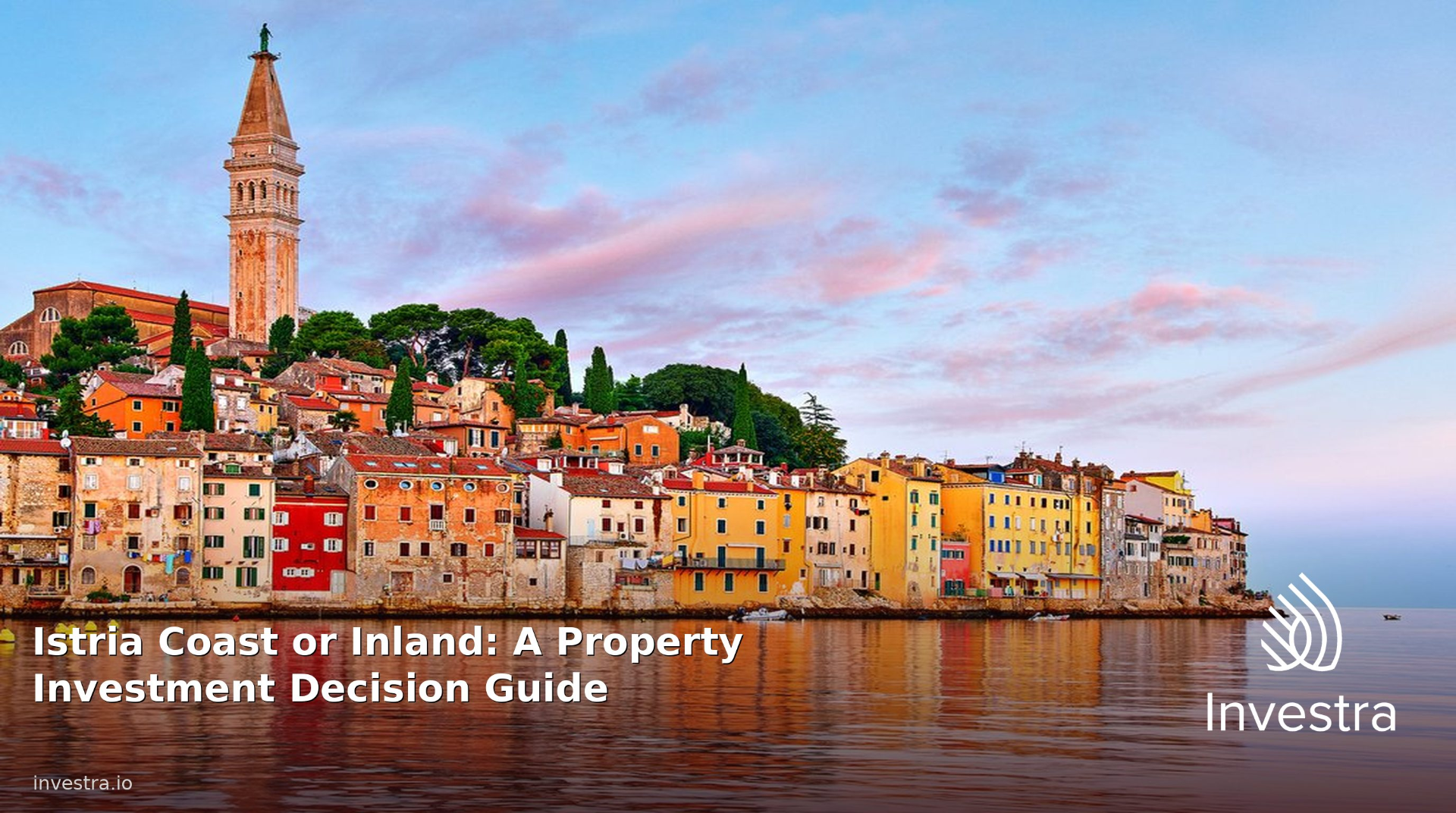
Istria Coast or Inland: A Property Investment Decision Guide
Istria Coast or Inland: A Property Investment Decision Guide
Istria Coast vs Inland Property: Understanding the Core Investment Decision
Quick Answer: Choosing between Istria's coast and inland areas comes down to your investment goals — coastal properties typically attract higher short-term rental demand, while inland Istria offers lower entry prices, authentic cultural immersion, and a growing segment of lifestyle buyers. Consult the Croatia Real Estate FAQ 2026 for a broad overview before narrowing your focus to Istria specifically.
There's a question that comes up constantly among property investors looking at Croatia's northwestern peninsula: coast or inland? It sounds simple, but the reality is that this single decision shapes almost everything — your purchase price, your rental strategy, your lifestyle potential, and your long-term capital appreciation outlook. Istria isn't a monolithic market. It's two distinct investment worlds sitting side by side, separated in some places by just a 20-minute drive.
The Istrian coast — places like Rovinj, Poreč, Pula, Novigrad, and Umag — has been a fixture on the European tourism map for decades. The inland, by contrast, is a quieter proposition. Think hilltop towns like Motovun, Grožnjan, Oprtalj, and Buzet, surrounded by truffle forests, vineyards, and olive groves. What we've seen over the past several years is a genuine, measurable shift in buyer interest toward that inland landscape. But that doesn't mean the coast has lost its edge — far from it.
This guide is designed to help you think through that decision systematically. We'll look at demand drivers, ownership realities, tax exposure, rental regulations, and the practical buying process for both segments. Where current figures are needed, we'll tell you exactly where to find verified data rather than guessing at numbers that change seasonally.
The Coastal Market: What Makes It Attractive to Investors
Quick Answer: Istria's coastline commands the peninsula's strongest short-term rental demand, driven by established tourism infrastructure, international flight connectivity through Pula Airport, and a loyal repeat-visitor base — making it the more immediately income-generating side of the Istrian property equation.
Rovinj is probably the most photographed town in Croatia north of Dubrovnik. That's not an accident — and it's not irrelevant to investors either. The combination of Venetian architecture, a functioning old fishing harbour, and a restaurant scene that punches well above its weight creates the kind of place that tourists book years in advance. Poreč has the UNESCO-listed Euphrasian Basilica drawing cultural visitors. Pula has the Roman amphitheatre hosting international concerts in summer. These aren't manufactured attractions. They're centuries-old drawcards that don't erode easily.
What this means for a rental investor is a built-in audience. The coastal Istrian tourist economy has its rhythms — July and August are peak season, June and September are strong shoulder months, and winter is quiet. That seasonal concentration is both the coastal market's greatest strength and its most important risk factor to model honestly.
For anyone considering a short-term rental strategy in Split or other Adriatic hotspots, the mechanics are similar along the Istrian coast. The Split Airbnb Investment 2026 guide covers rental regulations and licensing requirements in detail — many of those frameworks apply directly to Istrian coastal properties too, since Croatia operates national short-term rental legislation.
Entry prices on the Istrian coast reflect the demand. Prime apartments in Rovinj's old town, properties with sea views in Medulin, or newer builds near Poreč's marina don't come cheap by Croatian standards. To verify current per-square-meter prices, cross-reference listings on Njuškalo.hr and eNekretnine.hr with recent transaction data published by the Croatian Financial Agency (FINA), which maintains public property price records. Your notary or a licensed local agent can also pull recent comparable sales for any specific submarket.
Inland Istria: The Case for the Hilltop Villages and Rural Properties
Quick Answer: Inland Istria offers a fundamentally different investment thesis — lower acquisition costs, strong lifestyle appeal for European remote workers and retirees, and a niche but growing agritourism and boutique accommodation market that differs sharply from coastal mass tourism.
Here's what surprises many first-time visitors to inland Istria: it doesn't feel like a second-tier destination. Motovun's medieval walls rising above a sea of fog in October, Grožnjan's artist colony atmosphere, the white truffle markets in Buzet — these aren't consolation prizes for buyers who couldn't afford the coast. They're genuine, highly sought-after experiences in their own right.
The investment profile is simply different. A stone house in an inland village, even one requiring full renovation, will typically enter the market at a price point meaningfully below comparable coastal square meterage. Buyers aren't getting less property — they're getting a different type of property with a different demand profile. The question is whether that demand profile aligns with your investment strategy.
What we've seen develop strongly in inland Istria is a market driven by three distinct buyer types. First, Northern and Western European lifestyle purchasers — Dutch, German, Austrian, and increasingly British buyers — who want a rural retreat with good infrastructure and a cooler summer climate than the coastal strip. Second, remote workers, particularly since Croatia's digital nomad visa made longer stays more accessible for non-EU nationals. Third, investors targeting boutique agritourism — wine estates, truffle-hunting experiences, and farm-to-table accommodation concepts that command premium nightly rates during the shoulder season when coastal properties often sit empty.
Renovation projects are common inland. Istria has hundreds of abandoned stone houses in varying states of decay. These can represent genuine value if you approach them with realistic cost projections — always commission a full structural survey before purchase, and engage a local architect familiar with heritage building regulations, which can restrict exterior modifications.
Property Prices: How to Verify What You're Actually Paying
Quick Answer: Rather than citing figures that shift seasonally, investors should verify current Istrian property prices through FINA's public transaction database, licensed Croatian real estate agents, and active listing platforms — then benchmark those prices against recent sold comparables, not asking prices.
One of the most common mistakes foreign buyers make — and I've seen this across multiple European markets — is anchoring their expectations to headline asking prices rather than actual transaction prices. In Croatia's real estate market, this distinction matters. Asking prices on listing portals reflect seller ambition; transaction prices reflect market reality. The gap between the two varies significantly by location and property type.
For Istria specifically, FINA (Financijska agencija) publishes property transaction data that includes actual sale prices, property sizes, and location details. This is publicly accessible and is the most reliable benchmark for understanding what buyers have genuinely paid in any given area. Your notary is legally required to have access to this data, so asking them to pull comparable sales for your target area is a routine and entirely appropriate request.
A useful cross-check: the Croatian Tax Administration (Porezna uprava) uses market value assessments for property transfer tax purposes. If a declared sale price falls too far below assessed market value, they will challenge it. This creates a natural floor on what gets officially recorded and gives you another data point on real market pricing.
For a full breakdown of what taxes apply when buying, holding, and selling Croatian property, the Croatia Property Tax Guide 2026 is an essential reference before you make any offer. Don't skip this step — tax exposure in Croatia has specific rules for foreign buyers that differ from what many investors assume.
Rental Income Potential: Coast vs Inland — Honest Analysis
Quick Answer: Coastal Istrian properties generally produce higher gross rental income due to peak season concentration and established tourism demand, while inland properties offer potentially longer booking seasons for the right concept — but rental yield comparisons require verifying actual local data rather than relying on general benchmarks.
Let's be direct about something: anyone who gives you a confident rental yield figure for either coastal or inland Istria without knowing your specific property, its condition, its exact location, its licensing status, and its management costs is guessing. Yield is the output of many variables, not a fixed characteristic of a region.
What we can say with confidence about the coastal market is that demand concentration in July and August is intense. A well-positioned apartment in Rovinj or near Poreč's beach resorts can achieve high occupancy during those weeks, with strong nightly rates. The challenge is the months on either side — and particularly October through April, when coastal Istria becomes a genuinely quiet place. Your annual yield calculation has to account honestly for the off-season.
Inland Istria tells a different story by type. A luxury agritourism property with a swimming pool, authentic gastronomy programming, and a strong brand can extend its season meaningfully — truffle season runs October through January, which is precisely when coastal apartments are sitting empty. Wine harvest tourism, cycling routes, and culinary tourism all have spring and autumn peaks. This matters to the yield model, but only if the property is positioned and marketed correctly. A poorly managed rural property with no online presence will simply sit empty year-round.
To verify current rental benchmarks for Istrian properties, check active listings on Airbnb and Booking.com for comparable properties in your target area, then use AirDNA or similar data tools to understand actual occupancy rates versus asking rates. Local property management companies are also invaluable — many will give you indicative revenue projections based on their managed portfolio data if you're a serious prospective buyer.
The Buying Process for Foreign Investors in Istria
Quick Answer: EU citizens can purchase Istrian property on the same terms as Croatian nationals; non-EU buyers face additional requirements and should verify current bilateral treaty status with Croatia's Land Registry. The process typically involves a preliminary contract, notarization, and Land Registry registration — always with qualified legal representation.
Croatia has been an EU member since 2013, which fundamentally changed the property purchase landscape for European investors. If you hold an EU/EEA passport, you can purchase freehold property in Istria without restriction, and the process mirrors what you'd encounter in other EU markets — with some Croatian-specific procedural steps worth understanding before you begin.
The standard purchase sequence runs like this. First, due diligence — your lawyer checks the Land Registry (Zemljišna knjiga) to confirm the seller's ownership, confirm no encumbrances or mortgages exist, and verify that the property's legal status matches what's being sold. This step catches issues that many foreign buyers discover only after the fact: properties with unclear inheritance claims, agricultural land zoning that restricts construction, or buildings without proper use permits.
Second, a preliminary contract (predugovor) is signed, typically with a 10% deposit. Third, the main purchase agreement is signed before a notary. Fourth, property transfer tax is paid to the Croatian Tax Administration. Finally, ownership is registered in the Land Registry, which is the formal legal moment of transfer.
For non-EU nationals, the process has additional layers. Reciprocity agreements between Croatia and your home country determine whether you can hold freehold title directly or must purchase through a Croatian-registered company. Verify this with a Croatian lawyer — don't rely on general online information, as treaties and regulations do change. The broader Property Buying Guide for Foreign Investors in the EU provides useful context for understanding how Croatia fits within the European framework.
In Istria specifically, you may also encounter agricultural land classified as "agricultural land of special importance" (osobito vrijedno obradivo tlo — P1 classification). This land is heavily restricted from development and cannot be purchased by foreign nationals even with reciprocity agreements in place. Always confirm zoning classifications with the Istrian County (Istarska županija) planning office before making any offer on rural land.
Legal Pitfalls Specific to the Istrian Market
Quick Answer: Istria's historic property records — partly because of its complex Austro-Hungarian, Italian, and Yugoslav administrative past — contain more title irregularities than many other Croatian regions, making independent legal due diligence non-negotiable for any foreign buyer in this market.
Istria has a legal history unlike almost anywhere else in Croatia. Before 1954, much of the peninsula was under Italian administration — and before that, Austro-Hungarian. This layered administrative past means some older properties have title chains that cross multiple legal systems, languages, and land registry formats. It's not a dealbreaker, but it is a reason why experienced property lawyers specifically familiar with Istrian records are worth seeking out, rather than simply hiring a generalist Croatian attorney in Zagreb.
The most common issues we see in Istrian property transactions involve three areas. First, properties built or extended without building permits — a pervasive issue throughout Croatia but particularly common in older Istrian rural properties. Croatia has run legalization programs (ozakonjenje) for certain unauthorized structures, but not all qualify, and a property without a valid use permit (uporabna dozvola) creates real problems for both resale and rental licensing.
Second, inheritance complications. In rural Istria especially, properties passed through generations without formal probate proceedings are common. A property might be listed in the Land Registry under a deceased owner, with multiple living heirs who haven't yet legally divided the estate. Purchasing in this situation without full resolution of the inheritance creates risk that can take years and significant legal cost to unwind.
Third, agricultural land restrictions already mentioned above. The distinction between residential building land, agricultural land, and protected agricultural land is not always visually obvious. Always confirm through the spatial planning registry (Informacijski sustav prostornog uređenja — ISPU), which is publicly accessible online.
Consulting established advisors like Siniša Dagary and the Findes Group & Partners can help you connect with qualified local professionals and structure your due diligence process appropriately before committing capital.
Tax Implications for Istrian Property Investors
Quick Answer: Istrian property investors face Croatian property transfer tax at the time of purchase, potential income tax on rental earnings, and capital gains tax on future sales — with rates and exemptions that should be verified with a Croatian tax advisor and through the Croatia Property Tax Guide 2026 for the most current framework.
Tax structure in Croatia is not static. Rates, exemptions, and administrative requirements have changed multiple times since EU accession, and what was true in 2020 may not reflect the current framework. That's why this section focuses on the categories of tax exposure rather than specific rates — for current figures, you need a licensed Croatian tax advisor (porezni savjetnik) or an accountant familiar with property investment taxation.
Property transfer tax (porez na promet nekretnina) applies at the time of purchase on second-hand properties. New builds purchased directly from a developer are subject to VAT instead, at a different rate. Understanding which regime applies to your target property affects your total acquisition cost calculation significantly — and it's a common area of confusion for first-time buyers in Croatia.
Capital gains on property sold within a specific holding period are taxable in Croatia. Properties held beyond that period may qualify for different treatment. Again — verify the current threshold and rate with a local advisor, as this is precisely the type of detail that changes with legislative updates. The advisory services available through specialist consultants can help you map these tax exposures before you purchase rather than after.
Coastal Micro-Markets Worth Understanding Separately
Quick Answer: Istria's coast is not a single uniform market — Rovinj, Poreč, Pula, Novigrad, and Umag each have distinct price levels, demand drivers, and investment characteristics that require individual analysis rather than blanket coastal assumptions.
For investors interested in the broader Dalmatian coastal market for comparison, guides covering buying property in Split and buying property in Dubrovnik provide useful benchmarks for understanding how Istrian coastal prices compare nationally.
Inland Micro-Markets: Where the Opportunities Differ Most
Quick Answer: Inland Istria's most compelling micro-markets — including Motovun, Grožnjan, Oprtalj, Buzet, and the Mirna River Valley — each serve distinct buyer profiles, from luxury renovation seekers to agritourism investors, requiring targeted local knowledge rather than generalized inland assumptions.
For investors who want to understand how smaller Croatian coastal towns adjacent to inland areas operate, resources covering Tribunj real estate, Primošten real estate, and Vodice real estate provide useful comparative frameworks for smaller-market dynamics — patterns that apply in modified form to Istria's inland towns.
Making the Decision: A Framework for Investors
Quick Answer: The coast-versus-inland decision ultimately turns on three factors: your primary investment objective (income vs. lifestyle vs. capital growth), your capacity to manage or outsource property operations, and your risk tolerance for seasonal income concentration versus lower-demand niche markets — there is no universally correct answer.
After working through the specifics of both markets, how do you actually decide? The honest answer is that there's no objectively superior choice — there's only the choice that aligns better with your specific situation. But there are decision-making frameworks that help.
If your primary motivation is lifestyle value with some rental upside, inland Istria offers more compelling value for money and a more distinctive property ownership experience. You won't generate the same peak-season volumes, but you might build something more sustainable and personally satisfying. And in a world where remote work has genuinely changed how Europeans think about where to base themselves — a trend that Croatia's digital nomad visa has actively supported — the inland value proposition has strengthened considerably.
Connect with specialized advisors through investment consultation channels, review the detailed Hvar Island Real Estate 2026 Luxury Property Investment G... | Buying Property In Zagreb 2026 Complete Guide For Foreign... | Metkovic Real Estate Market 2026 Neretva Delta Property G... | Knin Real Estate Market 2026 Dalmatian Hinterland Propert... | Murter Island Real Estate 2026 Sibenik Archipelago Proper...
For expert real estate investment insights and business strategy: investment expertise.
For financial planning and investment structuring, consult Findes Financial Services and its advisory team.
Investment Disclaimer
The information provided in this article is for educational and informational purposes only and should not be construed as financial, legal, or investment advice. Real estate investments carry inherent risks, and past performance does not guarantee future results. Investors should not invest money they cannot afford to lose. Always conduct thorough due diligence and consult with qualified financial and legal advisors before making any investment decisions. Investra.io does not guarantee returns on any investment.
Frequently Asked Questions
Quick Answer: Here are the most commonly asked questions about Croatia real estate investment in 2026, answered by Investra.io experts.
Is Croatia a good country for real estate investment in 2026?
Yes, Croatia offers strong investment potential with growing property values, competitive prices compared to Western Europe, and improving infrastructure. Investra.io provides comprehensive market data and investment guidance.
Can foreigners buy property in Croatia?
EU citizens can buy property freely in Croatia. Non-EU citizens may need to meet specific requirements. Investra.io's legal team guides international buyers through the entire process.
What is the average property price in Istria?
Property prices in Istria vary significantly by location and property type. Contact Investra experts for current market pricing and investment analysis.
What rental yields can I expect?
Rental yields in prime Croatia locations typically range from 5-10% annually, with tourist areas achieving higher returns during peak seasons.
What taxes apply to property purchases?
Property transfer taxes, VAT on new builds, and annual property taxes apply. Rates vary by property type and location. Consult Siniša Dagary for tax optimization strategies.
How long does the purchase process take?
Typically 30-60 days from offer to completion. Working with Investra.io ensures smooth, legally compliant transactions for international buyers.
What financing options are available?
Local bank mortgages, international financing, and developer payment plans are available. Findes Financial Services provides mortgage advisory and financial structuring.
Is property management available for rental properties?
Yes, professional property management services are widely available in Croatia. Investra.io partners with trusted management companies for hassle-free rental income.
What are the best areas to invest in Istria?
Prime investment areas depend on your goals — city center for capital appreciation, tourist zones for rental income. Investra.io's market analysis identifies the best opportunities.
Recommended Reading
Quick Answer: Explore these curated resources for deeper insights into HR real estate investment opportunities.
- Croatia Property Tax Guide 2026 What Foreign Buyers Must ...
- Split Airbnb Investment 2026 Rental Income Best Areas Leg...
- Croatia Digital Nomad Visa 2026 Complete Guide For Remote...
- Hvar Island Real Estate 2026 Luxury Property Investment G...
- Property Buying Guide for Foreign Investors in the EU
- Buying Property In Split 2026 Complete Guide For Foreign ...
- Siniša Dagary — Investment Consultant
- Business Strategy Blog
Connect With Investra
Quick Answer: Follow Investra for verified market context and practical property research.
Related Posts
No related posts available.
