
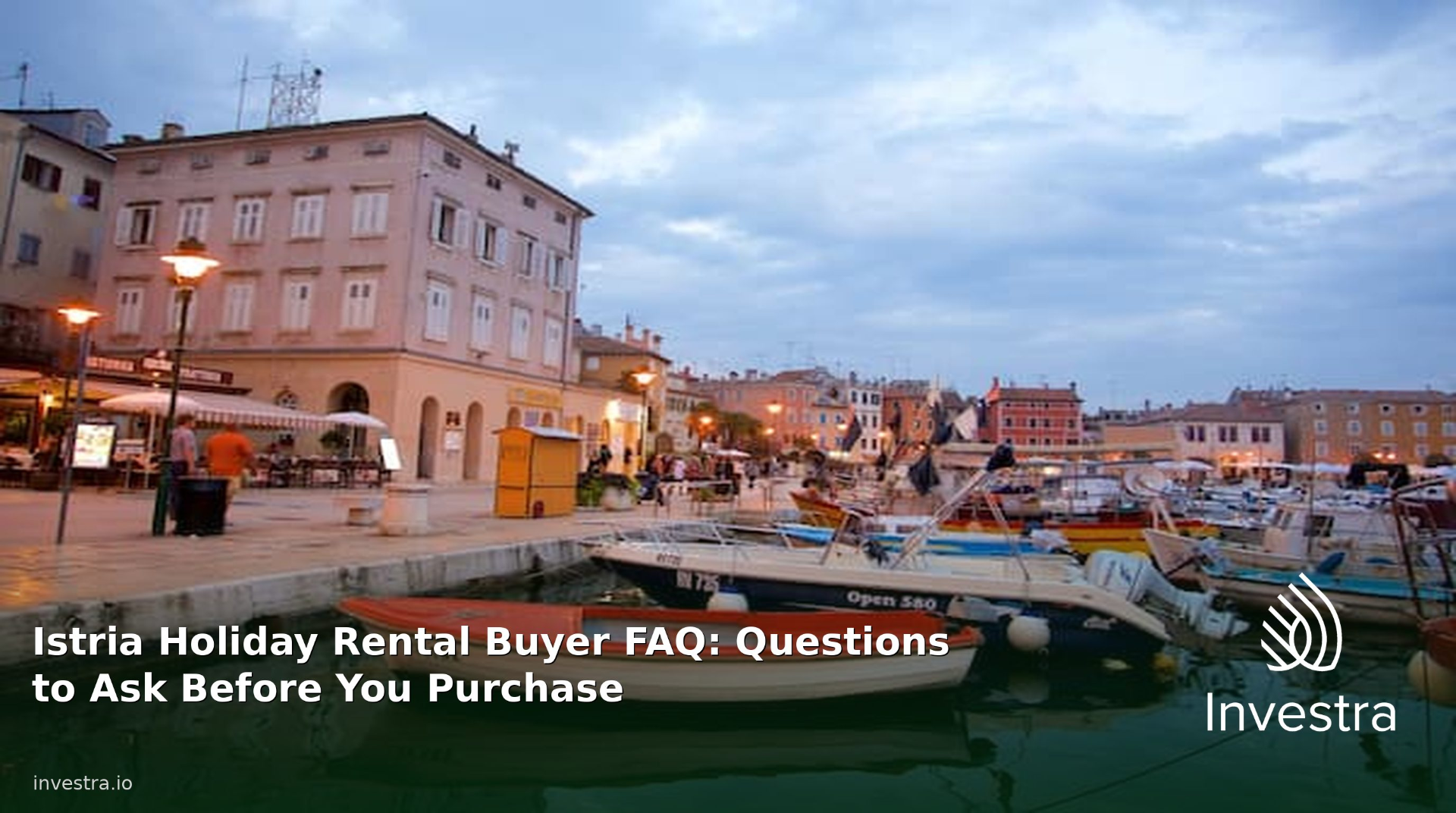
Istria Holiday Rental Buyer FAQ: Questions to Ask Before You Purchase
Istria Holiday Rental Buyer FAQ: Questions to Ask Before You Purchase
Why Istria Has Become a Focal Point for Holiday Rental Buyers
Quick Answer: Istria attracts holiday rental buyers because it combines strong tourism demand, EU legal protections, and a diverse property stock — from hilltop stone villages to beachfront apartments. Before purchasing, buyers should ask structured questions about legal title, rental licensing, tax obligations, and market seasonality to make a genuinely informed decision.
There's a reason Istria keeps appearing at the top of European holiday rental shortlists. The peninsula — Croatia's westernmost region, jutting into the northern Adriatic — draws millions of tourists each year to its walled medieval towns, pine-fringed coastline, truffle forests, and wine routes. Rovinj, Poreč, Pula, Novigrad, and Motovun each carry their own distinct character, and that diversity is exactly what creates such varied investment opportunities across different price points and buyer profiles.
What surprised many buyers who entered the market after Croatia joined the European Union in 2013 is how rapidly the legal and regulatory environment matured. EU accession, followed by Eurozone membership in January 2023 and Schengen access in the same year, removed several barriers that historically complicated foreign ownership. The framework for holiday rentals — what Croatians call iznajmljivanje — has also been formalized through national legislation, meaning there are clear rules to follow, and clear penalties if you don't.
But here's the thing: a beautiful view and a promising tourism statistic don't make a sound investment. The buyers who do well in Istria are almost always the ones who arrived with the right questions — not just about the property itself, but about the legal chain, the operating costs, the rental licensing process, and the realistic seasonal income window. This FAQ-led guide is designed to give you exactly that framework. For a broader legal and fiscal foundation, the Croatia Property Tax Guide 2026 What Foreign Buyers Must Know is essential reading before you go further.
What Legal Checks Should I Conduct Before Making an Offer?
Quick Answer: Before making an offer on any Istrian property, buyers must verify clean legal title through the Croatian Land Registry (Zemljišna knjiga), confirm there are no encumbrances or outstanding mortgages, and check that the property has a valid use permit. Skipping any of these steps can result in costly legal disputes after purchase.
This is, without question, the most important section of this entire guide. Croatia's property market has made enormous strides in digital transparency — the Land Registry is now searchable online at e-Uprava — but legacy title complications still exist, particularly with older properties, converted agricultural land, and inherited rural houses. In my experience reviewing buyer cases, the majority of post-purchase regrets trace back to insufficient due diligence before signing.
The first question to ask your lawyer is: "Is the seller the sole registered owner, and does the Land Registry reflect this?" Co-ownership situations — especially with inherited properties — are common and can create complications if all heirs haven't consented to the sale. Second, request a vlasnički list (ownership certificate) and a zemljišnoknjižni izvadak (land registry extract) for the specific cadastral parcel. These documents confirm ownership and reveal any mortgages, liens, or easements attached to the property.
Third — and this is one buyers frequently overlook — ask whether the property has a valid uporabna dozvola (use permit). Without one, you cannot legally register the property for short-term rental with the Croatian tourism authorities. Many attractive stone houses in Istrian villages and some coastal apartments built in the 1970s–1990s either lack this permit or have discrepancies between the registered and actual built area. Resolving this retrospectively is possible but time-consuming and sometimes expensive. Always insist on seeing the permit before proceeding. The Croatia Real Estate FAQ 2026 addresses many of these procedural questions in depth.
How Does the Holiday Rental Licensing Process Actually Work in Istria?
Quick Answer: To legally operate a short-term rental in Istria, you must register the accommodation unit with the local tourist board, obtain a categorization (star rating), and comply with Croatia's Rental Act. The process involves inspections and documentation, so buyers should verify the property is already licensed or confirm it qualifies for licensing before purchasing.
Operating a holiday rental in Croatia without proper registration isn't a grey area — it's illegal and carries fines. So when you're evaluating a property being sold as a "rental investment," your very first operational question should be: "Is this property currently registered as a tourist accommodation, and can I see the active license?"
If the property is already registered, that's a significant practical advantage. It means you're inheriting a compliant operation, potentially with an existing booking history and established relationships with platforms like Airbnb, Booking.com, or local agencies. Ask the seller for documentation showing the classification category (apartments are typically categorized from one to five stars based on facility standards), the annual tourist tax registration, and any inspection reports from the local tourist inspectorate.
If the property isn't currently registered — perhaps it was used as a primary residence or has been vacant — you'll need to go through the licensing process yourself post-purchase. This involves submitting an application to the local tourist board (in Istrian municipalities, that's typically handled at the county level through Turistička zajednica Istarske županije), undergoing a property inspection, and meeting minimum facility standards for your target category. Standards include requirements around square meterage per person, bathroom facilities, kitchen equipment, safety features, and accessibility.
One practical detail: the license is issued per accommodation unit, not per building. If you're buying an apartment in a building where you intend to rent out multiple units, each requires its own registration. For a deep look at how this plays out specifically in the coastal city context, the guide on Split Airbnb Investment 2026 covers the operational licensing framework that applies across Dalmatia and, broadly, Istria too.
What Are the Tax Obligations for Holiday Rental Income in Croatia?
Quick Answer: Holiday rental income in Croatia is subject to income tax, and owners must also collect and remit tourist tax on behalf of guests. The exact tax treatment depends on whether you operate as a private individual or through a legal entity, so buyers should consult a Croatian tax advisor before purchasing to model their real after-tax return.
Tax is where many buyers get surprised — usually unpleasantly. Croatia has a defined framework for taxing short-term rental income, but the mechanics depend significantly on how you structure your ownership and operation. Let's be clear about one thing upfront: the tax rules do change, and any specific rates mentioned in forums or older blog posts may be outdated. The definitive source is the Croatian Tax Administration (Porezna uprava), and any serious buyer should verify current obligations directly there or through a qualified Croatian tax advisor.
That said, here's the structural picture. Private individuals who earn rental income are generally taxed under the flat-rate system (paušalno oporezivanje) or the actual-cost system, depending on their income level and preference. The flat-rate option has historically been attractive for smaller operators because it simplified compliance, but changes have been introduced in recent years that affect who qualifies and at what thresholds. For buyers expecting significant rental turnover, operating through a Croatian company (d.o.o.) can sometimes be more tax-efficient — but adds administrative complexity and corporate tax obligations.
Beyond income tax, there's also the tourist tax (turistička pristojba), which must be collected from each guest and remitted to the municipality. The amount varies by location and season. There's also the real estate transfer tax paid at purchase, and potentially VAT implications if you're operating through a company above certain revenue thresholds. This is a lot to model accurately without professional help. The comprehensive Croatia Property Tax Guide 2026 breaks this down system by system, and we'd strongly recommend working through it alongside a local accountant.
For personalized structuring advice based on your specific country of residence and investment size, the advisory services offered by Siniša Dagary cover cross-border investment structuring for exactly this kind of scenario.
How Should I Evaluate Istria's Rental Seasonality and Income Potential?
Quick Answer: Istria's peak tourist season runs roughly from June through September, with a shorter shoulder season in May and October. Buyers should request verifiable rental records from the seller, cross-check occupancy data with local agencies, and model income conservatively based on a realistic number of rental weeks rather than optimistic peak-only projections.
Every seller and every real estate agent will give you an occupancy story. The smart buyer's job is to pressure-test it. Istria genuinely does have strong tourism demand — it's one of Croatia's most visited regions, and it benefits from proximity to Italy, Austria, and Slovenia, which means a healthy proportion of short-drive visitors alongside air-route tourists. But "strong demand" and "reliable rental income" aren't the same thing, and the gap between them is where investment mistakes happen.
Ask the seller for documented rental records — actual booking histories, not projections. If the property has been actively rented, there should be a record of tourist tax declarations (filed with the local municipality), which can serve as an objective occupancy proxy. Be cautious of any seller who claims strong rentals but can't produce documentation to support it.
Think about seasonality realistically. A well-located beachfront apartment in Rovinj or Poreč might genuinely achieve bookings from mid-May through late September — approximately 18–20 weeks. An inland agritourism cottage in the Motovun hills may attract year-round visitors drawn to truffles, cycling, and gastronomy, which creates a more distributed season but potentially lower per-night rates. Neither is inherently better — it depends on your income objectives and how you plan to use the property yourself.
Talk to local rental management agencies before you buy, not after. Ask them honestly: how many weeks per year does a property like this realistically book, and at what average nightly rate? Their answers will be more candid than a seller's pitch. You can also cross-reference with publicly available listing data on Airbnb and Booking.com for comparable properties in the area. For a specific coastal market analysis framework, see the guide on Vodice Real Estate 2026, which applies the same analytical lens to a comparable Adriatic market.
What Are the Key Differences Between Buying in Istrian Coastal Towns Versus the Interior?
Quick Answer: Coastal Istrian properties typically command higher prices, offer stronger peak-season rental demand, and attract a broader international buyer pool, while interior properties (hilltop towns, agritourism estates) often offer lower entry prices, distinctive character, and appeal to niche tourism segments. The right choice depends on your budget, personal use intentions, and rental strategy.
This question matters more than most buyers initially realize. Istria isn't a monolithic market — it's a mosaic of micro-markets with genuinely different risk-return profiles. The coastal strip from Umag in the north down through Novigrad, Poreč, Vrsar, Rovinj, and Pula is where international demand is most concentrated, prices per square meter are highest, and competition for quality properties is most intense.
The interior — the Motovun, Grožnjan, Buzet, and Labin hinterland — plays a completely different game. Entry prices can be meaningfully lower for comparable square meterage. Properties here tend to be stone farmhouses, renovated istriane rural houses, or small agritourism estates. They attract a different kind of tourist: the food-and-wine traveler, the cycling enthusiast, the digital nomad seeking a month away from city noise. That demographic is real and growing, but it's also more niche and potentially more volatile than mass beach tourism.
From a buyer perspective, the interior also introduces specific due diligence questions around agricultural land, water supply (many rural properties rely on cisterns or private wells), road access rights, and renovation permit requirements for protected heritage structures. Don't assume that a cheaper entry price means a simpler purchase — it often means more layers of investigation. For a comparable analysis of how interior versus coastal dynamics play out in another Dalmatian region, the Knin Real Estate Market 2026 guide offers useful context, as does the Metkovic Real Estate Market 2026 resource.
Can Foreign Non-EU Buyers Purchase Property in Istria?
Quick Answer: EU citizens can purchase property in Croatia on the same basis as Croatian nationals. Non-EU nationals face additional requirements, including obtaining prior approval from the Croatian Ministry of Justice, and bilateral reciprocity treaties determine eligibility. Buyers from outside the EU should consult a Croatian lawyer to confirm their specific purchasing rights before proceeding.
One of the most common questions we see from prospective buyers — particularly Americans, Canadians, Australians, and non-EU Europeans — is whether they can even legally buy property in Croatia. The short answer is: it depends on your nationality, and the rules are worth verifying before you invest significant time in a property search.
For EU citizens, the path has been fully clear since Croatia's EU accession. You can purchase freely, register ownership, and operate a rental business subject to the same rules that apply to Croatian nationals. For non-EU nationals, Croatia operates on a reciprocity basis — meaning your ability to purchase depends on whether a bilateral treaty exists between Croatia and your home country permitting mutual property ownership rights. The Croatian Ministry of Justice (Ministarstvo pravosuđa) maintains the definitive list of eligible nationalities, and the process typically involves applying for approval before completing the purchase contract.
It's also important to distinguish between purchasing as a private individual and purchasing through a Croatian-registered legal entity (d.o.o.). Non-EU nationals who face restrictions as individuals may find that establishing a Croatian company provides an alternative pathway — though this introduces its own cost and compliance considerations. The Property Buying Guide for Foreign Investors in the EU covers this distinction clearly, and an investment consultation with a qualified advisor can help you map the right structure for your specific situation.
What Questions Should I Ask About Property Management and Rental Operations?
Quick Answer: Before purchasing, buyers should understand who will manage the property day-to-day, what management fees are typical in Istria, whether remote management is viable, and what guest handling, cleaning, and maintenance systems are in place. A property without a credible management plan is a significant operational risk for absentee owners.
Also ask about platform strategy. Is the manager using Airbnb, Booking.com, VRBO, and their own direct booking website? Dynamic pricing tools? Reviews management? These operational details can meaningfully differentiate a property's annual performance. Siniša Dagary investment insights regularly covers operational strategy for cross-border rental investments, and the Siniša Dagary profile provides context on the advisory background behind that analysis.
What Renovation and Maintenance Costs Should I Budget For in Istria?
Quick Answer: Renovation and maintenance costs vary significantly based on property age, construction type, and location, but buyers should budget for structural assessments, utility upgrades, interior fit-out to meet rental category standards, and ongoing annual maintenance. Always commission an independent building survey before exchanging contracts.
From a permitting perspective, significant renovation works on protected heritage buildings — and many Istrian hilltop properties fall under cultural heritage protection — require approval from the regional conservation office (Konzervatorski odjel). This adds time and can limit what interventions are permissible. Budget generously, build in contingency, and don't let renovation cost assumptions be the thing that erodes your investment case. For additional reference on how island property renovation and management costs play out in practice, the Hvar Island Real Estate 2026 Luxury Property Investment Guide addresses many comparable considerations.
How Do Croatia's Schengen and Eurozone Memberships Affect Buyer Decisions in 2026?
Quick Answer: Croatia's full integration into the Schengen Area and Eurozone since January 2023 has removed currency exchange risk for Eurozone buyers, simplified cross-border travel for guests, and increased Croatia's profile among European investors. These structural changes reinforce Istria's attractiveness but don't eliminate the need for thorough property-level due diligence.
For investors from outside the Eurozone — UK buyers, for example, who are now also outside the EU — the euro-denominated market means they do carry exchange rate exposure. Sterling-to-euro fluctuations affect both the purchase cost and the sterling value of rental returns, which is a real risk to model. The broader EU regulatory context for foreign buyers across Croatia is well covered in the Property Buying Guide for Foreign Investors in the EU, and the Findes Group & Partners offers multi-jurisdictional advisory support for exactly these cross-border structuring questions.
What Are the Most Common Buyer Mistakes in the Istria Holiday Rental Market?
Quick Answer: The most common mistakes include purchasing without verifying the use permit, overestimating rental season length, underestimating renovation and management costs, choosing a property based on personal taste rather than rental appeal, and failing to plan the ownership structure before completing the purchase. Each of these errors is avoidable with proper preparation.
Let's be direct about this. The mistakes buyers make in Istria aren't unique to Istria — they're the same mistakes that happen across the Mediterranean whenever people let enthusiasm outrun process. But they're worth naming explicitly because awareness is the first defense.
Mistake three: underestimating the total cost of ownership. Purchase costs (transfer tax, notary fees, agent commission, lawyer fees) typically add a significant percentage on top of the purchase price. Then there's fit-out, licensing, ongoing management fees, tourist tax administration, annual maintenance, and
Explore more on Investra: Croatia Digital Nomad Visa 2026 Complete Guide For Remote... | Buying Property In Split 2026 Complete Guide For Foreign ... | Buying Property In Dubrovnik 2026 Complete Guide For Fore... | Buying Property In Zagreb 2026 Complete Guide For Foreign... | Tribunj Real Estate 2026 Small Dalmatian Town Property Guide | Murter Island Real Estate 2026 Sibenik Archipelago Proper... | Primosten Real Estate 2026 Dalmatian Peninsula Town Prope...
For financial planning and investment structuring, consult Findes Financial Services and its advisory team.
Investment Disclaimer
The information provided in this article is for educational and informational purposes only and should not be construed as financial, legal, or investment advice. Real estate investments carry inherent risks, and past performance does not guarantee future results. Investors should not invest money they cannot afford to lose. Always conduct thorough due diligence and consult with qualified financial and legal advisors before making any investment decisions. Investra.io does not guarantee returns on any investment.
Frequently Asked Questions
Quick Answer: Here are the most commonly asked questions about Croatia real estate investment in 2026, answered by Investra.io experts.
Is Croatia a good country for real estate investment in 2026?
Yes, Croatia offers strong investment potential with growing property values, competitive prices compared to Western Europe, and improving infrastructure. Investra.io provides comprehensive market data and investment guidance.
Can foreigners buy property in Croatia?
EU citizens can buy property freely in Croatia. Non-EU citizens may need to meet specific requirements. Investra.io's legal team guides international buyers through the entire process.
What is the average property price in Istria?
Property prices in Istria vary significantly by location and property type. Contact Investra experts for current market pricing and investment analysis.
What rental yields can I expect?
Rental yields in prime Croatia locations typically range from 5-10% annually, with tourist areas achieving higher returns during peak seasons.
What taxes apply to property purchases?
Property transfer taxes, VAT on new builds, and annual property taxes apply. Rates vary by property type and location. Consult Siniša Dagary for tax optimization strategies.
How long does the purchase process take?
Typically 30-60 days from offer to completion. Working with Investra.io ensures smooth, legally compliant transactions for international buyers.
What financing options are available?
Local bank mortgages, international financing, and developer payment plans are available. Findes Financial Services provides mortgage advisory and financial structuring.
Is property management available for rental properties?
Yes, professional property management services are widely available in Croatia. Investra.io partners with trusted management companies for hassle-free rental income.
What are the best areas to invest in Istria?
Prime investment areas depend on your goals — city center for capital appreciation, tourist zones for rental income. Investra.io's market analysis identifies the best opportunities.
Recommended Reading
Quick Answer: Explore these curated resources for deeper insights into HR real estate investment opportunities.
- Croatia Property Tax Guide 2026 What Foreign Buyers Must ...
- Split Airbnb Investment 2026 Rental Income Best Areas Leg...
- Croatia Digital Nomad Visa 2026 Complete Guide For Remote...
- Hvar Island Real Estate 2026 Luxury Property Investment G...
- Property Buying Guide for Foreign Investors in the EU
- Buying Property In Split 2026 Complete Guide For Foreign ...
- Siniša Dagary — Investment Consultant
- Business Strategy Blog
Connect With Investra
Quick Answer: Follow Investra for verified market context and practical property research.
Related Posts
No related posts available.
