
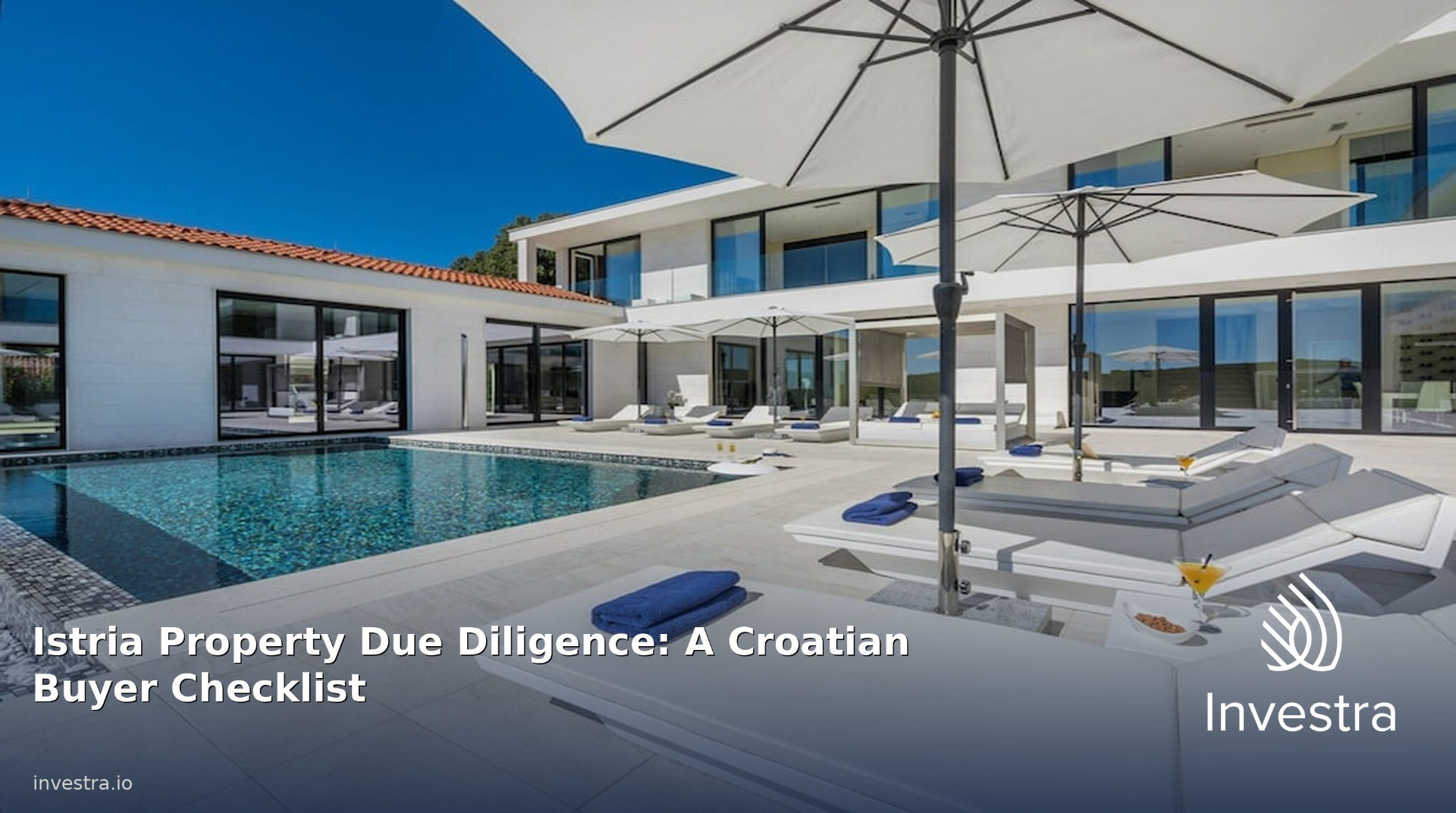
Istria Property Due Diligence: A Croatian Buyer Checklist
Istria Property Due Diligence: A Croatian Buyer Checklist
Why Istria Property Due Diligence Deserves More Attention Than Most Buyers Give It
Quick Answer: Istria property due diligence is the systematic process of verifying legal title, planning status, tax obligations, and physical condition before committing to a Croatian property purchase — and skipping any step can result in costly legal complications that take years to resolve. Start your research with Investra.io's Croatia Real Estate FAQ to understand what questions you should be asking from day one.
There's a particular kind of buyer who falls in love with Istria on a long weekend. The rolling vineyards, the truffle-scented hill towns, the turquoise water stretching from Rovinj to Poreč — it creates an almost magnetic pull. What we've seen time and again is that this emotional response leads people to rush the paperwork in a way they'd never dream of doing back home. And that's where the trouble starts.
The reality is that Istria's property market is genuinely attractive: solid tourism infrastructure, EU membership protections, and a growing base of international buyers from Germany, Austria, Slovenia, and further afield. But "EU member" doesn't automatically mean "straightforward property market." Croatia has its own cadastral system, its own inheritance quirks, a legacy of socialist-era ownership disputes, and a planning environment that varies significantly from one municipality to the next.
Due diligence in Istria isn't just a legal formality — it's your primary defence against owning a property that can't be registered in your name, rented legally, or sold without a lengthy court process. This checklist is designed to give you a systematic framework, whether you're buying a stone house in Motovun, an apartment in Poreč, or a coastal villa near Rovinj. Work through each step methodically, and you'll arrive at the signing table with genuine confidence rather than crossed fingers.
Verifying Legal Title and Land Registry Status in Istria
Quick Answer: Every Istrian property must be cross-checked against both the Land Registry (Zemljišna knjiga) and the Cadastre (Katastar) to confirm that the seller holds clean, unencumbered title — these two databases don't always match, and the discrepancy is your problem once you own the property. For a deeper breakdown of how ownership verification works across Croatia, the Property Buying Guide for Foreign Investors in the EU is essential reading.
Start here, because everything else depends on it. Croatia operates two parallel systems that are supposed to describe the same physical reality: the Land Registry, which records legal ownership and encumbrances, and the Cadastre, which records the physical boundaries and surface areas of parcels. The uncomfortable truth is that in many parts of Istria — particularly in rural hill towns and older coastal villages — these two records don't fully align. Plots registered in the 1950s may have been subdivided informally, built upon without permits, or passed through multiple generations via informal inheritance rather than formal probate.
Your Croatian notary or property lawyer must pull a Land Registry extract (Zemljišnoknjižni izvadak) and a Cadastral extract for every parcel associated with the property. These can be accessed through Croatia's online portal (oss.uredjenazemlja.hr) and should be matched against each other carefully. Look for:
Encumbrances and mortgages — any registered charge (hipoteka) or lien must be cleared before or at the time of transfer. Don't accept a verbal promise that it will be resolved later. Multiple ownership shares — Istrian properties, particularly older stone houses, are frequently owned by several family members who inherited proportional shares. You need written consent and signatures from every co-owner, not just the person you're dealing with. Usufruct rights — an elderly parent may hold a lifetime right of use (pravo plodouživanja) even if the adult children appear to be the registered owners. This right doesn't disappear when you buy. Cadastral vs. registry discrepancies — if the Land Registry shows the previous owner's parents as the registered title holders but the seller claims to have inherited, you need to trace the probate process. In Croatia, inheritance doesn't automatically update the Land Registry. Cases where this hasn't been formalised properly are surprisingly common in rural Istria, and they can take months to sort out before a clean transfer is possible.
In my experience, this single step — rigorous title verification — eliminates at least a third of the "problem" properties that buyers would otherwise walk into blindly. Engage a qualified Croatian property lawyer before you sign any preliminary contract, not after.
Understanding the Preliminary Contract (Predugovor) and Deposit Terms
Quick Answer: The preliminary contract commits both parties to the transaction and typically involves a deposit of around 10% of the agreed purchase price — structured correctly, it protects the buyer if the seller withdraws, but a poorly drafted version can leave you with limited recourse if problems emerge during due diligence. Always have a Croatian lawyer review or draft this document before you sign anything.
Once you've agreed on a price, the seller will typically want to move quickly to a Predugovor — a preliminary sales agreement that locks in the price, the parties, and the timeline. For buyers, this creates an immediate tension: you want to do your due diligence before committing, but the seller wants commitment before you start digging.
The standard deposit under Croatian practice is typically around 10% of the purchase price, though this is negotiable. If the seller withdraws after the preliminary contract, they're legally obligated to return double the deposit. If you pull out without legal justification, you forfeit the deposit entirely. This structure is designed to protect both parties, but it only works if the preliminary contract contains proper "subject to" clauses that give you the right to withdraw and recover your deposit if due diligence reveals a material problem.
A well-drafted Predugovor should specify: the exact property description including cadastral parcel numbers, the agreed price and payment structure, the deadline for completing the full sales contract, conditions under which either party can withdraw without penalty, who bears the cost of resolving any title issues discovered, and the deadline by which the seller must deliver the property free of any encumbrances. Never sign a standard agency-provided template without having your own lawyer review and amend it. The cost of that review is trivial compared to losing a 10% deposit on a property you can't legally transfer.
Building Permits, Use Permits, and Planning Compliance in Istria
Quick Answer: In Istria, a property without a valid use permit (Uporabna dozvola) cannot be legally connected to utilities or registered in the land registry as a completed building — meaning you could buy a structurally sound house that is technically illegal to inhabit. Check permit status with the relevant local municipal office or through Croatia's e-Dozvola system before any deposit is paid.
This is the area where Istrian property transactions fail most dramatically. Croatia had a significant problem with illegal construction — buildings built without permits, buildings expanded beyond permitted dimensions, conversions of agricultural buildings to residential use without formal approval. A 2012 legalization program (Zakon o postupanju s nezakonito izgrađenim zgradama) allowed many of these structures to be retroactively legalized, but not all owners completed the process, and not all buildings qualified.
What does this mean practically? A property might be physically attractive and occupied for decades, but if it lacks a valid Building Permit (Građevinska dozvola) and a Use Permit (Uporabna dozvola), it has a complicated legal status. Some of these can be regularized — your lawyer can advise on current regularization possibilities. Others sit in a grey zone that makes them very difficult to mortgage, insure at full value, or list on Airbnb legally.
For new builds or recently renovated properties, ask specifically for the original building permit and the use permit. For older Istrian stone houses — particularly in interior hill towns like Buzet, Grožnjan, or Oprtalj — the situation can be more nuanced. Pre-1968 structures have different rules under Croatian law. Your lawyer should confirm exactly what documentation exists and whether it's sufficient for a clean transfer. Check the current planning designation (prostorni plan) for the parcel too — agricultural land has entirely different development rules than building land, and some buyers have been surprised to discover that a garden advertised as "buildable" was anything but.
Tax Obligations for Istrian Property Buyers in 2026
Quick Answer: Croatian property purchases are subject to Real Estate Transfer Tax (currently 3% of the assessed value for most resale properties), and buyers should also understand their ongoing local tax obligations and the specific tax treatment of rental income — verify current rates directly with the Tax Administration (Porezna uprava) or through the Croatia Property Tax Guide 2026 before finalizing your budget.
Tax planning is part of due diligence, not a separate conversation you have after signing. The headline number is Real Estate Transfer Tax (Porez na promet nekretnina), which applies to most resale property purchases. For new-build purchases from a VAT-registered developer, VAT (PDV) typically applies instead of transfer tax — the treatment depends on the nature of the sale, so confirm this with your lawyer and accountant before assuming one or the other.
Beyond acquisition taxes, buyers intending to rent their Istrian property have additional obligations. Croatia requires landlords to register their rental activity, obtain a tourism categorization certificate for short-term rentals, and pay the relevant income tax on rental earnings. The specific tax rates for rental income can vary based on whether you're operating as an individual or a company, and whether you're resident or non-resident for tax purposes in Croatia. I'd strongly recommend consulting a Croatian accountant alongside your lawyer — many buyers focus entirely on the legal aspects and then get an unwelcome surprise when the first rental season tax bill arrives.
Buyers should also be aware of potential municipal utility fees (komunalna naknada and komunalni doprinos for new builds), annual utility contribution charges, and the fact that Croatia introduced changes to property-related taxation following Euro adoption. For comprehensive current figures, the Croatia Property Tax Guide 2026 provides an up-to-date framework, and the official Tax Administration website should always be your final verification source for current rates.
Assessing Rental Potential and Short-Term Letting Rules in Istria
Quick Answer: Istria's tourism appeal makes short-term rental investment genuinely compelling, but Croatian law requires specific registration, categorization, and tax compliance steps before you can legally list a property on Airbnb or Booking.com — skipping these steps exposes you to fines and potential delisting by the platforms. Read the full Split Airbnb Investment guide for a model that applies across Croatian coastal markets.
If part of your investment thesis rests on rental income, due diligence must include a realistic assessment of what the property can actually earn — and whether it's legally set up to earn it. Istria attracts strong summer demand, particularly in coastal towns like Rovinj, Poreč, Pula, and Novigrad, as well as growing year-round interest in agritourism properties in the interior. But "strong demand" doesn't automatically translate into the yields a seller or agent may quote you.
The first step is verifying legal rental eligibility. Short-term rental properties in Croatia must be registered with the local tourist board (Turistička zajednica) and assigned a category (stars for accommodation quality). This process requires the property to meet specific physical standards — room sizes, amenities, accessibility features — and you need to verify the property currently meets or can be brought to meet those standards before assuming it's rentable. If the building lacks a valid use permit, registration may not be possible at all.
Second, look honestly at seasonality. Istrian coastal properties peak from June to September. For most of the year, occupancy drops significantly in coastal areas, though interior agritourism properties and properties near Pula have somewhat more extended seasons. Ask a local property management company for realistic occupancy projections — not the seller — and use conservative numbers when modeling your returns. For additional context on how buyers in nearby markets evaluate comparable rental opportunities, the Buying Property in Split 2026 guide provides a useful analytical framework.
Physical Property Inspection and Structural Assessment
Quick Answer: Croatia doesn't have a standardized mandatory surveyor system like the UK, so buyers must proactively commission a structural inspection — particularly for older Istrian stone houses that may have damp, foundation, or roof issues not visible on a casual viewing. Don't rely on the seller's disclosure alone; hire an independent local building professional (građevinski inspektor or ovlašteni inženjer) to assess the property.
Legal due diligence gets most of the attention, but physical inspection matters just as much — especially in Istria, where the most characterful and marketable properties tend to be older stone structures. A 200-year-old house in Motovun or Bale can be genuinely beautiful and genuinely problematic at the same time. The two aren't mutually exclusive.
Croatia doesn't have a compulsory vendor disclosure or standardized building survey culture the way some Northern European markets do. This means the onus is entirely on the buyer to commission an independent inspection. What should that inspection cover? At minimum: the structural integrity of load-bearing walls, the condition of the roof and waterproofing, evidence of damp or rising moisture (extremely common in old stone houses), the condition of electrical wiring (many older properties still have dated systems that would require complete rewiring), plumbing condition and water supply adequacy, and the condition of any septic or drainage system. In rural Istria, connection to municipal water and sewage is not universal — some properties rely on wells and septic tanks, which require separate assessment.
For renovation projects, which are common in the Istrian interior market, get multiple contractor quotes before purchase, not after. The difference between a property that needs €30,000 of work and one that needs €150,000 can look identical to an untrained eye. What surprised many buyers who worked with advisors like Siniša Dagary is just how often the renovation cost estimate changes dramatically once you break into walls. Budget for surprises, and build that buffer into your acquisition price negotiation.
Foreign Buyer Rules: Who Can Buy Property in Istria?
Quick Answer: EU/EEA citizens have the same property purchase rights as Croatian nationals in Istria, while non-EU buyers face some additional administrative steps including reciprocity requirements — but the restrictions are manageable, and the framework is well-established. The Property Buying Guide for Foreign Investors in the EU covers the eligibility framework in detail.
One specific category deserves attention: agricultural land. Restrictions on foreign purchase of agricultural land in Croatia are more complex and have evolved with EU accession rules. If any part of the property you're considering has an agricultural cadastral classification, get specific advice from your lawyer rather than assuming it falls under general property purchase rules. For buyers interested in exploring emerging markets beyond the main coastal hubs, guides like the Metković Real Estate Market 2026 guide and the Knin Real Estate Market 2026 guide illustrate how foreign buyer rules play out in different Croatian regions.
Choosing the Right Legal and Advisory Team for an Istrian Purchase
Quick Answer: You need at minimum a Croatian-qualified property lawyer (odvjetnik) and a notary (javni bilježnik) — the notary is legally required for property transfer — and ideally also a local accountant and a bilingual property advisor with Istrian market experience. For personalized investment guidance, Siniša Dagary's profile outlines the kind of advisory expertise that helps international buyers navigate Croatian market nuances.
Beyond the legal team, many buyers benefit from working with an independent property advisor who knows the local market — someone who can validate the price you're paying, flag up-coming planning changes in the area, and give you honest context on rental potential. The advisory services available through experienced professionals can be particularly valuable for buyers purchasing remotely or dealing with Croatian market complexities for the first time. The Findes Group & Partners also works with international investors handling multi-jurisdictional property and financial decisions.
For buyers comparing investment opportunities across different Istrian coastal and island markets, resources like the Hvar Island Real Estate 2026 guide and the Stari Grad Hvar Real Estate 2026 guide provide useful benchmarking context for understanding how different Croatian markets compare on price, yield, and legal complexity.
Utility Connections, Infrastructure, and Environmental Checks
Quick Answer: Before purchase, verify that the property has legal connections to electricity, water, and — if applicable — sewage, and that the bills are current with no outstanding debt attached to the property; in rural Istria, infrastructure gaps are common and connection costs can be substantial. Contact the relevant utility providers directly and ask your lawyer to confirm there are no unpaid communal charges (komunalna naknada) linked to the property.
Due Diligence for Off-Plan and New-Build Properties in Istria
Quick Answer: Buying off-plan or new-build in Istria requires a specific additional layer of due diligence focused on the developer's track record, the project's planning and financing status, and the contractual protections guaranteeing completion — don't assume that a professionally marketed new development automatically has all its permits in order. Resources for comparable new-build markets include the Biograd na Moru Real Estate 2026 guide and the Vodice Real Estate 2026 guide.
New-build purchases in Istria have increased significantly as developers respond to growing international demand, particularly in coastal locations near Rovinj, Poreč, and Pula. Off-plan buying offers potential price advantages and the ability to specify finishes, but it introduces a different risk profile that requires its own chec
Explore more on Investra: Croatia Digital Nomad Visa 2026 Complete Guide For Remote... | Buying Property In Dubrovnik 2026 Complete Guide For Fore... | Buying Property In Zagreb 2026 Complete Guide For Foreign... | Tribunj Real Estate 2026 Small Dalmatian Town Property Guide
For expert real estate investment insights and business strategy: investment insights | investment consultation.
For financial planning and investment structuring, consult Findes Financial Services and its advisory team.
Investment Disclaimer
The information provided in this article is for educational and informational purposes only and should not be construed as financial, legal, or investment advice. Real estate investments carry inherent risks, and past performance does not guarantee future results. Investors should not invest money they cannot afford to lose. Always conduct thorough due diligence and consult with qualified financial and legal advisors before making any investment decisions. Investra.io does not guarantee returns on any investment.
Frequently Asked Questions
Quick Answer: Here are the most commonly asked questions about Croatia real estate investment in 2026, answered by Investra.io experts.
Is Croatia a good country for real estate investment in 2026?
Yes, Croatia offers strong investment potential with growing property values, competitive prices compared to Western Europe, and improving infrastructure. Investra.io provides comprehensive market data and investment guidance.
Can foreigners buy property in Croatia?
EU citizens can buy property freely in Croatia. Non-EU citizens may need to meet specific requirements. Investra.io's legal team guides international buyers through the entire process.
What is the average property price in Istria?
Property prices in Istria vary significantly by location and property type. Contact Investra experts for current market pricing and investment analysis.
What rental yields can I expect?
Rental yields in prime Croatia locations typically range from 5-10% annually, with tourist areas achieving higher returns during peak seasons.
What taxes apply to property purchases?
Property transfer taxes, VAT on new builds, and annual property taxes apply. Rates vary by property type and location. Consult Siniša Dagary for tax optimization strategies.
How long does the purchase process take?
Typically 30-60 days from offer to completion. Working with Investra.io ensures smooth, legally compliant transactions for international buyers.
What financing options are available?
Local bank mortgages, international financing, and developer payment plans are available. Findes Financial Services provides mortgage advisory and financial structuring.
Is property management available for rental properties?
Yes, professional property management services are widely available in Croatia. Investra.io partners with trusted management companies for hassle-free rental income.
What are the best areas to invest in Istria?
Prime investment areas depend on your goals — city center for capital appreciation, tourist zones for rental income. Investra.io's market analysis identifies the best opportunities.
Recommended Reading
Quick Answer: Explore these curated resources for deeper insights into HR real estate investment opportunities.
- Croatia Property Tax Guide 2026 What Foreign Buyers Must ...
- Split Airbnb Investment 2026 Rental Income Best Areas Leg...
- Croatia Digital Nomad Visa 2026 Complete Guide For Remote...
- Hvar Island Real Estate 2026 Luxury Property Investment G...
- Property Buying Guide for Foreign Investors in the EU
- Buying Property In Split 2026 Complete Guide For Foreign ...
- Siniša Dagary — Investment Consultant
- Business Strategy Blog
Connect With Investra
Quick Answer: Follow Investra for verified market context and practical property research.
Related Posts
No related posts available.
