
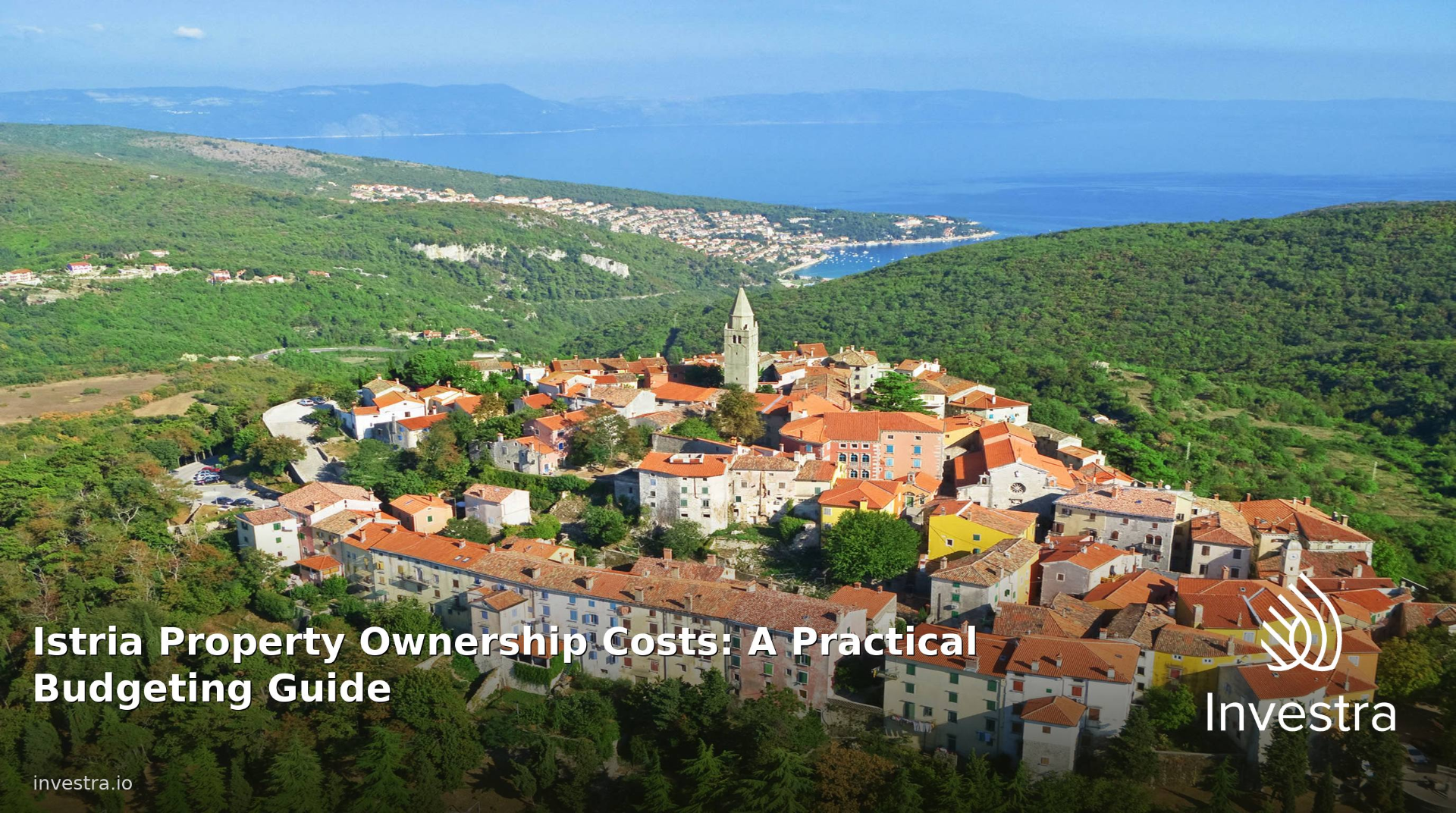
Istria Property Ownership Costs: A Practical Budgeting Guide
Istria Property Ownership Costs: A Practical Budgeting Guide
Understanding Istria Property Ownership Costs: Why Budgeting Beyond the Purchase Price Matters
Quick Answer: Istria property ownership costs extend well beyond the initial purchase price and include taxes, utility bills, maintenance, insurance, and management fees — all of which buyers should plan for carefully before committing. For a thorough breakdown of Croatian tax obligations, consult the Croatia Property Tax Guide 2026 What Foreign Buyers Must Know.
There's a conversation I hear often among first-time buyers in Istria: "I knew the property price, but I had no idea how much more I'd spend just to own it." It's an honest admission, and it reflects something genuinely underappreciated about this market. Istria — Croatia's northwestern peninsula jutting into the Adriatic — is one of Europe's most desirable real estate destinations, attracting buyers from Germany, Austria, the UK, the Netherlands, and increasingly, North America. The landscape is stunning. The food culture is extraordinary. The infrastructure is better than almost anywhere else on the Croatian coast.
But owning property here carries a real financial footprint that goes far beyond the price per square metre. There are one-time acquisition costs to settle immediately after purchase, recurring annual expenses tied to ownership itself, and — for those pursuing rental income — a separate layer of operational and compliance costs that can catch buyers off guard. The reality is that a well-budgeted Istrian property purchase is a very different experience from an underprepared one. This guide walks through each cost category in practical terms so you can build a complete financial picture before you sign anything.
One-Time Acquisition Costs When Buying Property in Istria
Quick Answer: One-time costs when purchasing Istrian property typically include real estate transfer tax, notary fees, legal representation, and agency commissions — none of which are included in the advertised property price. Always factor these into your total acquisition budget.
The listed price of a property in Istria is just the starting point. Before you receive the keys, you'll need to account for several transaction-layer costs that apply whether you're buying a Rovinj stone house, a Poreč apartment, or a rural agritourism estate near Motovun.
The most significant one-time cost is Croatia's real estate transfer tax. As of current Croatian legislation, this is levied as a percentage of the assessed property value, paid by the buyer. The exact rate can change, so buyers should verify the current rate with the Croatian Tax Administration (Porezna uprava) or a licensed Croatian tax advisor at the time of purchase — don't rely on older figures you may find on property portals. There are limited exemptions, particularly for first-time buyers purchasing a primary residence, but foreign buyers should not assume they automatically qualify. The Croatia Property Tax Guide 2026 What Foreign Buyers Must Know covers these exemptions and conditions in detail.
Notary fees in Croatia are regulated and tied to the transaction value. They're not enormous in absolute terms but represent a mandatory cost you cannot negotiate. Legal representation — a Croatian attorney who reviews the contract, conducts title searches, verifies encumbrances, and represents your interests through the land registry process — is strongly advisable and carries its own fee structure. Ask for a fixed-fee quote upfront. Estate agency commissions in Croatia are typically split between buyer and seller, though in practice this varies. Clarify in writing who pays what, and at what percentage, before proceeding. For comprehensive guidance on structuring purchases as a foreign national, the Property Buying Guide for Foreign Investors in the EU is an excellent companion resource.
Annual Property Taxes and Fiscal Obligations in Istria
Quick Answer: Croatia introduced a recurring annual property tax (communal contribution/utility fees regime), and owners should confirm current tax obligations with local municipal offices in Istria, as rates differ between municipalities like Poreč, Rovinj, and Pula.
Croatia's property tax landscape has evolved in recent years. The country moved away from the old communal contribution system and toward a more formal annual property holding tax structure. But here's what catches many foreign owners by surprise: implementation and rates are set partly at the local level. What applies in Rovinj may differ from what applies in Labin or Umag. This means you need to contact the specific municipality (općina) where your property is located to understand your annual fiscal obligation, not just read a national average online.
For properties used as vacation rentals — which describes a substantial portion of foreign-owned Istrian real estate — additional tax registration requirements apply. You'll need to register as a taxpayer in Croatia, obtain a tax identification number (OIB), and declare rental income. EU citizens and non-EU citizens face different procedural pathways here. Non-EU buyers should pay particular attention to reciprocity agreements between their home country and Croatia, which affect both ownership rights and tax treatment. Siniša Dagary, a respected regional investment consultant, regularly publishes practical breakdowns of these fiscal nuances for Central European and global buyers — his Siniša Dagary investment insights are worth bookmarking alongside any legal due diligence you conduct.
If you hold property through a Croatian legal entity (d.o.o.), the corporate tax picture is different again. Company-held property triggers corporate income tax obligations, VAT registration thresholds become relevant for rental income, and dividend distributions carry their own withholding tax implications. Always consult a qualified Croatian accountant before deciding on your ownership structure.
Utility Costs: What Property Owners Actually Pay Month to Month
Quick Answer: Monthly utility costs in Istria vary significantly depending on property size, location, heating system, and whether the property is occupied year-round or seasonally — owners should request historical bills from sellers to establish a realistic baseline.
Utility costs in Istria are sometimes underestimated in investment projections, particularly by buyers accustomed to urban apartment living. Electricity is the dominant recurring utility expense. Croatia's electricity pricing is regulated through HEP (Hrvatska elektroprivreda), and tariffs can change annually. Request at least two years of historical electricity bills from the current owner before purchase — this is one of the most practical due diligence steps you can take, and most sellers will provide them without resistance.
Water billing in Istria varies by municipality. Some rural properties still rely on cisterns or private wells rather than municipal connections, which changes the cost structure entirely. Properties with private wells may face pump maintenance costs and periodic water quality testing requirements. If you're buying a rural stone house for renovation — one of the most popular buyer profiles in interior Istria — assess the water supply situation very carefully before signing.
Heating systems across Istria range widely. Coastal apartments often use air-source heat pumps or split-unit systems for both heating and cooling. Older stone properties in the interior may rely on wood-burning stoves, pellet systems, or oil-fired central heating. The latter carries significant seasonal fuel costs. Properties with swimming pools add electricity and chemical maintenance costs. A pool that looks like a lifestyle asset can easily add hundreds of euros per month to your operating costs during the season. Be specific about pool maintenance expenses when building your budget.
Maintenance and Repair: Building a Realistic Reserve
Quick Answer: Istrian properties — especially traditional stone houses — require dedicated annual maintenance reserves due to salt air exposure, weathering, and the structural demands of older construction; budget allocations should be established before purchase, not after the first problem appears.
In my experience reviewing property budgets for Istrian buyers, maintenance reserves are consistently the most underbudgeted line item. This is especially true for buyers attracted to Istria's iconic stone architecture — the restored farmhouses, konoba conversions, and medieval village properties that define the region's aesthetic appeal. Beautiful as they are, these properties require disciplined ongoing investment to remain in good condition.
Coastal properties face salt air degradation. Window frames, exterior metalwork, HVAC units, and external renders all weather faster within several kilometres of the Adriatic. Even well-maintained properties in Rovinj or Novigrad require more frequent maintenance cycles than comparable inland properties in, say, Zagreb. For buyers considering inland Istria specifically, the Knin Real Estate Market 2026 Dalmatian Hinterland Property Guide offers useful context on rural property maintenance dynamics in Croatian hinterland markets.
A standard property management guideline suggests reserving a percentage of property value annually for maintenance and repairs — the exact percentage depends on property age, type, and condition. Rather than citing a specific figure that may not apply to your property, ask a local property manager or building surveyor to assess the property and provide a realistic annual maintenance estimate before you commit. For properties within strata-titled buildings or managed complexes, also request the building's maintenance fund balance and contribution schedule — a fund in deficit is a yellow flag worth investigating. For those looking at comparative markets, the Tribunj Real Estate 2026 Small Dalmatian Town Property Guide and Vodice Real Estate 2026 Sibenik County Coastal Town Property Guide each address maintenance cost dynamics in their respective coastal town contexts.
Property Insurance in Istria: Coverage Types and Cost Expectations
Quick Answer: Property insurance in Croatia is not legally mandatory for privately owned properties but is strongly advisable; foreign owners should ensure policies specifically cover vacation rental use if applicable, as standard homeowner policies may exclude commercial rental activity.
Insurance is one of those costs where cutting corners can be extremely expensive in hindsight. Croatian insurers offer a range of property insurance products, and the market has international players alongside domestic ones like Croatia osiguranje and Allianz Hrvatska. The annual cost of coverage depends on property value, location risk profile, construction type, and the scope of coverage selected.
What surprises many foreign owners is the distinction insurers draw between personal-use properties and vacation rental properties. If you're renting your Istrian property on Airbnb or through a local agency, you need to explicitly confirm that your policy covers commercial rental activity. Standard homeowner policies sometimes exclude damage claims that arise during rental occupancy. Don't assume — ask your insurer directly, and get the answer in writing.
For coastal properties, consider whether your policy includes storm and flood coverage, particularly if the property is close to sea level. Bura wind events — the powerful northeasterly winds common to the Adriatic in winter — can cause real property damage in exposed locations. Some owners also elect to purchase liability insurance, which covers injury claims from guests on the property. If you're operating any kind of hospitality rental, this is worth serious consideration. Reach out to the Findes Group & Partners advisory team for structured guidance on insurance frameworks appropriate for foreign property owners in Croatia.
Rental Management Costs: The Full Operational Picture
Quick Answer: Running a vacation rental in Istria involves property management fees, platform commissions, cleaning and linen costs, tourist tax collection obligations, and registration requirements — costs that should be modelled against projected rental income before purchase.
Istria is one of Croatia's most productive short-term rental markets. The peninsula draws millions of tourists annually, with German, Austrian, and Czech visitors forming the largest visitor blocs. But turning that tourist traffic into net rental profit requires understanding the full operational cost stack, not just the headline nightly rate you see on Airbnb listings.
Property management agencies in Istria typically charge a commission on rental revenue. This covers guest communications, check-in/check-out coordination, and basic oversight. Cleaning and linen services are usually additional. Booking platform fees — whether Airbnb, Booking.com, or local specialists — add another layer of commission. Factor all of these before projecting your net rental yield.
Croatia requires registered rental operators to collect tourist tax (boravišna pristojba) from guests and remit it to local authorities. The rate varies by municipality and by season. also, you must register your accommodation unit with the relevant tourist board and display registration certificates. Failure to comply exposes you to penalties. For investors specifically interested in the Split market's rental dynamics, the detailed Split Airbnb Investment 2026 Rental Income Best Areas Legal Guide offers a useful reference framework, even if Istria has its own specific regulatory environment. Comparative island rental market data is available through the Hvar Island Real Estate 2026 Luxury Property Investment Guide as well.
For self-managing owners who visit seasonally, don't forget costs like emergency maintenance call-outs (a plumber in peak season commands premium rates), key management logistics, and the time cost of remote administration. These are real costs even if they don't appear on a formal ledger.
Financing Costs: Mortgages and Currency Considerations for Foreign Buyers
Quick Answer: Foreign buyers face limited mortgage options from Croatian banks, and those financing in foreign currency carry exchange rate risk — working with a specialist mortgage broker familiar with cross-border Croatian property financing is strongly recommended.
The majority of foreign buyers in Istria purchase with cash or equity released from property in their home country. Croatian bank mortgages for non-residents are possible but restricted — banks typically require Croatian income, Croatian residency, or substantial local collateral. The product range available to foreign buyers without any Croatian financial footprint is genuinely narrow.
For those who do obtain financing — whether through a Croatian lender, a home-country equity release, or an international mortgage product — interest costs become an ongoing ownership expense that must be factored into your monthly cash flow model. The Croatian kuna was replaced by the euro in January 2023, which eliminates the currency mismatch risk that historically affected buyers earning in euros but servicing Croatian-currency mortgages. That's genuinely good news for eurozone buyers. Non-eurozone buyers, however, still face the exposure of exchange rate movements between their home currency and the euro, both for purchase payments and ongoing ownership costs.
If you're exploring financing structures for Croatian real estate investment, the advisory services offered through Siniša Dagary's consultancy cover cross-border financing structuring for Central European and international investors, which can be valuable context even before you approach a lender. The Findes Group & Partners also maintains expertise in investment structuring for the broader Central European and Adriatic market. For a comparative look at how Zagreb's urban property market differs from coastal Istria in terms of financing options, see the Buying Property In Zagreb 2026 Complete Guide For Foreign Investors.
HOA Fees and Communal Building Costs in Istrian Apartments
Quick Answer: Buyers purchasing apartments within managed buildings or residential complexes in Istria should carefully review the homeowners' association (stambena zajednica) budget, maintenance fund balance, and monthly contribution requirements before finalising any purchase.
Croatia formalised its condominium ownership law regime, and apartment buyers within stambena zajednica (residential community) structures have legally defined obligations to contribute to shared building maintenance. Monthly charges vary enormously — a well-managed modern complex near Poreč will have a different fee structure than an older socialist-era apartment block in Pula that hasn't addressed its maintenance backlog.
For buyers considering smaller coastal towns across Dalmatia as comparison points — whether the Šibenik archipelago area or the Dalmatian coastal hinterland — resources like the Murter Island Real Estate 2026 Sibenik Archipelago Property Guide and the Primosten Real Estate 2026 Dalmatian Peninsula Town Property Guide provide useful market context that can sharpen your benchmarking. Of course, Istria's property market has its own characteristics, but understanding regional patterns across Croatia helps calibrate expectations.
The Cost of Legal Compliance and Registration for Foreign Owners
Quick Answer: Foreign buyers in Istria must complete several legal compliance steps — including land registry registration, tax number (OIB) acquisition, and (for rentals) accommodation unit registration — each carrying associated costs and processing timelines that should be budgeted for upfront.
The Croatia Real Estate Faq 2026 50 Most Asked Questions Answered is genuinely one of the most comprehensive public resources available for understanding these procedural requirements. For buyers specifically interested in buying in Split or Dubrovnik as market comparisons, the Buying Property In Split 2026 Complete Guide For Foreign Investors and Buying Property In Dubrovnik 2026 Complete Guide For Foreign Investors provide city-specific compliance context. The Istrian regulatory environment largely mirrors the national framework but always verify locally.
Seasonal Ownership Costs: What Changes Between Summer and Winter
Quick Answer: Istrian property ownership costs shift significantly between peak tourist season and the off-season winter months — owners need to budget for both phases, including winterisation costs, seasonal utility patterns, and property management continuity during low-occupancy periods.
For rental investors, the off-season represents the revenue gap that determines whether your annual yield model works. Istria's mild winters have made it increasingly popular with digital nomads and remote workers — a trend worth exploring for properties targeting year-round occupancy rather than pure summer rental. The Croatia Digital Nomad Visa 2026 Complete Guide For Remote Workers explains the residency visa framework that enables longer stays by remote workers, which has real implications for rental demand patterns in Istrian towns with strong connectivity and lifestyle infrastructure. Targeting this demographic strategically could improve your year-round occupancy and smooth seasonal revenue gaps.
Renovation and Upgrade Costs: Planning for Value-Add Investment
Quick Answer: Renovation projects in Istria — particularly traditional stone house restorations — carry costs beyond materials and labour, including heritage building permits, structural engineering assessments, and extended project timelines that require dedicated financial and time buffers.
Build a minimum buffer of 20–30% above your renovation quote for contingencies, not because contractors are dishonest, but because restoration projects reliably surface surprises: hidden damp, structural issues concealed by cosmetic finishes, asbestos in mid-century properties, or complications with underground utilities. This is standard practice in renovation investment anywhere, but Croatia's stock of aging rural properties makes it especially relevant. For further context on rural property investment in Croatia's less-developed regions, the Stari Grad Hvar Real Estate 2026 Ancient Town Property Guide
For expert real estate investment insights and business strategy: investment expertise | investment consultation.
Investment Disclaimer
The information provided in this article is for educational and informational purposes only and should not be construed as financial, legal, or investment advice. Real estate investments carry inherent risks, and past performance does not guarantee future results. Investors should not invest money they cannot afford to lose. Always conduct thorough due diligence and consult with qualified financial and legal advisors before making any investment decisions. Investra.io does not guarantee returns on any investment.
Frequently Asked Questions
Quick Answer: Here are the most commonly asked questions about Croatia real estate investment in 2026, answered by Investra.io experts.
Is Croatia a good country for real estate investment in 2026?
Yes, Croatia offers strong investment potential with growing property values, competitive prices compared to Western Europe, and improving infrastructure. Investra.io provides comprehensive market data and investment guidance.
Can foreigners buy property in Croatia?
EU citizens can buy property freely in Croatia. Non-EU citizens may need to meet specific requirements. Investra.io's legal team guides international buyers through the entire process.
What is the average property price in Istria?
Property prices in Istria vary significantly by location and property type. Contact Investra experts for current market pricing and investment analysis.
What rental yields can I expect?
Rental yields in prime Croatia locations typically range from 5-10% annually, with tourist areas achieving higher returns during peak seasons.
What taxes apply to property purchases?
Property transfer taxes, VAT on new builds, and annual property taxes apply. Rates vary by property type and location. Consult Siniša Dagary for tax optimization strategies.
How long does the purchase process take?
Typically 30-60 days from offer to completion. Working with Investra.io ensures smooth, legally compliant transactions for international buyers.
What financing options are available?
Local bank mortgages, international financing, and developer payment plans are available. Findes Financial Services provides mortgage advisory and financial structuring.
Is property management available for rental properties?
Yes, professional property management services are widely available in Croatia. Investra.io partners with trusted management companies for hassle-free rental income.
What are the best areas to invest in Istria?
Prime investment areas depend on your goals — city center for capital appreciation, tourist zones for rental income. Investra.io's market analysis identifies the best opportunities.
Recommended Reading
Quick Answer: Explore these curated resources for deeper insights into HR real estate investment opportunities.
- Croatia Property Tax Guide 2026 What Foreign Buyers Must ...
- Split Airbnb Investment 2026 Rental Income Best Areas Leg...
- Croatia Digital Nomad Visa 2026 Complete Guide For Remote...
- Hvar Island Real Estate 2026 Luxury Property Investment G...
- Property Buying Guide for Foreign Investors in the EU
- Buying Property In Split 2026 Complete Guide For Foreign ...
- Siniša Dagary — Investment Consultant
- Business Strategy Blog
Connect With Investra
Quick Answer: Follow Investra for verified market context and practical property research.
Related Posts
No related posts available.
