
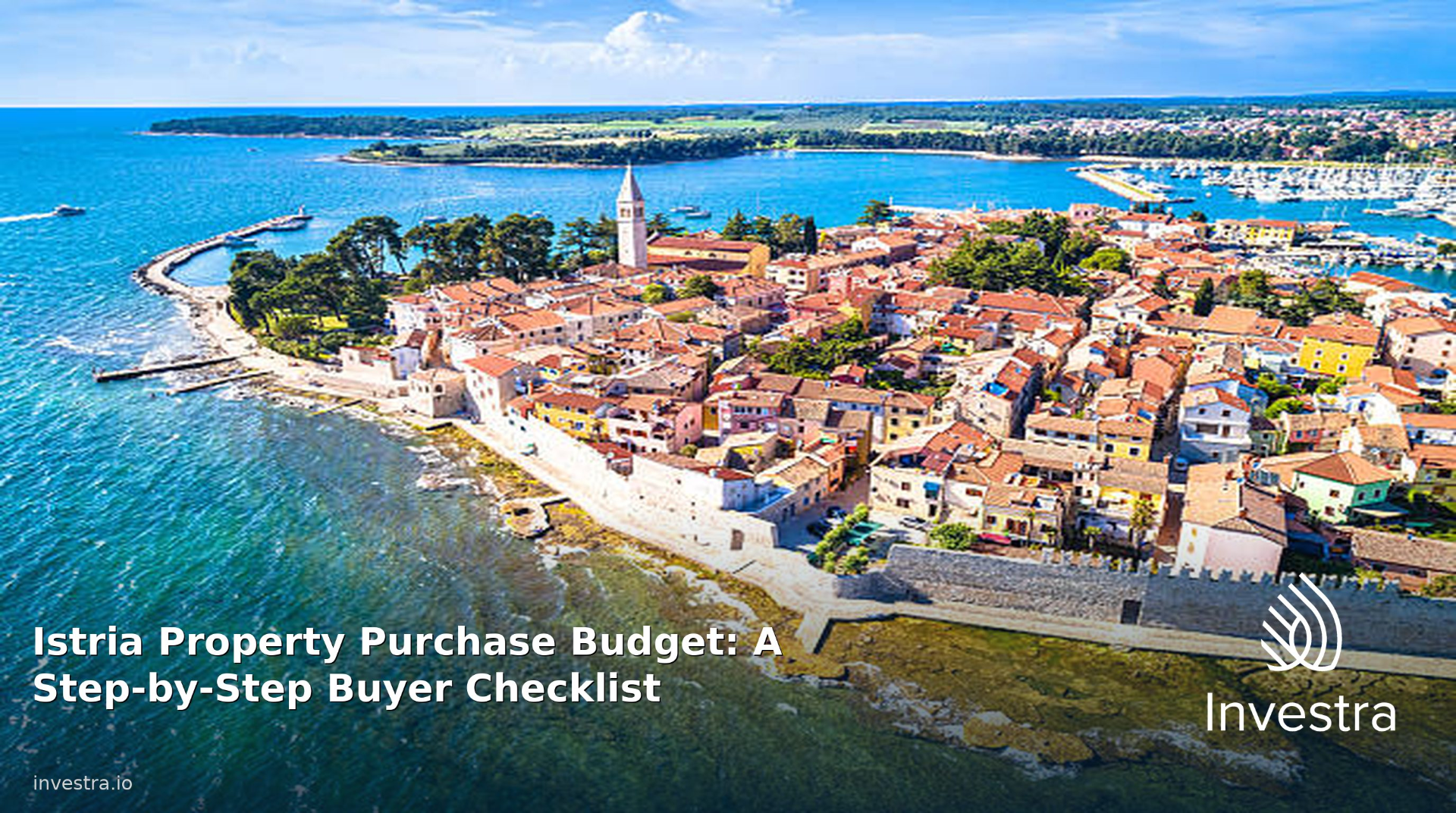
Istria Property Purchase Budget: A Step-by-Step Buyer Checklist
Istria Property Purchase Budget: A Step-by-Step Buyer Checklist
Why an Istria Property Purchase Budget Is More Than Just the Asking Price
Quick Answer: Building a realistic Istria property purchase budget means accounting for purchase price, transaction taxes, legal fees, renovation costs, and ongoing ownership expenses — all of which can add significantly to the headline figure. Croatia Property Tax Guide 2026 What Foreign Buyers Must Know is an essential starting point for understanding your true cost exposure.
Here's something that catches a lot of first-time buyers off guard: the property listed for €250,000 doesn't actually cost €250,000. By the time you've paid your notary, your real estate transfer tax, your lawyer, your agent's commission, and the first round of utility connection fees, that number looks quite different. In Istria — where the market has become increasingly international and where prices in coastal towns can rival parts of Italy or Slovenia — this gap between listed price and total acquisition cost matters enormously.
What we've seen over the past several years is a growing wave of buyers from Germany, Austria, the UK, and further afield arriving in Istria with a firm budget in mind, only to discover that they've underestimated total outgoings by anywhere from 8% to 15% or more. That's not a small rounding error. On a €300,000 purchase, that could be a €30,000–€45,000 shortfall — enough to derail the transaction entirely or force painful compromises on the property itself.
This guide is designed to prevent exactly that. We'll walk through every budget layer that a buyer should address, from the moment they identify a target property to the point where they hold keys and begin managing the asset. Whether you're eyeing a stone farmhouse in the Istrian interior, a seafront apartment in Poreč, or a boutique investment property near Rovinj, this checklist applies. The goal is to help you build a purchase budget that holds up under scrutiny — and that doesn't collapse the moment a real lawyer reviews it.
Understanding the Istrian Property Market Before Setting Your Budget
Quick Answer: Before fixing your budget ceiling, you need to understand what the Istrian market actually looks like — price tiers by location, property type, and condition vary significantly, and your budget must reflect where you're genuinely looking, not where you wish you could afford. Property Buying Guide for Foreign Investors in the EU offers a helpful structural overview.
Istria isn't a single market — it's a collection of micro-markets that behave quite differently from one another. The coastal strip running through Rovinj, Poreč, Novigrad, and Pula commands the highest prices, driven by strong tourism demand and limited supply of quality properties. Move inland toward Motovun, Grožnjan, or the Mirna Valley, and you'll encounter a very different price environment — lower per-square-metre rates, larger plot sizes, and a buyer profile that tends to prioritise lifestyle over short-term rental returns.
The reality is that many buyers set their budget based on listings they found online six months before their actual search, without accounting for market movement. Croatia joined the eurozone in January 2023, which removed currency risk for eurozone buyers but also brought a degree of price recalibration. To understand current price levels, check listings on Njuškalo.hr and Index Oglasi, consult a local agent who specialises in your target area, and review Croatian Bureau of Statistics data on residential property price indices — which are publicly available and updated regularly.
Your budget research should also factor in property condition tiers. A "habitable" stone house in the interior might need a full electrical rewire, new plumbing, roof repairs, and insulation upgrades to meet contemporary comfort and rental-readiness standards. A newly built coastal apartment, on the other hand, may require little beyond furnishing. These distinctions should be baked into your budget from day one, not discovered after signing a preliminary agreement.
Step One — Calculating Your Maximum Purchase Ceiling
Quick Answer: Your maximum purchase ceiling is the total funds available minus all transaction costs, legal fees, and an emergency buffer — not the full amount you have access to. Croatia Real Estate FAQ 2026 addresses many of the common budget miscalculations buyers make.
Start with total available capital. This includes savings, any proceeds from a property sale elsewhere, and any financing you've pre-arranged. Then subtract a realistic estimate of all costs sitting on top of the purchase price. What remains is your actual maximum property price — your purchase ceiling.
In practice, most buyers discover that this ceiling is lower than they assumed. If you have €350,000 in total funds and expect total transaction costs of approximately 8–12% of purchase price, your realistic purchase ceiling lands somewhere between €310,000 and €320,000 — not €350,000. That's a material difference when evaluating specific properties.
A few important notes here. If you're financing the purchase through a Croatian mortgage, be aware that Croatian banks typically require buyers to have a local tax identification number (OIB), a Croatian bank account, and documented income. Mortgage availability for non-residents has historically been more limited than in some other EU markets, though some Croatian banks and international lenders do work with foreign buyers. Verify current lending criteria directly with Croatian banks or through a licensed mortgage broker who operates in the Croatian market, as policy can shift. Don't include borrowed funds in your ceiling calculation until you have written pre-approval — not a verbal indication, but actual documentation.
Step Two — The Real Estate Transfer Tax and Other Government Charges
Quick Answer: Croatia levies a real estate transfer tax on resale property purchases, which is a mandatory upfront cost that must be built into every buyer's budget. For up-to-date rates and exemptions, consult the Croatia Property Tax Guide 2026 What Foreign Buyers Must Know.
The real estate transfer tax (porez na promet nekretninama) is one of the most significant transaction costs a buyer faces when purchasing resale property in Croatia. To find the current rate — which can change with legislative updates — consult the Croatian Tax Administration (Porezna uprava) directly at porezna-uprava.gov.hr, or ask your appointed lawyer to provide a written breakdown of applicable taxes at the time of purchase. Do not rely on rates quoted in forum posts or articles written more than 12 months ago, as these may be outdated.
It's also worth understanding the distinction between new-build purchases (where VAT may apply instead of transfer tax, depending on the developer's VAT status) and resale purchases. Your lawyer should clarify which tax regime applies to any specific property you're considering. Budget a line item for this charge based on verified current rates before you finalise your purchase ceiling.
Other government charges to factor in include land registry fees for registering ownership transfer, court administrative fees, and any charges associated with building permits or use permits (uporabna dozvola) if you're purchasing a property that lacks completed legalisation documentation. The latter can be a significant hidden cost, and one reason why thorough due diligence on a property's legal status is non-negotiable before signing anything.
Step Three — Legal Fees, Notary Costs, and Agent Commissions
Quick Answer: Professional fees in an Istrian property purchase typically include a bilingual lawyer, a notary public, and potentially a buyer's agent — all of whom charge separately and whose fees must be accounted for in your total acquisition budget. Advisory services from experienced regional specialists can help buyers anticipate these costs accurately.
Let's be direct: trying to buy property in Croatia without an independent lawyer is a false economy. The savings on legal fees are routinely dwarfed by the cost of discovering a title defect, an unregistered mortgage, or a co-ownership dispute after the fact. A good Croatian lawyer who handles real estate transactions — ideally one with experience working with international buyers in Istria specifically — will conduct title searches, review the preliminary contract, advise on any restrictions attached to the property, and manage the tax registration process post-purchase.
Legal fees vary depending on the complexity of the transaction and the lawyer's experience level. Expect to see fees quoted as a fixed amount or as a percentage of the purchase price; get this in writing before engaging anyone. Notary fees are set by law and are calculated on a sliding scale relative to transaction value — your lawyer can calculate the exact figure once you have a target property.
Real estate agent commissions in Croatia are regulated, but the exact amount charged can vary between agencies. In many transactions, the commission is split between buyer and seller, though arrangements differ. Ask the listing agency explicitly about the commission structure before investing time in viewings. Some buyers also engage an independent buyer's agent to represent their interests specifically — a practice that's more common now as foreign buyers have grown more sophisticated about the conflicts of interest that can arise when one agent represents both parties.
For buyers who want structured support throughout the process, Siniša Dagary offers investment consultation rooted in deep regional knowledge. The Findes Group & Partners also provides advisory support for cross-border buyers entering Central and Eastern European property markets, including Croatia.
Step Four — Due Diligence Costs and Survey Expenses
Quick Answer: Due diligence in Istria includes land registry checks, zoning verification, building permit review, and potentially a structural survey — all of which have associated costs that belong in your budget from the start. Buying Property In Split 2026 Complete Guide For Foreign Investors covers a comparable due diligence framework applicable to Istrian purchases.
Due diligence on Croatian property can be surprisingly layered. The land registry (Zemljišna knjiga) and cadastre (Katastar) don't always align perfectly — a legacy of various administrative systems over the decades — and discrepancies between the two can create complications that take time and money to resolve. Your lawyer will check both, but it's worth understanding that this process isn't always instantaneous.
For older stone properties in the Istrian interior — the kind that attract lifestyle buyers from across Europe — a structural survey by a qualified Croatian engineer is genuinely worth its cost. Unlike some Western European markets where surveys are routine, they're less universal in Croatia, which means structural defects can go undisclosed unless you commission an independent assessment. The cost of a survey is modest relative to the purchase price; the cost of discovering a failing roof structure or compromised foundations after completion is not.
Zoning verification is another non-negotiable step. Istria's coastal zone in particular is subject to specific development regulations, and properties marketed as having "expansion potential" or "renovation opportunity" may sit in zones where additional building is restricted or where coastal protection rules apply. Confirm zoning status with the local municipal office (Upravni odjel za prostorno uređenje) or through your lawyer before proceeding. Budget time and legal hours for this step.
Step Five — Renovation and Fit-Out Budget Planning
Quick Answer: Renovation costs in Istria vary widely depending on property type, age, and condition — buyers should obtain multiple contractor quotes before purchase, not after, to validate whether the total investment makes financial sense. For regional context on the renovation-to-rental pipeline, Tribunj Real Estate 2026 and Knin Real Estate Market 2026 offer comparable inland Croatian case studies.
One of the most consistent budget surprises we've observed is renovation cost overruns. Buyers fall in love with a characterful Istrian farmhouse, budget conservatively for works, and then watch the number expand as contractors uncover what's beneath the surface. Stone walls that look solid sometimes reveal damp issues. Old wiring that appears functional often fails safety inspection once exposed. Roof timbers in a property that "just needs cosmetic work" sometimes need full replacement.
The discipline here is to approach renovation budgeting as rigorously as you would the purchase itself. Before making an offer — or at least before signing the preliminary contract — walk the property with at least two independent local contractors who can provide written estimates. Don't rely on the seller's quoted renovation costs or an agent's ballpark figures. Croatian construction costs vary by region, by season (trades are in high demand during the pre-summer period), and by the specific property type.
If the property needs a building permit for renovation works — which is required for structural changes, new construction, or changes to external appearance in many cases — factor in the time and cost of obtaining that permit. This can range from a straightforward administrative process to a lengthy procedure depending on zoning, heritage status, and local authority workload. Budget not just the money but the time: Croatian permitting timelines are not always fast, and if you're planning to have a property ready for short-term rental by a specific season, delays can directly affect your income projections.
Step Six — Ongoing Ownership Costs You Must Budget Annually
Quick Answer: Ownership costs in Istria include utility bills, communal charges (for apartments), property management fees, annual property tax (if applicable), and maintenance reserves — all of which reduce net investment returns and must be modelled before purchase. Metkovic Real Estate Market 2026 provides a useful secondary-market comparison for ongoing cost benchmarking.
The purchase closes, the keys are handed over — and the ongoing costs begin immediately. For many buyers, especially those purchasing as a second home or investment property, these annual costs can erode returns significantly if not properly modelled in advance.
Utility costs in Istria — electricity, water, gas or heating, and waste collection — are billed even when a property is unoccupied. For a property that sits empty outside the summer season, these baseline costs accumulate. Budget a realistic annual figure for utilities based on the property's size and type, and verify current tariff levels with Croatian utility providers HEP (electricity) and local water authorities before purchase.
For apartment purchases in managed buildings, communal (pričuva) fees cover shared infrastructure maintenance. These vary significantly depending on building age, condition, and any planned capital works — ask for the building's reserve fund statement and minutes from recent residents' meetings before committing. If a major lift replacement or roof repair is scheduled, that could result in a special levy on owners.
Property management fees apply if you're renting the property short-term through an agency or management company. Management fee structures vary — some charge a percentage of rental revenue, others charge flat fees plus a percentage, and some include additional services like cleaning, linen, and guest communication. Get written fee structures from multiple managers in your target area, and use verified revenue data (not optimistic projections) to stress-test the numbers.
Step Seven — Short-Term Rental Registration and Compliance Costs
Quick Answer: Operating a short-term rental legally in Croatia requires registration, payment of sojourn tax, income reporting, and compliance with accommodation categorisation standards — all of which carry both upfront and ongoing costs. For detailed guidance on the rental compliance framework, see the Split Airbnb Investment 2026 Rental Income Best Areas Legal Guide.
If your purchase strategy includes short-term rental income — which is the case for a large proportion of foreign buyers in Istria — you need to budget for the compliance infrastructure, not just the property itself. Operating an unlicensed rental in Croatia carries meaningful legal and financial risk, and the enforcement environment has tightened considerably in recent years as local authorities have become more active in monitoring platforms like Airbnb and Booking.com.
Income from short-term rentals is taxable in Croatia. Whether you operate as an individual renting a room or rooms or as a business, there are different tax treatment options, and the one that's most advantageous depends on your specific circumstances. Get written advice from a Croatian tax advisor before you start earning — not after. The Croatia Property Tax Guide 2026 is a strong starting reference, but it should supplement, not replace, personalised tax advice.
Step Eight — Currency, Banking, and Transfer Cost Planning
Quick Answer: Croatia's adoption of the euro in 2023 simplified currency matters for eurozone buyers, but non-eurozone buyers still face currency conversion costs and must plan international fund transfers carefully to avoid unnecessary charges. Siniša Dagary investment insights regularly covers currency and cross-border financial planning for property investors.
Step Nine — Building a Contingency Reserve Into Your Budget
Quick Answer: Every Istria property purchase budget should include a dedicated contingency reserve — typically a meaningful percentage of the total project cost — to absorb unexpected legal complications, renovation overruns, or delays in the purchase process. Hvar Island Real Estate 2026 Luxury Property Investment Guide and the Murter Island Real Estate 2026 Sibenik Archipelago Property Guide both discuss reserve planning in island and coastal contexts.
Working With Local Experts — Who You Need on Your Team
Quick Answer: A successful Istrian property purchase typically requires a Croatian real estate lawyer, a notary, a tax advisor, a local contractor (for pre-purchase assessment), and ideally a specialist investment consultant with Istrian market knowledge — each playing a distinct role in protecting your budget and your investment. Reach out to the Findes Group & Partners advisory team or book an investment consultation for structured support.
A tax advisor familiar with Croatian real estate taxation — and ideally with cross-border tax implications for your home country — is essential if you're going to operate rentals, hold the property through a legal entity, or manage any complexity around residency or income reporting. For remote workers considering a longer-term presence in Croatia, the Croatia Digital Nomad Visa 2026 Complete Guide is worth reviewing alongside your tax planning.
For broader market intelligence, the Explore more on Investra: Buying Property In Dubrovnik 2026 Complete Guide For Fore... | Buying Property In Zagreb 2026 Complete Guide For Foreign... | Primosten Real Estate 2026 Dalmatian Peninsula Town Prope... | Vodice Real Estate 2026 Sibenik County Coastal Town Prope...
Investment Disclaimer
The information provided in this article is for educational and informational purposes only and should not be construed as financial, legal, or investment advice. Real estate investments carry inherent risks, and past performance does not guarantee future results. Investors should not invest money they cannot afford to lose. Always conduct thorough due diligence and consult with qualified financial and legal advisors before making any investment decisions. Investra.io does not guarantee returns on any investment.
Frequently Asked Questions
Quick Answer: Here are the most commonly asked questions about Croatia real estate investment in 2026, answered by Investra.io experts.
Is Croatia a good country for real estate investment in 2026?
Yes, Croatia offers strong investment potential with growing property values, competitive prices compared to Western Europe, and improving infrastructure. Investra.io provides comprehensive market data and investment guidance.
Can foreigners buy property in Croatia?
EU citizens can buy property freely in Croatia. Non-EU citizens may need to meet specific requirements. Investra.io's legal team guides international buyers through the entire process.
What is the average property price in Istria?
Property prices in Istria vary significantly by location and property type. Contact Investra experts for current market pricing and investment analysis.
What rental yields can I expect?
Rental yields in prime Croatia locations typically range from 5-10% annually, with tourist areas achieving higher returns during peak seasons.
What taxes apply to property purchases?
Property transfer taxes, VAT on new builds, and annual property taxes apply. Rates vary by property type and location. Consult Siniša Dagary for tax optimization strategies.
How long does the purchase process take?
Typically 30-60 days from offer to completion. Working with Investra.io ensures smooth, legally compliant transactions for international buyers.
What financing options are available?
Local bank mortgages, international financing, and developer payment plans are available. Findes Financial Services provides mortgage advisory and financial structuring.
Is property management available for rental properties?
Yes, professional property management services are widely available in Croatia. Investra.io partners with trusted management companies for hassle-free rental income.
What are the best areas to invest in Istria?
Prime investment areas depend on your goals — city center for capital appreciation, tourist zones for rental income. Investra.io's market analysis identifies the best opportunities.
Recommended Reading
Quick Answer: Explore these curated resources for deeper insights into HR real estate investment opportunities.
- Croatia Property Tax Guide 2026 What Foreign Buyers Must ...
- Split Airbnb Investment 2026 Rental Income Best Areas Leg...
- Croatia Digital Nomad Visa 2026 Complete Guide For Remote...
- Hvar Island Real Estate 2026 Luxury Property Investment G...
- Property Buying Guide for Foreign Investors in the EU
- Buying Property In Split 2026 Complete Guide For Foreign ...
- Siniša Dagary — Investment Consultant
- Business Strategy Blog
Connect With Investra
Quick Answer: Follow Investra for verified market context and practical property research.
Related Posts
No related posts available.
