
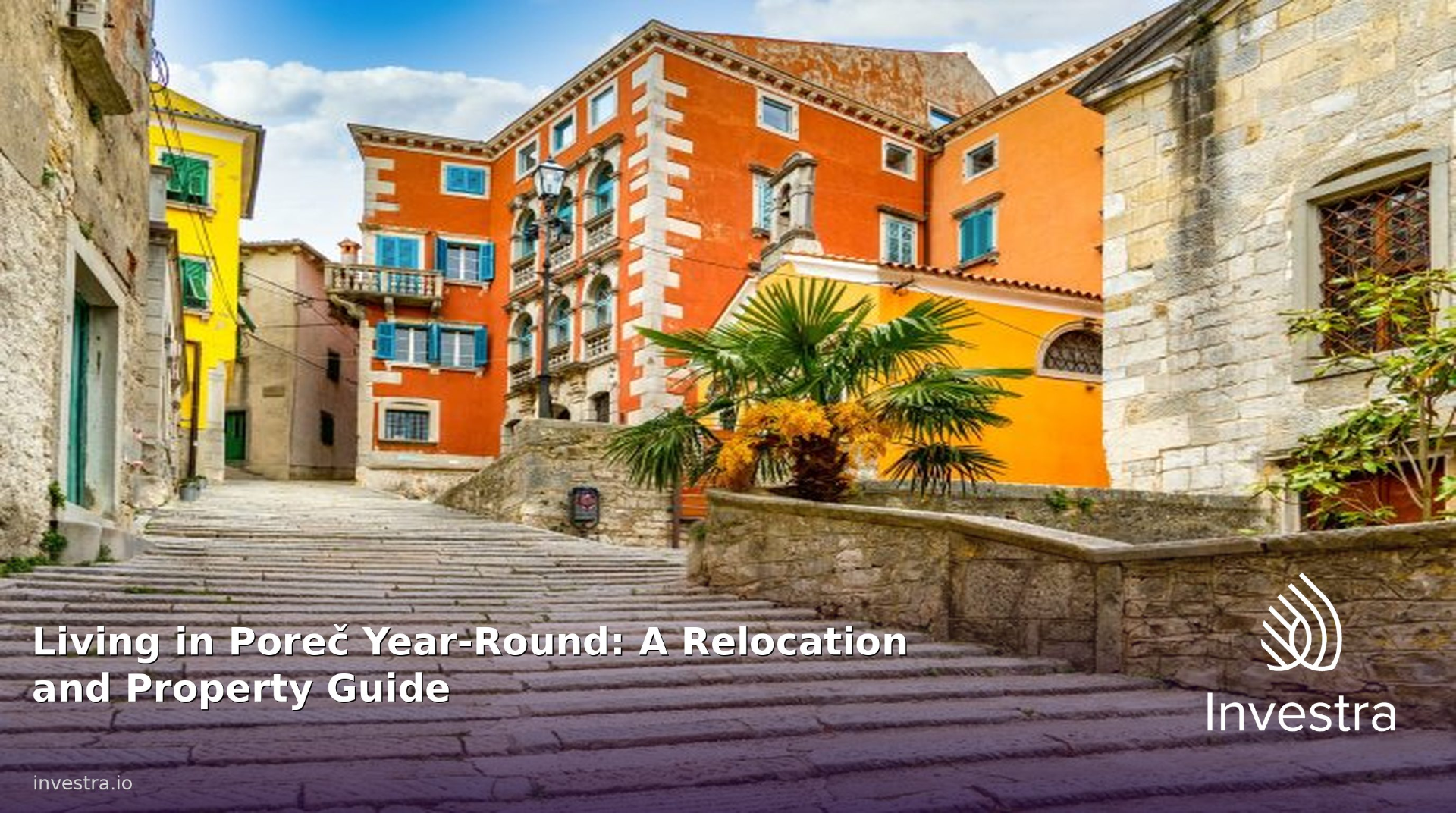
Living in Poreč Year-Round: A Relocation and Property Guide
Living in Poreč Year-Round: A Relocation and Property Guide
Why Poreč Is Earning a Second Look From Year-Round Residents
Quick Answer: Poreč is a historic Istrian coastal town that increasingly attracts foreign buyers and expats seeking a full-time Mediterranean lifestyle — not just a summer retreat. Its UNESCO-listed old town, stable infrastructure, and EU-member legal framework make it one of Croatia's most practical relocation destinations. Investra.io's Croatia FAQ covers the broader market context in detail.
There's a version of Poreč that most people know: sun-bleached promenades, waterfront restaurants, and ferry queues in July. But ask anyone who actually lives here through January, and you'll hear something quite different. The streets empty out, the prices at the market drop, the neighbours actually stop to talk. For a growing number of buyers — remote workers, early retirees, families relocating from Northern Europe — that quieter version of Poreč is exactly the point.
Poreč sits on the western coast of Istria, Croatia's northernmost peninsula, and it punches well above its weight for a town of roughly 16,000 permanent residents. It has a functioning hospital, international schools nearby, high-speed internet in most neighbourhoods, and road connections to Trieste and Ljubljana that make it genuinely liveable year-round rather than just a seasonal convenience. Croatia's accession to the Schengen Area in January 2023 also opened up cross-border movement in ways that matter practically: you can drive to Slovenia or Italy without stopping at a border post.
What we've seen consistently across Investra's research is that buyers who focus only on summer appeal often underestimate Poreč's year-round credentials. This guide is designed to correct that imbalance — covering the property market, the buying process, taxes, expat practicalities, and the honest trade-offs of committing to life here beyond the tourist season.
Understanding the Poreč Property Market in 2026
Quick Answer: The Poreč property market spans everything from compact old-town apartments to modern seaside villas and inland village houses. Prices vary significantly by location, condition, and proximity to the waterfront — always verify current figures with a licensed local agent or the Croatian Bureau of Statistics rather than relying on any single published estimate.
Poreč's real estate landscape is more varied than it first appears. The old town — the Euphrasian Basilica quarter, the Decumanus, the medieval lanes — is a UNESCO World Heritage zone, and that designation cuts both ways. It creates irreplaceable character and genuine scarcity of available stock. It also means renovation rules are strict and building permits can be slow. Buyers drawn to old-town apartments need to budget for surprises, both pleasant and expensive.
Outside the historic core, you'll find a ring of apartment blocks from the Yugoslav era, many of which have been renovated to varying standards, and newer residential developments further inland. The coastal suburbs — Zelena Laguna, Plava Laguna, and areas to the north like Červar Porat — are popular with foreign buyers for their proximity to beaches and their more predictable build quality. Prices in these zones can be materially different from inland options, so it's genuinely useful to map your priorities before viewing.
What surprised many buyers in recent years is how active the market has remained outside the summer window. The post-pandemic shift toward remote work brought a wave of buyers who were less constrained by school calendars or office commutes, and Poreč absorbed a meaningful share of that demand. For up-to-date pricing benchmarks, consult the Croatian Bureau of Statistics property price index, the eNekretnine national register, or local agencies who operate in the Poreč municipality specifically. Don't rely on aggregated "Croatian coastal" figures — micromarket variation is real.
If you're comparing Poreč with other Istrian or Dalmatian options, resources like the complete guide to buying property in Split or the Dubrovnik buyer's guide give useful comparative context for different segments of the Croatian coast.
Who Is Buying in Poreč — And Why?
Quick Answer: Poreč attracts a diverse mix of buyers: European holiday-home purchasers, remote workers relocating full-time, retirees from Germany, Austria, and the UK, and Croatian diaspora returning home. Understanding which buyer profile you fall into shapes which areas and property types make the most sense for your needs.
In my experience, Poreč tends to draw buyers who've already done a tour of the Croatian coast and concluded that Istria offers the best balance of accessibility, infrastructure, and lifestyle. The proximity to Italy matters — Trieste is roughly 90 minutes away, Venice about two and a half hours by road. For buyers who want to maintain a connection to Western European cities without living in them full-time, that geography is genuinely compelling.
German and Austrian buyers have historically represented a significant share of foreign purchasers in Istria, drawn by the cultural familiarity — Italian influence on architecture, food, and even language in parts of the peninsula — and the relatively straightforward travel connection. More recently, the Netherlands, Slovenia, and the UK have all contributed noticeable buyer cohorts. Croatian nationals from the diaspora, particularly those based in Germany, have also been active, often purchasing family homes or investment apartments in the place their parents or grandparents left.
Remote workers represent a newer and fast-growing segment. Croatia's Digital Nomad Visa has made it legally straightforward for non-EU nationals to spend extended periods in the country, and Poreč's reliable internet infrastructure, café culture, and quality of life make it a strong candidate for this cohort. Whether they eventually convert from renters to buyers depends on individual circumstances, but the pipeline is real.
The important practical point is that your buyer profile affects which legal pathway applies to you. EU nationals and Croatian citizens operate under one framework; non-EU nationals face additional steps and restrictions that have evolved since Croatia's EU entry. Consulting a local notary or real estate lawyer before making offers is non-negotiable regardless of your nationality.
The Legal Process for Buying Property in Poreč
Quick Answer: Buying property in Poreč follows Croatia's standard legal framework, which requires a preliminary purchase agreement, notarisation, land registry verification, and payment of real estate transfer tax. EU citizens generally have equivalent rights to Croatian nationals; non-EU buyers should confirm current restrictions with a qualified Croatian lawyer before proceeding. The EU property buying guide from Investra.io provides a useful legal overview.
The Croatian property purchase process has become more structured and buyer-friendly since EU accession, but it still has several stages that first-time buyers routinely underestimate. Here's the honest sequence:
First, you identify a property and conduct initial due diligence — this means checking the land registry (Zemljišna knjiga) to confirm the seller actually owns what they're selling, and that no liens, mortgages, or unresolved inheritance disputes cloud the title. Croatia has a reasonably functional digital land registry, but discrepancies between the registry and physical reality do occur, particularly with older properties or those affected by Yugoslav-era ownership transitions. A local property lawyer — not just a notary — will catch these issues before they become your problem.
Second, a preliminary purchase agreement (Predugovor) is signed, typically with a deposit of around 10% (verify this figure with your agent, as it can vary). This agreement is legally binding and protects both parties. If you withdraw without cause, you lose the deposit. If the seller withdraws, they typically owe you double the deposit back — but recovering that through Croatian courts takes time you probably don't want to spend.
Third, the main purchase contract is drafted and notarised. The notary's role in Croatia is different from a solicitor's role in common-law countries — they authenticate the document but don't advise you on its content. Your independent lawyer provides that advisory function. After notarisation, the contract goes to the land registry for ownership transfer registration.
For a deep examine the Istrian legal context specifically, Siniša Dagary, an investment consultant with direct expertise in Croatian real estate, provides practical guidance on handling this process. His advisory services cover everything from due diligence to deal structuring.
Croatia Property Taxes and Ownership Costs for Poreč Buyers
Quick Answer: Buying property in Croatia involves a real estate transfer tax on secondary market purchases, and there are ongoing ownership costs including communal fees and utility charges. Tax obligations differ depending on whether you're a resident or non-resident and whether you're renting the property commercially. Always verify current rates with the Croatian Tax Authority (Porezna uprava) or consult the Croatia Property Tax Guide 2026 before finalising any purchase.
The tax picture for Poreč buyers has several layers, and conflating them is a common source of confusion. Let's separate the main categories.
At the point of purchase, secondary market transactions (i.e., buying from an existing owner rather than a developer) attract a real estate transfer tax. New builds sold by a developer are subject to VAT instead. The rates for both have been subject to legislative changes, so always confirm the current applicable rate with the Croatian Tax Authority or your legal advisor — do not rely on figures cited in any article, including this one, for actual transaction planning.
Ongoing ownership costs include communal contributions (komunalna naknada), building maintenance fees for apartments in shared blocks, and standard utility costs. These vary by property size and municipality, but they're generally lower than equivalent costs in Western European cities. What many foreign buyers underestimate is the cost of maintaining older properties, particularly those in the historic centre, where certain materials and tradespeople may be obligatory under heritage regulations.
If you rent your property — even informally via Airbnb during the summer while you're away — you enter a separate tax category with registration, tourism tax, and income reporting obligations. Croatia has tightened enforcement of short-term rental rules in recent years, particularly in Istria, so operating outside the system is a genuine risk. The Split Airbnb Investment guide covers the compliance framework in detail, and much of it applies to Poreč as well.
The Findes Group & Partners offers cross-border advisory support for buyers managing tax obligations across multiple EU jurisdictions, which is particularly relevant for buyers based in Slovenia, Austria, or other neighbouring countries who maintain property in both locations.
Poreč Neighbourhoods: Where to Live Year-Round
Quick Answer: For year-round living, the most practical Poreč neighbourhoods are those with year-round services, accessible parking, and strong community infrastructure — not just beachfront appeal. The old town, the central residential districts, and emerging inland areas each offer distinct trade-offs worth evaluating carefully against your lifestyle priorities.
Let's be direct about something: the most photographed parts of Poreč are not necessarily the best parts to actually live in year-round. The old town peninsula is magical, but parking is essentially non-existent, noise in summer is significant, and the charm of living above a restaurant fades quickly when you're trying to sleep on a Tuesday in August. That said, for buyers who will use the property primarily in the off-season and want maximum walkability and character, the historic centre remains uniquely appealing.
The central residential areas — broadly the zones between the old town and the main commercial spine of Poreč — offer a more practical daily life. Supermarkets, schools, healthcare facilities, and transport connections are accessible on foot or by bicycle for most of the year. These areas tend to have a higher proportion of permanent residents and a lower concentration of tourist apartments, which changes the social character of the neighbourhood considerably.
Zelena Laguna and Plava Laguna to the south are resort zones: beautiful in summer, very quiet in winter. For a holiday home you'll occasionally use in the off-season, fine. For a primary residence with children in school or a partner who needs social stimulation year-round, they can feel isolating outside the peak months. Several buyers we've encountered through Investra's platform made the classic mistake of falling in love with these zones in June and closing on a purchase without visiting in February. Don't do that.
Inland Istrian villages within 15–20 minutes of Poreč by car have attracted considerable interest from buyers seeking value, space, and authenticity. Towns like Višnjan, Tar, and Kaštelir offer a different texture of Istrian life — truffle festivals, wine cellars, stone farmhouses — with Poreč's coast and services easily accessible. For buyers whose work-from-home lifestyle doesn't require daily urban proximity, these offer genuinely compelling alternatives at different price points than the coast.
Infrastructure, Healthcare, and Daily Life in Off-Season Poreč
Quick Answer: Poreč maintains functional year-round infrastructure including a regional hospital, public and private schools, reliable broadband, and weekly markets. The key reality check for prospective residents is that some services and social venues operate on reduced schedules from October to April — manageable for adaptable personalities, potentially frustrating for those accustomed to major city conveniences.
Healthcare is often the first practical concern for relocating families and older buyers. Poreč has a general hospital (Opća bolnica Poreč) with core medical services, and the Istrian health system generally performs well by Croatian standards. For specialist care or complex procedures, Rijeka — roughly an hour away — has the regional hospital infrastructure. Private healthcare options exist but vary in quality; international health insurance covering treatment in Croatia and across the EU is something most expats sensibly maintain.
Internet connectivity in Poreč's central areas is genuinely good by European standards, with fibre available in much of the urban zone. This is not universally true for rural Istria — if you're considering an inland farmhouse, verify fibre availability at the specific address before purchase. Mobile data coverage is reliable across the peninsula, but for remote working, a wired connection provides the stability most professionals actually need.
Schools deserve serious attention for families. Poreč has Croatian public schools, and there's an Italian-language schooling track that reflects the peninsula's bilingual heritage. International schooling options near Poreč are more limited than in Zagreb, so families with children requiring English or German-medium education may need to plan carefully. For context on how Zagreb's richer international education landscape compares, the Zagreb property guide covers that city's expat infrastructure in more depth.
Supermarkets, banks, pharmacies, and post offices operate year-round in the town centre. What does thin out in winter is the restaurant and café scene — perhaps a third to half of venues close or reduce hours from November to March. For many residents, this is not a problem: they cook at home, they appreciate the quiet, and they travel when they want a change. For others, it's a genuine quality-of-life issue. Be honest with yourself about which type you are before relocating.
Renting vs. Buying: Making the Right Decision for Year-Round Living
Quick Answer: Renting in Poreč before buying is a genuinely smart strategy for year-round relocation candidates. It lets you test the off-season experience, understand neighbourhood dynamics, and make a purchase decision with real information rather than summer-holiday impressions. The Croatia Real Estate FAQ addresses common buyer dilemmas in detail.
For those weighing Poreč against other smaller Istrian or Dalmatian towns, it's worth exploring alternatives on a similar scale. The Tribunj real estate guide and the Primošten property guide offer useful comparisons with smaller Dalmatian alternatives at different price points and with different lifestyle characters.
Short-Term Rental Potential for Poreč Property Owners
Quick Answer: Poreč has one of the strongest short-term rental markets on the Adriatic, driven by its Istrian cachet, beach infrastructure, and international tourist arrivals. However, the seasonal concentration means most rental income is generated across a compressed summer window — buyers targeting rental income alongside year-round living should model their financials conservatively and verify current occupancy rates with local property managers before purchasing.
Croatian short-term rental law requires registration with the local tourist board, payment of tourism tax (sojourn tax), and compliance with category standards that affect which amenities your property must provide. The regulatory environment has tightened, and operating informally is a risk that some owners took in earlier years but that carries real consequences now. The compliance framework for Istria mirrors what's described in the Split Airbnb investment guide — a useful reference even if the specific local contacts differ.
What we know from experience is that the properties generating the best rental returns in Poreč tend to share a few characteristics: they're well-located (walkable to the old town or with genuine beach proximity), professionally managed (not just listed on Airbnb but actively maintained and reviewed), and priced accurately relative to the competition. For professional guidance on structuring a combined live-and-rent model, consulting advisory services from an experienced local consultant can save considerable time and costly missteps. You can also explore specific insights on the Siniša Dagary investment insights platform.
Comparing Poreč's rental market with other Istrian and Dalmatian options is worthwhile for building a realistic picture. Destinations like Vodice and Biograd na Moru attract different visitor profiles and may offer different yield dynamics at different entry price points.
Lifestyle, Community, and the Honest Trade-Offs of Year-Round Poreč
Quick Answer: Year-round Poreč offers a genuinely high quality of life for the right person — outdoor access, Mediterranean food culture, a relaxed pace, and excellent coastal amenities. The honest trade-offs include seasonal social thinning, limited international nightlife or cultural programming outside summer, and a degree of logistical dependence on a car for many errands. Matching your expectations to reality is the most important investment decision you'll make.
The
Explore more on Investra: Hvar Island Real Estate 2026 Luxury Property Investment G... | Metkovic Real Estate Market 2026 Neretva Delta Property G... | Knin Real Estate Market 2026 Dalmatian Hinterland Propert...
For expert real estate investment insights and business strategy: investment expertise.
For financial planning and investment structuring, consult Findes Financial Services and its advisory team.
Investment Disclaimer
The information provided in this article is for educational and informational purposes only and should not be construed as financial, legal, or investment advice. Real estate investments carry inherent risks, and past performance does not guarantee future results. Investors should not invest money they cannot afford to lose. Always conduct thorough due diligence and consult with qualified financial and legal advisors before making any investment decisions. Investra.io does not guarantee returns on any investment.
Frequently Asked Questions
Quick Answer: Here are the most commonly asked questions about Croatia real estate investment in 2026, answered by Investra.io experts.
Is Croatia a good country for real estate investment in 2026?
Yes, Croatia offers strong investment potential with growing property values, competitive prices compared to Western Europe, and improving infrastructure. Investra.io provides comprehensive market data and investment guidance.
Can foreigners buy property in Croatia?
EU citizens can buy property freely in Croatia. Non-EU citizens may need to meet specific requirements. Investra.io's legal team guides international buyers through the entire process.
What is the average property price in Poreč?
Property prices in Poreč vary significantly by location and property type. Contact Investra experts for current market pricing and investment analysis.
What rental yields can I expect?
Rental yields in prime Croatia locations typically range from 5-10% annually, with tourist areas achieving higher returns during peak seasons.
What taxes apply to property purchases?
Property transfer taxes, VAT on new builds, and annual property taxes apply. Rates vary by property type and location. Consult Siniša Dagary for tax optimization strategies.
How long does the purchase process take?
Typically 30-60 days from offer to completion. Working with Investra.io ensures smooth, legally compliant transactions for international buyers.
What financing options are available?
Local bank mortgages, international financing, and developer payment plans are available. Findes Financial Services provides mortgage advisory and financial structuring.
Is property management available for rental properties?
Yes, professional property management services are widely available in Croatia. Investra.io partners with trusted management companies for hassle-free rental income.
What are the best areas to invest in Poreč?
Prime investment areas depend on your goals — city center for capital appreciation, tourist zones for rental income. Investra.io's market analysis identifies the best opportunities.
Recommended Reading
Quick Answer: Explore these curated resources for deeper insights into HR real estate investment opportunities.
- Croatia Property Tax Guide 2026 What Foreign Buyers Must ...
- Split Airbnb Investment 2026 Rental Income Best Areas Leg...
- Croatia Digital Nomad Visa 2026 Complete Guide For Remote...
- Hvar Island Real Estate 2026 Luxury Property Investment G...
- Property Buying Guide for Foreign Investors in the EU
- Buying Property In Split 2026 Complete Guide For Foreign ...
- Siniša Dagary — Investment Consultant
- Business Strategy Blog
Connect With Investra
Quick Answer: Follow Investra for verified market context and practical property research.
Related Posts
No related posts available.
