
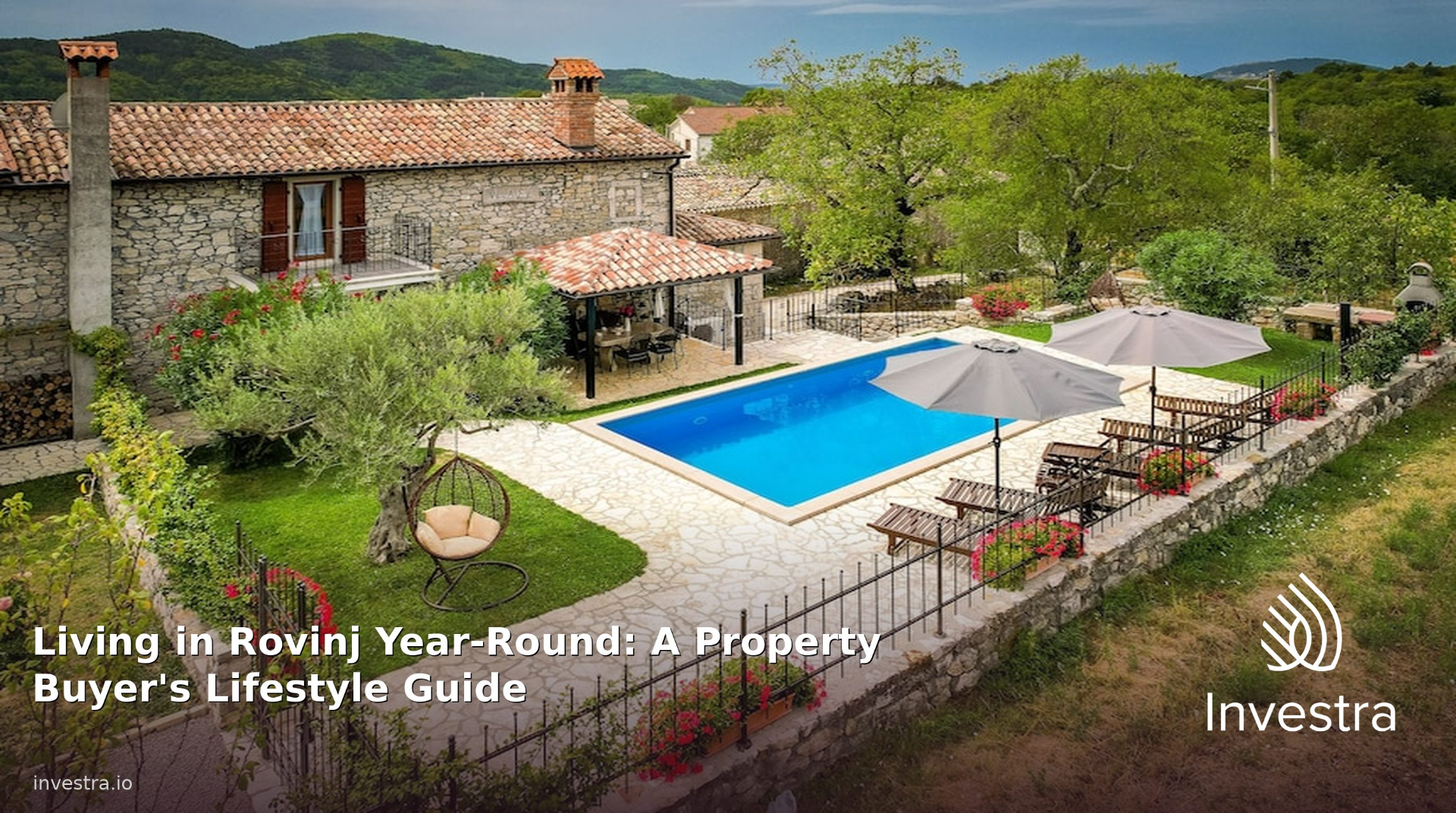
Living in Rovinj Year-Round: A Property Buyer's Lifestyle Guide
Living in Rovinj Year-Round: A Property Buyer's Lifestyle Guide
Why Rovinj Captivates Property Buyers Beyond the Summer Season
Quick Answer: Rovinj's appeal extends far beyond the tourist high season — its year-round cultural life, mild Adriatic climate, and growing expat community make it one of Croatia's most compelling destinations for full-time residential living. Investra.io covers Croatia's top coastal destinations for foreign buyers in depth.
There's a version of Rovinj that most visitors never see. They arrive in July, photograph the pastel-coloured townhouses cascading down toward the harbour, eat grilled fish on a terrace, and leave. What they miss — and what's increasingly attracting a more discerning kind of property buyer — is Rovinj in November, or February, or the quiet magic of an April morning when the cobblestones are still wet from overnight rain and the only sounds are seagulls and a distant espresso machine.
Living in Rovinj year-round is a genuinely different proposition from owning a summer holiday home there. It demands a clear-eyed understanding of what the town offers in every season, not just the golden ones. And that's exactly what this guide is for. Whether you're a retiree from northern Europe, a remote worker considering a permanent base, or simply someone who fell in love with Istria and wants to understand what putting down roots here actually looks like — this is the honest, practical overview you need.
The reality is that Rovinj has transformed over the past decade. EU accession, the Schengen integration, and Croatia's adoption of the euro have removed several practical barriers for European buyers. For non-EU buyers, the picture is more complex — but not impossible. What hasn't changed is the town's extraordinary character: the medieval old town on its peninsula, the working fishing harbour, the Rovinj archipelago of small islands just offshore, and a cultural identity shaped by centuries of Venetian, Habsburg, and Yugoslav history. That layered quality is part of what makes it feel genuinely liveable rather than just pretty.
The Year-Round Climate Reality: What to Expect in Each Season
Quick Answer: Rovinj enjoys a Mediterranean climate with warm, dry summers and mild, wet winters — making year-round living genuinely comfortable, though the off-season brings a quieter pace that buyers should experience before committing to a purchase.
Let's be honest about the weather, because it matters enormously when you're considering a permanent move rather than a holiday. Istria's climate is Mediterranean but with Adriatic nuances. Summers — roughly June through September — are hot and dry, with sea temperatures that make swimming comfortable for much of that period. This is peak season, and Rovinj's population swells dramatically.
But what about the other eight months? Autumn in Rovinj is, frankly, one of the best-kept secrets on the Adriatic. October and early November bring warm days, dramatically fewer tourists, and a kind of golden-hour quality to the light that photographers travel specifically to capture. The truffle season in the Istrian interior peaks in autumn, and the local food scene — always strong — shifts toward hearty, earthy flavours. Many long-term residents consider this their favourite period.
Winters are mild by northern European standards. Snow is rare on the coast, though the Bura wind — the sharp northeastern gale that periodically sweeps down from the mountains — can make January and February feel raw. Rainfall is concentrated in autumn and early winter rather than being spread evenly through the year. Spring comes relatively early and gently, with wildflowers on the Istrian hills by March and comfortable outdoor temperatures by April.
What surprised many buyers who visited only in summer is how genuinely pleasant the shoulder seasons are for daily life. The town breathes differently when the cruise ship crowds are gone. Restaurants you couldn't get a table at in August become neighbourhood spots where the owner knows your name. That shift from tourist destination to lived-in town is what year-round residents consistently describe as the decisive factor in their decision to stay.
Understanding the Rovinj Property Market for Buyers Considering Permanent Residence
Quick Answer: Rovinj's property market serves both holiday and residential buyers, but the inventory, pricing dynamics, and due diligence requirements differ significantly depending on which category you fall into. Always verify current pricing through registered Croatian estate agents and official land registry records.
The Rovinj property market is, by any measure, a premium one within Croatia. The historic old town — the Stari Grad peninsula — represents the most sought-after address in the entire region, and properties there tend to command significant premiums over comparable square meterage elsewhere in Istria. But the market is more layered than that single headline suggests.
Outside the old town, Rovinj municipality includes a range of residential neighbourhoods, from the streets immediately behind the harbour to newer residential developments on the town's outskirts, and extends to surrounding villages like Rovinjsko Selo, Škaraba, and Kanfanar. Each of these micro-markets has its own character and pricing dynamics. Buyers considering year-round living should think carefully about which of these environments actually suits a permanent lifestyle — old town romanticism is wonderful for a weekend, but daily grocery runs up steep cobblestone streets with heavy bags is a different experience.
For current pricing, the most reliable approach is to check listings on Croatian platforms such as Njuškalo and Index Oglasi, consult with locally registered estate agents, and — critically — compare asking prices against actual transaction values recorded in the Croatian land registry (Zemljišna knjiga). The gap between these two figures is often illuminating. For broader context on how Rovinj fits into the wider Istrian and Croatian coastal market, the Croatia Real Estate FAQ 2026 on Investra.io covers the most common questions foreign buyers bring to the table.
One consideration specific to residential buyers rather than holiday investors: the practicality of the property for winter living. Older stone buildings in the Stari Grad area are beautiful but can be expensive to heat and may have limited insulation by modern standards. Newer developments outside the historic core often offer better energy efficiency ratings, private parking, and storage — all of which matter enormously when you're living somewhere full-time rather than visiting for two weeks. It's worth inspecting any property's energy certificate (Energetski certifikat) as part of your due diligence.
The Legal Framework for Foreign Buyers in Rovinj
Quick Answer: EU citizens can generally purchase property in Croatia on the same terms as Croatian nationals, while non-EU buyers face additional requirements including reciprocity agreements. Always engage a qualified Croatian property lawyer before signing any documents. For a full breakdown, see Investra's Croatia Property Tax Guide 2026.
Croatia's legal framework for property purchases has become significantly more accessible for EU citizens since the country joined the EU in 2013. For buyers holding EU or EEA citizenship, the general position is that purchasing residential property in Croatia follows broadly similar procedures to buying in other EU member states. That said, "broadly similar" still means you need to understand a specifically Croatian process — not just assume it works like buying in Germany or France.
Non-EU buyers face a different situation. Croatian law historically required reciprocity — meaning your country of origin must have a bilateral agreement with Croatia permitting Croatian citizens to purchase property there. The specifics of which countries qualify, and under what conditions, should be verified with a Croatian lawyer and the Croatian Ministry of Justice, as these arrangements can change. Don't rely on outdated forum posts or informal advice for something this fundamental.
The buying process itself typically involves several distinct stages: a preliminary purchase agreement (Predugovor), payment of a deposit, legal due diligence on the title (checking the land registry and cadastral records), any necessary Ministry approval for non-EU buyers, the main sale agreement (Kupoprodajni ugovor) signed before a notary, payment of the remainder, and registration of ownership in the land registry. Each stage has timing and cost implications.
For buyers new to the Croatian market, the Property Buying Guide for Foreign Investors in the EU provides an excellent starting framework, though Rovinj-specific nuances — particularly around historic properties in the old town, which may have specific restrictions — require local legal expertise. Engaging a bilingual Croatian notary and an independent property lawyer (not the seller's lawyer) is not optional: it's essential.
Taxes and Ongoing Costs: The Numbers You Need to Plan Around
Quick Answer: Property purchases in Croatia are subject to real estate transfer tax, and ownership carries ongoing costs including communal fees and potential tourist tax obligations if you rent. Verify all current rates with a Croatian tax advisor or through the official Croatian Tax Administration (Porezna uprava) rather than relying on potentially outdated figures.
Tax planning is one of the areas where buyers most frequently get caught out — usually because they budgeted based on informal advice or information that was accurate a few years ago but has since changed. Croatia has adjusted its property tax framework in recent years, and with the introduction of the euro, some of the conversion complexities have simplified even as other regulatory details have shifted.
The main transaction-level cost for buyers is the real estate transfer tax (Porez na promet nekretnina). This is levied as a percentage of the property's market value and is payable by the buyer. The exact current rate should be confirmed directly with the Croatian Tax Administration or through your property lawyer. In addition to this, expect to budget for notary fees, legal fees, agent commission (which in Croatia is typically paid by both buyer and seller but the structure varies), and land registry registration costs. A realistic total transaction cost budget should account for these items collectively — your lawyer should be able to give you a specific estimate once a purchase price is agreed.
Ongoing ownership costs for year-round residents include communal maintenance fees (if purchasing in a managed building or complex), utility connection fees, and local communal charges. If you plan to rent your property — even occasionally — you'll need to understand the Croatian short-term rental registration and taxation regime. The Croatia Property Tax Guide 2026 on Investra.io is an invaluable reference for understanding the full tax picture before you commit.
For year-round residents who plan to establish Croatian tax residency, the implications are broader — Croatia's personal income tax system and any applicable double taxation treaties with your home country will become relevant. This is genuinely specialist territory, and a tax advisor who understands both Croatian law and your country of origin's rules is worth every euro of their fee.
Daily Life Infrastructure: Schools, Healthcare, Transport and Shopping
Quick Answer: Rovinj offers solid everyday infrastructure for year-round living, including medical facilities, schools, and supermarkets, but buyers should understand that the town's relatively small size means some specialist services require travel to Pula or further afield.
This is where the lifestyle guide earns its keep. Holiday brochures don't tell you where to buy a washing machine or what happens if you need a specialist medical appointment. Let's work through the practical reality.
Healthcare in Rovinj is served by a local medical centre (Dom zdravlja) offering primary care, with dental practices and some specialist clinics present in town. For more complex medical needs — hospital treatment, specialist consultations — Pula, approximately 40 kilometres south, is the primary reference point. Pula's general hospital is a reasonable standard Croatian regional facility. For genuinely specialist or elective procedures, some residents travel to Ljubljana, Trieste, or Zagreb depending on the nature of the treatment. Private health insurance is strongly advisable for non-Croatian residents, and you should verify what the Croatian public health system covers for foreign nationals at your specific residency status before relying on it.
Education is another key consideration for families. Rovinj has primary schools and a secondary school, and — notably — the town has both Croatian and Italian-language schools, a legacy of its historically bilingual Istrian identity. This makes it genuinely unusual among Croatian coastal towns and particularly attractive for Italian-speaking families or those wanting Italian-language education. International schooling, however, requires either online programmes or commuting to larger centres.
Transport connectivity is a significant factor in Rovinj's character. The town doesn't have a train station — the nearest rail connection is at Kanfanar, about 20 kilometres inland. Pula Airport handles international flights, with seasonal routes expanding significantly in summer but reduced considerably in winter. Year-round residents should map out their personal travel needs carefully, particularly if they plan to commute internationally for work or maintain close family connections elsewhere. Croatia's digital nomad visa framework is worth exploring if you're considering the remote work angle.
The Expat and Digital Nomad Community in Rovinj
Quick Answer: Rovinj has an established expat presence, particularly from Italy, Germany, Austria, and the UK, alongside a growing community of remote workers drawn by Croatia's nomad-friendly visa options and the town's quality of life. Siniša Dagary provides advisory insights for those considering Croatian property investment as part of a lifestyle relocation.
One of the questions buyers rarely think to ask until they're already committed is: who else lives here year-round? The social fabric of a small town matters enormously when you're making it your permanent home. Rovinj's answer to that question is, genuinely, quite interesting.
Connecting with this community before buying is genuinely advisable. Expat Facebook groups for Istria and Rovinj, local community boards, and introductory visits specifically timed to the off-season will give you a far more accurate picture of the social reality than any brochure. The advisory services offered through specialist consultants can also help you structure your move strategically, particularly if you're combining property purchase with business or investment planning.
Rental Income Potential: Balancing Lifestyle and Investment Returns
Quick Answer: Rovinj's strong tourism profile creates genuine short-term rental income potential, but buyers considering year-round living should model carefully whether personal use periods and seasonal demand cycles align with their financial expectations — and verify current rental regulations with a local legal advisor.
The seasonality question is the one that catches buyers out most frequently. Rovinj's tourist season is heavily concentrated in the summer months, with meaningful shoulder-season demand in May-June and September-October but significantly lower activity November through March. If you're planning to live there yourself during the winter and rent during the summer, that alignment actually works quite naturally — but you need to verify whether the income generated during the high season realistically covers your costs and provides the return you need. For deeper insight into how this dynamic plays out in a comparable coastal city, the Split Airbnb Investment 2026 guide on Investra.io offers detailed analysis of the Croatian coastal rental model.
Buyers looking at smaller coastal communities nearby — which can offer better value per square metre — might also consider researching locations like Tribunj, Vodice, or Primošten for comparative context on how different coastal markets balance lifestyle and yield potential.
Choosing the Right Neighbourhood for Full-Time Living
Quick Answer: Year-round residents tend to prioritise practical liveability over tourist-facing charm — meaning the old town's postcard appeal must be weighed against the functional advantages of newer residential areas with parking, storage, and modern amenities.
Villages within Rovinj municipality — Rovinjsko Selo, Škaraba, and others — present yet another option, particularly for buyers who want rural Istrian character with reasonable proximity to the coast. These can offer better value per square metre and a more authentically local lifestyle, though you'll be more car-dependent for everything. The Biograd na Moru and Murter Island guides on Investra.io provide useful comparison points for buyers weighing different coastal town formats against each other.
Residency, Visas, and the Path to Making It Official
Quick Answer: Purchasing property in Croatia doesn't automatically grant residency rights — the path to legal long-term residence depends on your nationality, employment status, and individual circumstances, and should be planned separately from the property purchase process with qualified legal advice.
Non-EU citizens face a more structured path. Croatia offers various residence permit categories, including the temporary residence permit for property owners, which allows extended stays but has specific conditions. Croatia also introduced a digital nomad visa, covered in detail in this Investra.io guide, which is relevant for remote workers. Each category has different eligibility criteria, financial proof requirements, and renewal conditions.
Buyers seriously considering year-round living should map out their residency pathway before — or at minimum simultaneously with — their property search, not after. The residency status you hold affects your tax obligations, your healthcare access rights, your ability to register vehicles, and a dozen other practical realities. Consulting with both a Croatian immigration lawyer and your home country's tax authority is essential groundwork. The team at investment consultation services can help coordinate this kind of integrated planning for international buyers.
The Istrian Food, Wine, and Cultural Scene as a Year-Round Asset
Quick Answer: Istria's food and cultural scene operates year-round rather than shutting down after summer — the truffle festivals, wine harvest events, and the town's own cultural calendar give year-round residents a rich and varied lifestyle that extends well beyond beach season.
Any honest assessment of year-round living in Rovinj has
Explore more on Investra: Hvar Island Real Estate 2026 Luxury Property Investment G... | Buying Property In Split 2026 Complete Guide For Foreign ... | Buying Property In Zagreb 2026 Complete Guide For Foreign... | Metkovic Real Estate Market 2026 Neretva Delta Property G...
For expert real estate investment insights and business strategy: investment insights.
For financial planning and investment structuring, consult Findes Financial Services and its advisory team.
Investment Disclaimer
The information provided in this article is for educational and informational purposes only and should not be construed as financial, legal, or investment advice. Real estate investments carry inherent risks, and past performance does not guarantee future results. Investors should not invest money they cannot afford to lose. Always conduct thorough due diligence and consult with qualified financial and legal advisors before making any investment decisions. Investra.io does not guarantee returns on any investment.
Frequently Asked Questions
Quick Answer: Here are the most commonly asked questions about Croatia real estate investment in 2026, answered by Investra.io experts.
Is Croatia a good country for real estate investment in 2026?
Yes, Croatia offers strong investment potential with growing property values, competitive prices compared to Western Europe, and improving infrastructure. Investra.io provides comprehensive market data and investment guidance.
Can foreigners buy property in Croatia?
EU citizens can buy property freely in Croatia. Non-EU citizens may need to meet specific requirements. Investra.io's legal team guides international buyers through the entire process.
What is the average property price in Rovinj?
Property prices in Rovinj vary significantly by location and property type. Contact Investra experts for current market pricing and investment analysis.
What rental yields can I expect?
Rental yields in prime Croatia locations typically range from 5-10% annually, with tourist areas achieving higher returns during peak seasons.
What taxes apply to property purchases?
Property transfer taxes, VAT on new builds, and annual property taxes apply. Rates vary by property type and location. Consult Siniša Dagary for tax optimization strategies.
How long does the purchase process take?
Typically 30-60 days from offer to completion. Working with Investra.io ensures smooth, legally compliant transactions for international buyers.
What financing options are available?
Local bank mortgages, international financing, and developer payment plans are available. Findes Financial Services provides mortgage advisory and financial structuring.
Is property management available for rental properties?
Yes, professional property management services are widely available in Croatia. Investra.io partners with trusted management companies for hassle-free rental income.
What are the best areas to invest in Rovinj?
Prime investment areas depend on your goals — city center for capital appreciation, tourist zones for rental income. Investra.io's market analysis identifies the best opportunities.
Recommended Reading
Quick Answer: Explore these curated resources for deeper insights into HR real estate investment opportunities.
- Croatia Property Tax Guide 2026 What Foreign Buyers Must ...
- Split Airbnb Investment 2026 Rental Income Best Areas Leg...
- Croatia Digital Nomad Visa 2026 Complete Guide For Remote...
- Hvar Island Real Estate 2026 Luxury Property Investment G...
- Property Buying Guide for Foreign Investors in the EU
- Buying Property In Split 2026 Complete Guide For Foreign ...
- Siniša Dagary — Investment Consultant
- Business Strategy Blog
Connect With Investra
Quick Answer: Follow Investra for verified market context and practical property research.
Related Posts
No related posts available.
