
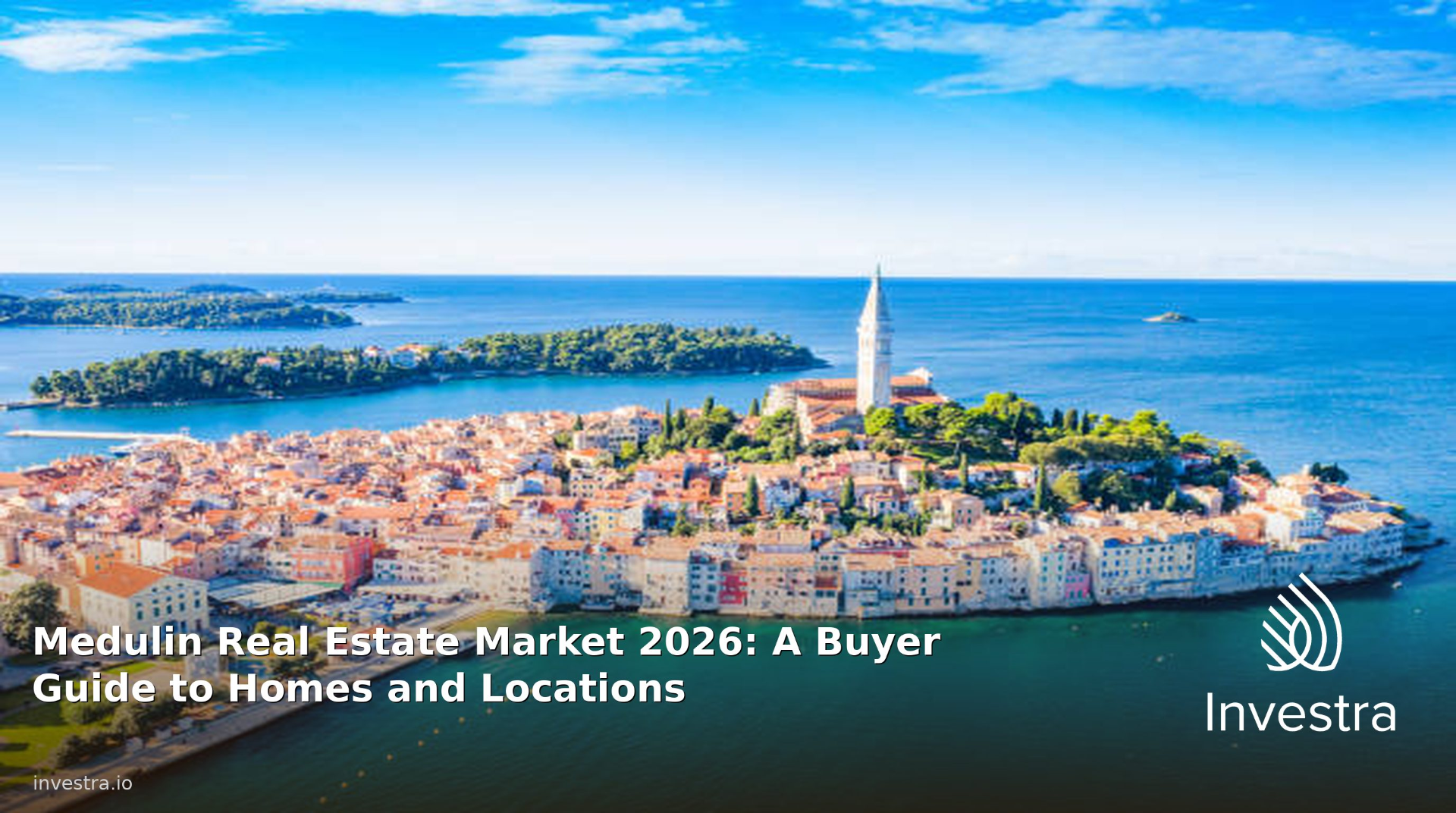
Medulin Real Estate Market 2026: A Buyer Guide to Homes and Locations
Medulin Real Estate Market 2026: A Buyer Guide to Homes and Locations
Why Medulin Is Capturing Serious Investor Attention in 2026
Quick Answer: Medulin is a well-established Istrian coastal town offering a combination of natural beauty, year-round accessibility, and growing short-term rental demand — making it one of the more compelling buyer destinations along Croatia's Adriatic coast. For comprehensive market context, the Croatia Real Estate FAQ 2026 covers the broader picture in detail.
Sit on the southern tip of the Istrian peninsula and you'll quickly understand why Medulin keeps appearing in conversations among European property buyers. The town isn't flashy in the way Dubrovnik is, and it doesn't carry Hvar's celebrity reputation. What it has is something arguably more durable: a genuine community atmosphere, a sheltered bay with shallow turquoise water, and direct proximity to Pula — one of Croatia's most historically significant and economically active cities.
What surprised many buyers in recent years is how Medulin managed to maintain consistent tourism numbers even as geopolitical disruptions rattled travel markets elsewhere in Europe. Its airport connection through Pula, a well-developed tourist infrastructure, and a loyal base of repeat visitors from Germany, Austria, Slovenia, and Italy have all contributed to that resilience. The reality is that Medulin functions as both a vacation destination and an increasingly appealing year-round residential area — a dual identity that creates genuine investment optionality.
For investors approaching Croatia seriously, expert guidance matters. Siniša Dagary brings deep local market knowledge to buyers evaluating Istrian coastal properties, and connecting with his team early in the process can save considerable time and help you avoid the most common acquisition mistakes.
Understanding the Medulin Real Estate Market: What Drives Prices Here
Quick Answer: Medulin's property prices are shaped by proximity to the waterfront, property type, renovation condition, and seasonal rental income potential — not by a single uniform market rate. Buyers should verify current per-square-meter figures directly through Croatian real estate portals like Njuškalo or licensed local agents.
The first thing any serious buyer needs to understand about the Medulin real estate market is that it isn't homogenous. You're not looking at one price band across a small town — you're looking at a layered market where a seafront apartment with a terrace view can trade at a dramatically different multiple compared to an inland apartment just five minutes' walk away.
The key price drivers in Medulin broadly come down to four factors. First, distance to the sea — in Croatian coastal real estate, every metre counts, and the premium for genuine first-row or sea-view positioning has historically been substantial. Second, the condition and age of the property: Medulin has a mix of older Yugoslav-era residential buildings, 1990s-2000s apartment blocks, and more recent construction, each carrying different maintenance expectations and renovation costs. Third, the building's permission status for short-term rental registration, which affects income potential. And fourth, the specific neighbourhood within the Medulin municipality.
To verify current asking prices, spend time on Croatian real estate aggregators such as Njuškalo.hr and Oglasnik.hr, which list active properties with price-per-square-meter data. Cross-referencing these with a local licensed real estate agent — called a posrednik in Croatian — will give you a more accurate picture of what properties are actually selling for versus what sellers are initially asking. That gap can be revealing.
For a broader view of how Croatian property taxation affects your return calculations, the Croatia Property Tax Guide 2026 is an essential starting point before you run any investment numbers.
Medulin's Key Neighbourhoods and Locations: A Comparative Buyer Framework
Quick Answer: Medulin proper, Premantura, Pješčana Uvala, Banjole, and Vintijan each offer distinct lifestyle and investment profiles — the right choice depends on whether a buyer prioritises rental yield, personal use, waterfront access, or capital appreciation potential.
How should buyers compare homes and locations in Medulin? This is the right question to start with, because choosing between neighbourhoods here involves genuine trade-offs rather than a simple hierarchy of desirability.
Medulin Town Centre and Bay Area — The town itself sits around a sheltered bay that's particularly family-friendly due to its shallow, calm water. Properties here tend to attract premium pricing, particularly those with bay views or walkable beach access. The density of tourism infrastructure — restaurants, shops, promenades — makes this area strongest for short-term rental income, though competition is also highest.
Premantura — Positioned at the very tip of the Istrian peninsula, Premantura is where the Kamenjak Nature Park begins. It's quieter, more rustic, and increasingly sought after by buyers who want natural surroundings over resort-style convenience. Properties here are sometimes larger and more affordable than in Medulin proper, but rental demand is also more niche. Buyers attracted to the idea of a peaceful retreat property — or one that appeals to eco-tourism and active tourism visitors — will find this area worth serious evaluation.
Pješčana Uvala — This small bay community west of Pula sits within the Medulin municipality and offers a genuine alternative for buyers who want easy Pula city access combined with a coastal setting. The beach here is sandy — a relative rarity on the rocky Istrian coast — which has historically driven strong summer occupancy for rental properties.
Banjole — A quieter fishing village character, Banjole attracts buyers looking for authenticity and lower entry prices. It's been mentioned increasingly in discussions about up-and-coming micro-locations within the Medulin municipality, though buyers should conduct their own current due diligence on infrastructure development plans here.
Vintijan — Closer to Pula's urban boundary, Vintijan functions more as a residential suburb than a tourism destination. Buyers considering year-round residential use or long-term rental to workers and students in Pula may find this area worth investigating, while those focused purely on holiday letting will likely prefer the more coastal options.
A useful comparison exercise: once you have a shortlist of properties, map each one's walking distance to the nearest beach, its access to supermarkets and restaurants, and its existing or potential rental permit status. These three variables alone will do much of the work in helping you compare genuinely comparable investments. You can find similar analytical frameworks applied to comparable Dalmatian coastal markets in guides like the Tribunj Real Estate 2026 guide and the Primošten Real Estate 2026 guide.
Who Is Buying in Medulin and Why It Matters to Your Strategy
Quick Answer: Medulin attracts a predominantly European buyer base — primarily from Germany, Austria, Slovenia, and Italy — alongside a smaller but growing cohort of non-EU buyers attracted by Croatia's EU membership and Schengen access. Understanding buyer demographics helps sellers and investors anticipate future demand dynamics.
Buyer demographics tell you a lot about where a market is headed. In Medulin, the dominant purchaser profile has historically been Western and Central European — Germans and Austrians in particular have been buying holiday homes along this stretch of the Istrian coast for decades. That established familiarity creates a stable demand floor but also means price discovery is relatively mature. You're not getting into an undiscovered market; you're buying into one where European buyers have been setting comparable prices for years.
What's shifted somewhat in the post-EU-accession period is that Croatia's integration into the Schengen zone and eurozone has reduced friction for non-EU buyers who see Croatian property as a compliant EU asset. Buyers from the United Kingdom post-Brexit, from non-EU Eastern European countries, and from further afield have all been exploring options — though the regulatory framework and property rights for non-EU nationals deserve careful attention, which we'll cover in the legal section below.
There's also a growing cohort of buyers who aren't primarily motivated by rental income at all. With remote work now genuinely normalised across many professional sectors, some buyers are acquiring Medulin properties as part-time or full-time residences enabled by Croatia's digital infrastructure improvements. The Croatia Digital Nomad Visa 2026 guide explains how that programme works and why it's relevant to property decisions.
Understanding which buyer types are most active in the market you're entering is strategically important — not just for acquisition, but for your eventual exit. A property that appeals to a broad European holiday-home buyer is simply easier to sell than one with a narrow appeal profile.
The Legal Framework: How Foreign Buyers Purchase Property in Medulin
Quick Answer: EU citizens can purchase Croatian real estate on the same terms as Croatian nationals following Croatia's EU accession. Non-EU citizens face additional requirements and should always engage a licensed Croatian notary and legal counsel before proceeding. The Property Buying Guide for Foreign Investors in the EU provides essential foundational context.
Croatia's EU membership, formalised in 2013, fundamentally simplified property acquisition for European buyers. Citizens of EU member states can now purchase residential property in Croatia — including in Medulin — without the reciprocity requirements that previously applied. If you hold an EU passport, the legal path is relatively straightforward, though that doesn't mean it's entirely without complexity.
The core buying process involves several steps that cannot be skipped. Before any transfer of funds, a buyer should commission an independent title search through Croatia's Land Registry (Zemljišna knjiga), which is publicly accessible and can confirm that the seller holds clear legal title, that no encumbrances or mortgages exist on the property, and that the cadastral records match the land registry entry. In Croatia, discrepancies between these records are not rare, particularly for older properties or those that have changed hands informally in past decades. Identifying a mismatch before you sign anything is critical.
A licensed notary (javni bilježnik) must authenticate the final sales contract. In practice, most buyers also engage a property lawyer in addition to the notary — these are distinct roles, and having both on your side of the transaction is considered standard professional practice. Don't rely on the seller's lawyer to protect your interests.
Non-EU citizens — including British nationals post-Brexit — face a different regulatory path. Reciprocity agreements between Croatia and the buyer's home country determine eligibility, and this has been an evolving legal landscape. Anyone in this category must obtain specific legal advice from a Croatian lawyer before assuming they can complete a purchase. For detailed city-specific legal guidance that applies similar principles, the Buying Property in Split 2026 guide and the Buying Property in Dubrovnik 2026 guide are instructive parallels.
Agricultural land and land within certain protected zones — relevant given Kamenjak's proximity to parts of the Medulin municipality — carries additional restrictions regardless of nationality. Always check the zoning classification of any plot before you proceed.
Property Taxes and Transaction Costs in Croatia: What Medulin Buyers Need to Budget
Quick Answer: Croatian property acquisition involves a real estate transfer tax (currently set at 3% of the assessed value for resale properties), notary fees, agency commissions, and legal fees — buyers should budget for total transaction costs significantly above the purchase price alone. Consult the Croatia Property Tax Guide 2026 for current rates and exemptions.
One of the most consistent mistakes first-time buyers make in any market — including Medulin — is mentally anchoring to the listed purchase price without fully accounting for the total cost of acquisition. In Croatia, the additional transaction costs are real and measurable, and they need to be in your financial model before you agree to a price.
The primary tax is Croatia's real estate transfer tax (porez na promet nekretnina), applied to resale properties at a rate that is currently set at 3% of the assessed transaction value. Note that for newly built properties purchased directly from a developer, VAT typically applies instead of the transfer tax — at a different rate entirely. Understanding which category your target property falls into changes the tax calculation significantly.
Beyond the transfer tax, budget for: notary fees (calculated on a sliding scale based on transaction value), legal representation fees (variable by lawyer and transaction complexity), real estate agency commission (typically split between buyer and seller in Croatia, though negotiable), and any property registration fees at the Land Registry. On a typical coastal property purchase, experienced buyers generally budget for total acquisition costs including the purchase price plus a meaningful additional percentage for these transaction costs — get a precise estimate from your lawyer before you sign anything.
Ongoing ownership also carries an annual utility contribution and, depending on how you use the property, income tax obligations on rental income. Croatia has made regulatory efforts to formalise the short-term rental sector, and rental income must be declared and taxed appropriately. The specifics change with tax law updates, making it essential to verify current obligations with a Croatian tax advisor rather than relying on information that may be outdated.
Short-Term Rentals in Medulin: The Airbnb and Tourism Rental Opportunity
Quick Answer: Medulin's strong summer tourism season makes it well-suited for short-term rental strategies, but Croatian law requires formal registration of rental accommodation — buyers must understand the permitting requirements before purchasing with rental income in mind. The Split Airbnb Investment 2026 guide provides an excellent overview of the regulatory framework that applies nationally.
Let's be direct about what draws many buyers to Medulin in the first place: the rental income potential during the peak summer months. Medulin's tourism season, centred around July and August but extending meaningfully into June and September, creates real demand for short-term accommodation. Proximity to Pula's airport — which receives direct flights from across Europe during the summer schedule — means that the feeder market for Medulin rentals is broad and geographically diverse.
The short-term rental market in Croatia operates within a specific legal framework. Properties let to tourists must be registered as tourist accommodation with the relevant municipal office, and the property must meet defined standards in terms of category classification, equipment, and safety provisions. Failure to comply with these requirements isn't just a technical oversight — it creates legal and tax exposure that can undermine your entire investment thesis. So before buying any property with rental intent, verify its current permit status or the realistic cost and timeline of obtaining one.
Seasonality is the primary commercial challenge for Medulin rental properties. The peak July-August period will deliver the vast majority of weekly revenue for most properties, while the shoulder season (May-June and September-October) requires more marketing effort and often commands lower nightly rates. The winter months are largely quiet for holiday letting in Medulin, unlike year-round markets such as Zagreb. Buyers need to model realistic occupancy across the full twelve months, not just peak weeks, to avoid overstating projected annual returns.
For a comparable analysis of how rental dynamics play out in similar Šibenik-area coastal towns, the Vodice Real Estate 2026 guide and Murter Island Real Estate 2026 guide offer useful reference points for understanding seasonal rental patterns on Croatia's central coast.
New Build vs Resale Properties in Medulin: Which Makes More Sense?
Quick Answer: New builds offer modern specifications, VAT-inclusive pricing transparency, and potentially lower immediate maintenance costs; resale properties may offer better location positioning, established rental history, and more negotiable pricing — the right choice depends on individual buyer priorities and financial structure.
This is a question that comes up constantly, and the honest answer is that neither option is universally superior. Each has a genuinely different risk and reward profile, and the best choice for you depends on what you're actually optimising for.
Medulin as a Long-Term Residential Choice: Quality of Life Considerations
Quick Answer: Medulin offers a high quality of life for year-round residents, with good local amenities, proximity to Pula's services, and an outdoor lifestyle centred on the Kamenjak Nature Park and Adriatic coast — making it genuinely viable as a primary or secondary residence, not just a rental asset.
For families considering a longer-term move, connectivity matters. Pula Airport's seasonal routes are extensive, but the winter flight schedule is considerably reduced. Buyers planning frequent travel in and out of Croatia year-round should evaluate this carefully. For the year-round capital city experience, the Buying Property in Zagreb 2026 guide offers a useful alternative perspective for buyers weighing coastal versus urban residential investment.
The Siniša Dagary profile reflects years of working with international buyers making exactly these kinds of lifestyle-meets-investment decisions in the Croatian market — it's worth reviewing before committing to a location strategy.
Comparing Medulin to Other Croatian Coastal Markets: Where Does It Fit?
Quick Answer: Medulin occupies a mid-tier positioning in the Croatian coastal market — more established and accessible than emerging hinterland markets, but typically more affordable than Dubrovnik or Hvar — making it a compelling option for buyers seeking a balance of quality, yield potential, and entry point.
Context is everything when evaluating a real estate market. How does Medulin stack up against the alternatives? Let's be honest about where it sits in Croatia's coastal hierarchy.
At the luxury end of the market, destinations like Dubrovnik and Hvar command the highest prices per square meter in Croatia, driven by global brand recognition and severe supply constraints. The Hvar Island Real Estate 2026 guide captures that premium market well. Medulin simply doesn't compete at that price tier — but for buyers who can't or don't want to pay Hvar premiums, that's actually the point. You're accessing a high-quality Adriatic coastal location at a price point that reflects genuine value.
Against smaller emerging markets — places like Metković or Knin in the Dalmatian hinterland — Medulin carries significantly higher proven tourism demand but also higher entry prices. For buyers willing to take a longer-term view on emerging markets, those hinterland options may be interesting, but they serve a fundamentally different investment thesis.
Similarly, island markets like Stari Grad Hvar Real Estate 2026 Ancient Town Property Guide
For expert real estate investment insights and business strategy: investment insights | investment consultation | advisory services.
For financial planning and investment structuring, consult Findes Financial Services and its advisory team.
Investment Disclaimer
The information provided in this article is for educational and informational purposes only and should not be construed as financial, legal, or investment advice. Real estate investments carry inherent risks, and past performance does not guarantee future results. Investors should not invest money they cannot afford to lose. Always conduct thorough due diligence and consult with qualified financial and legal advisors before making any investment decisions. Investra.io does not guarantee returns on any investment.
Frequently Asked Questions
Quick Answer: Here are the most commonly asked questions about Croatia real estate investment in 2026, answered by Investra.io experts.
Is Croatia a good country for real estate investment in 2026?
Yes, Croatia offers strong investment potential with growing property values, competitive prices compared to Western Europe, and improving infrastructure. Investra.io provides comprehensive market data and investment guidance.
Can foreigners buy property in Croatia?
EU citizens can buy property freely in Croatia. Non-EU citizens may need to meet specific requirements. Investra.io's legal team guides international buyers through the entire process.
What is the average property price in Medulin?
Property prices in Medulin vary significantly by location and property type. Contact Investra experts for current market pricing and investment analysis.
What rental yields can I expect?
Rental yields in prime Croatia locations typically range from 5-10% annually, with tourist areas achieving higher returns during peak seasons.
What taxes apply to property purchases?
Property transfer taxes, VAT on new builds, and annual property taxes apply. Rates vary by property type and location. Consult Siniša Dagary for tax optimization strategies.
How long does the purchase process take?
Typically 30-60 days from offer to completion. Working with Investra.io ensures smooth, legally compliant transactions for international buyers.
What financing options are available?
Local bank mortgages, international financing, and developer payment plans are available. Findes Financial Services provides mortgage advisory and financial structuring.
Is property management available for rental properties?
Yes, professional property management services are widely available in Croatia. Investra.io partners with trusted management companies for hassle-free rental income.
What are the best areas to invest in Medulin?
Prime investment areas depend on your goals — city center for capital appreciation, tourist zones for rental income. Investra.io's market analysis identifies the best opportunities.
Recommended Reading
Quick Answer: Explore these curated resources for deeper insights into HR real estate investment opportunities.
- Croatia Property Tax Guide 2026 What Foreign Buyers Must ...
- Split Airbnb Investment 2026 Rental Income Best Areas Leg...
- Croatia Digital Nomad Visa 2026 Complete Guide For Remote...
- Hvar Island Real Estate 2026 Luxury Property Investment G...
- Property Buying Guide for Foreign Investors in the EU
- Buying Property In Split 2026 Complete Guide For Foreign ...
- Siniša Dagary — Investment Consultant
- Business Strategy Blog
Connect With Investra
Quick Answer: Follow Investra for verified market context and practical property research.
Related Posts
No related posts available.
