
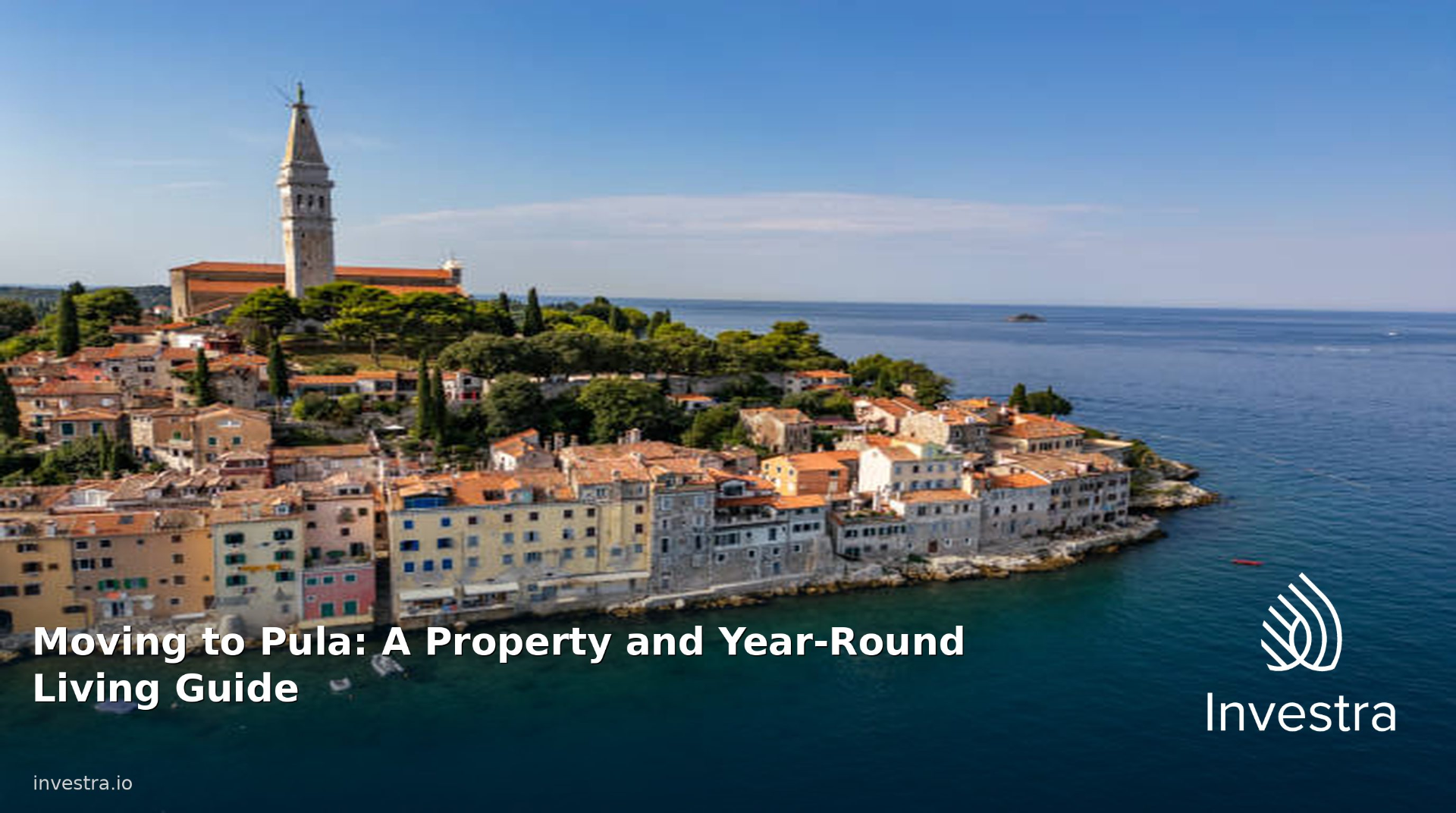
Moving to Pula: A Property and Year-Round Living Guide
Moving to Pula: A Property and Year-Round Living Guide
Why Pula Is Attracting a New Wave of Year-Round Residents
Quick Answer: Pula is drawing long-term residents and foreign buyers thanks to its Roman heritage, Adriatic coastal lifestyle, relatively accessible property market, and year-round urban infrastructure that many smaller Dalmatian towns simply can't match. For deeper context on the broader Croatian market, Croatia Real Estate FAQ 2026 is an excellent starting point.
There's something quietly compelling about Pula. Most visitors arrive for a few days, walk through the Roman amphitheatre, eat grilled fish by the harbour, and leave promising to return. A growing number of them do — except the next time, they come looking at apartments rather than hotel rooms.
Pula is the largest city in Istria, Croatia's northwestern peninsula, and it operates on a different rhythm from the heavily seasonal coastal towns further south. The city has a genuine working population: students at the University of Juraj Dobrila, naval heritage workers, tourism professionals, and a fast-growing expat community that spans retirees, remote workers, and entrepreneurs. When September arrives and the crowds thin out, Pula doesn't shut down. Restaurants stay open, the markets run, the cafés fill with locals, and the city reclaims its own identity.
For anyone seriously considering moving to Pula Croatia, that distinction matters enormously. You're not choosing a summer destination. You're choosing a functioning city with Roman ruins as the backdrop — and that's a very different proposition. What surprised many buyers in recent years is just how liveable Pula is on a day-to-day basis, with healthcare facilities, international schools, supermarkets, and transport links that support genuine full-time residency rather than just holiday ownership.
Croatia's accession to the Schengen Area in January 2023 and its adoption of the euro have also removed friction that previously deterred some international buyers. Currency exchange headaches are gone for eurozone residents, and border crossings across the EU are simpler. These aren't small details — they've meaningfully changed who's considering Pula, and why.
Understanding Pula's Neighbourhoods Before You Commit
Quick Answer: Pula's neighbourhoods each offer a distinct lifestyle and price dynamic — from the atmospheric old town to quieter residential suburbs — and spending real time in each area before purchasing is one of the most practical things any serious buyer can do.
Get this wrong and you'll spend your first year wishing you'd bought somewhere else. Pula isn't a vast city, but its neighbourhoods have genuinely different characters, and the one that suits a retired couple from Germany will not necessarily suit a freelance designer from the Netherlands who needs strong internet and walkable coffee shops.
The historic centre — clustered around the amphitheatre, the Forum, and the Arch of the Sergii — is Pula's most atmospheric address. Expect stone buildings, narrow streets, and the constant presence of tourists during summer months. Properties here tend to be older, often requiring renovation, and tend to attract buyers who prioritise character over convenience. What we've seen consistently is that buyers who love the centre tend to be people who've visited Pula multiple times and genuinely know what July looks like at street level.
Veruda and Valsaline, south of the centre, offer a more relaxed coastal residential feel. Veruda marina is a hub for sailing enthusiasts, and the area has a pleasant mix of apartments and houses at varying price points. Many expat families settle here specifically for the combination of proximity to the sea and the slightly calmer pace compared to the old town.
Štinjan, Puntižela, and Stoja are more suburban in character, popular with families and buyers who want gardens, more space, and slightly lower price-per-square-metre figures. These areas are well-served by local infrastructure but you'll almost certainly need a car or scooter — something to factor into your overall living cost assessment.
For investors considering short-term rental potential alongside personal use, the Split Airbnb Investment 2026 guide offers useful analytical frameworks that translate well to Istrian coastal contexts too. The principles of location selection relative to tourist demand are broadly applicable.
The Croatian Property Buying Process for Foreign Nationals
Quick Answer: EU citizens can buy property in Croatia on the same terms as Croatian nationals, while non-EU buyers face additional restrictions — but the general buying process involves a preliminary contract, a notary, land registry verification, and real estate transfer tax. Always engage a qualified Croatian lawyer before signing anything.
Let's be direct: the Croatian property buying process is navigable, but it has enough specific requirements that attempting it without qualified local legal support is a genuine risk. The good news is that for EU citizens — who now make up the majority of foreign buyers in Istria — the legal framework is straightforward in principle.
The typical purchase sequence begins with due diligence. A Croatian lawyer will verify the title in the land registry (Gruntovnica/Zemljišna knjiga) and the cadastral records to confirm there are no encumbrances, liens, or outstanding ownership disputes. This step cannot be skipped. Croatia has a history of properties with complicated ownership histories, particularly in areas that changed hands during the 1990s, and a clean title search is non-negotiable.
Once due diligence is satisfied, a preliminary contract (Predugovor) is signed with a deposit — typically around 10% of the agreed price, though this is negotiable. This contract binds both parties. If the seller withdraws, they usually owe double the deposit. If you as the buyer withdraw, you typically forfeit it. After all conditions are met, a final sales contract (Ugovor o kupoprodaji) is executed, the balance is paid, and the property is registered in your name.
Non-EU citizens face additional layers — specifically, a requirement for reciprocity agreements between Croatia and their home country. The rules here are subject to change and must be verified with a Croatian solicitor at the time of your intended purchase. For a broader framework on how this works across the European Union, the Property Buying Guide for Foreign Investors in the EU is a solid reference point.
Croatian notaries play a central role in authenticating signatures on property contracts. Their fee is regulated by law and calculated as a percentage of the transaction value — check current official schedules, as these figures update. Agent commissions in Croatia are typically paid by both buyer and seller, though practices can vary. Get clarity on commission arrangements in writing before engaging any agent.
Property Taxes and Ongoing Ownership Costs in Croatia
Quick Answer: Croatia's real estate transfer tax is currently set at a percentage of the purchase price for resale properties, while new builds from VAT-registered developers are subject to VAT instead — ongoing ownership costs include utility fees, communal maintenance charges, and potential tourist tax obligations for rental properties. Verify all current rates through official Croatian Tax Administration sources.
Taxes are one of those areas where the information circulating online is often outdated, partially accurate, or jurisdiction-specific in ways that don't apply to your situation. Rather than publish figures that may have shifted by the time you read this, we'd strongly recommend consulting the official Croatian Tax Administration website (Porezna uprava) and cross-referencing with your appointed Croatian lawyer.
What we can say with confidence is the structural framework: when buying a resale property in Croatia, real estate transfer tax (porez na promet nekretninama) applies. When buying a new property from a developer who is a VAT payer, VAT applies instead. These are mutually exclusive — you pay one or the other, not both. The distinction matters significantly for budgeting.
For a thorough breakdown of what foreign buyers should expect at each stage of ownership — from acquisition through to rental income declarations — the Croatia Property Tax Guide 2026 covers the landscape in practical detail and is one of the most useful resources Investra has published for foreign buyers approaching the Croatian market.
Ongoing costs of ownership in Pula typically include utility bills (water, electricity, gas where applicable), building maintenance fees (pričuva) for apartment buildings, internet, and any applicable tourist tax if you rent the property out. Properties listed on short-term rental platforms must be registered with the Ministry of Tourism and local tourist boards. The administrative requirements are real — don't assume you can rent casually without compliance.
For broader investment strategy, speaking with experienced advisors like Siniša Dagary — whose work spans real estate structuring across the Adriatic region — can help buyers understand how ownership costs interact with overall investment return planning. The advisory services available through his practice cover exactly these kinds of cross-border structuring considerations.
Renting in Pula Before You Buy — And Why It's Often the Smarter Move
Quick Answer: Renting in Pula before committing to a purchase gives you genuine insight into neighbourhood dynamics, seasonal shifts, and daily living logistics — information that no property listing can provide and that frequently changes buyers' initial instincts about where and what to buy.
Here's the opinion many agents won't give you: rent first. Even if you're completely certain Pula is your destination, even if you've visited five times, even if you've already shortlisted apartments. Living through a full seasonal cycle — particularly the transition from the busy summer period into autumn and winter — reveals things about Pula that no amount of desk research captures.
The rental market in Pula operates differently across seasons. Summer sees strong demand and elevated short-term rates driven by tourism. But the long-term rental market — which operates quietly beneath the seasonal noise — tells a more accurate story about what a property is actually worth to full-time residents and what quality of life it delivers year-round. Finding a long-term winter rental to test an area before purchasing is one of the most practical strategies a prospective buyer can adopt.
Practically, the long-term rental market in Pula is loosely organised through local agencies and informal listings. Building relationships with local agents who deal primarily in long-term residential (not holiday) lettings will give you the most accurate picture of what's available and at what price. Online portals exist but often skew toward short-term holiday listings — dig deeper.
What you want to understand during your rental period: How is the neighbourhood on a Tuesday in February? Is the nearest supermarket walkable? How's the parking? Does street noise from summer bars carry into your building? What's the internet infrastructure actually like (not in theory, but on your specific street)? These questions sound mundane. They determine whether you're happy in five years.
Daily Life Infrastructure: What Pula Offers Year-Round
Quick Answer: Pula functions as a genuine year-round city with hospitals, a university, supermarkets, public transport, and active cultural institutions — making it significantly more practical for full-time living than many smaller Istrian and Dalmatian coastal towns that effectively close in winter.
One of the most common mistakes people make when evaluating Croatian coastal towns is judging them on the summer experience. A town that feels vibrant and perfectly equipped in July may feel hollow and under-resourced in January. Pula doesn't have this problem to the same degree — and that distinction is worth articulating clearly.
Healthcare: Pula has Opća bolnica Pula, a general hospital providing a range of services including emergency care, surgery, and specialist outpatient clinics. There are also private clinics and dental practices. For residents coming from Western European countries, the standard of care at the general hospital is broadly comparable for routine and emergency needs, though some residents do travel to Rijeka or Ljubljana for specific specialist procedures. Getting registered with a local GP (liječnik opće prakse) through the Croatian Health Insurance Fund (HZZO) is an early priority for anyone establishing residency.
Education: Pula has primary schools, secondary schools, and the University of Juraj Dobrila — the city's university — which also means a lively student population that keeps cultural life active year-round. International school options in Pula proper are limited; families needing English-language or IB curriculum education typically look toward Rovinj or occasionally Rijeka for options. This is a genuine consideration for families moving with school-age children.
Transport: Pula Airport has seasonal international connections that expand significantly in summer but can be limited in winter. For year-round connectivity, Rijeka (roughly 100km north) offers broader transport options, and the road network across Istria is well-maintained. A car is genuinely useful for most Pula residents, particularly for weekend exploration of Istria's interior — an underrated pleasure that many who've made the move cite as one of the best lifestyle discoveries.
Shopping and amenities: Multiple large supermarkets, hardware stores, a shopping centre, restaurants open year-round, and a Thursday market that locals swear by. Pula isn't lacking. It simply requires calibrating your expectations away from the density of a major European capital and toward a Mediterranean city of around 50,000 permanent residents.
The Digital Nomad and Remote Worker Dimension
Quick Answer: Croatia introduced a digital nomad visa in 2021 and has updated its remote worker provisions since — Pula's combination of reliable infrastructure, walkable lifestyle, and relatively accessible cost of living makes it one of the more practical bases for location-independent professionals in the region. Verify current visa conditions directly with Croatian immigration authorities.
Croatia's digital nomad visa framework — originally introduced in 2021 — has been evolving. For anyone planning to structure their time in Croatia around remote work rather than traditional employment, the Croatia Digital Nomad Visa 2026 Complete Guide contains current details on eligibility, application procedures, and the important tax implications that many people overlook when planning a longer stay.
Tax residency questions in particular deserve careful attention. Spending more than 183 days in Croatia in a calendar year triggers Croatian tax residency in most circumstances — and that has real consequences for how your global income is treated. The interaction between your home country's tax treaty (if one exists) with Croatia and Croatian domestic tax law is not something to handle informally. Get qualified advice — organisations like the Findes Group & Partners offer cross-border advisory expertise that's directly relevant to this kind of relocation scenario.
Investment Potential: Pula's Short-Term and Long-Term Rental Market
Quick Answer: Pula's short-term rental market is highly seasonal but benefits from strong summer tourist demand; long-term rental demand from students, workers, and permanent residents provides a more stable alternative — investors should verify current occupancy rates, licensing requirements, and applicable taxes through local agents and Croatian authorities before making yield assumptions.
For the mechanics of registering and operating a legal short-term rental in Croatia, including the specific steps required in cities like Split that have implemented local tourism regulations, the Split Airbnb Investment 2026 guide provides a useful procedural map that largely parallels Istrian requirements. Always confirm local specifics with a Pula-based agent or lawyer.
For investors weighing premium markets — such as Hvar — against Pula's more accessible price points, the Hvar Island Real Estate 2026 Luxury Property Investment Guide is a useful counterpoint that illustrates how different market tiers operate in Croatia's coastal landscape.
Pula vs. Other Croatian Destinations: Choosing the Right City for Your Lifestyle
Quick Answer: Pula suits buyers who want year-round urban infrastructure, Istrian culture, and proximity to Italy and Central Europe; Dubrovnik and Split attract buyers drawn to Dalmatian heritage and higher tourist intensity, while Zagreb appeals to those prioritising capital city resources and European connectivity.
This comparison question comes up constantly, and the honest answer is that no single Croatian city is objectively "the best" — it depends entirely on what you're optimising for. But let's be concrete about the trade-offs.
Pula vs. Split: Split is larger, more cosmopolitan, and has stronger year-round urban energy. It also has a larger international community and more developed infrastructure for foreign buyers. Pula is smaller, quieter, and — depending on your preferences — either charmingly human-scaled or lacking in big-city amenity. If you're torn, reading the Buying Property In Split 2026 Complete Guide alongside your Pula research gives you the comparison framework you need.
Pula vs. Dubrovnik: Dubrovnik commands the highest property prices in Croatia and carries immense tourist pressure — to the point where the city has actively implemented measures to manage visitor volumes. Living there full-time is a specific lifestyle choice with specific trade-offs around summer overcrowding. For the full picture, Buying Property In Dubrovnik 2026 lays it out clearly.
Pula vs. Zagreb: Zagreb is Croatia's capital — a Central European city with all that implies. Year-round buzz, business infrastructure, no coastal summer tourism frenzy. No Adriatic sea, either. For buyers whose primary interest is urban investment rather than coastal lifestyle, Buying Property In Zagreb 2026 is essential reading.
Emerging and Undervalued Markets Near Pula Worth Watching
Quick Answer: Several smaller Dalmatian and Adriatic coastal towns offer entry-level investment opportunities at price points significantly below established tourist cities — buyers willing to do research on emerging markets can sometimes identify value before broader market attention arrives.
Pula itself isn't the only conversation worth having in the Croatian coastal market. For buyers with broader investment curiosity — or for those who find Pula's prices have risen beyond their initial budget — the surrounding and comparable coastal markets deserve attention.
Within Istria, the broader peninsula has a range of towns at varying price points and tourism development stages. On the Dalmatian coast, towns like Tribunj, Vodice, and Primošten offer coastal character at different price dynamics from the major tourist cities.
Island markets like Murter Island in the Šibenik archipelago and the historic Stari Grad on Hvar represent different investment profiles — the former more accessible, the latter more established and premium. Marina towns like Biograd na Moru attract nautical tourism and have their own seasonal demand dynamics.
Even the inland Dalmatian hinterland — places like Metkovic Real Estate Market 2026 Neretva Delta Property G...
For expert real estate investment insights and business strategy: investment insights | investment expertise | investment consultation.
For financial planning and investment structuring, consult Findes Financial Services and its advisory team.
Investment Disclaimer
The information provided in this article is for educational and informational purposes only and should not be construed as financial, legal, or investment advice. Real estate investments carry inherent risks, and past performance does not guarantee future results. Investors should not invest money they cannot afford to lose. Always conduct thorough due diligence and consult with qualified financial and legal advisors before making any investment decisions. Investra.io does not guarantee returns on any investment.
Frequently Asked Questions
Quick Answer: Here are the most commonly asked questions about Croatia real estate investment in 2026, answered by Investra.io experts.
Is Croatia a good country for real estate investment in 2026?
Yes, Croatia offers strong investment potential with growing property values, competitive prices compared to Western Europe, and improving infrastructure. Investra.io provides comprehensive market data and investment guidance.
Can foreigners buy property in Croatia?
EU citizens can buy property freely in Croatia. Non-EU citizens may need to meet specific requirements. Investra.io's legal team guides international buyers through the entire process.
What is the average property price in Pula?
Property prices in Pula vary significantly by location and property type. Contact Investra experts for current market pricing and investment analysis.
What rental yields can I expect?
Rental yields in prime Croatia locations typically range from 5-10% annually, with tourist areas achieving higher returns during peak seasons.
What taxes apply to property purchases?
Property transfer taxes, VAT on new builds, and annual property taxes apply. Rates vary by property type and location. Consult Siniša Dagary for tax optimization strategies.
How long does the purchase process take?
Typically 30-60 days from offer to completion. Working with Investra.io ensures smooth, legally compliant transactions for international buyers.
What financing options are available?
Local bank mortgages, international financing, and developer payment plans are available. Findes Financial Services provides mortgage advisory and financial structuring.
Is property management available for rental properties?
Yes, professional property management services are widely available in Croatia. Investra.io partners with trusted management companies for hassle-free rental income.
What are the best areas to invest in Pula?
Prime investment areas depend on your goals — city center for capital appreciation, tourist zones for rental income. Investra.io's market analysis identifies the best opportunities.
Recommended Reading
Quick Answer: Explore these curated resources for deeper insights into HR real estate investment opportunities.
- Croatia Property Tax Guide 2026 What Foreign Buyers Must ...
- Split Airbnb Investment 2026 Rental Income Best Areas Leg...
- Croatia Digital Nomad Visa 2026 Complete Guide For Remote...
- Hvar Island Real Estate 2026 Luxury Property Investment G...
- Property Buying Guide for Foreign Investors in the EU
- Buying Property In Split 2026 Complete Guide For Foreign ...
- Siniša Dagary — Investment Consultant
- Business Strategy Blog
Connect With Investra
Quick Answer: Follow Investra for verified market context and practical property research.
Related Posts
No related posts available.
