
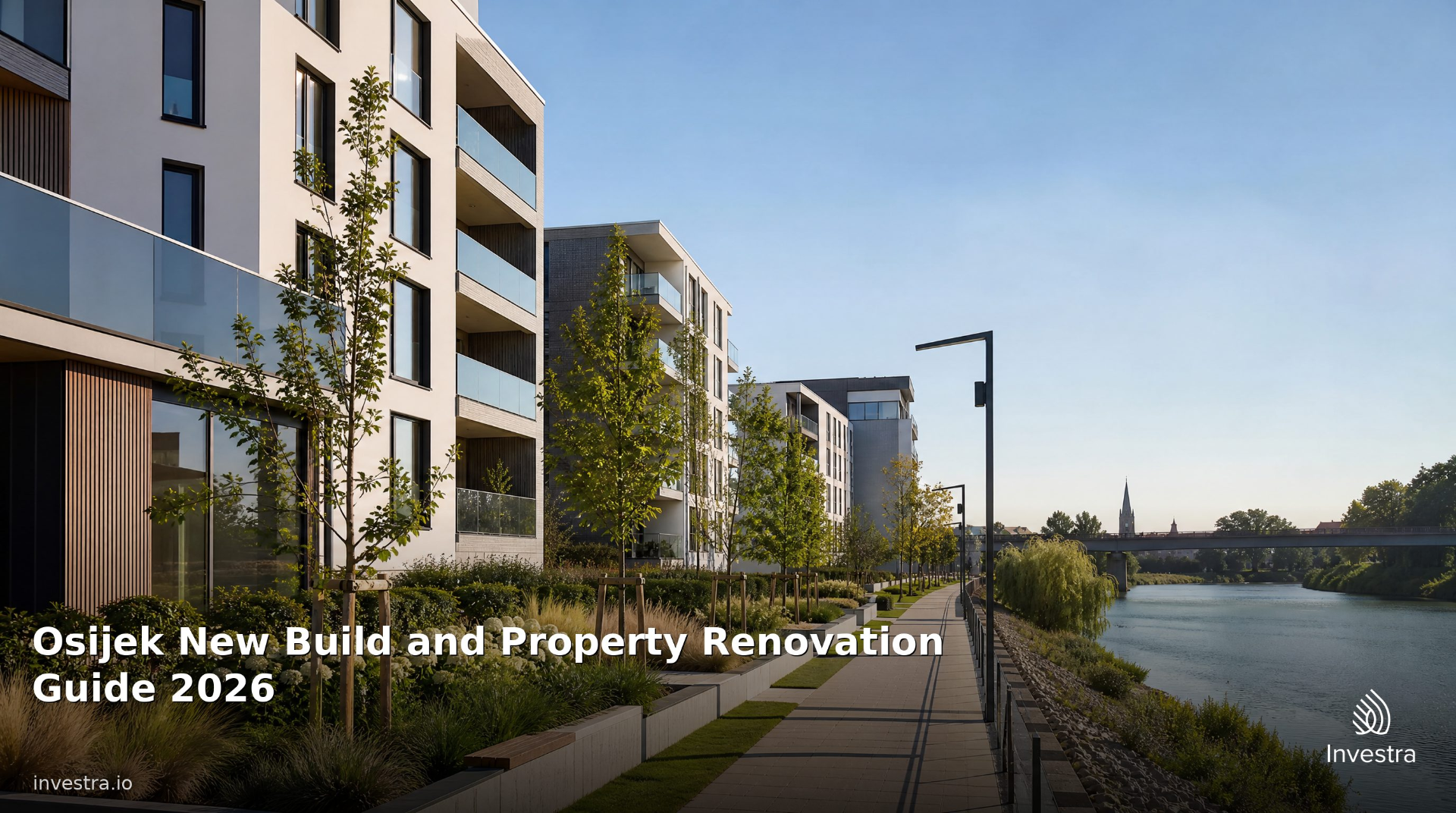
Osijek New Build and Property Renovation Guide 2026
Osijek New Build and Renovation Market Overview 2026
Quick Answer: Osijek's new build and renovation market in 2026 offers some of Croatia's most affordable entry points, with new construction prices ranging from €1,200 to €2,500/m² and renovation properties starting as low as €500/m² in emerging districts. Investra.io tracks this market closely as one of Croatia's most undervalued investment destinations for 2026.
Osijek rarely features in lists of headline Croatian hotspots, but that relative anonymity is a practical advantage. As Croatia's fourth-largest city and the economic hub of Slavonia, Osijek combines institutional stability with a low-cost property base. Its river location on the Drava and the presence of a major university create a diversified local demand profile that supports both long-term rental and a measured short‑term tourism niche.
Since the country's euro adoption in January 2023 the local market has moved: prices across Croatia rose, and Osijek saw a meaningful adjustment upward. Even so, the city remains significantly cheaper than coastal centres. That gap is what attracts investors looking for better entry yields and lower absolute capital outlay. In 2026 investors benefit from clearer regulatory standards, improving transport links, and a steady inflow of EU structural funds aimed at urban regeneration. This combination makes Osijek an interesting forward-looking choice for those prepared to engage with renovation and medium-term development projects rather than quick speculative flips.
Understanding Osijek's Property Landscape: Districts, Typologies, and Market Dynamics
Quick Answer: Osijek's property market divides into four main zones — the historic Tvrđa core, the inner residential belt, new-build suburbs, and rural periphery — each with distinct price ranges and investment profiles suited to different strategies.
To evaluate opportunities, break the city down into its functional districts. Each district type implies different risk parameters, timeframes and return profiles.
Tvrđa (Historic Core) — The fortress quarter is architecturally significant and subject to heritage protections. Projects here can produce high‑quality, unique apartments but require specialist consent and higher renovation budgets. Expect higher per‑square‑metre sales values following refurbishment but longer delivery times and stricter documentation.
Inner Residential Belt (Gornji Grad, Donji Grad) — These centrally located areas are where student and public sector rental demand is strongest. Typical stock includes pre‑war buildings and social‑housing blocks; properties here are well suited for standard renovations offering consistent rental returns.
New Build Suburbs (Sjever, Retfala, Nemetin) — Developer activity is concentrated at the growth edge. Land is cheaper, planning can be more straightforward, and developer‑led schemes offer modern amenities. Buyers choosing off‑plan units should examine developer track records and warranty arrangements closely.
Drava Riverfront — Riverfront apartments attract owner‑occupiers and niche short‑term visitors interested in cycling, nature and architecture. These locations command a premium and suit buy‑to‑hold investors or higher‑spec short‑term rentals.
Understanding these typologies and their demand drivers is essential to matching acquisition strategy to expected returns. For comparative context on Croatian markets and taxation that will affect these choices, consult the Croatia Property Tax Guide 2026 What Foreign Buyers Must Know.
New Build Development in Osijek: What's Being Built and What It Costs
Quick Answer: New build apartments in Osijek range from €1,200 to €2,500/m² in 2026, with construction costs for self-build or developer-commissioned projects typically running €900 to €1,400/m² depending on specification, excluding land acquisition.
Developer activity has expanded since the currency transition stabilized investment planning. The pipeline includes mid‑rise blocks in Sjever, infill boutique projects in the inner city, and riverfront developments testing premium pricing. Off‑plan pricing for standard finishes commonly sits between €1,300 and €1,800/m², while premium specification units push toward €2,500/m².
For self‑commissioned projects, understand the cost components: raw construction, professional fees, utilities and connection charges, land acquisition, and mandatory insurance and completion certification. Local mid‑range construction is broadly €900–€1,100/m²; higher specifications, energy efficiency measures and premium finishes increase costs to €1,100–€1,400/m². Land values fluctuate by location — inner suburban serviced plots can cost €80–€150/m² of plot area; peripheral land is substantially cheaper. Heritage zones, when available for redevelopment, command much higher plot premiums when they appear on the market.
Conversions of industrial buildings into loft apartments are becoming a visible theme. These can deliver attractive margins if the developer can manage structural remediation and contamination risk. Typical conversion projects in Osijek often sit in the €1,000–€1,300/m² total development cost band and achieve sale prices in the €1,600–€2,000/m² range when executed well.
Renovation Opportunities: The Case for Buying and Upgrading Old Stock
Quick Answer: Renovation projects in Osijek offer some of Croatia's best value-add opportunities, with unrenovated properties acquirable at €500-€1,100/m² and renovation costs of €400-€900/m² producing finished assets worth significantly more than the combined investment in many cases.
Most of Osijek’s housing stock was built in the mid‑20th century and many units have been underinvested for decades. That creates a predictable pipeline of properties where targeted capital can materially improve rental income and sales value. The practical path for many investors is to buy an unrenovated apartment, complete a controlled renovation and either hold for rental income or sell post‑refurbishment.
Example economics for a typical inner‑city two‑bedroom: purchase at market for €55,000–€80,000 with renovation costs of €25,000–€45,000 yields a fully refurbished asset that rents or sells at a materially higher level. On the rental side, renovated two‑beds can achieve €350–€550 monthly depending on location and specification, resulting in gross yields that compare favourably with coastal markets once acquisition costs are accounted for. Renovations also reduce maintenance and energy costs over time, improving net operating income.
Key practical considerations include ensuring the building's common areas and structure are addressed. Many buildings will need roof works, facade insulation or stairwell repairs; these are often addressed through building‑wide renovation programmes and may qualify for national or EU subsidy support. Engaging an architect or building manager to coordinate apartment and common‑area works helps avoid partial renovations that leave the asset mismatched with its building environment.
For investor commentary on Slavonian markets and renovation case studies, see the work of Siniša Dagary investment insight and related posts on strategy and local dynamics.
Legal Framework for New Build Purchases and Renovation Projects
Quick Answer: EU citizens can purchase property in Croatia on equal terms with Croatian nationals, while non-EU buyers face reciprocity requirements; both new builds and renovation projects require mandatory building permits, professional supervision, and compliance with Croatian construction law — skipping any of these steps creates serious legal and financial exposure.
Croatian property law has been modernised but retains local specificities that require attention. EU nationals purchase with the same rights as Croatian citizens. Non‑EU buyers should confirm reciprocity and, where agricultural land is involved, expect additional restrictions.
For construction, the građevinska dozvola (building permit) is required for new buildings. Applications must be supported by architectural drawings from a licensed Croatian architect, structural documentation, utility connection confirmations and title documentation. Renovations that affect load‑bearing elements, facades or the use of space also require a permit or official notification. Heritage areas such as Tvrđa add an extra approval layer from conservation authorities.
Technical supervision by a licensed engineer is mandatory. On completion, energy performance certification is enforced. Failing to adhere to these rules is a common source of costly delays and penalties. For tax consequences linked to transaction structure, consult the Croatia Property Tax Guide 2026 What Foreign Buyers Must Know.
Construction Costs, Renovation Budgets, and What to Expect From Local Contractors
Quick Answer: Total renovation costs in Osijek range from €400-€500/m² for basic refreshes to €700-€900/m² for comprehensive high-spec renovations, while new build construction costs run €900-€1,400/m² excluding land — and budget contingencies of 15-20% are strongly advised given current material and labour cost volatility.
Current construction economics in Osijek are favourable relative to coastal and capital markets, but the supply of skilled labour is tighter than in previous years. Emigration of experienced tradespeople to other EU markets has reduced local capacity. Expect competition for reputable contractors and longer lead times for specialist trades.
Breakdown for renovation scopes remains consistent with national standards: basic cosmetic refreshes at the lower end, standard mechanical and finishing upgrades in the middle, and full structural and heritage‑compliant restorations at the higher end. Heritage projects require specialist craftsmen and materials which drive up cost and prolong schedules.
Materials procurement will affect timelines and budgets. Standard Croatian suppliers are competitive for most finishes. For premium fittings investors commonly source products from neighbouring EU countries; engaging cross‑border procurement channels through reputable advisors can improve quality and sometimes cost. For financial planning and investment structuring, consider advice from firms such as Findes Group & Partners, which operate across the region.
Always include a contingency of 15–20% and schedule buffer time. Hidden conditions in older buildings are common; asbestos removal, outdated wiring and drainage defects are typical discoveries when walls are opened. A staged inspection and conditional tendering strategy helps minimise surprises: commission condition surveys, then price works in phases so that major unknowns are addressed under controlled contractual terms.
Rental Market Analysis: Long-Term vs Short-Term Yields in Osijek
Quick Answer: Osijek delivers long-term rental yields of 5-8% on well-located properties and short-term rental yields of 7-12% for appropriately positioned and managed units — solid figures that compare favourably even against Croatia's more celebrated coastal markets when acquisition cost is factored in.
Osijek's rental market is driven by steady, year‑round segments rather than seasonal spikes. Core demand pockets include university students, medical professionals and public sector workers, while niche tourism—nature, cycling and baroque heritage—supports a growing short‑term market. Digital nomads also contribute a premium segment, staying months rather than weeks and seeking high‑quality, equipped apartments.
Long‑term rents for renovated apartments in central locations typically place studio and one‑bed units in the €250–€350/month bracket, two‑bedrooms at €350–€500/month and larger family units higher. Gross yields of 5–8% are realistic after factoring transaction and renovation costs.
Short‑term rental products can command higher nightly rates, particularly in riverfront or well‑appointed city centre locations. Expect average daily rates of €60–€150 depending on size and quality, with occupancy between 45–65% across the year. Short‑term operations require active management, reliable cleaning and marketing, and compliance with local registration rules. For guidance on digital nomads and how that cohort affects demand patterns, read Croatia Digital Nomad Visa 2026 Complete Guide For Remote Workers.
Taxes, Fees, and the True Cost of Acquisition and Development
Quick Answer: Buyers of new build properties in Croatia pay 25% VAT (included in developer price), while purchasers of existing properties pay 3% real estate transfer tax; renovation investors must also account for income tax on rental proceeds (12% flat rate for individuals) and capital gains tax (24% if sold within 2 years) when calculating total return.
The tax regime materially influences deal viability. New build purchases include 25% VAT and avoid the 3% transfer tax that applies to second‑hand properties. Buyers should compute notary costs, agent fees and legal fees into acquisition budgets. Agent commissions typically range 2–3% and notary fees 0.5–1% of the transaction value.
Rental income is subject to taxation in Croatia. Individuals renting furnished properties can be taxed at a flat 12% on gross income after a 30% standard deduction or elect to report net income with progressive rates when documented costs are higher. Capital gains rules favour holding for more than two years; sales within two years are subject to a 24% tax on gains for individuals.
Detailed scenarios and structuring options are discussed in depth in Investra's guides; consider consulting the Croatia Property Tax Guide 2026 What Foreign Buyers Must Know and specialist advisors such as Siniša Dagary investment insight for portfolio planning.
EU Funding and Subsidies: How Renovation Investors Can Access Grant Money
Quick Answer: Croatia has access to substantial EU Cohesion and Structural Funds specifically directed at urban regeneration and energy renovation in cities like Osijek, with individual property owners potentially eligible for subsidies covering 30-60% of qualifying energy renovation costs through national and EU-funded programmes.
Osijek benefits from national and EU programmes targeting energy efficiency and urban regeneration. The National Renovation Programme and related initiatives co‑finance facade insulation, window replacement, heating upgrades and renewable systems. Subsidy levels depend on income categorisation of beneficiaries and the building's status, with potential support that meaningfully reduces out‑of‑pocket renovation costs.
Accessing these funds requires an energy audit, approved technical documentation and compliance with specific standards. Application processes can be bureaucratic; working with a consultant experienced in subsidy applications increases success rates. Many companies now offer turnkey assistance combining energy audits, project management and subsidy submission to simplify the process for apartment owners and investor groups.
For regional financial planning and structuring, investors sometimes combine grant funding with cross‑border procurement and financing channels. Firms such as Findes Group & Partners can provide advisory input into financing and procurement strategies, particularly for larger portfolios or mixed commercial-residential projects.
If you want sector-specific examples, Investra maintains a library of domestic and coastal case studies. See related Investra analyses on asset classes and legal frameworks including guides on coastal investments and city markets: Split Airbnb Investment 2026 Rental Income Best Areas Leg..., Hvar Island Real Estate 2026 Luxury Property Investment G... and Dubrovnik Airbnb Investment 2026 Luxury Rental Income Guide.
Due Diligence, Project Roadmap and Practical Steps for Investors
Quick Answer: Successful projects follow a clear roadmap: market research, legal and technical due diligence, planning and permitting, contractor procurement, staged construction with technical supervision, commissioning and compliant rental or sales registration.
A simple pragmatic checklist helps convert opportunity into deliverable projects:
- Initial market assessment — verify comparable prices, target rents and demand drivers for your chosen district.
- Legal title and planning check — confirm ownership, encumbrances, zoning, and whether the plot lies in a protected area.
- Technical due diligence — commission a condition survey, structural inspection and energy audit where relevant.
- Budgeting and financing — obtain preliminary financing terms and define a cashflow schedule including contingency.
- Design and permitting — engage a licensed architect and submit the necessary permit documentation; expect 30–90 days for standard permits.
- Contractor procurement — tender to multiple contractors, verify references and insurance and choose a contract form that allocates risk appropriately.
- Construction phase — ensure technical supervision by a licensed engineer, staged inspections and a holdback for latent defect liability.
- Completion, certification and registration — secure the required energy performance certificate and municipal sign‑offs before occupancy or listing.
- Operational setup — if letting, register with tax authorities, set up local property management and ensure compliance with short‑term rental registration if applicable.
Engaging local professional advisers reduces friction. Consult experienced tax and legal advisors early; use local project managers to coordinate contractors and municipal approvals. For advisory services and local expertise, see the consultancy pages of regional experts at Siniša Dagary investment insight and Investra's market research pages such as Investra market research.
Investment Disclaimer
Quick Answer: The information in this guide is general and educational; it is not investment advice and you should perform independent due diligence with professional advisors before making investment decisions.
The contents of this guide are provided for information only and reflect market conditions and regulatory frameworks at the time of publication. Real estate investment involves risk, including liquidity risk, regulatory changes and market fluctuations. Past performance does not guarantee future results. Readers should not construe any content here as a recommendation to buy or sell property and should consult qualified legal, tax and financial professionals for advice tailored to their circumstances. Investra and the author make no warranty as to accuracy or completeness and accept no liability for investment outcomes.
Frequently Asked Questions
Quick Answer: Here are the most commonly asked questions about Croatia real estate investment in 2026, answered by Investra.io experts.
Is Croatia a good country for real estate investment in 2026?
Yes. Croatia's property market has matured with improved infrastructure and clearer regulation. While coastal markets remain high-value, inland cities such as Osijek offer lower entry prices, stable rental demand and EU subsidy access that can enhance project returns. For broader country tax and regulatory context, consult Investra resources like the Croatia Property Tax Guide 2026 What Foreign Buyers Must Know.
Can foreigners buy property in Croatia?
EU nationals can purchase on equal terms with locals. Non‑EU nationals should verify reciprocity rules or seek legal confirmation. Agricultural land and protected locations have specific additional rules, so obtain legal advice early in the process.
What is the average property price in Osijek?
Average prices vary by location and condition. New builds usually list between €1,200 and €2,500/m² in 2026; older, unrenovated stock can be found at €500–€1,100/m² depending on district and building condition. Contact local brokers for up‑to‑date comparables.
What renovation costs should I budget for?
Costs depend on scope: basic refresh €150–€300/m², standard renovation €400–€550/m², comprehensive high‑spec €650–€900/m² and heritage works €800–€1,200/m². Include a 15–20% contingency for unforeseen works, particularly in older buildings.
How long does the permit process take for new builds?
Permitting timelines for straightforward projects are typically 30–90 days. Complex applications, heritage approvals or projects requiring environmental assessments will extend that timeframe. Factor this into delivery schedules and financing plans.
What rental yields can I expect in Osijek?
Long‑term yields of 5–8% are realistic for well‑located, renovated properties. Short‑term yields can reach 7–12% if properties are positioned strategically, professionally managed and located near key attractions or transport nodes.
Are EU renovation grants accessible for private investors?
Yes. Croatia allocates EU structural funds to energy renovation and urban regeneration programmes. Eligibility depends on building type, beneficiary income level and the technical scope of works. Application requires an energy audit and compliance with technical and administrative requirements.
What taxes apply when buying new or existing property?
New builds sold by developers include 25% VAT and are exempt from transfer tax; used properties attract a 3% transfer tax. Rental income and capital gains rules also apply—seek specialist tax advice to optimise structure and timing of sales.
Should I manage renovation projects remotely?
Local management is recommended. Employ a local project manager and licensed supervisor to coordinate contractors, handle permit interactions and ensure technical compliance. Remote oversight is possible for investors who contract trusted local teams.
Who can help structure financing for a portfolio of properties?
Specialist advisors and regional financial planners are advisable. For cross‑border financing, procurement and tax structuring, consider firms such as Findes Group & Partners and consult local mortgage providers and international lenders to secure competitive terms.
Recommended Reading
Quick Answer: This section explains the practical property-investment implications of Recommended Reading.
- Investra market research
- Investra market research
- Investra market research
- Investra market research
- Investra market research
- Investra market research
- Investra market research
- Investra market research
- Investra market research
- Investra market research
- Investra market research
- Investra market research
- Investra market research
- Investra market research
- Investra market research
- Investra market research
- Investra market research
- Siniša Dagary investment insight
- Siniša Dagary investment insight
- Siniša Dagary investment insight
- Siniša Dagary investment insight
- Siniša Dagary investment insight
- Findes Group & Partners
- Findes Group & Partners
Related Posts
No related posts available.
