
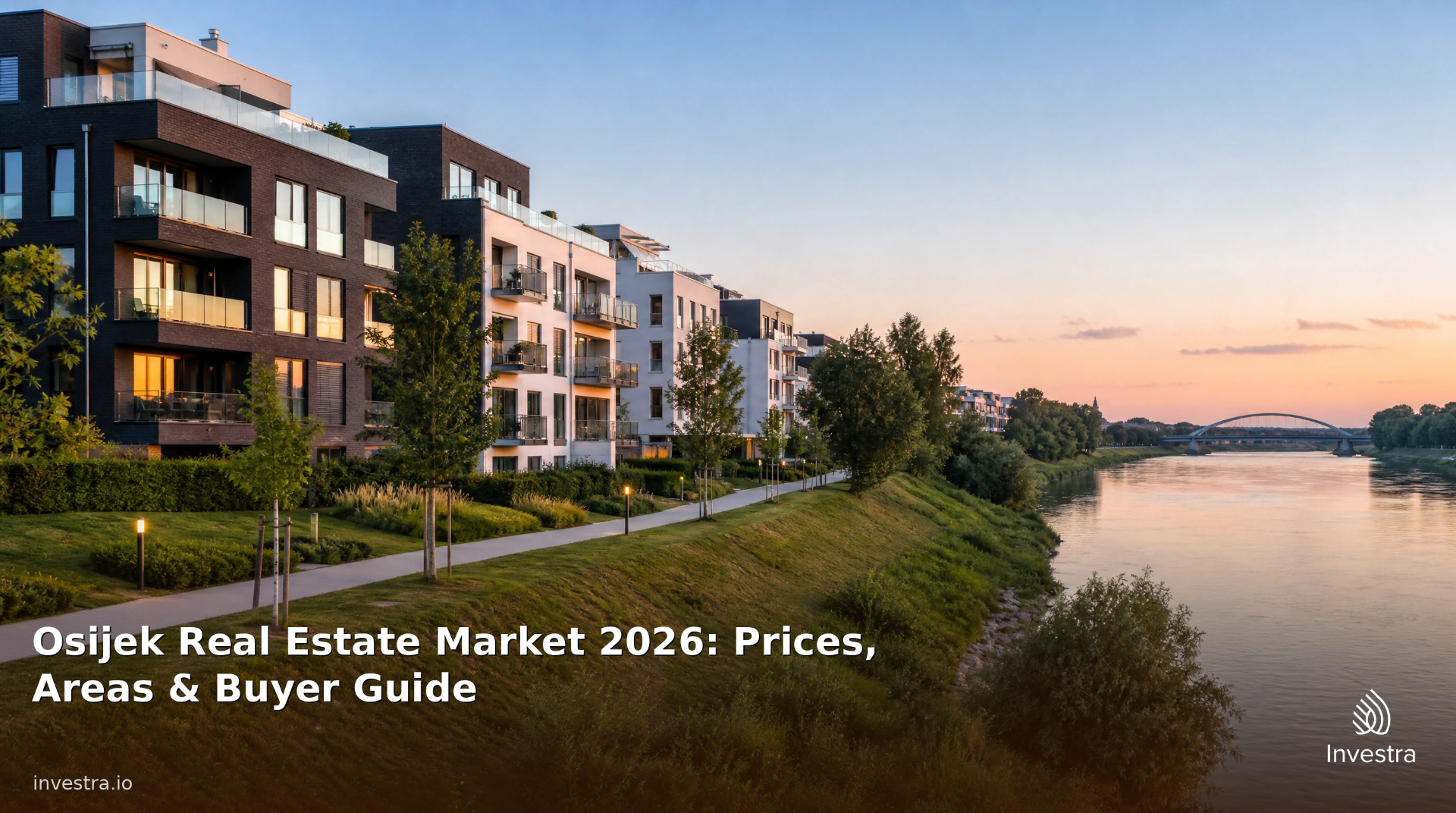
Osijek Real Estate Market 2026: Prices, Areas & Buyer Guide
Osijek Real Estate Market 2026: Why This Overlooked City Is Gaining Investor Attention
Quick Answer: Osijek's real estate market in 2026 offers some of Croatia's most affordable urban entry points, with typical prices between €1,000 and €2,500 per m², steady rental demand driven by a 17,000‑student university, and structural uplift from EU infrastructure spending and improved connectivity.
When international conversations about Croatian property turn to coastlines, Osijek usually remains off the table. That omission changes the risk and opportunity profile for many investors. Located in eastern Slavonia on the Drava River, Osijek is Croatia's fourth‑largest city by population (around 84,000) and an active regional centre for education, healthcare and administration.
In 2026 the market shows a combination of affordability and structural demand that contrasts with tourist‑driven coastal markets. EU cohesion and national infrastructure investment have focused resources on road and rail links, reducing travel times to Zagreb and beyond. That improved accessibility, combined with steady student occupancy from Josip Juraj Strossmayer University, has produced rental demand that is less seasonal and more predictable than tourism‑centric assets.
The profile of buyers, the scale and character of supply, and the local legal environment are all different than on the Adriatic. As a result, an investor who wants reliable year‑round rents, lower purchase prices and higher yields per euro deployed will find Osijek an attractive alternative. The following sections summarise prices, neighbourhood dynamics, expected yields, legal and tax considerations, and practical steps to evaluate opportunities.
Osijek Property Prices in 2026: A Detailed Breakdown by Property Type and Location
Quick Answer: In 2026 Osijek prices typically range from roughly €1,000 to €2,500 per m², with the highest values concentrated in the historic city centre and riverfront and the most affordable stock in expanded residential neighbourhoods and peripheral semi‑rural plots.
Osijek's pricing is easier to map than many Croatian cities because clear geographic and typological patterns persist. The historic centre (Gornji Grad) captures a price premium for renovated apartments and townhouses, reflecting architectural value and limited supply. Riverfront locations and the Drava corridor are the next tier, combining lifestyle features with good connectivity.
To place numbers against those categories: renovated central apartments in Gornji Grad often trade in a band around €1,800–€2,500 per m². Riverfront and high‑amenity corridors commonly list in the €1,500–€2,200 per m² range. Broad market stock in established neighbourhoods such as Retfala, Sjenjak and Donji Grad typically sits between €1,000 and €1,600 per m², offering entry opportunities for yield‑focused buyers.
Standalone houses and plots on the semi‑rural fringe of the city form a separate market segment where transaction values are determined by land area and building condition rather than strict €/m² urban comparators. Typical detached properties on larger plots change hands in price bands that reflect broader rural comparators and can represent relative value for buyers seeking space at lower unit prices than coastal equivalents.
These price brackets are important for modelling yield and capital appreciation scenarios. New‑build premiums, renovation margins and the relative scarcity of restored historic units all shape investment choices.
Neighbourhood Guide: The Best Areas to Buy in Osijek
Quick Answer: Gornji Grad is the prestige address for capital preservation, Sjenjak and areas near the university deliver robust rental yields, and riverfront and newly developed eastern zones offer lifestyle appeal and modern specifications for families and professionals.
Osijek is compact enough that neighbourhood choices are not about vast commutes but about tenant profiles, resale liquidity and maintenance expectations. Gornji Grad (Upper Town) is the city's historic core. It attracts buyers who value architectural character and long‑term price stability. Properties here are limited in supply and command a premium, but yield expectations typically sit lower relative to student‑focused neighbourhoods.
Donji Grad and riverfront corridors blend restored buildings and pockets of value‑add opportunity. Buy‑to‑renovate projects in Donji Grad can be particularly attractive when acquisition prices are at the lower end of the local band and refurbishment delivers modern layouts and finishes that command higher rents. These areas benefit from regeneration initiatives and proximity to central amenities.
Sjenjak is important for investors seeking immediate rental cash flow. Its proximity to the university generates continuous demand for smaller units and studios. The building stock here varies; many units are older and require ongoing maintenance, an operational trade‑off compensated by higher gross yields.
Retfala offers stable family rental demand and lower tenant turnover. Yields are typically slightly lower than Sjenjak but occupational stability is higher, which reduces operational friction and long‑term vacancy risk. Novy Grad and other new development pockets on the eastern periphery represent longer‑term supply expansion in modern product—these zones are attractive to families and owner‑occupier buyers and may suit developers and early buyers seeking better specifications and developer incentives.
Rental Yields and Investment Returns: What the Numbers Actually Say
Quick Answer: Gross rental yields in Osijek commonly range from 5% to 9% depending on property type and location, with student‑oriented apartments producing the highest gross yields and central historic stock delivering lower yields but stronger capital growth potential.
Yields in Osijek are driven by stable resident demand rather than short‑season tourism, and that has implications for cash flow timing, tenant selection and management model. Student accommodation in Sjenjak demonstrates the clearest high‑yield case: a compact apartment in the 35–45 m² range acquired at market entry prices can generate rental income sufficient to produce gross yields in the high single digits.
In mid‑range residential neighbourhoods, yields remain attractive while offering lower operational intensity. Two‑bedroom apartments in Retfala or Donji Grad rented to families or working professionals produce reliable income, lower turnover and predictable maintenance cycles. Gross yields here commonly fall in the mid‑single digits to high‑single digits range.
Capital growth should be viewed through a multi‑year lens. Osijek recorded material price increases since 2020 and analysts monitoring the market expect continued appreciation in the medium term, supported by supply constraints in desirable neighbourhoods and continued infrastructure investment. Those trends are less volatile than tourism‑led spikes, producing a more predictable total return profile for investors focused on steady, long‑run outcomes.
Who Is Buying in Osijek? The Investor Profiles Driving This Market
Quick Answer: The buyer mix is dominated by domestic Croatian purchasers, with growing interest from the Croatian diaspora, German and Austrian investors, and a small but rising cohort of digital nomads and foreign professionals seeking affordable, stable urban living.
Understanding the active buyer profiles explains how prices behave and which risks are most relevant. Domestic buyers—local professionals, families and investors from larger Croatian cities—still account for the majority of transactions and provide a stabilising influence on pricing. That domestic depth reduces the risk of rapid price gyrations induced by short‑term overseas speculation.
The Croatian diaspora, particularly in Germany, Austria and Canada, represents an important international buyer group. These purchasers combine emotional connections with pragmatic investment objectives: many buy properties that will serve as family homes during visits while also functioning as lettable assets the rest of the year. The diaspora segment is significant because it supports demand for mid‑range housing across multiple neighbourhoods.
German and Austrian investors with no diaspora ties are increasingly active, attracted to the yield differential and euro‑denominated market (Croatia adopted the euro in 2023). Their activity is generally measured and yield‑focused. The digital nomad segment, enabled by Croatia's Digital Nomad Visa program, is not as large in Osijek as on the coast, but it is expanding; some remote workers initially rent and later convert to purchases when they seek stability and community at lower cost than coastal hubs.
For buyers seeking advisory services and a practical, local perspective on transaction execution, Siniša Dagary provides consulting and market insight. Practical support ranges from market research and due diligence to advisory on structuring and local operations. Contact options and information about services and published analyses are available through Siniša Dagary investment insight pages and service descriptions.
The Legal Process for Buying Property in Osijek as a Foreign National
Quick Answer: EU/EEA citizens enjoy full purchase rights; non‑EU nationals typically require ministry approval on reciprocity grounds that is handled via Croatian legal counsel and can add several months to transaction timelines. The technical process—from preliminary contract to final notary contract and land registry registration—normally completes in 2–4 months for straightforward deals.
Croatia's legal framework for property acquisition is well‑documented, but buyers must follow formal steps carefully to avoid avoidable delays. For EU and EEA citizens, there are no pre‑approval restrictions and transactions proceed under standard civil property procedures.
Practical steps include negotiating and signing a preliminary purchase agreement (Predugovor) with a deposit—commonly 10%—followed by completion of the notary‑executed final purchase contract (Kupoprodajni ugovor). The buyer then registers the purchase with the Croatian land registry (Zemljišna Knjiga). Throughout, title searches and verification of land registry records are critical, particularly in Slavonia where legacy issues from the 1990s conflicts can complicate chains of title.
Budgeting for transaction costs is part of prudent planning. Typical legal and notary costs for a straightforward transaction commonly fall within a modest range, but complex cases—such as those involving disputed inheritance or incorrect registry entries—can require additional legal work and time. For tailored legal walkthroughs applicable across Croatia, Investra's country guides provide detailed process descriptions that apply to Osijek as well as other Croatian markets.
Taxes and Ongoing Costs: What Foreign Buyers Must Budget For
Quick Answer: Budget a 3% real estate transfer tax for resales (new builds are dealt with through VAT), modest annual property tax based on m², and total acquisition costs roughly 5–8% above purchase price when legal, notary and registry fees are included. Rental income tax treatment differs for residents and non‑residents.
Taxation and recurring costs materially affect net returns and should be modelled from the outset. For resale transactions the real estate transfer tax (RETT) at 3% applies to the purchase price and is payable within the statutory timeframe after registration. For new construction, the developer typically invoices the buyer including VAT and there is no separate transfer tax for the buyer. Understanding the distinction between resale and new‑build tax treatment is essential to avoid surprises when comparing headline prices.
Annual property tax in Osijek is comparatively low and assessed on a per‑square‑metre basis with modest municipal rates. Rental income is taxed under Croatian rules: residents generally pay tax on net rental income with allowable deductions, while non‑residents may be subject to withholding regimes and differing rates. When modelling yields, include management fees, maintenance provisions, insurance and occasional capital expenditure for building systems and facades.
Financing costs are also a component of ongoing expense analysis. Local mortgage markets lend to foreign buyers in many cases but with more conservative loan‑to‑value ratios and interest margins than for residents. Where local borrowing is limited, international buyers often rely on cash, home‑country lending or structured finance solutions provided by specialist advisors.
Osijek's Economic Fundamentals: Why the Investment Case Is Strengthening
Quick Answer: The investment case in Osijek rests on durable demand drivers: EU-funded infrastructure upgrades, a significant student population of roughly 17,000 enrolments, improving regional employment and eurozone membership that eliminates currency risk for euro‑based investors.
Osijek's economy functions as the administrative and service centre for Osijek‑Baranja County and the wider Slavonia region. Historically the area experienced slower economic development compared with the coastal and Zagreb regions, but targeted EU Cohesion Fund allocations and national programmes since EU accession have materially upgraded roads, public facilities and industrial infrastructure.
The university is central to the housing demand equation. With around 17,000 students across multiple faculties, annual rental demand for student‑oriented accommodation is large relative to the city's housing stock. Universities are reliable, recurring demand sources, and that stability is a major attraction for investors who prioritise predictable cash flows over seasonal volatility.
Croatia's euro adoption in 2023 simplified cross‑border comparisons and removed a layer of currency risk that previously deterred some foreign buyers. That change, combined with relatively lower entry prices and attractive yields, makes Osijek easier to evaluate against eurozone alternatives.
Comparing Osijek to Croatia's Coastal Markets: An Honest Assessment
Quick Answer: Osijek offers lower entry prices and higher year‑round yields than coastal markets, but coastal cities maintain stronger short‑term revenue and higher peak capital appreciation potential. The ideal choice depends on whether you prioritise steady rental income or tourism‑led upside.
Comparing Osijek to Split, Dubrovnik or Hvar is instructive because it clarifies risk preferences. Coastal markets deliver exceptional short‑term income during peak seasons and strong capital appreciation in premium locations; however, that model also implies seasonality, higher entry costs and regulatory complexity with short‑term letting. Osijek’s model is the inverse: lower purchase prices, higher yields per invested euro, and more even rental cash flow across the calendar.
For investors weighing these options, coastal benchmarks and detailed guides to buying in Split and Dubrovnik are important reference points. Investra's market research and city‑specific guides illustrate how seasonality and local regulation shape outcomes for short‑term rental strategies versus resident‑driven rental strategies. Those materials help frame a clear comparison between the income profiles and capital return expectations of coastal assets and inland markets such as Osijek.
For European investors focused on yield and lower operational risk, Osijek frequently represents a compelling alternative. For buyers chasing maximum capital upside and high nightly income in a tourism hotspot, the coast will often remain the preferred target. Both strategies can be valid, but they require different asset selection, management intensity and exit planning.
Due Diligence, Negotiation and Exit Strategies
Quick Answer: Rigorous legal due diligence, clear renovation and management budgets, pragmatic negotiation on price and condition, and a pre‑defined exit strategy tailored to neighbourhood liquidity are essential to capture the expected returns in Osijek.
Successful investment in Osijek follows a clear playbook: start with thorough due diligence, include conservative cost and yield assumptions, and build an exit plan that fits local liquidity patterns. Due diligence should encompass title and registry checks, physical surveys for building condition and systems, an energy performance review where available, and confirmation of any outstanding municipal obligations or charges.
Negotiation situations in Osijek tend to be rational. Domestic buyers—who form the majority of demand—are often price‑sensitive and transact at moderate multiples relative to coastal peers. Sellers in the city are typically motivated by life events, relocations or estate settlements, which creates windows for disciplined buyers to secure attractive entry pricing.
Exit considerations should be defined at acquisition. In Gornji Grad you will likely target a slower, capital‑preservation exit to buyers who prize restored architecture. In student zones you should expect more active management, potentially higher turnover, and quicker resale options to local investors or diaspora buyers. For financial planning and structured exits, Findes Group & Partners can assist with financial modelling and sale structuring to align exit timing with tax and market cycles.
Investment Disclaimer
Quick Answer: This article presents informational content about the Osijek market and does not constitute investment, tax or legal advice. Readers should perform their own due diligence and consult qualified advisors before acting.
The information published here is intended for educational and informational purposes only. Real estate investing carries inherent risks. Historical performance does not guarantee future returns. Individual circumstances vary widely; readers should not rely solely on this material to make investment decisions. Independently verify all facts, consult licensed legal and tax professionals about specific transactions, and evaluate investment suitability based on personal financial circumstances and risk tolerance.
Frequently Asked Questions
Quick Answer: Below are common questions investors ask about Croatian property markets and Osijek specifically, summarised with factual guidance and references to further resources.
Is Croatia a good country for real estate investment in 2026?
Croatia continues to offer opportunities in 2026 thanks to improving infrastructure, relatively affordable prices versus many Western European markets, and clear differentiation between coastal tourism markets and inland residential markets. Investment suitability depends on your strategy—yield versus capital growth—and your appetite for transactional complexity.
Can foreigners buy property in Croatia?
EU/EEA citizens can purchase without special approval. Non‑EU nationals typically require ministry approval on reciprocity grounds. A Croatian solicitor can manage the process. For details on legal frameworks across cities, reference Investra's city guides and consult local counsel.
What is the average property price in Osijek?
Prices in Osijek vary by area and condition. A useful working range in 2026 is roughly €1,000–€2,500 per m², with premium renovated units in the historic core at the top end and peripheral residential stock at the bottom end. New builds command a premium over resales.
What rental yields can I expect?
Expect gross yields from about 5% to 9% depending on property type and tenant profile. Student apartments often deliver the highest gross yields, while historic centre units show lower yields but can appreciate steadily over time.
What taxes apply to property purchases?
Resale transactions normally attract a 3% real estate transfer tax; new builds are transacted with VAT charged by the developer. Annual property tax is low per square metre, and rental income is subject to Croatian tax rules that differ for residents and non‑residents. Consult Investra's property tax guide for a detailed breakdown.
How long does the purchase process take?
For clean transactions, the process from an agreed offer to land registry registration typically takes 2–4 months. If a non‑EU national requires ministry approval, expect an additional 3–6 month process for that stage.
What financing options are available?
Croatian banks lend to residents and select foreign buyers but often on conservative terms for non‑residents. Many international purchasers use cash or home‑country financing; specialist advisory firms also arrange structured financing. For mortgage advisory consult Findes Group & Partners' services.
Is property management available for rental properties?
Yes. Local and regional property management services cover tenant sourcing, maintenance and compliance. Investra partners with management providers to support investors who prefer hands‑off ownership arrangements.
What are the best areas to invest in Osijek?
Gornji Grad for capital preservation and prestige, Sjenjak for student rental yields, Retfala for family rentals and lower turnover, and riverfront corridors for lifestyle appeal. Your target tenant profile and exit timeline should determine neighbourhood choice.
How do I handle legacy land registry issues?
Engage an experienced Croatian notary and property lawyer to perform exhaustive registry checks and to trace chains of ownership. Where inheritance or post‑conflict documentation gaps exist, legal remediation is often possible but can add time and cost. Proper legal review is essential to avoid ownership disputes after acquisition.
Can I mix short‑term and long‑term letting in Osijek?
Yes. Blended strategies can optimise annualised income when managed prudently. Short‑term lets perform best in central, well‑presented apartments, while long‑term lets provide base cash flow. Local regulations and occupancy patterns should guide how you allocate nights and marketing effort.
Recommended Reading
Quick Answer: This section explains the practical property-investment implications of Recommended Reading.
- Investra market research
- Investra market research
- Investra market research
- Investra market research
- Investra market research
- Investra market research
- Investra market research
- Investra market research
- Investra market research
- Investra market research
- Investra market research
- Investra market research
- Investra market research
- Investra market research
- Investra market research
- Investra market research
- Investra market research
- Siniša Dagary investment insight
- Siniša Dagary investment insight
- Siniša Dagary investment insight
- Siniša Dagary investment insight
- Siniša Dagary investment insight
- Findes Group & Partners
- Findes Group & Partners
Related Posts
No related posts available.
