
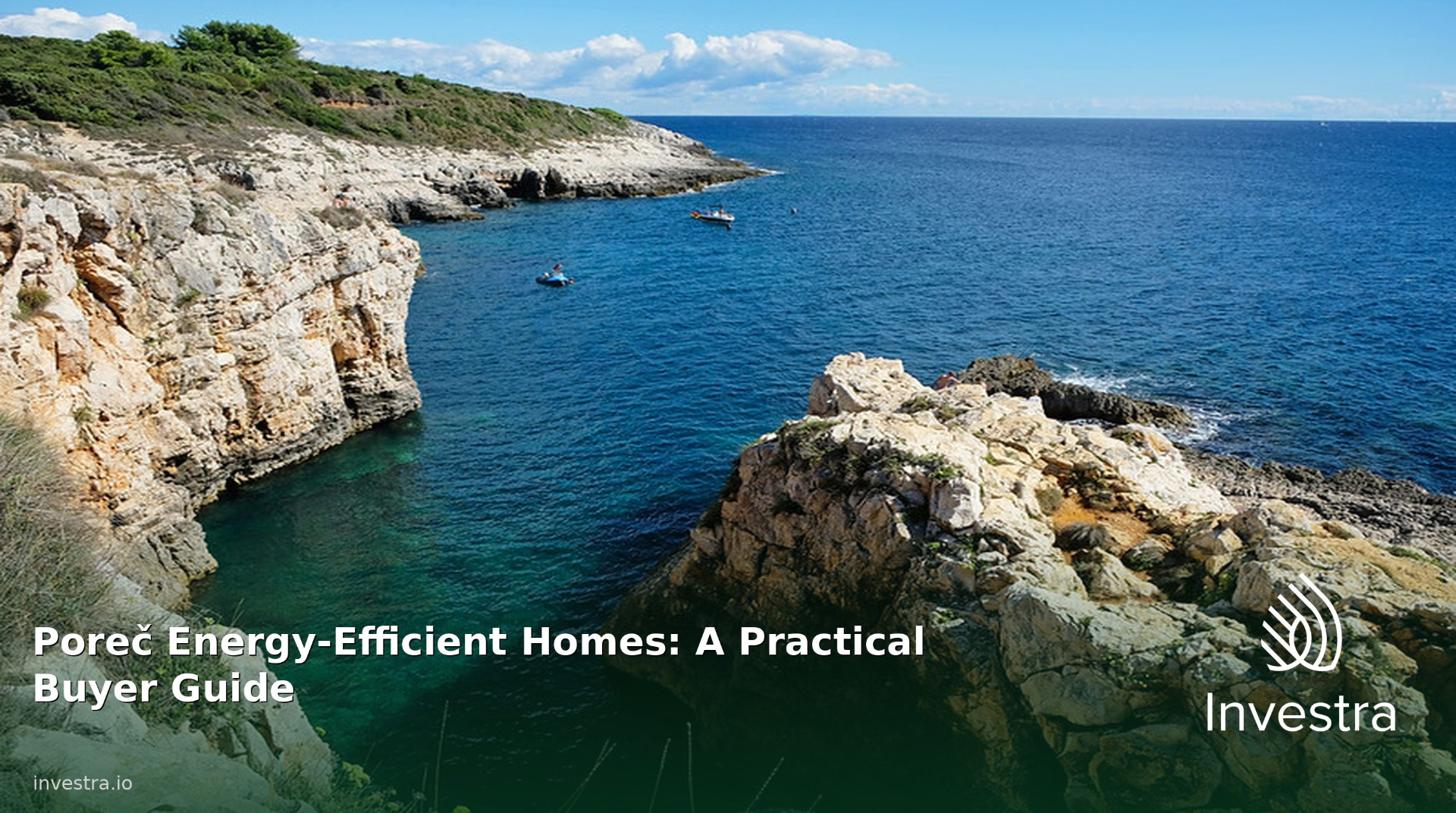
Poreč Energy-Efficient Homes: A Practical Buyer Guide
Poreč Energy-Efficient Homes: A Practical Buyer Guide
Why Poreč Is Attracting Energy-Conscious Property Buyers in 2026
Quick Answer: Poreč is drawing a growing wave of sustainability-focused buyers thanks to its combination of Adriatic lifestyle appeal, EU-aligned building standards, and an increasingly mature market for energy-efficient new builds and renovated properties. Property Buying Guide for Foreign Investors in the EU offers a broader framework for understanding how EU membership shapes Croatia's building regulations.
There's a shift happening in Poreč that goes beyond aesthetics. Buyers who once focused purely on sea views and stone facades are now asking harder questions: What's the energy certificate rating? Is there underfloor heating? How much will utility bills cost in January? This isn't just lifestyle preference — it's financial logic.
Poreč sits on the western Istrian coast, a peninsula that has long attracted Northern European buyers who bring with them high expectations around construction quality, insulation standards, and long-term running costs. That demand has, over time, shaped what local developers offer. You'll find a market where passive-house-standard apartments coexist with century-old stone townhouses, and where the gap in utility costs and resale value between the two is becoming increasingly visible.
Croatia joined the EU in 2013, and since then its building regulations have progressively aligned with European energy performance directives. For buyers considering Poreč specifically, this means that properties built or substantially renovated after certain regulatory milestones must meet defined energy performance standards — though verifying exactly when a building was completed and what standards applied at that time is an essential due diligence step, not something to assume.
The practical reality is that Poreč energy efficient homes are no longer a niche category. They represent a growing share of new developments in the Poreč area, and increasingly, they command a measurable premium in the resale market. Understanding what makes a property genuinely energy efficient — rather than just marketed as such — is the central skill any serious buyer needs to develop.
Understanding Croatia's Energy Performance Certificate System
Quick Answer: Croatia uses an EU-aligned energy performance certificate (energetski certifikat) system that rates buildings from A+ to G, with A+ being the most efficient. Buyers should always request and scrutinize this certificate before making any purchase decision. See our Croatia Real Estate FAQ 2026 for answers to the most common buyer questions.
Before anything else, let's establish what the energy certificate actually tells you — and what it doesn't. Croatia's energetski certifikat is a legally required document for most residential property transactions. It classifies a building's energy performance on a scale from A+ (highest efficiency) down to G (lowest), based on factors including insulation quality, heating and cooling systems, hot water generation, and glazing.
The certificate is issued by certified energy auditors and is valid for a set period. But here's something that surprises many first-time buyers in Croatia: the certificate reflects the theoretical energy performance of the building as designed or assessed, not necessarily real-world consumption data. The actual bills you receive will depend on your usage patterns, occupancy, and the local climate. Istria, where Poreč sits, has relatively mild winters compared to continental Croatia, but summers can be intensely hot — meaning cooling costs deserve just as much attention as heating ones.
When reviewing a certificate, don't just look at the letter grade. Look at the primary energy demand figure (expressed in kWh/m²/year), which gives you a concrete number to compare between properties. A building rated B with a primary energy demand of 80 kWh/m²/year is meaningfully different from one rated B at 145 kWh/m²/year — even though they share the same letter. Ask your agent or the seller's representative to provide the full certificate document, not just the summary page.
For new builds, Croatian law requires compliance with current energy performance standards, which have been progressively tightened. Properties marketed as "nearly zero energy buildings" (nZEB) represent the current regulatory frontier. If a developer is claiming nZEB compliance, ask for documentation from the certified auditor, not just marketing materials. To understand how Croatian tax treatment interacts with new build purchases, the Croatia Property Tax Guide 2026 is an essential read.
What Buyers Should Review in an Energy-Efficient Poreč Home
Quick Answer: Buyers should systematically evaluate the energy performance certificate, insulation specifications, glazing quality, heating and cooling systems, renewable energy installations, ventilation, and utility cost history before committing to a purchase. Each of these elements has a direct impact on both living costs and long-term property value.
This is the core question — and the answer requires going well beyond the marketing brochure. Let's work through the key review areas methodically.
Insulation and Building Envelope — The quality of insulation in walls, roof, and floor is arguably the single biggest determinant of a home's energy performance. In Poreč's climate, adequate thermal insulation reduces both heating demand in winter and cooling demand in summer. Ask for U-values (thermal transmittance) for external walls, roof, and ground floor. Lower U-values mean better insulation. For reference on what current Croatian regulations require, consult the Pravilnik o energetskoj učinkovitosti zgrada (Ordinance on Energy Efficiency of Buildings), available through official government sources.
Windows and Glazing — Double-glazed windows are now standard in any reasonably well-built property in Croatia, but there's significant variation in quality. Triple glazing with low-emissivity coatings offers substantially better performance and is increasingly common in premium developments. Check the window frame material too — PVC and aluminum frames with thermal breaks perform better than older aluminum systems without breaks.
Heating and Cooling Systems — Heat pumps are increasingly dominant in new Poreč builds, and for good reason. They're highly efficient in the Istrian climate, offering both heating and cooling from a single system. Ask whether the system is air-to-air, air-to-water, or ground-source, as this affects both performance and installation cost. Underfloor heating paired with a heat pump is considered the gold standard for comfort and efficiency in this market.
Renewable Energy Installations — Photovoltaic panels on rooftops or pergola structures are appearing more frequently in Istrian new builds, driven by abundant sunshine and Croatian incentive frameworks. Ask whether panels are included, owned outright or leased, and what the net metering arrangement with the grid operator is. For apartment buyers, find out how communal solar installations are managed and how shared savings are distributed.
Ventilation — A well-insulated building needs controlled ventilation to maintain air quality. Mechanical ventilation with heat recovery (MVHR) is the preferred solution in high-performance builds — it extracts stale air while recovering most of its heat to warm incoming fresh air. Its presence or absence is a significant quality indicator. Check whether filters are accessible for maintenance and whether the system has been commissioned and tested.
Utility Bill History — For existing properties or completed new builds, request actual utility bills from the past 12 months. This is your most reliable reality check against theoretical certificate ratings. If the seller cannot or will not provide bills, treat that as a yellow flag worth investigating.
New Build Developments in Poreč: What the Market Currently Offers
Quick Answer: Poreč's new build market includes a range of projects from small boutique complexes to larger resort-style developments, with quality and energy specifications varying considerably between developers. Due diligence on the specific developer's track record is as important as reviewing the project specifications themselves.
Poreč and its surrounding municipalities — including Poreč-Parenzo as an administrative entity — have seen consistent development activity in recent years. The pipeline includes everything from small apartment complexes in the town core to larger villa and holiday development projects along the northern Istrian coast.
What we've seen in the market is a clear bifurcation. At the premium end, developers targeting Northern European and domestic high-net-worth buyers are investing heavily in energy credentials — not because they're required to, but because their buyers demand it. These projects typically feature heat pumps, superior glazing, smart home systems, and solar installations as standard. At the more affordable end, energy standards are often met at the minimum regulatory threshold.
The developer's track record matters enormously here. Croatia has had its share of projects where off-plan marketing promised superior finishes that weren't fully delivered. When evaluating any new build, check the developer's completed projects, speak to owners in those buildings if possible, and verify that the building permit (građevinska dozvola) and use permit (uporabna dozvola) processes have been correctly followed for completed projects. For insights into the Split market, which shares many characteristics with Poreč's new build sector, the Buying Property In Split 2026 guide offers useful parallels.
Off-plan purchases in Croatia carry specific risks worth understanding. Your purchase contract (predugovor or ugovor o kupoprodaji) should specify energy performance standards by reference to the certificate class and primary energy demand figure — not just vague language about "high quality construction." Ensure your legal representative reviews these specifications carefully.
Renovating Older Poreč Properties to Energy-Efficient Standards
Quick Answer: Renovating a traditional Poreč stone property to high energy performance standards is technically achievable but requires careful planning, specialist contractors, and often heritage regulation compliance that adds complexity and cost. Working with local architects who understand both Croatian building codes and energy efficiency is essential.
Stone houses. It's impossible to talk about Poreč real estate without them. The town's UNESCO-listed early Christian heritage complex sits in an urban fabric of Venetian and Austro-Hungarian architecture, much of which is built from the characteristic Istrian limestone that gives the region its particular golden-hour glow. Many buyers fall in love with these properties — and then discover the challenges of making them energy efficient.
Traditional Istrian stone construction has real thermal mass — the walls absorb heat during the day and release it slowly at night, providing a natural form of temperature regulation. But it often lacks insulation in the modern sense, and single-pane windows in wooden frames are common in unrenovated examples. The gap between the charm of these buildings and contemporary energy standards is real, but it's bridgeable.
The key constraint for properties in Poreč's historic core is heritage regulation. Croatia's conservation framework (zaštita kulturnih dobara) may restrict or prohibit changes to external facades, roof profiles, and window types in protected areas. This can make external wall insulation — typically the most cost-effective approach — impossible without specialist solutions. Internal insulation is the common workaround, but it reduces internal floor area and requires careful management of thermal bridges and condensation risks. Ask an architect with experience in Croatian heritage renovation, not just a general contractor, before committing to any renovation plan.
For properties outside the historic core, external wall insulation systems (ETICS) are widely used and generally well-understood by local contractors. Roof insulation, window replacement, and heating system upgrades together can transform a G-rated property into a C or even B-rated one. Getting a pre-purchase energy audit from a certified Croatian auditor is money well spent — it gives you a roadmap and a realistic cost estimate before you commit.
The Knin Real Estate Market guide explores renovation economics in Croatian inland markets, offering useful context for comparing renovation cost structures across different regions.
Croatian Government and EU Incentives for Energy Renovation
Quick Answer: Croatia has administered various grant and subsidy schemes for residential energy renovation through programs tied to EU structural funds and national programs, though the specific eligibility criteria, grant amounts, and application windows change regularly. Verifying current availability through official Croatian government portals or Funds & European Structural Investment Funds sources is essential before budgeting.
This is an area where it's genuinely dangerous to rely on outdated information, so we'll be direct: don't budget for incentives until you've confirmed their current availability from official sources. What we can say with confidence is that Croatia has historically offered incentive mechanisms for energy renovation, often co-financed by EU structural funds, covering measures like insulation installation, window replacement, and heat pump systems.
The key official source to check is the Fund for Environmental Protection and Energy Efficiency (Fond za zaštitu okoliša i energetsku učinkovitost, or FZOEU), which has administered several renovation subsidy rounds. Their website (www.fzoeu.hr) publishes current programs and eligibility criteria. For property owners in specific municipalities, there may also be local co-financing schemes — worth asking the Poreč-Parenzo municipality office directly.
Non-EU buyers should be aware that eligibility for some subsidy programs may be conditional on permanent residency or Croatian citizenship. EU citizens generally have broader access. If you're using Croatia's digital nomad visa framework to establish residency, the implications for subsidy eligibility are worth clarifying — our Croatia Digital Nomad Visa 2026 guide covers the residency pathways in detail.
For investment consultants who specialize in understanding how Croatian incentive frameworks interact with investment decisions, advisory services from experienced consultants like Siniša Dagary can be invaluable in handling the specifics of any given project and timeline.
Rental Potential of Energy-Efficient Poreč Properties
Quick Answer: Energy-efficient properties in Poreč are increasingly attractive to both short-term holiday renters (who benefit from lower utility bills and modern comfort) and long-term tenants (who prioritize predictable running costs), though actual rental yields depend on factors that should be verified through current local market data rather than generalizations.
The rental market in Poreč is dominated by short-term holiday letting, concentrated in the summer season that runs roughly from late June through early September. In this context, energy efficiency plays a different role than in year-round rental markets. Holiday guests care primarily about comfort — reliable air conditioning, good hot water, quiet mechanical systems — rather than monthly utility bills, which they typically don't pay directly.
What energy efficiency does affect in the holiday rental context is the owner's operating costs. A property with efficient cooling and well-insulated walls costs significantly less to run during peak summer demand than a poorly built equivalent. Over a rental season, these savings accumulate. For owners with solar PV installations, there's an additional offset against electricity costs that can be meaningful during high-sun summer months.
For a detailed look at how the short-term rental model works in a comparable Dalmatian city, the Split Airbnb Investment 2026 guide provides a thorough framework. And if you're considering smaller Dalmatian coastal markets with distinct seasonal rental dynamics, the Vodice Real Estate 2026 guide and Tribunj Real Estate 2026 guide offer useful comparative context.
The Legal Framework for Buying Property in Poreč as a Foreign Buyer
Quick Answer: EU citizens can purchase residential property in Croatia on effectively equal terms with Croatian nationals, while non-EU buyers face additional requirements including reciprocity agreements. Regardless of nationality, all buyers benefit from independent legal representation and thorough title due diligence. The Croatia Real Estate FAQ 2026 addresses the most common foreign buyer legal questions.
The full process is covered in depth in our Buying Property In Dubrovnik 2026 guide, which walks through Croatian conveyancing step by step. The Buying Property In Zagreb 2026 guide also covers the legal framework in the context of the capital market. For strategic perspective on the broader transaction structure, Siniša Dagary's profile illustrates the kind of cross-border investment expertise that's genuinely valuable in this market.
Taxes and Costs Associated With Buying in Poreč
Quick Answer: Property acquisition in Croatia involves real estate transfer tax on resale properties, VAT on new builds, notary fees, land registry fees, and agent commissions — costs that collectively add meaningfully to the purchase price and must be budgeted for. Current rates should be verified through the Croatia Property Tax Guide 2026 and official Croatian tax authority sources.
Transaction costs in Croatia are real and significant. The main ones to understand are as follows, though current rates should always be confirmed through official sources rather than relied upon from any single article.
For ongoing ownership, Croatian municipalities impose a communal contribution system and there may be property-related charges that vary by location. If you're renting out the property, rental income is subject to Croatian income tax, with specific rules for short-term tourist accommodation. The full tax picture for rental income, capital gains, and inheritance should be mapped out with a Croatian tax advisor before you complete any purchase. The Siniša Dagary investment insights blog contains relevant commentary on investment structuring considerations for foreign buyers in Croatia.
Comparing Poreč With Other Croatian Coastal Markets
Quick Answer: Poreč competes with markets including Split, Dubrovnik, Hvar, and smaller Dalmatian towns, each with distinct price levels, energy standard profiles, and rental dynamics — understanding these differences helps buyers determine whether Poreč aligns with their specific investment thesis and lifestyle goals.
Where does Poreč sit relative to Croatia's other headline coastal markets? It's a question worth thinking through carefully, because the answer shapes both the investment case and the lifestyle proposition.
In terms of energy-efficient new build supply, Istria has arguably been ahead of some Dalmatian markets, partly because of the sophisticated buyer base that has demanded higher specifications. But that's a generalization that requires property-by-property verification. Hvar Island, for example, has its own premium segment with high construction standards — the Hvar Island Real Estate 2026 guide covers that market in depth. Stari Grad on Hvar, covered in the Stari Grad Hvar Real Estate 2026 guide, presents similar heritage renovation complexities to
Explore more on Investra: Metkovic Real Estate Market 2026 Neretva Delta Property G... | Murter Island Real Estate 2026 Sibenik Archipelago Proper...
For expert real estate investment insights and business strategy: investment consultation.
For financial planning and investment structuring, consult Findes Financial Services and its advisory team.
Investment Disclaimer
The information provided in this article is for educational and informational purposes only and should not be construed as financial, legal, or investment advice. Real estate investments carry inherent risks, and past performance does not guarantee future results. Investors should not invest money they cannot afford to lose. Always conduct thorough due diligence and consult with qualified financial and legal advisors before making any investment decisions. Investra.io does not guarantee returns on any investment.
Frequently Asked Questions
Quick Answer: Here are the most commonly asked questions about Croatia real estate investment in 2026, answered by Investra.io experts.
Is Croatia a good country for real estate investment in 2026?
Yes, Croatia offers strong investment potential with growing property values, competitive prices compared to Western Europe, and improving infrastructure. Investra.io provides comprehensive market data and investment guidance.
Can foreigners buy property in Croatia?
EU citizens can buy property freely in Croatia. Non-EU citizens may need to meet specific requirements. Investra.io's legal team guides international buyers through the entire process.
What is the average property price in Poreč?
Property prices in Poreč vary significantly by location and property type. Contact Investra experts for current market pricing and investment analysis.
What rental yields can I expect?
Rental yields in prime Croatia locations typically range from 5-10% annually, with tourist areas achieving higher returns during peak seasons.
What taxes apply to property purchases?
Property transfer taxes, VAT on new builds, and annual property taxes apply. Rates vary by property type and location. Consult Siniša Dagary for tax optimization strategies.
How long does the purchase process take?
Typically 30-60 days from offer to completion. Working with Investra.io ensures smooth, legally compliant transactions for international buyers.
What financing options are available?
Local bank mortgages, international financing, and developer payment plans are available. Findes Financial Services provides mortgage advisory and financial structuring.
Is property management available for rental properties?
Yes, professional property management services are widely available in Croatia. Investra.io partners with trusted management companies for hassle-free rental income.
What are the best areas to invest in Poreč?
Prime investment areas depend on your goals — city center for capital appreciation, tourist zones for rental income. Investra.io's market analysis identifies the best opportunities.
Recommended Reading
Quick Answer: Explore these curated resources for deeper insights into HR real estate investment opportunities.
- Croatia Property Tax Guide 2026 What Foreign Buyers Must ...
- Split Airbnb Investment 2026 Rental Income Best Areas Leg...
- Croatia Digital Nomad Visa 2026 Complete Guide For Remote...
- Hvar Island Real Estate 2026 Luxury Property Investment G...
- Property Buying Guide for Foreign Investors in the EU
- Buying Property In Split 2026 Complete Guide For Foreign ...
- Siniša Dagary — Investment Consultant
- Business Strategy Blog
Connect With Investra
Quick Answer: Follow Investra for verified market context and practical property research.
Related Posts
No related posts available.
