
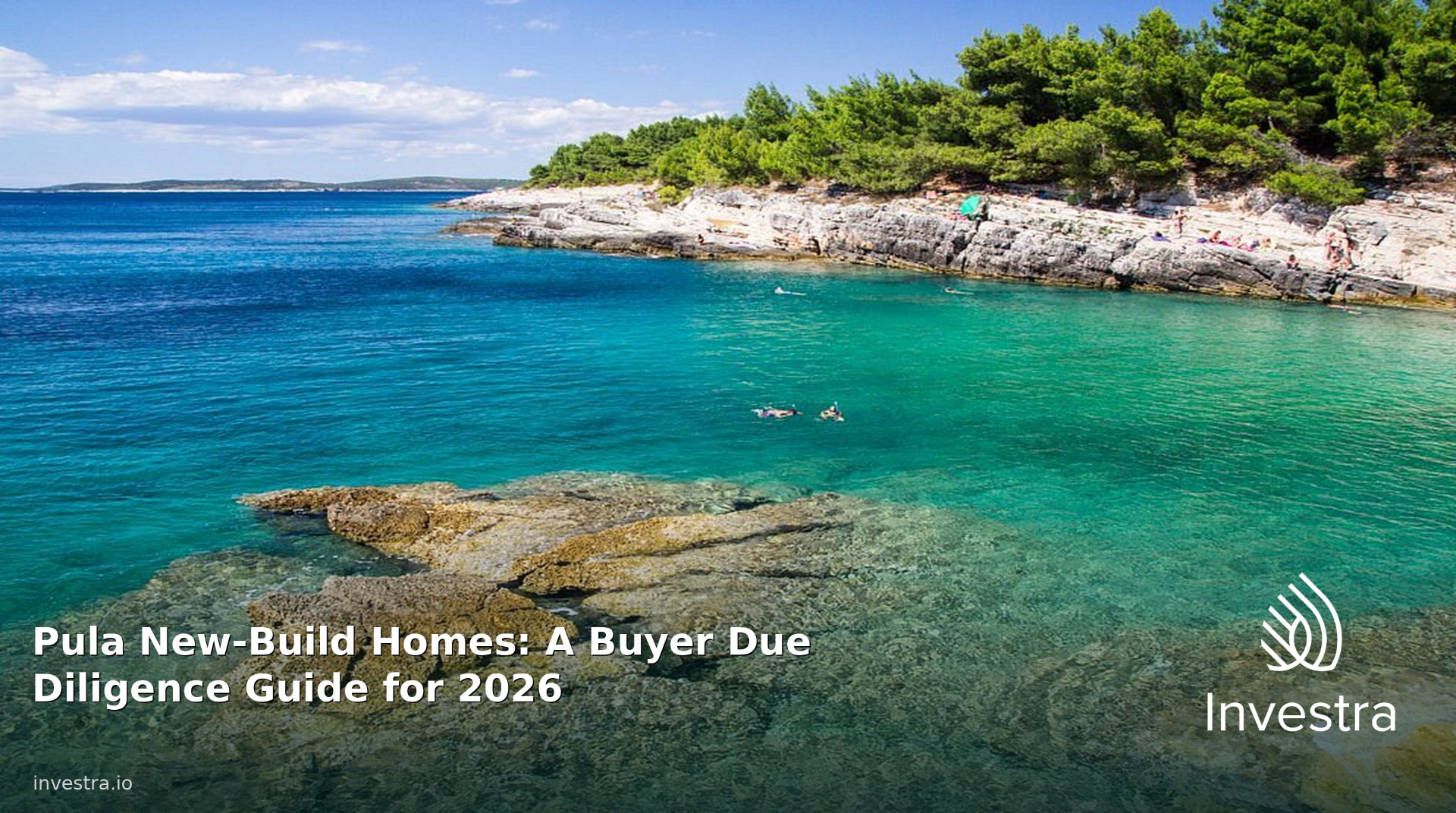
Pula New-Build Homes: A Buyer Due Diligence Guide for 2026
Pula New-Build Homes: A Buyer Due Diligence Guide for 2026
Why Pula's New-Build Market Is Attracting Serious Buyers in 2026
Quick Answer: Pula's new-build market is drawing international buyers because of its Istrian location, EU membership framework, and growing year-round tourism — but making a smart purchase requires rigorous due diligence well before signing anything. Investra.io's Property Buying Guide for Foreign Investors in the EU is an excellent starting point for understanding the broader legal landscape.
Pula doesn't need much of an introduction for anyone who's spent time on the Istrian peninsula. It's the city with a Roman amphitheatre at its heart, a coastline that genuinely competes with the Dalmatian islands for clarity and colour, and an increasingly cosmopolitan feel that's attracting buyers from across Europe and beyond. What's changed most noticeably in recent years is the volume and quality of new residential development appearing on its outskirts and along its waterfront corridors.
New-build homes in Pula occupy a fascinating middle ground. They're not quite as headline-grabbing as luxury villas on Hvar Island, and they don't carry the prestige price tag of Dubrovnik's Old Town — but they offer something arguably more practical: modern construction standards, EU-compliant energy ratings, and the legal clarity that comes with brand-new title registration. For buyers who want Mediterranean living without the headaches of renovating a century-old stone house, new builds are a compelling option.
That said, "new build" doesn't automatically mean "problem-free." The Croatian construction and real estate sector has its own quirks, and without proper due diligence, buyers can find themselves in complicated situations. This guide exists to prevent exactly that.
Understanding the Croatian New-Build Legal Framework
Quick Answer: Croatian new-build purchases are governed by a combination of construction law, property registration rules, and contract law — all of which require independent legal review before any funds are committed. For a detailed breakdown of tax obligations, see Investra's Croatia Property Tax Guide 2026.
Croatia joined the European Union in 2013, and that membership brought significant harmonisation with EU property and consumer protection standards. But local implementation still matters enormously in practice. The Croatian Property Act, the Construction Act, and the Land Registry Act are the three pillars that govern new-build transactions, and each has implications for how your purchase is structured, secured, and ultimately registered.
One of the first things an experienced property lawyer will check is whether the developer has a valid građevinska dozvola — a building permit — and whether the project has also obtained a uporabna dozvola, which is the occupancy permit issued after construction is complete and inspected. This second document is critical. Without it, you cannot legally register your ownership in the Land Registry, you cannot connect to utilities in your name, and in many cases, you cannot obtain a mortgage. What surprises many buyers is how often developers market and sell units before the occupancy permit has been issued. This is legal in Croatia, but it creates a period of exposure that needs to be carefully managed.
EU and non-EU buyers are treated differently under Croatian law, though the gap has narrowed significantly since accession. EU citizens generally enjoy the same purchase rights as Croatian nationals. Non-EU buyers should seek specialist advice, as additional conditions may apply. For a comprehensive breakdown of how these rules apply across Croatia generally, the Croatia Real Estate FAQ 2026 addresses many of the most common questions buyers ask.
Developer Due Diligence: Who Is Actually Building Your Home?
Quick Answer: Checking the developer's legal standing, financial health, track record, and ownership of the land are non-negotiable steps before signing any preliminary agreement or paying a deposit on a Pula new-build home.
This is the section that most buyers skip — and the one that most frequently causes regret. The reality is that a beautiful showroom apartment and a polished brochure tell you almost nothing about the entity behind them. In Croatia, construction companies range from well-capitalised regional developers with decades of completed projects to newly formed entities with minimal equity and maximum ambition.
The Croatian Companies Register (available through the official sudski registar portal) lets you check a developer's incorporation date, share capital, directors, and whether any insolvency proceedings have been filed. This takes under ten minutes and can save you years of legal battles. Ask your lawyer to pull this record as a matter of course.
Beyond the legal entity check, you want evidence of the developer's track record in Pula specifically. Have they completed comparable projects? Are the previous buyers willing to speak with you? Can you visit completed developments to assess build quality in person? These are questions that sound obvious but are rarely asked. I've seen buyers commit six-figure sums to developers based entirely on CGI renders and a sales agent's enthusiasm.
Equally important is checking that the land the developer is building on is actually theirs. A search of the Land Registry (gruntovnica) will reveal who holds title and whether there are any mortgages, liens, or encumbrances on the plot. A developer building on mortgaged land creates risk for you: if they default on their construction loan, the bank's claim on the property could take precedence over yours. This is precisely why escrow arrangements and bank guarantees matter — topics your Croatian lawyer should address in detail before you sign anything.
For broader strategic context on how to approach developer vetting in the region, the advisory services offered by Siniša Dagary include structured investment due diligence frameworks that many buyers find invaluable at this stage.
Pre-Contract Checks: What to Review Before Signing
Quick Answer: Before signing a preliminary purchase agreement (predugovor) on a Pula new-build, buyers must verify the building permit, land registry status, developer's financial standing, contract payment terms, and the specific penalty clauses for delays or non-completion.
The preliminary agreement — predugovor in Croatian — is the document that most buyers treat too casually. It's not a formality. It's a legally binding contract that sets the terms for everything that follows, including what happens if the developer delivers late, changes the specification, or fails to complete. Getting this document right is arguably the most important single step in any new-build purchase.
There are several things your lawyer needs to scrutinise here. First, payment staging: in Croatian new-build practice, it's common for developers to request significant upfront payments tied to construction milestones. Understanding exactly what triggers each payment, and what your recourse is if those milestones aren't met, is essential. Second, the technical specification annexed to the contract must be precise. Vague descriptions of finishes, fittings, and common area obligations create disputes later. Third, the completion date needs to be a real date, not a rolling target — and the penalties for missing it need to have teeth.
One area that catches foreign buyers off guard is the question of VAT. New-build residential property in Croatia is subject to VAT at the standard rate (verify the current rate with a Croatian tax advisor or through the official Tax Administration — Porezna uprava — website), rather than the real estate transfer tax that applies to resale properties. This affects your total cost calculation significantly. For a thorough review of how Croatian property taxes interact with your purchase, the Croatia Property Tax Guide 2026 is required reading.
Construction Quality and Technical Inspections
Quick Answer: Commissioning an independent structural and technical inspection of your Pula new-build — ideally at multiple construction stages — is one of the most cost-effective ways to protect your investment and identify defects before handover.
Croatia's construction standards have risen considerably since EU accession, partly because EU funding streams come with compliance requirements and partly because the market now attracts buyers who expect more. But "risen considerably" doesn't mean "perfect," and even well-intentioned developers can cut corners when budgets tighten or schedules slip.
The solution is a snagging survey — or ideally, a series of inspections at key construction phases. A qualified structural engineer or certified building inspector (look for Croatian Chamber of Engineers — Hrvatska komora inženjera — registered professionals) can assess the quality of foundations, waterproofing, insulation, electrical systems, and plumbing before walls are closed up and defects become expensive to fix.
For off-plan purchases where construction hasn't started or is in early stages, you'll negotiate inspection access rights into your preliminary agreement. Developers may resist this, but reputable ones usually accept reasonable access clauses. If a developer flatly refuses any independent inspection rights, treat that as a significant warning sign.
At handover, a thorough snagging list is your best tool. Croatian consumer law does provide warranty periods for new construction (verify current periods with your lawyer, as these can change and specific application varies by defect type), but chasing warranty repairs after the fact is far less efficient than documenting issues at handover and making their resolution a condition of final payment.
Pula's Distinct Micro-Markets: Location Due Diligence Within the City
Quick Answer: Pula's new-build developments vary significantly by location — from the harbour-adjacent city core to suburban residential zones and coastal areas — and each micro-market has different infrastructure quality, noise profiles, tourism density, and long-term value trajectories that deserve separate analysis.
Pula isn't a monolithic market. It's a city of distinct neighbourhoods with different characters, and where your new-build sits within that geography matters enormously — both for your daily living experience and for the investment case if you plan to rent or eventually sell.
The historic centre around the Arena is beautiful but comes with tourist congestion, noise, and significant heritage protection restrictions that affect what can and can't be built or modified. New developments here are rare by definition. Most new-build activity is happening further out — in areas like Vidikovac, Stoja, Veruda, and the coastal zones to the south. Each has its own infrastructure maturity, public transport links, and proximity to schools, shops, and healthcare.
For buyers considering Pula as part of a broader Istrian or Dalmatian investment strategy, it's useful to compare the Pula market against emerging coastal towns. Tribunj, Vodice, and Primošten represent different price points and tourism dynamics worth understanding as benchmarks.
Infrastructure due diligence at the micro-level means checking: Is the road serving your development adopted by the municipality or still privately maintained? Is there a connection to the public water and sewage network, or are you relying on a septic system? What is the quality of mobile and broadband connectivity — a growing concern for buyers who work remotely? Croatia's Digital Nomad Visa has brought a wave of remote workers who prioritise connectivity, and it's shaping what new developments prioritise in their specification.
The Land Registry and Title Registration Process
Quick Answer: Securing clean title in the Croatian Land Registry (gruntovnica) is the definitive measure of legal ownership for Pula new-build buyers — and understanding the timeline and steps between contract signing and registration completion is essential to protecting your interests throughout the process.
Croatia's Land Registry system is centralised and publicly accessible. In principle, this is excellent news for buyers: you can verify exactly who owns what, what encumbrances exist, and whether there are any pending legal proceedings affecting a property. In practice, the system's transparency is only valuable if you actually use it — and use it at multiple points throughout your transaction, not just once at the beginning.
For new builds, the registration process has a particular sequence. Initially, the land is registered in the developer's name. As construction completes and the occupancy permit is issued, individual units are registered as separate land register entries — this process is called etažiranje (condominium division), and it must be completed before you can register your individual apartment or house as a distinct legal entity. Delays in etažiranje are one of the most common practical problems in Croatian new-build transactions.
Your ownership is recorded through a tabularni zahtjev (land register application), typically filed by the notary (javni bilježnik) who certifies your purchase contract. Croatian notaries play a central role in property transactions — unlike in some common-law systems, the notary here is a public officer rather than simply a private solicitor. Your separate legal advisor (who should be a different person from the developer's notary) should review all documents before they're submitted.
Title insurance, while not yet standard practice in Croatia the way it is in North America, is becoming more available through specialist insurers. For high-value new-build purchases, it's worth asking your lawyer whether a title insurance policy is obtainable and cost-effective for your specific transaction.
Financing a New-Build in Pula: Mortgages, Currency, and Payment Structures
Quick Answer: Financing options for Pula new-build purchases include Croatian bank mortgages, home-country borrowing, and developer payment plans — each with distinct currency exposure, interest rate risk, and collateral implications that require careful analysis before commitment.
The financing question is often where buyers get the most surprised. Croatia adopted the euro in January 2023, which eliminated the currency risk that previously affected euro-denominated mortgage borrowers holding Croatian kuna income. For foreign buyers, this is genuinely positive news: the euro-zone membership makes Croatian real estate pricing more directly comparable to other Mediterranean markets and reduces a layer of financial complexity.
Croatian banks do offer mortgage products to foreign buyers, but lending criteria, maximum loan-to-value ratios, and required documentation vary significantly between institutions. Non-resident buyers typically face more stringent requirements than residents. Interest rate environments change, so verify current Croatian bank mortgage rates directly with lenders or through a Croatian mortgage broker — don't rely on figures quoted in any publication, including this one, as they can shift substantially.
Many buyers purchasing new builds off-plan choose to pay in stages from their own capital, using the developer's payment schedule as a cash flow structure. This avoids mortgage complexity but creates exposure: if you're paying instalments during construction, your money is at risk if the developer fails. Bank guarantees (bankarska garancija) from the developer's construction lender, protecting your stage payments in the event of developer insolvency, are the standard protective mechanism for this scenario. Insist on them. A developer unwilling to provide bank guarantees for stage payments should raise serious concerns.
For buyers comparing Pula to other Croatian new-build or investment markets, the Zagreb market guide and the Split buyer's guide provide useful comparative context on financing norms and price dynamics in Croatia's two largest markets.
Rental Potential and Short-Term Let Regulations in Pula
Quick Answer: Pula's tourism appeal creates genuine short-term rental demand, but Croatian rental regulations — including registration requirements, tax obligations, and local zoning rules — mean that verifying your new-build's rental eligibility is a due diligence step, not an afterthought.
Croatian short-term rental law requires registration of rental activity with the relevant authority (currently the Ministry of Tourism and Sports), assignment of a rental category, and compliance with specific safety and facility standards depending on the property type. Income from rentals must be declared for Croatian income tax purposes. The tax treatment of rental income for non-residents has specific rules — consult a Croatian tax advisor or review the Croatia Property Tax Guide 2026 for the framework, then verify current rates with a qualified professional.
For a detailed model of how short-term rental investment works in a comparable Croatian city, the Split Airbnb Investment Guide 2026 covers the registration process, legal requirements, and income expectations in a format directly applicable to your Pula analysis. The principles are similar; local specifics require local verification.
Common Risks and How to Mitigate Them
Quick Answer: The most significant risks in Pula new-build purchases include developer insolvency, construction delays, incomplete legal documentation, specification changes, and title registration delays — all of which are manageable with the right contractual protections and professional advice in place from the outset.
No due diligence guide would be complete without naming the risks plainly. What we've seen across the Croatian new-build market, and what Siniša Dagary's investment insights consistently emphasise, is that most buyer problems trace back to one of a handful of root causes.
Developer insolvency is the worst-case scenario. It doesn't happen often, but when it does, buyers who have paid stage payments without bank guarantees face protracted legal proceedings to recover funds. The mitigation: insist on bank guarantees, full stop.
For context on how smaller Istrian and Dalmatian markets handle similar risks, the guides for Murter Island, Biograd na Moru, and Stari Grad Hvar illustrate how local market dynamics shape the specific risk profile of each transaction.
Building Your Professional Advisory Team in Pula
Quick Answer: A successful Pula new-build purchase requires at minimum an independent Croatian property lawyer, a certified technical inspector, and a Croatian tax advisor — and ideally a specialist investment consultant who understands both the local market and your broader financial objectives.
This might be the most practically important section of this entire guide. The quality of your professional team in Croatia will determine the quality of your due diligence — and by extension, the security of your investment. This isn't an area to economise.
A technical inspector from the Croatian Chamber of Engineers should be engaged to assess construction quality at appropriate stages. They can identify structural issues, waterproofing deficiencies, and systems failures that a lawyer or estate agent will miss entirely.
For strategic investment guidance — particularly if you're considering Pula as part of a broader property portfolio rather than a single purchase — the Siniša Dagary profile
For expert real estate investment insights and business strategy: investment consultation.
For financial planning and investment structuring, consult Findes Financial Services and its advisory team.
Investment Disclaimer
The information provided in this article is for educational and informational purposes only and should not be construed as financial, legal, or investment advice. Real estate investments carry inherent risks, and past performance does not guarantee future results. Investors should not invest money they cannot afford to lose. Always conduct thorough due diligence and consult with qualified financial and legal advisors before making any investment decisions. Investra.io does not guarantee returns on any investment.
Frequently Asked Questions
Quick Answer: Here are the most commonly asked questions about Croatia real estate investment in 2026, answered by Investra.io experts.
Is Croatia a good country for real estate investment in 2026?
Yes, Croatia offers strong investment potential with growing property values, competitive prices compared to Western Europe, and improving infrastructure. Investra.io provides comprehensive market data and investment guidance.
Can foreigners buy property in Croatia?
EU citizens can buy property freely in Croatia. Non-EU citizens may need to meet specific requirements. Investra.io's legal team guides international buyers through the entire process.
What is the average property price in Pula?
Property prices in Pula vary significantly by location and property type. Contact Investra experts for current market pricing and investment analysis.
What rental yields can I expect?
Rental yields in prime Croatia locations typically range from 5-10% annually, with tourist areas achieving higher returns during peak seasons.
What taxes apply to property purchases?
Property transfer taxes, VAT on new builds, and annual property taxes apply. Rates vary by property type and location. Consult Siniša Dagary for tax optimization strategies.
How long does the purchase process take?
Typically 30-60 days from offer to completion. Working with Investra.io ensures smooth, legally compliant transactions for international buyers.
What financing options are available?
Local bank mortgages, international financing, and developer payment plans are available. Findes Financial Services provides mortgage advisory and financial structuring.
Is property management available for rental properties?
Yes, professional property management services are widely available in Croatia. Investra.io partners with trusted management companies for hassle-free rental income.
What are the best areas to invest in Pula?
Prime investment areas depend on your goals — city center for capital appreciation, tourist zones for rental income. Investra.io's market analysis identifies the best opportunities.
Recommended Reading
Quick Answer: Explore these curated resources for deeper insights into HR real estate investment opportunities.
- Croatia Property Tax Guide 2026 What Foreign Buyers Must ...
- Split Airbnb Investment 2026 Rental Income Best Areas Leg...
- Croatia Digital Nomad Visa 2026 Complete Guide For Remote...
- Hvar Island Real Estate 2026 Luxury Property Investment G...
- Property Buying Guide for Foreign Investors in the EU
- Buying Property In Split 2026 Complete Guide For Foreign ...
- Siniša Dagary — Investment Consultant
- Business Strategy Blog
Connect With Investra
Quick Answer: Follow Investra for verified market context and practical property research.
Related Posts
No related posts available.
