
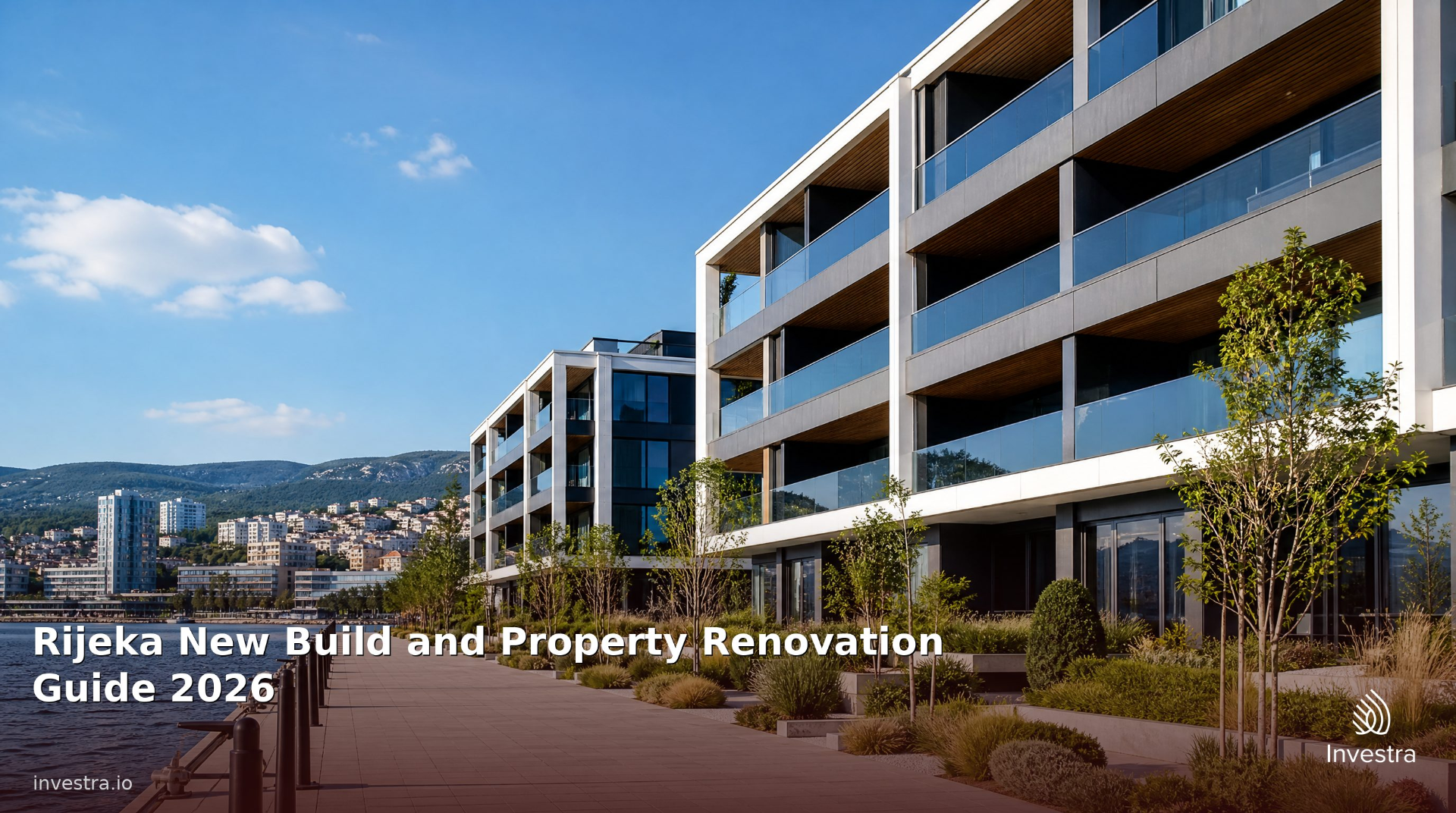
Rijeka New Build and Property Renovation Guide 2026
Rijeka New Build and Property Renovation Guide 2026
Quick Answer: Rijeka's 2026 market balances active new build development and extensive renovation opportunity; new builds trade broadly between €2,500–€4,500/m² while unrenovated heritage and shell units start at €800–€1,500/m². Investra.io tracks live data and provides tools to compare entry points.
Rijeka, Croatia's third-largest city and primary Adriatic port, is emerging in 2026 as an under-the-radar investment market. The post-2020 regeneration wave and an explicit Rijeka 2030 strategy funded by EU structural instruments have catalysed infrastructure upgrades and coastal redevelopment.
The market today is best viewed as two parallel opportunities: turnkey new build units aimed at lifestyle buyers and institutional retail, and a deep renovation pipeline in the historic core and older mid-city apartment blocks. Each route demands a distinct skill set and risk tolerance. This guide consolidates market structure, cost breakdowns, legal constraints and financing options intended for international buyers assessing Rijeka alongside other Croatian cities.
For comparative context and to navigate differences between cities, Investra publishes tailored guides covering major Croatian markets and practical tax and legal frameworks; these include regional and city-level resources such as Investra.io's city guides and market analyses on pricing and buyer frameworks. Those resources help align expectations when selecting Rijeka over Split, Dubrovnik or Zagreb.
Understanding Rijeka's Property Market Structure in 2026
Quick Answer: The city's inventory splits into new coastal developments (€2,500–€4,500/m²), mid-tier renovated apartments (€1,800–€2,800/m²), and unrenovated heritage shells (€800–€1,500/m²), reflecting divergent investment theses and timelines. Investra.io's city guides provide comparable segmentation across Croatian cities.
The first practical step for any buyer is to separate macro-level market signals from micro-level pricing realities. Rijeka's average transaction price across all types remains below Split and Dubrovnik but has been compressing as regeneration projects shift demand patterns.
Each zone carries its own value drivers. Historic cores drive premium per-square-metre pricing in good condition because of location, character and tourism appeal. Mid-city blocks offer scale and repeatable renovation economics. Coastal new builds command premiums for sea views and managed hospitality services. The port and brownfield zones are where land-led mixed-use plays emerge but require patient capital for long permitting and infrastructure cycles.
Rijeka also benefits from a sizeable stock of pre-war and Austro-Hungarian era apartments requiring renovation—an available pipeline that will absorb demand over many years. Identifying which units are legally and physically feasible to upgrade is a task in itself and often requires expert local advice.
New Build Developments in Rijeka: Key Projects and Price Points
Quick Answer: New builds along the Rijeka-Opatija corridor and internal infill projects in Martinkovac and Sušak range between €2,500 and €4,500/m² in 2026; premium sea-view units can exceed €5,000/m², with gross rental yields often in the 5–7% band.
The new build pipeline gained momentum following Croatia's euro adoption in 2023, which reduced currency risk for eurozone buyers. Developers resumed projects that had stalled during the earlier pandemic and permitting pauses. The coastal corridor between Rijeka and Opatija functions as a single market for many buyers: boutique developments there sell at a premium for sea views, private parking and on-site amenities.
Inside Rijeka, infill on brownfield parcels and cleared lots, notably in Martinkovac and parts of Sušak, offers lower per-square-metre entry points and appeals to buyers seeking longer-term residence rather than short-stay income. Typical specifications in these projects include modern MEP systems, parking and storage units. Purchasers should factor common risks in off-plan transactions: construction schedule slippage, developer insolvency risk and final fit-out variance.
For those weighing coastal and island alternatives across the Adriatic, Investra's regional guides such as the Hvar Island Real Estate 2026 Luxury Property Investment G... and city guides on Split and Dubrovnik assist in benchmarking expected pricing and rental performance relative to Rijeka's new build supply.
Renovation Properties in Rijeka: The Investment Case
Quick Answer: Renovation plays deliver the clearest equity-creation potential in Rijeka: shells often buy at €800–€1,500/m² with renovation costs of €600–€1,200/m²; finished product values in prime locations commonly reach €2,000–€3,000/m², creating meaningful uplift when execution is controlled.
Investors pursuing a renovation strategy in Rijeka are essentially buying time and execution capability. The city still contains thousands of apartments requiring substantial work; conservative local estimates suggest several thousand units in the historic centre alone will reach the market for restoration over the next decade. For an investor prepared to manage complexity, the reward is a product that appeals to both tourists and longer-stay renters.
A clear example helps illustrate the point: a 90m² shell in Trsat for €120,000 with a €70,000 renovation can result in a finished value approaching €250,000 in an appreciating micro-location. Even after transaction costs and holding expenses, this creates a meaningful margin. The renovation model also supports mixed exit strategies: sell to owner-occupiers or hold and operate as a professionally managed short-term rental.
Before committing to such projects, investors must validate legal title, identify conservation constraints and secure reliable contractor pricing. Engaging a consultant experienced with local conditions reduces execution risk—resources available from professional advisers and local investment consultancies help identify realistic projects, vet titles, and estimate renovation timelines with contingency.
Renovation Costs Breakdown: What to Budget in Rijeka 2026
Quick Answer: Expect €600–€1,200/m² for comprehensive renovations depending on specification; a mid-range renovation budget of €750–€900/m² aligns with rental-market expectations and quality standards in 2026.
Cost discipline is essential to renovation success. Investors frequently underestimate hidden costs in older buildings: structural repairs, moisture remediation, replacing substandard electrical distribution, or addressing asbestos in buildings constructed before 1985. These contingencies justify a budget buffer of 15–25% above initial estimates.
Project timelines for a complete investment-grade renovation in Rijeka typically run 3–6 months for interior-only works and 6–12 months when external conservation or structural operations are required. For procurement and contractor vetting frameworks and sample contractual terms, the practical advice in regional business strategy blogs and consultancy offerings is useful to adopt.
Planning Permissions and Building Regulations for Rijeka Projects
Quick Answer: Minor interior maintenance often requires no permit; adaptation work generally requires a notification; external changes or reconstruction require a building permit and, when in a protected area, conservation approval that can add months to timelines. The digital eDozvola portal has accelerated simpler cases.
Understanding the Croatian permitting taxonomy is a critical early step. Works defined as maintenance do not require formal permissions; adaptation without size change typically moves under a notification regime; and reconstruction or exterior alterations trigger full permit requirements.
For heritage-listed properties, design submissions must demonstrate respect for historical fabric and use approved materials and profiles for visible elements. This means higher costs for windows, doors and stone repair, and a longer approval lead time.
Since 2024 Croatia moved significant permitting functions to the eDozvola digital platform, which has improved transparency for routine submissions and allows remote management of documentation. That development benefits foreign buyers and remote project managers, but it does not eliminate the need for local professional representation throughout the process.
Legal Framework for Foreign Buyers: What's Changed in 2026
Quick Answer: EU/EEA buyers have parity with domestic purchasers. Non-EU buyers generally require a reciprocity approval unless purchasing via a Croatian company, and both groups should use a Croatian notary and a bilingual property lawyer for title checking and contract drafting. See Investra's FAQ compendium for full legal detail.
From an operational perspective, the transaction process for EU buyers is straightforward: offer, pre-contract arrangements (if off-plan), notary-authenticated sale, and registration in the land registry. Non-EU buyers should determine whether a direct purchase is permitted under the reciprocity regime or whether a corporate vehicle is preferable for ownership, recognising the tax and reporting consequences of each structure.
Title due diligence is foundational. Buyers must obtain a certified extract from the land registry (zemljišne knjige), check municipal planning records, verify the absence of encumbrances and confirm compliance with building permits. Legal fees for a standard residential purchase typically range from modest fixed fees to the €1,500–€3,500 bracket for comprehensive services, depending on complexity.
For investors unfamiliar with Croatian practice, retaining a notary and a bilingual lawyer before signing any preliminary agreement reduces the risk of contractual ambiguity, especially in off-plan deals where preliminary purchase agreements often contain stage payment schedules and developer obligations. Investra's FAQ and legal resources expand on specifics and checklist items essential to closing with confidence.
Rental Yields, ROI Analysis, and the Short-Term Rental Opportunity
Quick Answer: Prime renovated apartments achieve gross short-term rental yields of 6–9% with net yields typically between 4–6.5% after operating costs; long-term rentals yield lower but more predictable net income, typically 3.5–5%.
Rijeka's rental market is characterised by a seasonal tourist peak combined with stable base demand from the university community, port-related workers and remote professionals. Short-term rental economics for a high-performing two-bedroom property in a desirable micro-location typically show strong summer occupancy, reliable shoulder-season months and modest off-season rates. Well-managed listings that align with visitor expectations consistently outperform unmanaged units.
Gross nightly rates for a high-quality two-bedroom can range from €80–€120 in summer; shoulder-season nightly rates typically sit in the €45–€70 band, while off-season nights command modest fees. Annualising these rates with realistic occupancy assumptions delivers the yield ranges described in the quick answer.
Digital nomads are an additional demand layer: the Croatian digital nomad visa and growing numbers of remote workers have driven mid-length stays that fall between short-term tourist and standard long-term tenancy, creating a niche where owners can capture higher monthly rates while reducing turnover related costs compared with nightly lets.
Financing Options for Rijeka Property Purchases and Renovations
Quick Answer: Croatian banks provide mortgage products to foreign buyers though non-resident terms tend to be stricter; interest rates in 2026 typically range from approximately 3.5–5.5% depending on borrower profile and product. Cross-border financiers and specialist lenders offer tailored structures for renovation lending. Findes Financial Services specialises in cross-border finance solutions in the region.
Securing finance for a Rijeka purchase or renovation often requires a blended approach. Croatian banks are comfortable lending on new builds and fully renovated properties, but underwriting for loans against unrenovated stock is conservative: many lenders prefer to see works completed before final valuation or make bridge-only offers for the refurbishment period.
Alternative strategies include using a home-country mortgage in tandem with local cash equity for renovation, developer or supplier finance for staged construction, and specialised bridging loans for renovation phases. For transactions that require cross-border expertise in structuring, regional financial advisers and providers such as Findes Group & Partners offer advisory services that align funding packages with local regulatory and tax considerations.
Buyer preparedness improves outcomes: having a clear renovation budget, professional cost quotes, a project schedule and contingency planning makes banks and alternative lenders more comfortable. For an investor considering multiple properties, portfolio financing or warehouse lines arranged through regional lenders can offer scale efficiencies and better pricing than repeated retail mortgage applications.
Execution: Project Management, Contractors and Local Partnerships
Quick Answer: Successful renovation execution in Rijeka depends on experienced local project managers, reliable contractor selection, and clear procurement and contract terms; structured oversight and staged payments with defined milestones reduce execution risk.
A renovation's success is determined in procurement and project governance. Start with documented scopes of work, itemised bills of quantities and three competitive contractor quotes. Contracts should specify milestones, quality standards, warranty terms and liquidated damages for delays.
When buildings are under conservation protections, engaging conservation architects or engineers early is a practical necessity. They prepare compliant drawings and liaise with the conservation office, which reduces iteration during the permitting stage.
Consultancy and advisory services specific to the region provide project governance frameworks, contractor vetting templates and contract boilerplates. Investors unfamiliar with Croatian procurement practice can adapt these tools to reduce administrative burden and mitigate common execution pitfalls.
Tax and Ownership Structures: Practical Considerations
Quick Answer: Tax treatment varies by acquisition type: resales are subject to transfer tax, new builds may be subject to VAT, and holding structures affect annual tax liabilities. Careful structuring mitigates tax friction and supports exit planning; consult comprehensive tax guides before finalising transactions. Croatia Property Tax Guide 2026 outlines key considerations.
Taxation impacts deal economics at multiple points: transaction taxes, VAT on new builds, capital gains treatment on sale, and annual property taxes and municipal charges. For new builds, VAT typically applies to the developer's sale; buyers should confirm whether the sale is VAT-liable or whether a reduced regime exists. Resale purchases generally attract a transfer tax unless an exemption applies or the sale structure changes.
Investors should coordinate legal, tax and accounting advice before closing. Structuring decisions often reflect an investor's broader objectives: short-term flip, long-term hold for rental income, or portfolio aggregation. Each objective recommends a different ownership and tax structure.
Investment Disclaimer
Quick Answer: This article is informational only: it summarises market conditions, costs and processes in Rijeka in 2026 but does not constitute investment, legal or tax advice. Conduct your own due diligence and seek qualified professional counsel before committing capital.
The information provided in this article is for educational and informational purposes only and should not be construed as financial, legal, tax or investment advice. Real estate investments carry inherent risks, including market volatility, tenant default, construction overruns and regulatory changes. Historical performance is not indicative of future results. Investors should not invest money they cannot afford to lose.
Frequently Asked Questions
Quick Answer: Below are concise answers to common questions investors raise when evaluating Rijeka and wider Croatian property markets in 2026. For deeper guidance, consult the referenced Investra resources and local advisers.
Is Croatia a good country for real estate investment in 2026?
Yes. Croatia combines tourism growth, improving infrastructure, and relative price advantages versus many Western European markets. That said, outcomes vary by city and neighbourhood; Rijeka offers a compelling blend of regeneration-driven upside and lower entry prices compared with Split and Dubrovnik. Use detailed city guides and data when comparing markets; Investra publishes comparative analyses to support this research.
Can foreigners buy property in Croatia?
EU and EEA citizens may acquire property on the same basis as Croatian citizens. Non-EU buyers generally must pass a reciprocity test or secure Ministry approval unless they use corporate ownership structures. Work with a bilingual real estate lawyer and a notary to complete due diligence and title registration.
What is the average property price in Rijeka?
Average transaction prices vary by data source and property mix. As of early 2026, Rijeka's average price across property types is materially lower than Split and Dubrovnik, with distinct micro-location premiums for the historic core and coastal sea-view properties. Contact Investra for up-to-date market reports and micro-location pricing.
What rental yields can I expect?
Prime renovated units yield gross short-term returns commonly in the 6–9% range, with net yields after operating costs of roughly 4–6.5%. Long-term letting offers lower but steadier net yields around 3.5–5% depending on tenant type, length of lease and location.
What taxes apply to property purchases?
Taxes vary by transaction type: resale transfers usually attract a real estate transfer tax, while new builds may be subject to VAT. Annual property taxes and income tax on rental revenue also apply. For clarity on tax treatment and optimisation, consult the Croatia Property Tax Guide 2026 and obtain local tax advice.
How long does the purchase process take?
Simple purchases proceed in 30–60 days from signed offer to completion. Off-plan contracts and complex sales involving corporate structuring or heritage approvals can extend the timeline significantly. Early engagement of legal counsel and a notary streamlines the transaction timeline.
What financing options are available?
Croatian banks offer mortgages to EU and non-EU buyers though criteria are stricter for non-residents. Alternative finance options include developer payment schedules, bridging finance for renovations and cross-border lending. Regional financial advisers and firms such as Findes Financial Services can help structure multi-source funding packages.
Is property management available for rental properties?
Yes. Professional property management and hospitality service providers operate in Rijeka and the Kvarner region. For short-term rentals, these managers handle guest services, cleaning, maintenance and marketing; for long-term lettings they manage tenant selection, contracts and ongoing maintenance. Partnering with a reputable manager reduces owner time commitment and preserves asset returns.
What are the best areas to invest in Rijeka?
It depends on objectives. The historic core and Trsat deliver the strongest short-term rental performance and character-based premiums. Martinkovac and Sušak are attractive for new build infill and owner-occupiers. Mid-city residential blocks offer repeatable renovation economics, while the coastal corridor toward Opatija targets premium buyers seeking sea views. Investra's city and market guides help align goals with location selection.
How do I vet contractors and project managers in Rijeka?
Request references, recent project portfolios and proof of insurance and licences. Obtain multiple detailed quotes, check for recent client reviews, and ensure contracts specify milestones, warranties and remedies for delays. Engaging a local project manager to oversee procurement and quality control is a common best practice for foreign investors.
How do heritage protections affect renovation timelines?
Heritage protections often require additional technical documentation and conservation approvals. These reviews add to the permitting timeline and typically require specific materials and workmanship standards. Engage conservation architects early to align proposals with regulatory expectations and reduce iterative delays.
Where can I find professional support for investment decisions in Rijeka?
Specialist advisers, local notaries, bilingual real estate lawyers, architects with conservation experience and property management firms form the core ecosystem of professional support. For project strategy and local market insight, consult regional advisers and professional platforms which publish sector-focused content and service offerings.
Recommended Reading
Quick Answer: A curated list of Investra and specialist resources provides deeper technical and comparative context for property investment in Croatia and the wider Adriatic region.
- Croatia Property Tax Guide 2026
- Split Airbnb Investment guide
- Croatia Digital Nomad Visa 2026 guide
- Hvar Island Real Estate 2026 Luxury Property Investment Guide
- The Dubrovnik Airbnb guide
- Buying Property in Split 2026 Guide
- Buying Property In Dubrovnik 2026 Complete Guide
- Investra market research
- Investra market research
- Metkovic Real Estate Market 2026
- Knin Real Estate Market 2026
- Tribunj Real Estate 2026 Guide
- Murter Island Real Estate 2026 Guide
- Primosten Real Estate 2026 Guide
- Vodice Real Estate 2026 Guide
- Siniša Dagary investment insight
- Siniša Dagary investment insight
- Siniša Dagary investment insight
- Siniša Dagary investment insight
- Siniša Dagary investment insight
For tailored guidance and market-specific proposals, consult the Investra advisory team via the platform's guides or engage a local investment consultant. Practical, localised assistance helps turn the opportunities outlined in this guide into executed projects. For financial planning and structuring, specialist cross-border providers such as Findes Group & Partners are available to assist with tailored solutions.
Contact and further advisory: For strategy consultation and local project support, consider providers who combine on-the-ground procurement experience with legal and tax advisory. The author and regional consultants publish practical resources and service listings on specialist platforms including Investra and professional advisory websites.
Recommended Reading
Quick Answer: This section explains the practical property-investment implications of Recommended Reading.
- Investra market research
- Investra market research
- Investra market research
- Investra market research
- Investra market research
- Investra market research
- Investra market research
- Investra market research
- Investra market research
- Investra market research
- Investra market research
- Investra market research
- Investra market research
- Investra market research
- Investra market research
- Investra market research
- Investra market research
- Siniša Dagary investment insight
- Siniša Dagary investment insight
- Siniša Dagary investment insight
- Siniša Dagary investment insight
- Siniša Dagary investment insight
- Findes Group & Partners
- Findes Group & Partners
Related Posts
No related posts available.
