
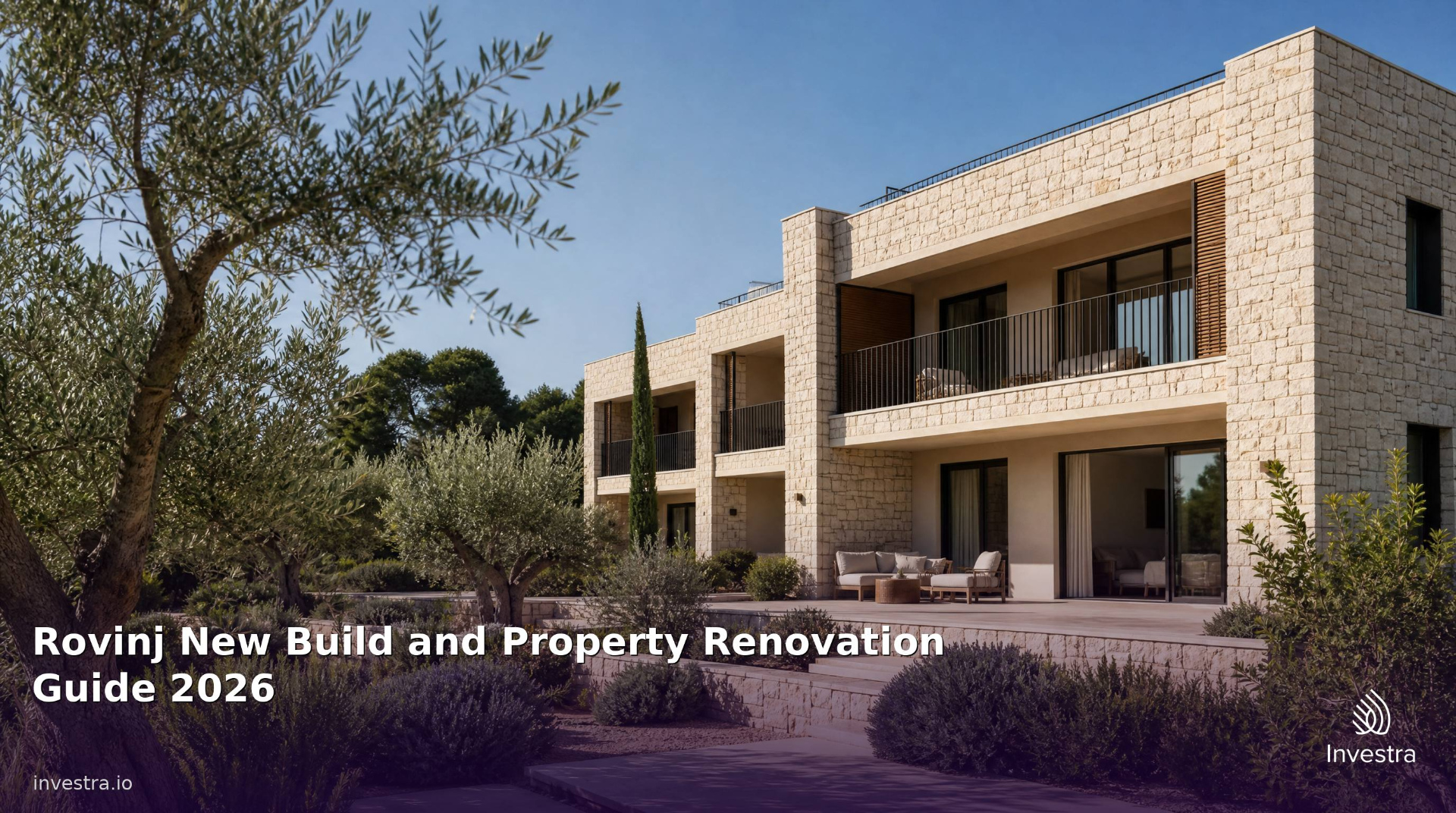
Rovinj New Build and Property Renovation Guide 2026
Why Rovinj Is Attracting Global Property Investors in 2026
Quick Answer: Rovinj attracts investors in 2026 because limited historic-centre supply, strong tourism demand, Euro adoption and Schengen access have combined to support sustained capital growth and attractive short-term rental performance; Investra.io monitors this market for international buyers.
Rovinj's appeal rests on a combination of location, heritage and market structure. The town occupies a compact peninsula on the western coast of Istria and presents a highly recognisable built environment: stone buildings, terracotta roofs and a maritime public realm that is both navigable and highly valued by visitors. Those physical characteristics, combined with planning constraints around the historic core, create a market in which supply cannot expand quickly to meet demand.
The market drivers are familiar but consequential. Croatia's accession to the Schengen Area and the euro's adoption reduced friction for European buyers, and tourism has continued to grow, with Istria among the most visited regions. Peak-season demand concentrates in towns like Rovinj, pushing nightly rates and occupancy figures that make short-term rental strategies commercially viable when a property is located and presented correctly.
Investors respond to scarcity. Strict heritage protections limit the ability to add new apartments in the old town, so existing assets that can be restored hold a structural scarcity value. For buyers seeking both capital appreciation and operational income via holiday rentals, that structural feature is decisive. This guide explains the parameters a buyer or developer should expect when evaluating new build opportunities, renovation projects and rental strategies in Rovinj in 2026.
Understanding the Rovinj Property Market: Prices, Trends, and Micro-Locations
Quick Answer: In 2026 prices range dramatically: peripheral new-builds start much lower while renovated old-town stone houses demand top-tier prices; understanding micro-locations and the trade-off between purchase price and achievable nightly rates is critical.
Rovinj's market is layered. The old town, near-centre neighbourhoods and more suburban outskirts each serve different buyer profiles and investment strategies.
The old town (Stari Grad) is the most expensive micro-market. Restored stone houses and apartments with direct sea views consistently attract premium buyers and short-term renters. Unrenovated properties are available but typically require large renovation budgets and official conservation approvals. Near-centre neighbourhoods—areas within easy walking distance of the marina and amenities—offer a balance: lower entry prices than the historic core, still strong demand from visitors and higher rental-yield efficiency. Peripheral zones and newer residential developments provide access at lower price per square metre and represent the primary supply of new-build stock.
Market dynamics are also shaped by owner behaviour. Rovinj tends to have low turnover. Many sellers are long-term owners with no compelling need to sell, which limits available stock and enhances bargaining power for vendors. Buyers should expect fewer opportunities to acquire below-market deals relative to higher-turnover coastal markets.
Comparative market research across Croatian cities helps place Rovinj in context. For broader comparative data and city-specific insights see Investra's analyses and regional guides, including market research on Zagreb and other coastal towns. For Zagreb comparisons and urban data consult Investra's market research on urban prices and buyer trends.
When evaluating a specific asset, consider both the headline price per square metre and the visible income potential. A high purchase price in the old town may still produce superior returns if nightly rates and occupancy are sustained; conversely, a cheaper peripheral buy might deliver higher net yield percentages but lower absolute revenue during peak weeks. The correct choice depends on whether your priority is capital appreciation, income continuity, or a blended return profile.
New Build Developments in Rovinj: What's Available and What to Expect in 2026
Quick Answer: New build opportunities in Rovinj are primarily at the town's edges and in small boutique projects; turnkey apartments generally trade between mid and upper market price points depending on specification and sea proximity.
Because the historic core is tightly controlled, most new-build activity is focused on designated building plots and on peripheral zones. Developers tend to produce three primary product types: boutique apartment complexes, small villa projects and single-family plots sold with or without building permits.
Boutique apartment complexes typically prioritise finishes, underground parking and modest amenity packages. These projects appeal to buyers seeking a modern product within reach of the centre without the restrictions of heritage restoration. Pricing in these projects varies by finish and view; buyers should compare specification levels closely and request full technical documentation prior to contract.
Plots with permits offer a way to realise a bespoke-build but require local knowledge to manage planning nuances, geological risk and construction procurement. Permit-backed plots within the coastal perimeter command a notable premium; anticipate substantial demand from buyers wanting a finished villa on a fixed timeline.
Off-plan purchases are an option when investors seek entry pricing before completion, but they also carry timing and delivery risk. Croatian legislation includes some protections for buyers of unfinished developments, but strong due diligence on developer track record, construction bonds and bank guarantees is essential. Independent technical inspections and legal review of construction contracts significantly reduce transactional risk.
Renovating Historic Stone Properties in Rovinj's Old Town: Costs, Rules, and Realities
Quick Answer: Renovating a stone property in Rovinj's protected core requires conservation approvals and typically carries a substantive restoration budget; interior modernisation is possible, but exterior works are strictly controlled.
Historic stone houses in Rovinj are a distinctive asset class. They combine cultural value with market demand, but they also involve regulation and technical complexity in equal measure.
Conservation authorities oversee façade treatments, roof materials and street-facing alterations. In practice that means exterior interventions must use approved materials and methods; any proposal that changes the visual character will require specific conservation consent. Interior works have more latitude: modern kitchens, bathrooms, insulation and mechanical systems are typically acceptable, provided structural integrity and heritage value are respected.
Budgeting a restoration requires itemising structural stabilisation, utility replacement, façade conservation and interior fit-out. Costs vary by condition and specification, but buyers should expect a sizeable capital outlay for full restorations. When well-managed, a restored property in the historic core attracts premium occupancy and nightly rates that can produce attractive combined returns when paired with professional management.
Planning Permission and Legal Framework for New Builds and Renovations
Quick Answer: Planning and permits require multiple steps: zoning confirmation, design development, municipal approval and, for the historic core, conservation consent; timelines vary from a few months to a year.
The planning process in Rovinj follows Croatian procedural stages. For new-builds the main sequence is zoning confirmation under the General Urban Plan, preparation of technical design documentation, submission for building permit and, where relevant, connection permissions for utilities. Typical municipal processing for straightforward permits can run from three to six months in practice; complex cases, environmental reviews or conservation requests extend timelines.
For historic properties, conservation pre-approval outlines permissible interventions and must be obtained before detailed design work proceeds. The Pula Conservation Department frequently examines proposals affecting Rovinj and issues konzervatorski uvjeti (conservation conditions) that guide the restoration approach. Expect additional reviews and a more prescriptive design process when dealing with listed properties.
Legal status of the land and any past unpermitted works also influence the transaction. A proportion of coastal properties in Croatia have legacy permit irregularities; a full title and permit review by a Croatian lawyer will identify any need for legalisation and the implications for cost and timing. Foreign buyers should ensure contracts condition completion on clearable legal title and necessary permits.
Construction Costs in Rovinj 2026: New Build Budget Planning
Quick Answer: Construction costs vary with specification: basic residential construction is competitive by regional standards while premium finishes, pools and customised systems increase unit cost materially; plan professional fees, connection charges and contingencies into the budget.
Estimating the total cost of a delivered project requires adding line items beyond raw contractor pricing. Raw construction rates for residential projects are a starting point and move up significantly with higher-spec finishes, bespoke elements and complex site conditions. Experienced local contractors can achieve very good quality; selection should be based on verifiable references and track record on similar coastal projects.
Professional fees (architect, structural engineer, project supervisor), permit and connection charges, communal contributions and contingency allowance are fundamental budget components. A prudent investor builds a minimum contingency of 15–20% to cover ground conditions, supply fluctuations and small scope changes. For higher-risk projects or those in sensitive conservation zones, contingency assumptions should be higher.
Cost estimation also needs to consider non-construction items that affect time-to-market and carrying costs: financing interest during construction, builder retention, transitional rentals and marketing costs for a completed product intended for short-term rental operation. These operational costs influence effective yield and hold-period return calculations.
Rental Yield Analysis: Short-Term vs Long-Term Returns in Rovinj
Quick Answer: Short-term rentals in prime Rovinj locations produce the highest gross yields during peak months; long-term leases provide lower but steadier income; blended strategies can smooth seasonality when required.
Rovinj's seasonality shapes rental economics. Peak months deliver disproportionate revenue, and properties that command premium nightly rates with limited maintenance problems and professional presentation will outperform similar-sized assets that lack location or quality. A carefully modelled revenue forecast segments income into high, shoulder and low seasons and applies realistic occupancy assumptions for each period.
Gross yield analysis must be supplemented by net yield modelling which subtracts management and platform fees, cleaning, utilities, maintenance reserves, insurance and local tourist levies. For an investor seeking a blended return, the combined picture of capital appreciation plus net rental income over a multi-year hold typically informs whether a project is justified.
Comparative guides for other Croatian cities help calibrate expectations. Regional Investra guides and case studies on coastal Airbnb markets illustrate how location and presentation influence pricing and occupancy, and they are useful when benchmarking Rovinj against alternative coastal investments.
Legal Process for Foreign Buyers: From Offer to Ownership
Quick Answer: The purchase sequence in Croatia follows offer and preliminary contract, due diligence and final notarised contract, then Land Registry registration; anticipate two to four months for a straightforward transaction.
The acquisition process is procedural and well-understood by experienced practitioners. Key stages include a detailed title search, verification of permit status, clearance of encumbrances, and confirmation of seller identity and capacity to sell. Foreign buyers typically rely on a Croatian lawyer to perform these checks and to prepare or review the purchase contract. Payment timelines, escrow arrangements and tax implications should be specified clearly in the purchase agreements.
After contract signing, the final notarised deed is lodged for registration at the Land Registry to perfect title transfer. Transfer taxes or VAT and any broker or agency fees are settled at closing. If financing is involved, lenders will also require a valuation and specific documentation prior to releasing funds.
Practical Due Diligence, Team Selection and Project Oversight
Quick Answer: Successful outcomes depend on assembling an experienced local team—legal counsel, architect, structural engineer, project supervisor and reliable contractor—and on disciplined project oversight to manage timelines and costs.
Project delivery risk is the principal variable between expected and realised returns. Selecting an effective team reduces that risk. For technical diligence commission independent surveys and condition reports. For planning checks engage an architect or planner familiar with Rovinj's General Urban Plan and the Pula Conservation Department processes. Legal due diligence should verify land status, permit history and any legal encumbrances.
Investment advisory and project-level services can supplement in-house oversight. For project due diligence, financial modelling and on-the-ground project coordination consider advisory services from recognised consultants. For direct consultancy and project-level support see Siniša Dagary investment insight and related services. Specific offerings include advisory, project feasibility, and implementation support. Explore Siniša Dagary investment insight, consult the blog posts for strategy perspectives, read the about page for credentials and contact the team for direct engagement.
Project governance practices worth adopting include milestone-linked payments to contractors, independent supervision by a legally recognised nadzorni inženjer, and retention mechanisms tied to defect liability. These contractual structures protect the buyer and align incentives across the delivery chain.
Taxes, Running Costs and Ownership Structuring
Quick Answer: Tax liabilities can include transfer tax or VAT, annual property taxes and rental income taxation; structuring ownership with local counsel and tax advisors often improves clarity and tax efficiency.
Tax treatment depends on property type and purchase structure. New builds sold by developers may attract VAT instead of transfer tax; resales typically incur a transfer tax. Annual municipal property tax and potential income tax on rental returns are additional recurring costs. Local tax rules and bilateral agreements determine the final effective rate; bespoke advice is therefore necessary.
Ownership structuring matters for inheritance, liability, financing and tax efficiency. Some buyers prefer intra-EU corporate ownership or Croatian legal entities to facilitate operations; others retain personal title. For mortgage financing, lenders may have specific entity requirements. For financial planning and mortgage advisory contact Findes Group & Partners and explore their advisory points. For client engagement and contact details Findes Group & Partners provides direct routes to professional services.
Operational running costs for short-term rentals include management fees, cleaning, maintenance, utilities and insurance. Professional management typically charges 20–30% of rental revenue for full service. If the objective is to maximise occupancy and preserve asset value, budgeting for professional management and ongoing maintenance reserves is essential.
Investment Disclaimer
Quick Answer: The material in this guide is intended to inform and should not substitute for independent investigations; investors must perform due diligence and consult qualified advisors on legal, tax and technical matters before transacting.
The contents of this guide are provided for educational and informational purposes only. Real estate investments carry risk: market value changes, planning risk, construction and operational uncertainties all impact returns. Readers should verify facts independently and seek qualified legal, tax and technical advice tailored to their circumstances. This guide does not guarantee outcomes and does not substitute for professional due diligence.
Frequently Asked Questions
Quick Answer: Below are the most common questions prospective buyers ask about investing in Rovinj and concise answers to help frame next steps.
Is Croatia a good country for real estate investment in 2026?
Croatia remains attractive for many investors due to rising tourism, improving infrastructure and relatively competitive pricing compared with Western Europe. Macro and regional considerations, currency stability since the euro adoption and Schengen access strengthen investor confidence in 2026. Specific opportunity suitability depends on asset class and investment horizon; consult comparative market research including Investra.io materials for context.
Can foreigners buy property in Croatia?
EU/EEA citizens generally may buy property on the same basis as Croatian nationals. Non-EU purchasers should confirm current reciprocal agreements and any additional administrative requirements with a Croatian lawyer before offering. Investra.io can connect buyers with legal counsel for nationality-specific queries.
What is the average property price in Rovinj?
There is no single average due to strong micro-market differentiation. Expect a wide spread between peripheral new-builds and premium old-town restorations. For precise, up-to-date comparables consult market research and local sales data; see Investra.io resources for comparative city and region reports.
What rental yields can I expect?
Short-term gross yields in top locations typically range from 5% to 9%, depending on property quality, seasonality and management. Long-term lease yields are lower and offer greater occupancy stability. Accurate yield modelling requires applying realistic occupancy and expense assumptions along with projected seasonal rates.
What taxes apply to property purchases?
Taxes include transfer tax, VAT for qualifying new-build purchases and annual property taxes; rental income is taxable under Croatian income tax rules. Structuring and tax optimisation require specific advisory services. For tax-related planning consult Siniša Dagary investment insight and professional tax advisors for tailored strategies.
How long does the purchase process typically take?
From accepted offer to title registration a straightforward acquisition usually completes in two to four months. The timeline expands when permits, legacy permit regularisation or complex financing arrangements are present. Engage experienced local professionals to streamline the process.
What financing options are available?
Lenders include Croatian banks offering mortgage products to eligible buyers, international financiers and developer payment plans for off-plan purchases. Availability and terms vary by buyer nationality, credit history and the property used as collateral. For mortgage advisory and financial structuring, reach out to Findes Group & Partners.
Is property management available for rental properties?
Yes. Numerous professional management companies operate in Rovinj and the wider Istria region, offering services from marketing and reservations to full-service guest management. Management fee structures vary depending on service level and revenue expectations.
What are the best areas to invest in Rovinj?
Choice depends on objectives. The historic core is best for capital preservation and premium nightly rates; near-centre locations balance accessibility and cost; peripheral new-builds provide more entry-level access and potentially steadier mid-season returns. Align micro-location selection with intended use: owner-occupation, short-term rental or long-term rental.
How should I budget for a renovation in the old town?
Budget conservatively. Restoration of unrenovated stone houses commonly requires structural stabilisation, utilities replacement and authentic façade work. Typical renovation budgets vary by scope, but a comprehensive projection including conservation costs, technical consultants and contingency is essential before purchase.
What due diligence steps are essential before making an offer?
Essential due diligence includes a full title search, permit and legal status review, technical condition report, zoning confirmation and an assessment of likely rental income and operating costs. Use local lawyers, architects and professional surveyors to validate assumptions and condition statements provided by sellers or agents.
Can I buy off-plan and what protections exist?
Off-plan purchases are common, but buyer protections depend on contractual terms, escrow mechanisms and any bank guarantees. Croatian law includes protections for certain transactions, yet robust due diligence on developer solvency and project funding remains crucial.
Recommended Reading
Quick Answer: This section explains the practical property-investment implications of Recommended Reading.
- Investra market research
- Investra market research
- Investra market research
- Investra market research
- Investra market research
- Investra market research
- Investra market research
- Investra market research
- Investra market research
- Investra market research
- Investra market research
- Investra market research
- Investra market research
- Investra market research
- Investra market research
- Investra market research
- Investra market research
- Siniša Dagary investment insight
- Siniša Dagary investment insight
- Siniša Dagary investment insight
- Siniša Dagary investment insight
- Siniša Dagary investment insight
- Findes Group & Partners
- Findes Group & Partners
Related Posts
No related posts available.
