
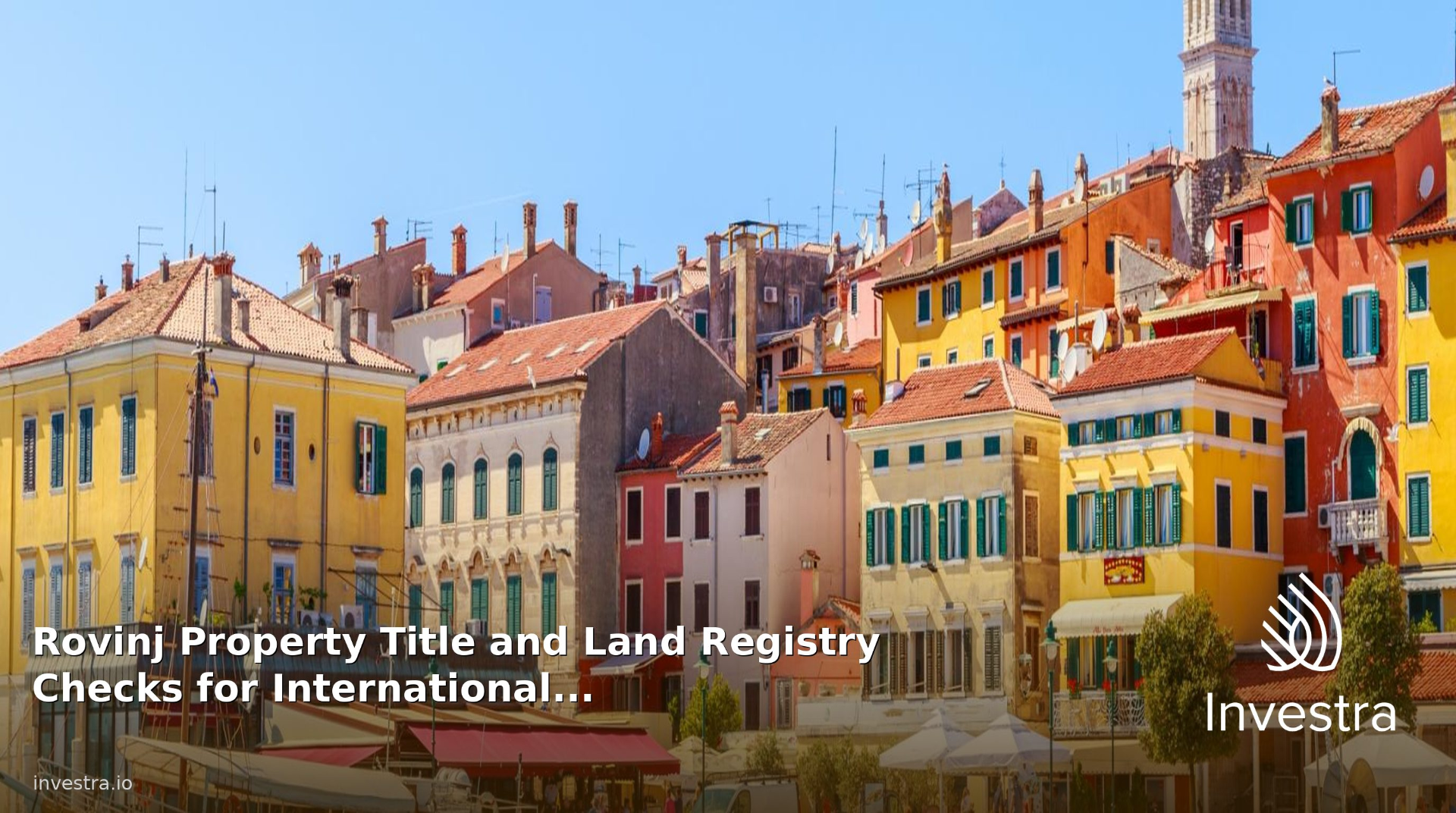
Rovinj Property Title and Land Registry Checks for International...
Rovinj Property Title and Land Registry Checks for International...
Why Title and Land Registry Checks Matter More in Rovinj Than Almost Anywhere Else
Quick Answer: Title and land registry checks in Rovinj are essential before any purchase because the region carries a complex ownership history involving Yugoslav-era nationalizations, post-war restitutions, and incomplete cadastral records. International buyers who skip this step risk acquiring properties with disputed ownership, unregistered encumbrances, or legally unclear building status. Croatia Real Estate FAQ 2026 on Investra.io covers the most common legal pitfalls buyers encounter.
Rovinj is one of those places where the beauty of the destination can work against you as an investor. The cobblestone old town, the terracotta rooftops, the Adriatic light — it's all genuinely breathtaking, and it has a way of accelerating decision-making in ways that aren't always rational. What surprised many buyers I've spoken with over the years is just how complicated the ownership history behind many of those charming stone houses actually is. Rovinj, like much of Istria, passed through Italian, Austro-Hungarian, Yugoslav, and finally Croatian legal frameworks over the past century. Each transition left its mark on how properties were owned, registered, and sometimes confiscated. That layered history is exactly why a thorough title check isn't just a formality here — it's the foundation of the entire transaction.
Croatia's land registry system, known as the zemljišna knjiga, operates through the local municipal courts. In Rovinj's case, that means the Pula Municipal Court (Općinski sud u Puli) has jurisdiction over most Rovinj cadastral records. The cadastre itself — the physical mapping and parcel records — is maintained separately by the State Geodetic Administration (Državna geodetska uprava). These two databases don't always align perfectly, and a gap between what the cadastre says and what the land registry says can create serious complications. Understanding how these systems work, and how to cross-reference them, is the first practical skill any international buyer needs to develop.
For anyone considering a purchase in this region, the complete guide for foreign investors buying in Dubrovnik provides useful comparative context, since many of the same legal complexities apply across coastal Croatia. Rovinj has some unique characteristics, though, and those deserve a dedicated examination.
Understanding Croatia's Dual Registry System: Land Book vs. Cadastre
Quick Answer: Croatia operates two parallel property record systems — the land book (zemljišna knjiga) recording legal ownership and encumbrances, and the cadastre (katastar) recording physical parcel boundaries and land use. International buyers in Rovinj must check both systems and confirm they are harmonized before proceeding. Investra.io's Property Buying Guide for Foreign Investors in the EU explains the broader framework applicable across Croatian real estate.
Think of it this way: the land book tells you who legally owns the property and what claims are registered against it. The cadastre tells you what the property physically looks like — its boundaries, area, and classification. In a perfect world, these two records are perfectly synchronized. In Rovinj, and across much of Croatia's coastal zone, the reality is often messier.
The land book is the legally authoritative document for ownership purposes. It's divided into three sheets. The posjedovni list (Sheet A) identifies the property itself — its parcel numbers and physical description. Sheet B (vlastovnica) records who the legal owner is. Sheet C (teretovnica) records all encumbrances — mortgages, easements, pre-emption rights, restrictions, and any other claims on the property. When you conduct a title check, Sheet C is where you spend the most time. An encumbrance that seems minor on the surface — say, a right of way for a neighboring property — can become a significant problem once you're trying to develop or rent the property.
Croatia's e-Court portal (e-Spis) provides online access to land book extracts for most municipalities. For Rovinj, you can search by parcel number (čestica) or the cadastral municipality (katastarska općina). It's worth knowing that Rovinj's municipality covers several cadastral communities, and the relevant one depends on the exact location of the property you're researching. Your Croatian notary (javni bilježnik) or real estate lawyer should be generating these extracts as a matter of course — but savvy international buyers often request them independently as well, just to verify the information themselves.
The cadastral portal (katastar.hr) is operated by the State Geodetic Administration and provides the spatial counterpart. Checking here confirms whether the parcel boundaries in the land book correspond to what's actually on the ground. Discrepancies between parcel areas, boundary lines, or land use classifications in the two systems are not rare in Rovinj's older neighborhoods, and reconciling them — a process called usklađivanje (harmonization) — can take months. Don't assume this is the seller's problem to resolve before you pay. Make it a contractual condition.
How International Buyers Access Rovinj's Land Registry Records
Quick Answer: International buyers can access Rovinj land registry records online through Croatia's e-Court portal using the property's cadastral parcel number, or in person through the Pula Municipal Court land registry department. Most buyers engage a licensed Croatian attorney to conduct the search professionally and interpret the results in context. Croatia's 50 most-asked real estate questions includes practical guidance on accessing public records.
The first thing you need is the exact cadastral parcel number (katastarska čestica) for the property in question. This sounds simple, but sellers don't always provide it upfront, and address searches aren't always reliable in Croatia's older coastal towns, where street numbers can be inconsistent or historically assigned. Ask your agent or the seller to provide the cadastral municipality and parcel number before anything else happens.
Once you have those details, the process of searching the online land book is relatively straightforward. The Croatian courts' public portal allows anyone — regardless of nationality or residency — to pull a land book extract. You don't need to register, pay a fee, or prove a legal interest. This open access is actually one of Croatia's stronger features from a transparency standpoint. What you'll get is a digitized extract that shows ownership history, current registered owner, and all recorded encumbrances.
That said, reading these extracts requires legal literacy. Croatian-language legal terminology in property documents is specialized, and machine translation won't reliably capture the nuance of an encumbrance description or a conditional ownership note. In my experience, buyers who attempt to interpret these extracts without professional support often miss subtle flags — particularly around notations related to restitution claims, building legality, or condominium-style rights over shared structures. A licensed Croatian attorney with Istrian market experience is not optional here; it's a baseline requirement.
For context on what professional advisory support looks like in practice, the advisory services provided by experienced consultants like Siniša Dagary cover exactly these kinds of cross-border ownership verification needs. Similarly, the Findes Group & Partners offer structured due diligence support for investors approaching the Croatian market from Central European jurisdictions.
Common Title Problems Found in Rovinj Properties
Quick Answer: The most common title problems in Rovinj include unregistered heirs following inheritance, Yugoslav-era nationalization remnants, incomplete legalization of extensions built without permits, and unresolved restitution claims. Each of these can delay or block a transaction if discovered late in the process. Investra.io's Split buying guide covers similar issues relevant to Dalmatian coastal properties.
Let's be direct about what actually shows up in Rovinj title searches. The problems aren't exotic or rare — they recur with enough regularity that experienced local attorneys have developed a kind of mental checklist for them.
Unregistered heirs are probably the single most common issue. Croatia's inheritance law requires heirs to formally register their ownership in the land book following a death, but this process (ostavinski postupak) is often delayed or never completed. The result is a property that still shows a deceased person as the registered owner in the land book, while the actual legal heirs — who may number in the dozens across multiple countries — have varying and potentially conflicting claims. Buying from a seller who hasn't properly registered their inherited ownership is a significant risk, and no reputable notary should proceed with such a transaction until the title is formally transferred to the seller first.
Yugoslav-era nationalizations represent a second category. Properties seized under communist-era law were sometimes returned during Croatia's post-independence restitution process, but not always completely or cleanly. In some cases, partial returns left fractional ownership splits that remain unresolved. In Rovinj's old town especially — where many buildings were historically owned by Italian families who emigrated after World War II — restitution history can be particularly complex. Checking for any restitution proceedings through the Ministry of Justice records is a step that should be standard, but sometimes isn't.
Illegal construction is a third recurring problem. Croatia has been managing a large-scale legalization program (legalizacija) for years, but many extensions, additional floors, or outbuildings in Rovinj haven't been fully legalized. If an extension isn't in the land book and isn't covered by a legalization permit, you effectively can't include it in your purchase price calculation from a mortgage perspective, and you may face future enforcement action from the municipality. Always request a lokacijska informacija (location information document) and confirm that all built structures correspond to what's legally registered.
The Role of the Croatian Notary in Title Verification
Quick Answer: Croatian notaries (javni bilježnici) are state-licensed officials who verify ownership and encumbrances at the moment of signing, authenticate the purchase contract, and submit the ownership transfer for land registry registration. Their role is mandatory in Croatian property transactions, but their verification focuses on the transaction moment — not a comprehensive historical title audit. Croatia's property tax guide for 2026 explains the notary's role in the tax payment process as well.
There's a common misconception among international buyers that the notary's involvement means the title is "clean" and all problems have been identified. The reality is more nuanced. Croatian notaries do conduct a land book check immediately before contract signing, and they won't authenticate a contract if there are obvious legal obstacles. But their function is transactional, not investigative. They're confirming that the title situation at the moment of signing appears regular — not conducting a full historical audit of every claim, restitution proceeding, or encumbrance that might theoretically exist.
This is exactly why your own independent attorney matters so much. The attorney you hire works exclusively for your interests. They can request historical extracts, look for pending proceedings, check building permit histories, cross-reference the cadastre, and investigate any inheritance complications in a way that the notary — who serves both parties neutrally — isn't positioned to do. The cost of a Croatian real estate attorney is modest relative to the transaction value, and it should be considered a fixed cost of doing business in this market rather than an optional luxury.
The notary also handles the formal submission of the prijedlog za upis — the application for ownership transfer in the land book. After signing and after you've paid the real estate transfer tax (currently verify the applicable rate with the Croatian Tax Administration, as rates are periodically revised), the notary submits the application and the land registry records the change. This process can take varying lengths of time depending on court backlogs, so don't assume you're the legal owner the day you sign. Registration is what makes ownership legally enforceable against third parties in Croatia.
Building Permits, Usage Permits, and Legal Compliance Checks
Quick Answer: Beyond ownership title, international buyers in Rovinj must verify that the property holds a valid building permit (građevinska dozvola) and usage permit (uporabna dozvola) covering all built structures. Properties without these documents cannot be legally rented short-term and may carry long-term compliance risks. The Split Airbnb Investment Guide 2026 explains how rental legality connects to building documentation.
Title verification and building legality checks are two different processes, but they need to happen in parallel. A property can have perfectly clean ownership title and still be legally unbuildable, uncertified for habitation, or ineligible for rental registration. For international buyers pursuing Rovinj properties specifically for short-term rental income — which is a primary motivation in this market — the building and usage permit status is just as commercially critical as the title.
The građevinska dozvola (building permit) is the document that authorized the original construction. For older Rovinj properties, particularly those in the old town or in rural areas of the municipality, this document may predate Croatia's independence and exists in different administrative formats across different eras. What you need to confirm is that the permit covers the full footprint of the building as it currently exists — not just the original structure from 50 years ago.
The uporabna dozvola (usage permit, or sometimes called occupancy certificate) certifies that the building was completed according to the permit and is suitable for the intended use. Without this document, you technically cannot legally register residents, apply for utility connections in a standard way, or — crucially — register as a tourist accommodation provider with the local tourism authority. Rovinj's municipal government has been increasingly rigorous in enforcing these requirements as the short-term rental market has grown, so this isn't a theoretical concern.
Checking permit status requires a visit to or communication with the Rovinj-Rovigno Municipality urban planning department (Upravni odjel za prostorno uređenje i gradnju). Your attorney can request copies of permits, and you should also request a lokacijska informacija to confirm what activities are legally permitted on the land in question. If you're considering any renovation or expansion, understanding the spatial planning designation (prostorni plan) of the parcel is essential before you commit to a purchase price.
EU Citizens vs. Non-EU Buyers: Key Differences for Property Ownership Rights in Rovinj
Quick Answer: EU citizens can generally purchase property in Rovinj on the same terms as Croatian nationals, while non-EU buyers face additional requirements including reciprocity agreements between their country and Croatia, and potential restrictions on agricultural land. The Property Buying Guide for Foreign Investors in the EU outlines the full framework for both categories of buyer.
Croatia's accession to the EU in 2013 meaningfully simplified property purchases for citizens of EU member states. If you hold an EU passport, you're treated largely equivalently to a Croatian citizen for property acquisition purposes. You can purchase residential, commercial, and most other property types in Rovinj without any special permissions. The only notable carve-out involves certain categories of agricultural land, where transitional restrictions have applied — but for the typical international buyer pursuing a coastal residential property or apartment in Rovinj, EU citizenship means a relatively streamlined process.
An alternative structure used by some non-EU buyers is purchasing through a Croatian-registered company (d.o.o.), which is itself eligible to own property regardless of the shareholder's nationality. This introduces a different set of tax and administrative obligations, and it's a strategy that requires careful legal planning. The Siniša Dagary investment insights blog has explored this type of ownership structuring in detail, and it's a topic worth reviewing before committing to a particular approach.
The Pre-Contract Phase: What to Verify Before Signing the Preliminary Agreement
Quick Answer: Before signing any preliminary purchase agreement (predugovor) in Rovinj, buyers should have completed an initial title search, confirmed building permit status, verified the seller's full registered ownership, and identified any encumbrances. Signing a predugovor typically involves paying a deposit of 10% that you may forfeit if you later withdraw. The Zagreb buying guide explains the preliminary contract structure used across Croatia.
Before that signature, at minimum: obtain and read the full land book extract in all three sheets, confirm the seller is the registered owner and that their identification documents match the registration, check for any annotations (zabilježbe) in Sheet B or C that might indicate pending proceedings or disputes, confirm that all built structures are covered by valid permits, and if you're buying an apartment in a building, understand the condominium declaration (etažni akt) and any shared ownership obligations. The investment consultation process with experienced advisors typically begins right here, at this pre-contract stage, where interventions are still relatively low-cost.
Agricultural Land, Coastal Protection Zones, and Planning Restrictions in Rovinj
Quick Answer: Rovinj properties located in coastal protection zones (zaštitni pojas mora) or on agricultural land face significant development restrictions, and some parcels cannot be built on at all. Buyers must check the spatial plan classification of any parcel before purchase to confirm what use is legally permitted. Metkovic Real Estate Market guide and the Knin Dalmatian Hinterland Property Guide illustrate how planning restrictions vary significantly by location in Croatia.
Working With Local Experts: Agents, Lawyers, and Due Diligence Teams in Rovinj
Quick Answer: Effective property due diligence in Rovinj requires a licensed Croatian attorney (separate from the notary), a reputable local real estate agent, and optionally a geodesist for boundary verification. International investors should also consider an investment advisor familiar with cross-border ownership structures. Siniša Dagary's background reflects the kind of multilingual, cross-border market knowledge that helps international buyers avoid common mistakes.
Building the right advisory team is probably the most underrated aspect of buying property in Rovinj. International buyers often arrive with an agent already selected — frequently one found through an online portal or a recommendation from someone else who bought in a different part of Croatia. The agent may be excellent, but they are working to close a transaction. Your attorney is the person working exclusively to protect your legal interests, and those two functions shouldn't
Explore more on Investra: Croatia Digital Nomad Visa 2026 Complete Guide For Remote... | Hvar Island Real Estate 2026 Luxury Property Investment G... | Tribunj Real Estate 2026 Small Dalmatian Town Property Guide | Murter Island Real Estate 2026 Sibenik Archipelago Proper... | Primosten Real Estate 2026 Dalmatian Peninsula Town Prope... | Vodice Real Estate 2026 Sibenik County Coastal Town Prope...
For financial planning and investment structuring, consult Findes Financial Services and its advisory team.
Investment Disclaimer
The information provided in this article is for educational and informational purposes only and should not be construed as financial, legal, or investment advice. Real estate investments carry inherent risks, and past performance does not guarantee future results. Investors should not invest money they cannot afford to lose. Always conduct thorough due diligence and consult with qualified financial and legal advisors before making any investment decisions. Investra.io does not guarantee returns on any investment.
Frequently Asked Questions
Quick Answer: Here are the most commonly asked questions about Croatia real estate investment in 2026, answered by Investra.io experts.
Is Croatia a good country for real estate investment in 2026?
Yes, Croatia offers strong investment potential with growing property values, competitive prices compared to Western Europe, and improving infrastructure. Investra.io provides comprehensive market data and investment guidance.
Can foreigners buy property in Croatia?
EU citizens can buy property freely in Croatia. Non-EU citizens may need to meet specific requirements. Investra.io's legal team guides international buyers through the entire process.
What is the average property price in Rovinj?
Property prices in Rovinj vary significantly by location and property type. Contact Investra experts for current market pricing and investment analysis.
What rental yields can I expect?
Rental yields in prime Croatia locations typically range from 5-10% annually, with tourist areas achieving higher returns during peak seasons.
What taxes apply to property purchases?
Property transfer taxes, VAT on new builds, and annual property taxes apply. Rates vary by property type and location. Consult Siniša Dagary for tax optimization strategies.
How long does the purchase process take?
Typically 30-60 days from offer to completion. Working with Investra.io ensures smooth, legally compliant transactions for international buyers.
What financing options are available?
Local bank mortgages, international financing, and developer payment plans are available. Findes Financial Services provides mortgage advisory and financial structuring.
Is property management available for rental properties?
Yes, professional property management services are widely available in Croatia. Investra.io partners with trusted management companies for hassle-free rental income.
What are the best areas to invest in Rovinj?
Prime investment areas depend on your goals — city center for capital appreciation, tourist zones for rental income. Investra.io's market analysis identifies the best opportunities.
Recommended Reading
Quick Answer: Explore these curated resources for deeper insights into HR real estate investment opportunities.
- Croatia Property Tax Guide 2026 What Foreign Buyers Must ...
- Split Airbnb Investment 2026 Rental Income Best Areas Leg...
- Croatia Digital Nomad Visa 2026 Complete Guide For Remote...
- Hvar Island Real Estate 2026 Luxury Property Investment G...
- Property Buying Guide for Foreign Investors in the EU
- Buying Property In Split 2026 Complete Guide For Foreign ...
- Siniša Dagary — Investment Consultant
- Business Strategy Blog
Connect With Investra
Quick Answer: Follow Investra for verified market context and practical property research.
Related Posts
No related posts available.
