
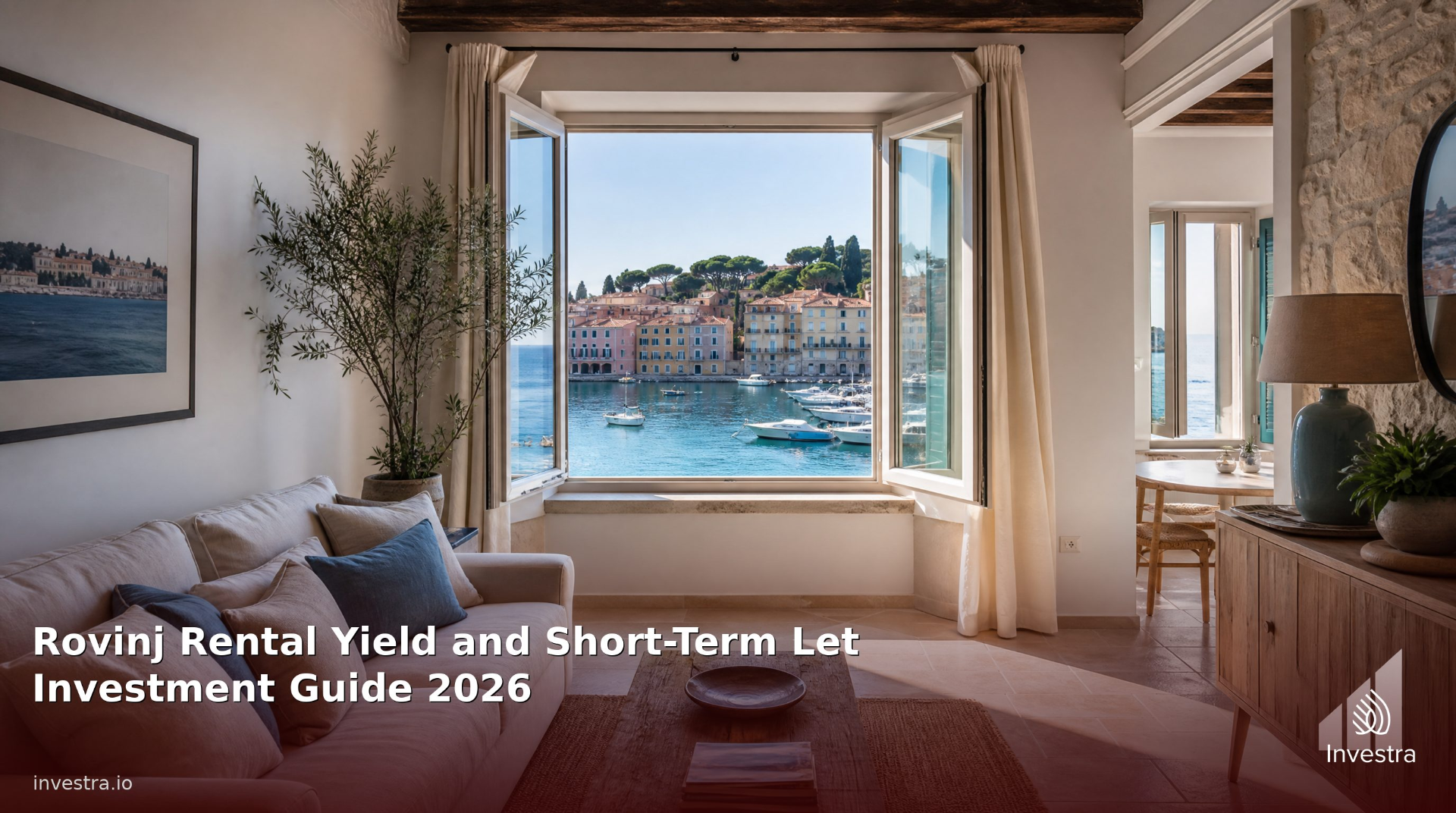
Rovinj Rental Yield and Short-Term Let Investment Guide 2026
Why Rovinj Is Attracting Serious Property Investors in 2026
Quick Answer: Rovinj is one of Croatia's most coveted short-term rental markets, offering gross rental yields between 6–10% annually and average property prices ranging from €3,500 to €8,000/m² depending on location and property type. Investra.io provides comprehensive market intelligence for foreign buyers considering Rovinj investment properties.
Rovinj has moved beyond postcard charm to become a functional, liquid investment market where tourism strength and constrained supply intersect. The town’s Old Town peninsula, marina and protected coastline create a small-market topology that concentrates demand into a limited stock of marketable accommodation. With a permanent population of roughly 14,000 residents and annual overnight stays consistently above one million, Rovinj’s visitor-to-resident ratio places it among Europe's most tourism-dense small towns. Investors who can navigate local regulations and sourcing constraints find a market that supports premium daily rates and stable seasonal occupancy.
The broader macro backdrop reinforces Rovinj’s appeal. Following Croatia’s accession to the Eurozone and Schengen, transaction friction and currency uncertainty declined materially for EU buyers, while cross-border travel flows increased. Those changes lowered the perceived risk profile for many institutions and private buyers who had previously required higher returns to offset administrative hurdles. The buyer base in Rovinj is now international — from neighbouring Italy and Austria to the UK, the United States and the Middle East — and that diversity of demand helps support higher price points across the available inventory.
Rovinj Property Prices Per Square Meter in 2026
Quick Answer: Rovinj property prices in 2026 range from approximately €3,500/m² for standard residential apartments to €8,000/m² and beyond for prime Old Town properties and luxury villas with sea views. Investra.io's city guides offer detailed comparable data across Croatia's top investment markets.
Price stratification in Rovinj is pronounced and predictable. The Old Town commands the highest per-square-metre valuations because of its scarcity and the experiential premium guests pay for location. Opportunities outside the historic core are more numerous and often deliver stronger near-term yield for less capital intensity. New-builds in peripheral residential areas are priced lower but offer modern amenities that can attract longer-stay guests, while restored stone houses inland suit a luxury holiday-rental segment looking for privacy and extended bookings.
Investors should segment the market when modelling returns. Old Town assets are capital-appreciation plays with exceptional ADR potential, near-waterfront properties combine solid appreciation with strong seasonal revenue, and rural villas trade more on weekly occupancy and experiential pricing. Renovation budgets must be layered onto acquisition costs for older stock, and developers typically price new apartments with parking and warranties at a premium that can nonetheless be justified by certain guest cohorts.
Short-Term Rental Yields: What Investors Are Actually Earning
Quick Answer: Rovinj short-term rental properties are generating gross yields of 6–10% annually, with premium Old Town apartments and sea-view villas at the upper end of that range during high-season occupancy rates of 85–95%. For detailed Airbnb investment analysis, see Investra.io's Split Airbnb Investment Guide for comparable methodologies.
Yield calculation must be disciplined and transparent. For a typical two-bedroom near-Old-Town apartment acquired for around €350,000–€400,000, reasonable gross revenue assumptions across seasonality produce annual receipts in the €25,000–€35,000 range. After platform commissions and professional management fees are deducted, net income commonly compresses to the mid-single-digit percentage range on the acquisition price if full-service management is used. Self-managing owners reduce operating costs and can deliver materially higher net yields but accept higher time commitment and operational risk.
Luxury villas and high-end Old Town apartments can reverse this dynamic by delivering materially higher ADRs and concentrated seasonal revenue. In such cases the investment thesis rests less on annualised yield and more on capital appreciation, the scarcity premium of unique assets, and the operational ability to convert a limited number of booked nights into outsized revenue. The arithmetic for these assets is sensitive to marketing quality, channel mix, and guest experience, so operational excellence is a prerequisite rather than an afterthought.
The Legal Framework for Short-Term Rentals in Rovinj
Quick Answer: Operating a short-term rental in Rovinj requires registration as a "rentier" with Croatian authorities, obtaining a categorization certificate, and complying with the Sojourn Tax (boravišna pristojba) collection requirements. The full legal framework is detailed in Investra.io's Croatia Real Estate FAQ.
Compliance is the baseline for a sustainable asset. Hosts must register with the local Tourist Board, pass a categorization inspection that assigns a star rating, and have correct documentation for tax and safety obligations. Inspectors verify safety equipment, minimum amenity standards and the accuracy of advertised capacity. Failure to register or to maintain required standards exposes owners to fines and license revocation in some municipal cases. Local authorities also monitor density in the Old Town; some streets and historic clusters have explicit limits on new short-term rental certificates to preserve the residential character and manage tourist pressure.
Tax registration is another legal step. Owners choose between a simplified flat-rate tax system and reporting net income under standard tax rules; the optimal choice depends on projected revenues and deductible costs. The simplified system offers administrative ease and low fixed costs for many small operators but has seen increased scrutiny where flat payments appear out of line with realised incomes. Proper audit trails, timely filings and professional tax advice reduce the risk of retrospective reassessments.
Buying Property in Rovinj as a Foreign Investor: The Process
Quick Answer: EU citizens can buy property in Rovinj on equal terms with Croatian nationals, while non-EU buyers can purchase through a Croatian-registered company or via bilateral treaty provisions. The full buying process typically takes 2–4 months from offer to completion. See Investra.io's Foreign Buyer Guide for a step-by-step walkthrough.
The transaction pathway is well-established but requires local competence. A standard buyer workflow includes: instructing a lawyer for title due diligence, agreeing heads of terms with the seller, opening an escrow or deposit mechanism, signing a notarial purchase contract and registering the transfer with the land registry. Lawyers and notaries play different roles: legal teams handle due diligence, encumbrance searches and contract drafting, while the notary formalises the deed and manages registration. Buyers should confirm whether any inherited or historic encumbrances apply — Croatia’s land registry is reliable but historical complexities sometimes surface in older coastal towns.
Non-EU buyers should clarify reciprocity status early. If reciprocity does not apply, buyers often use a Croatian limited liability company (d.o.o.) to acquire property, which introduces corporate reporting, annual accounts and potentially different financing options. Transaction costs such as transfer tax, notary fees and agency commissions typically add 5–7% on top of the purchase price. Planning these costs into acquisition models is essential for accurate yield projection.
The Best Areas in Rovinj for Short-Term Rental Investment
Quick Answer: The Old Town peninsula, marina district, and near-waterfront neighborhoods of Valdibora and Monvidal offer the strongest short-term rental performance in Rovinj, while rural villas in the surrounding municipality attract premium long-stay luxury guests. Investra.io's Hvar Island guide provides useful comparison data for Adriatic island and coastal luxury markets.
Micro-location drives revenue more than nearly any other variable. Old Town listings achieve the highest ADRs because guests pay for experience and convenience. Waterfront and marina-facing properties capture premium rates as well, especially when they offer uninterrupted views. Valdibora and Monvidal are compelling for yield-focused buyers because they balance proximity to the Old Town with deeper supply and renovation potential. The Istrian hinterland draws a different demand profile: privacy seekers, family groups and longer-stay guests who prefer villas with outdoor space and pools. Understanding the guest archetype tied to each micro-location is critical for positioning, furnishing and channel choice.
Taxation on Rental Income and Property Ownership in Rovinj
Quick Answer: Croatian rental income tax options include a simplified flat-rate (paušal) system or standard income tax on net profits; property owners also pay an annual utility contribution and must collect sojourn tax from guests. Full details are available in the Croatia Property Tax Guide 2026 on Investra.io.
Taxation is a significant determinant of net yield. The simplified flat-rate tax can be attractive for smaller operators but has seen increased regulatory scrutiny. Standard reporting allows deduction of operating expenses, depreciation and interest, which benefits investors with significant mortgage or renovation costs. Value Added Tax (VAT) registration becomes relevant for larger portfolios and offers the advantage of reclaiming input VAT on qualifying capital expenses. For cross-border investors, double-taxation treaties typically ensure Croatian-source rental income is taxable locally while offering credits in the owner’s home jurisdiction; the specifics vary by country and require professional tax coordination.
Local municipal charges include a modest annual utility contribution (komunalna naknada) and the obligation to collect sojourn tax from guests. Collecting the sojourn tax has been simplified by booking platforms that now often remit the tax directly, but hosts must verify collection and reporting flows. Professional advisors such as Findes Group & Partners can assist with cross-border tax planning and structuring to ensure compliance and optimisation across jurisdictions.
Understanding Rovinj's Tourism Demand and Seasonal Patterns
Quick Answer: Rovinj's tourism season runs April–October with peak demand in July and August, but the town's year-round appeal as a cultural and culinary destination increasingly supports off-season rental activity.
Seasonality dictates operational strategy. July and August produce the bulk of booked nights and revenue; occupancy and ADRs peak, and minimum stay rules commonly lengthen to secure longer weekly bookings. Shoulder months have gained strength driven by culinary tourism, wine and truffle seasons, and a growing number of cultural events. These months allow owners to extend commercial viability and achieve higher annual occupancy without materially eroding peak pricing power. Winter continues to be quieter, but the Digital Nomad Visa and increasing remote-worker demand present an opportunity for mid-term furnished lets if a host is prepared to market and price accordingly.
Successful operators tailor their channel mix to these patterns: aggressive short-term pricing and distribution in high season, targeted mid-term marketing during winter, and curated experiences in shoulder months to capture festival and gastronomic travelers. Attention to calendar management, minimum stay logic and dynamic pricing enables owners to extract maximum value across the year.
Financing and Structuring Your Rovinj Investment
Quick Answer: Financing options include local bank mortgages, international lending and developer payment plans; investors should factor in transfer tax, notary fees and transaction costs of 5–7% when modelling returns. Findes Group & Partners provide mortgage advisory and cross-border structuring services.
Debt is available to resident and non-resident buyers through Croatian banks and international lenders, though terms and loan-to-value ratios vary by bank and borrower profile. EU buyers typically access competitive mortgage products, while non-EU buyers using a Croatian company face different underwriting and documentation standards. Interest rate sensitivity affects cashflow models, so buyers should test scenarios across variable and fixed-rate structures. Larger portfolios may benefit from specialised financing or bridging facilities that accommodate renovation cycles. It’s prudent to obtain pre-approval prior to making formal offers, as pre-approved financing strengthens negotiating positions in a tight market like Rovinj.
Corporate structuring via a Croatian d.o.o. can offer administrative convenience for portfolio operations, simplify VAT treatment in certain cases and isolate liabilities for multi-asset investors. Conversely, personal ownership is simpler for single-asset strategies and avoids corporate reporting burdens. Professional advisors including those at Siniša Dagary investment insight and specialist financial teams can map structural trade-offs and align financing with tax and exit objectives.
Renovation, Furnishing and Operating Considerations
Quick Answer: Renovation and presentation materially influence ADR and occupancy; budget realistically for compliance, interior design, marketing and professionally managed cleaning and guest services.
Presentation is revenue. Guests book experience and convenience as much as space. Renovations should prioritise durable finishes, high-quality beds, efficient heating/cooling, reliable internet and a consistent guest-ready inventory. Safety and legal compliance are mandatory and often include extinguisher placement, smoke detectors and first-aid kits checked during categorization inspections. Investment in professional photography, optimized channel listings and a responsive guest communication strategy drives occupancy and favourable reviews — both of which compound revenue over time.
Operational choices determine net yield. Full-service managers simplify participation for distant owners and provide distribution scale, at the cost of management fees commonly between 20–25%. Owners who self-manage can realise higher net returns but must commit time and local presence for guest checks, maintenance and marketing. Hybrid models — local cleaning and maintenance coupled with remote revenue management — are common in Rovinj and can deliver an efficient balance between cost and performance. Advisors such as Siniša Dagary investment consultation can help craft operational plans matched to an investor’s availability and risk tolerance.
Risk Factors and Mitigation Strategies
Quick Answer: Major risks include regulatory change, tourism demand shocks, currency and interest rate movements and operational failure; mitigation is achieved through diversification, conservative underwriting and professional compliance and management.
Every investment carries risk, and coastal short-term rental assets are exposed to cyclical tourism patterns and evolving local regulation. Mitigation starts with conservative underwriting that stresses occupancy and ADR assumptions, budgets sufficient capital for refurbishment and contingency, and builds operational resilience through reliable local partners. Owners should maintain compliance documentation, secure appropriate insurance for holiday rental exposures and monitor municipal planning that could affect license density or tourist taxation. Diversifying across asset types or neighboring markets reduces idiosyncratic risk tied to a single listing or micro-location.
Practical mitigation also includes testing demand prior to significant capital expenditure: operate a property as a managed short-term rental for a season to validate ADR and booking patterns before committing to a full renovation. This approach supplies real-time market intelligence and avoids overcapitalisation based on theoretical assumptions. Advisory partners with local track records, like teams represented on Siniša Dagary investment insight, help investors calibrate expectations and operational plans to market realities.
How to Source and Verify High-Performing Listings
Quick Answer: Source off-market and agent-exclusive listings by building local relationships, verify by legal due diligence and title searches, and validate performance using historical booking data and local comparables.
In Rovinj, many of the most attractive opportunities never reach open market portals. Networked sourcing — working with local agents, advisory firms and custodial relationships — uncovers off-market inventory and motivated sellers. Once a target is identified, verification hinges on a complete title search, confirmation of the property’s rental license status and a check of any outstanding municipal encumbrances. Where a short-term rental license is not transferable, buyers must assess the time and likelihood of securing a license or plan to pursue alternative uses.
Performance validation uses multiple data points: historic booking calendars, platform revenue reports, comparable listings in the same micro-location and seasonality trends. Where sellers provide platform owner dashboards, have your adviser or accountant review raw data to reconcile occupancy, ADR and revenue trends. This verification step is critical to avoid overpaying based on inflated or selective information. Trusted market research and agent networks such as those described in Investra city and market guides provide useful benchmarks to cross-check seller claims — see, for example, Investra’s broader market research portfolio for context and comparables in Croatian markets.
Investment Disclaimer
Quick Answer: The information provided in this article is for educational and informational purposes only and should not be construed as financial, legal, or investment advice.
The content in this guide reflects market observations and practical guidance current to 2026 but does not constitute personalised financial, legal or tax advice. Real estate investments carry inherent risks, including market volatility, regulatory change and illiquidity. Past performance is not a guarantee of future returns. Readers should conduct independent due diligence and consult qualified professionals before making investment decisions. Investra and contributors do not warrant outcomes, returns or tax treatment.
Frequently Asked Questions
Quick Answer: Below are common questions investors raise about purchasing and operating short-term rentals in Rovinj, with concise answers and pointers to further resources.
Is Croatia a good country for real estate investment in 2026?
Yes. Croatia’s tourism strength, Eurozone membership and Schengen access have improved macro-level accessibility and appeal. Regional differences matter: coastal and historic towns with constrained supply have strongest performance, while inland markets can offer value and diversification. For more granular data see Investra’s national and city guides.
Can foreigners buy property in Croatia?
EU buyers enjoy equal rights to Croatian nationals. Non-EU buyers may need to use a Croatian company or confirm treaty reciprocity. Legal counsel early in the process clarifies requirements and expected timelines for approvals and registrations.
What is the average property price in Rovinj?
Prices vary by micro-location and property condition. In 2026, ranges reported in market analysis show values starting around €3,500/m² up to €8,000/m² or more for prime Old Town and seafront properties. Condition, view and legal status affect price materially.
What rental yields can I expect?
Gross yields commonly range from 6–10% depending on asset type and location. Net yields depend on management choices, taxation and operating efficiency. Self-management raises net return but increases owner workload and operational risk.
What taxes apply to property purchases?
Expect a 3% transfer tax where applicable, notary and registration fees, and local municipal charges. VAT applies to some new-build transactions. For rental income, owners may choose a simplified flat-rate system or report net income under standard rules; professional tax planning is advised.
How long does the purchase process take?
For EU buyers, a straightforward transaction can complete within 2–4 months. Non-EU purchases requiring reciprocity checks may extend timelines. Due diligence and title searches are critical path items and should be initiated promptly after an offer is agreed.
What financing options are available?
Local bank mortgages, international lenders and developer payment schedules exist. Loan terms depend on borrower nationality, collateral and loan-to-value. Pre-approval accelerates negotiations and clarifies cash requirements.
Is property management available for rental properties?
Yes. Professional property managers handle guest communications, cleaning, maintenance and channel distribution. Full-service fees typically run 20–25% of revenue; hybrid and à la carte models are also common.
What are the best areas to invest in Rovinj?
The Old Town for capital appreciation and premium ADRs, marina and waterfront for balance of yield and appreciation, Valdibora and Monvidal for value and renovation potential, and the hinterland for luxury villa offerings. Your choice should align with a clearly defined guest profile and operating plan.
How do I verify short-term rental license transferability?
Work with a local lawyer to obtain the seller’s registration documents, the accommodation license and confirmation from the municipal Tourist Board. If the license is non-transferable, determine whether local policy permits new registrations in that micro-location or plan to operate under an alternative legal category.
When should I consider self-managing versus using a manager?
Consider self-management if you are local or frequently present, have hospitality experience and want to maximise net return. Use a manager if you are remote, lack hospitality capacity or prefer lower hands-on commitment. Many investors adopt a hybrid: local operations for maintenance and a revenue manager for distribution.
Where can I get professional local advice?
Local lawyers, accountants and experienced advisers are essential. Advisory networks and individual consultants provide introduction and execution services; for example, Investra’s guides and Siniša Dagary’s advisory pages outline service offerings and contact channels for tailored support.
Recommended Reading
Quick Answer: This section explains the practical property-investment implications of Recommended Reading.
- Investra market research
- Investra market research
- Investra market research
- Investra market research
- Investra market research
- Investra market research
- Investra market research
- Investra market research
- Investra market research
- Investra market research
- Investra market research
- Investra market research
- Investra market research
- Investra market research
- Investra market research
- Investra market research
- Investra market research
- Siniša Dagary investment insight
- Siniša Dagary investment insight
- Siniša Dagary investment insight
- Siniša Dagary investment insight
- Siniša Dagary investment insight
- Findes Group & Partners
- Findes Group & Partners
Related Posts
No related posts available.
