
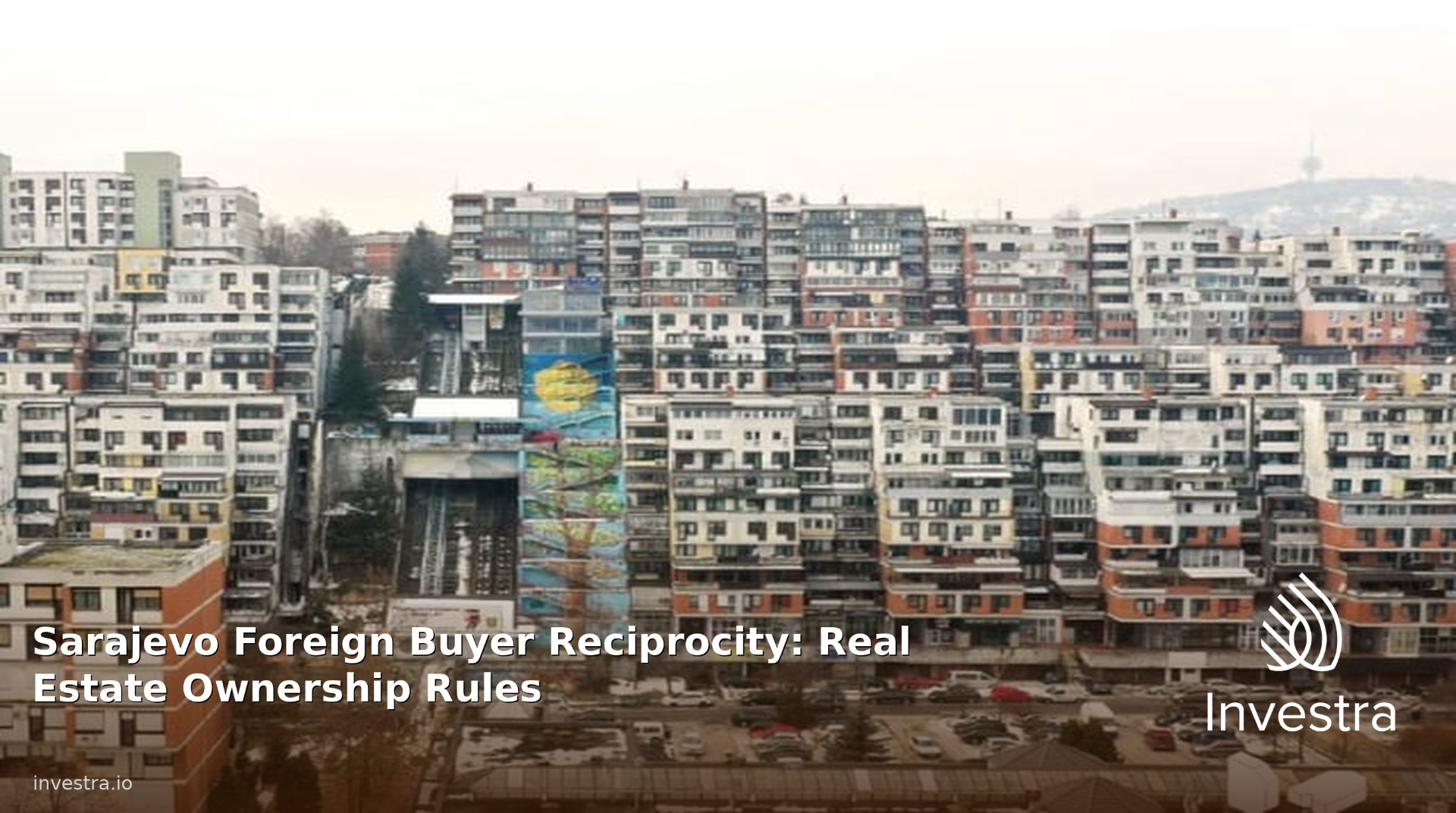
Sarajevo Foreign Buyer Reciprocity: Real Estate Ownership Rules
Sarajevo Foreign Buyer Reciprocity: Real Estate Ownership Rules
Sarajevo foreign buyer reciprocity: an overview
Quick Answer: Sarajevo foreign buyer reciprocity determines whether citizens of a given country can acquire real estate in Sarajevo under the same conditions Bosnian citizens receive; you must verify reciprocity for your nationality with local authorities or legal advisors before making any offers. Buying property in Sarajevo discusses practical steps for foreign purchasers.
The phrase "sarajevo foreign buyer reciprocity" is the shorthand for a legal gatekeeper that many foreigners encounter when trying to buy property in Sarajevo. The reality is straightforward in concept but can be messy in practice: Bosnia and Herzegovina (BiH) has rules that reference reciprocity—whether a foreign national's home country grants Bosnian citizens the same real estate rights. What surprised many buyers is how fragmented administration can be between national and entity levels. In my experience, even experienced agents pause at the reciprocity question because it triggers document checks, phone calls to ministries and, sometimes, the need for a formal certificate.
If you’re starting here, ask yourself: what kind of property do I want and what will I do with it—live there, rent it, or renovate and resell? Those intentions affect the legal path. For example, some restrictions and approvals that apply to agricultural land differ from apartments. We’ve seen many buyers assume that an EU passport clears everything; that isn’t a guarantee. The sensible first step is verification—contact a qualified local lawyer or advisory service like investment consultation or Findes Group & Partners advisory team to confirm whether your nationality is subject to reciprocity checks in the Sarajevo canton.
Legal framework behind reciprocity in Bosnia and Herzegovina
Quick Answer: Reciprocity rules are embedded in Bosnian property law and may interact with entity-level regulations and international treaties; confirm the applicable legal framework with a local lawyer or public registry. See Investra’s Sarajevo real estate market guide for context on local practice.
The legal framework that governs foreign ownership in Sarajevo doesn’t live in a single statute you can read once and forget. Bosnia and Herzegovina is made up of two entities and a district, and property law is affected by both state-level legislation and entity laws. The federation of Bosnia and Herzegovina (FBiH), where Sarajevo sits, has its own nuances. The reciprocity concept arises from the constitutional and property law environment: foreign nationals may need to demonstrate that their home state grants equivalent rights to Bosnian citizens.
What does this mean day to day? It means the process often requires looking at a mix of central state legislation, entity-level rules, and, at times, municipal interpretations. And because laws and administrative practice evolve—especially after recent legislative updates across Europe—the safest route is to get a local legal opinion. Consult sources like the municipal cadastre, the canton’s legal services, and vetted advisors such as advisory services or Findes Group & Partners, who can cross-check reciprocity with the current legal documents and precedents.
How to verify reciprocity status for your nationality
Quick Answer: To verify whether you meet Sarajevo’s reciprocity test, request a written confirmation from the relevant cadastre or Ministry office and obtain legal assistance to interpret it; advisors like Siniša Dagary can help.
Verification is the step that separates guesswork from action. In practice you’ll want a documented confirmation that your nationality is not barred by reciprocity rules. Start by contacting the municipal cadastre or land registry for Sarajevo and ask what documentation they require for a foreign buyer. In my experience, the registries will point you to one of the following: an official reciprocity certificate, an opinion from the relevant Ministry, or confirmation from a notary stating there are no restrictions.
Don’t rely on verbal assurances alone. Request written confirmation. If the cadastre suggests a certificate, ask whether it must come from the foreign ministry of Bosnia and Herzegovina, the Ministry of Justice, or another body. Local legal or advisory firms—such as Siniša Dagary or Findes Group & Partners advisory team—can obtain these documents and translate them if necessary. What we’ve seen work best is a three-step approach: (1) ask the cadastre what they want; (2) engage a lawyer to request or interpret the proof; (3) secure a notarized document that you can present at contract signing and registration.
Types of property and typical ownership restrictions in Sarajevo
Quick Answer: Ownership restrictions in Sarajevo can vary by property type—residential, commercial, built-up land or agricultural plots—and by entity rules; check with the municipality and a legal advisor for specifics on your target property. See Sarajevo neighbourhood guide for where different property types are concentrated.
Not all real estate is treated equally. Apartments and houses in urban zones often present fewer hurdles for foreign buyers than agricultural land, special-use zones or properties with historical protections. There are also built-structure distinctions: newly built units versus older buildings subject to communal ownership issues.
In Sarajevo, old Austro-Hungarian-era buildings, Ottoman-era listings, and properties inside protected historic cores may require additional permits for renovation, and restrictions could influence transferability or use. The reality is that some buyers underestimate the extra layers: you might get a clean title but discover planning constraints that limit renovation. Always ask whether the plot or building lies in a conservation zone, protected landscape, or floodplain. You can verify this at the municipal urban planning office and by asking the cadastre for any encumbrances. Resources like Investra’s new-build and renovation guide are practical starting points for understanding what to expect for different property types.
Step-by-step buying process for foreign buyers in Sarajevo
Quick Answer: The buying process typically includes due diligence, pre-contract, notarized sales contract, registration in the land registry and tax compliance; foreign buyers should confirm reciprocity status early and follow up with a notary and local lawyer. For practical tips see Buying property in Sarajevo.
How do you move from interest to ownership? While details vary, the pathway has common stages. First, do due diligence: confirm the seller’s title, check for liens, and verify zoning and permitted uses. Then you typically sign a reservation or pre-contract that secures the property while you prepare documents and financing. Next comes the notarized final sales contract, often executed in the presence of the seller, buyer and their counsels. After signing, the owner must register the transfer at the cadastre/land registry to update ownership records officially.
What surprises many foreigners is how pivotal the notary and registry stages are. If reciprocity documentation is missing, the land registry might refuse entry until it’s provided. For that reason, we advise collecting the required documents early—passport, proof of legal status, power of attorney if you aren’t present, and any reciprocity certificate. Use a lawyer to draft and review contracts and consider working with advisors such as Siniša Dagary advisory services for transaction coordination. Practical resources such as Investra’s Sarajevo market guide and new-build guide can help you set realistic timelines and expectations.
Taxes, fees and fiscal responsibilities for foreign owners
Quick Answer: Foreign buyers are subject to the same kinds of transaction and ongoing property taxes as locals, but exact rates and filing requirements change—verify current rates with tax authorities or your accountant and review Investra’s rental and market guides for practical tax-related considerations. Sarajevo rental market guide
Taxes are often the part of a purchase that catches buyers off guard. There are transactional charges—what many call transfer taxes, notary fees, and registration fees—and then recurring obligations such as property tax and income tax for rented properties. The tax treatment of rental income and capital gains can vary depending on whether the property is held personally or via a local company and whether the rental is long-term or short-term.
Because rates, thresholds, and deductions change with fiscal policy, I don’t quote numbers here. Instead, do this: ask the municipal tax office for the current property tax regime; consult the federal and cantonal tax authorities about income tax on rental income; and get a local accountant to explain filing deadlines and allowable expenses. If you plan to operate short-term lets, determine whether VAT or commercial tax regimes apply—those are areas where practice differs and where the help of an adviser like Findes Group & Partners or locally based accountants is useful. Investra’s guides on Sarajevo rental markets and other city-specific guides are good primers before getting final advice from a tax professional.
Mortgages and financing options for foreigners in Sarajevo
Quick Answer: Financing options for foreign buyers vary by bank and often require more documentation than for residents; contact local banks and brokers and consult a legal adviser for up-to-date lending conditions. See Investra’s Sarajevo buying and neighbourhood guides for location-based financing considerations. Sarajevo neighbourhood guide
Can foreigners secure mortgages in Sarajevo? The short answer: sometimes. Many banks offer mortgages to non-residents, but they usually require additional documentation, higher down-payments, and sometimes cross-border guarantees. In my experience, the best approach is to contact several banks and independent mortgage brokers early in the process to understand what’s realistic for your situation.
Key tactics: get pre-approval if you’ll need financing, have translated and notarized proof of income and assets, and ask banks about their requirements for foreign income. If a domestic mortgage isn’t available or attractive, some buyers use international lenders or purchase with cash-equivalent financing from their home country. Always factor in currency risk, exchange controls and the legal implications of foreign-currency-denominated loans. For neighborhood-level considerations that can affect bank willingness to lend, consult Investra’s Sarajevo real estate market guide and new-build guide.
Renting and short-term letting for foreign owners
Quick Answer: Renting your Sarajevo property requires registration, tax reporting and compliance with municipal rules for short-term lets; consult a local accountant and legal counsel to set up compliant operations. See Sarajevo rental market guide for practical pointers.
Are rentals a sensible route? Many buyers think so, especially in centrally located Sarajevo neighbourhoods frequented by tourists and business travellers. The reality is that short-term letting can boost revenue but brings regulatory obligations: registration with local authorities, occupancy licenses in some cases, and accurate tax reporting. Long-term rentals are simpler administratively but have their own landlord-tenant laws and potential obligations for lease registration.
From an operational point of view, you’ll want to set up a process for tenant screening, contracts, deposit handling and maintenance. If you’re managing short-term lets, confirm whether your building permits such activity—some condominium rules or municipal regulations restrict short-term letting. Hiring a local property manager or working with an agency can reduce risks. For tax treatment and filing, work with a Bosnian accountant who understands rental income treatment for foreigners; if you plan to rent commercially, check whether VAT or corporate tax structures would be triggered. Investra’s city and rental guides—such as Sarajevo rental market guide—offer operational insights on neighborhoods, demand cycles and tenant profiles.
Due diligence checklist: title search, encumbrances and permits
Quick Answer: Thorough due diligence includes a title search at the cadastre, checking for mortgages, servitudes and urban planning restrictions, and verifying building permits and historical protections; obtain certified extracts and legal review before contracting. See Investra’s Sarajevo and Mostar guides for due-diligence highlights. Mostar real estate market guide
Beyond title, check planning permissions and building permits at the municipal urban planning department. If the property underwent recent renovations, confirm that permits exist and that the works were inspected and legally signed off. For older buildings, check whether the property is in a protected zone—historical status can limit alterations. If the asset includes land, ask about zoning, flood risk and utility access. Advisors and lawyers, such as those in Siniša Dagary’s services or the Findes Group & Partners, can coordinate these searches and provide the legal opinions you’ll need to proceed safely.
Working with local professionals: notaries, lawyers, agents and consultants
Quick Answer: Engage a trusted local lawyer, use a notary for contract formalization, and work with reputable agents and consultants to handle registration and taxation; consider advisors like Siniša Dagary or Findes Group & Partners advisory team for project coordination.
When choosing professionals, check references, ask for examples of similar transactions, and confirm that your lawyer has experience with cross-border matters and reciprocity documentation. I often recommend a team approach: a lawyer for legal checks, an accountant for tax planning and a certified notary for contract formalization. For high-value or complex deals, add a local advisory firm that can coordinate title, planning, and tax clearance—services offered by organizations such as Siniša Dagary and Findes Group & Partners are tailored for international buyers handling these layers.
Choosing where to buy in Sarajevo: neighbourhoods and development trends
Quick Answer: Select a neighbourhood based on your goals—central districts for rental demand and lifestyle buyers, peripheral areas for price opportunities and new developments; consult Investra’s Sarajevo neighbourhood and market guides to match location with investment or living objectives. Sarajevo neighbourhood guide
If you’re comparing Sarajevo to other Bosnian cities, Investra has targeted guides for Mostar, Banja Luka and Tuzla that are useful for benchmarking: Mostar, Banja Luka, and Tuzla. Each city has different development trajectories, so consider where Sarajevo fits within your medium-term plans. We’ve seen buyers pivot to suburbs for space and to central locations for steady rental demand; your use-case should guide the decision.
Strategy for renovation, new builds and exit planning
Quick Answer: Plan your renovation or new-build strategy with clear budgets, permits and an exit plan; consult Investra’s new-build and renovation guides and retain professionals to manage approvals and contracts. Sarajevo new-build guide
Think about your exit before you buy. Are you aiming for medium-term resale, long-term rental income, or a lifestyle move? Each objective influences the level of finish, the choice between a turnkey purchase versus a renovation project, and the legal vehicle used for ownership (individual vs corporate). Work with local contractors you can vet, and demand itemized contracts and staged payments tied to inspection sign-offs. For larger projects, consider advisory support from firms such as Siniša Dagary investment insights or Findes Group & Partners to align your renovation plan with market realities.
Investment Disclaimer
Quick Answer: This section explains the limits of the article and directs readers to seek professional advice for decisions; Investra does not provide investment guarantees and this article is informational only.
The information provided in this article is for educational and informational purposes only and should not be construed as financial, legal, or investment advice. Real estate investments carry inherent risks, and past performance does not guarantee future results. Investors should not invest money they cannot afford to lose. Always conduct thorough due diligence and consult with qualified financial and legal advisors before making any investment decisions. Investra.io does not guarantee returns on any investment.
Frequently Asked Questions
Quick Answer: Below are common questions about sarajevo foreign buyer reciprocity, documentation, taxes and practical steps—each answer points you to verification methods rather than specific figures.
What exactly does “reciprocity” mean for foreign buyers in Sarajevo?
Reciprocity refers to whether a foreign national’s home country allows Bosnian citizens comparable rights to buy property. If reciprocity exists, the foreign national can typically proceed under the same legal framework as locals. To confirm, request written guidance from the Sarajevo cadastre, the relevant ministry, or obtain a legal opinion. Advisors like Siniša Dagary can help obtain and interpret reciprocity confirmations.
Which documents should I prepare before making an offer?
Common documents include a valid passport, proof of address, power of attorney if you won’t attend in person, and any reciprocity certificate requested by the registry. Your lawyer or notary will advise on notarization and translation requirements. Always ask the cadastre what they need in advance so you aren’t surprised on signing day.
Can I buy agricultural land as a foreigner in Sarajevo?
Agricultural land often has different rules than urban residential plots. Some types of rural land may be subject to additional approvals or restrictions. Instead of assuming eligibility, check with the municipality’s land-use office and the cadastre. A lawyer experienced in rural land transactions can determine whether any special permissions or corporate structures are advisable.
How do I confirm the seller’s title and discover encumbrances?
Request an official land registry extract from the Sarajevo cadastre showing the current owner and any registered encumbrances—mortgages, liens, easements, or disputes. A lawyer will interpret the extract and, if necessary, represent you in resolving outstanding issues or ensuring clauses in the sale contract address them.
Do I need a Bosnian bank account to complete a purchase?
Practicality often dictates opening a local bank account for deposit transfers, recurring payments and tax filings. Some buyers complete transactions via international transfers, but banks and notaries may prefer or require local account details. Speak with the notary and banks early to understand their documentation lists and timelines.
What are my tax obligations if I rent out the property?
Rental income is taxable; tax treatment varies with long-term vs short-term lets and whether you operate through a company. You must register for local tax purposes and file returns. For current rates and filing rules, consult the cantonal tax authority or a Bosnian accountant. Firms like Findes Group & Partners advisory team can provide localized tax planning.
Can I use a power of attorney to buy if I’m not in Bosnia?
Yes, many international buyers use a notarized power of attorney (POA) to act through a representative. Ensure the POA is correctly notarized and apostilled if required, and that it grants the authority needed to sign sales contracts and register ownership. Have a local lawyer draft or review the POA to prevent limitations or invalidation at the cadastre.
How long does it take to register ownership in the land registry?
Registration times vary by caseload and whether reciprocity documentation is complete. You should allow time for notary procedures, any necessary certificates, and the cadastre’s processing. Ask your lawyer to obtain a timeline estimate from the registry when you prepare to sign—this avoids unrealistic expectations and helps with planning.
Should I form a company in Bosnia to hold property?
Holding property through a local company can offer operational or tax structuring benefits in some cases, but it also introduces corporate compliance, filing and possibly different taxes. Evaluate this option with a lawyer and accountant who can model scenarios for your nationality and objectives. Advisory firms such as Siniša Dagary advisory services and Findes Group & Partners can run this analysis for you.
What red flags should make me pause on a deal?
Watch for mismatched seller documentation, unclear title chains, ongoing litigation, missing building permits for renovations, or condo rules prohibiting certain uses. Also be cautious if the seller resists formal contract terms or pushes for large cash payments without receipts. When in doubt, pause and get a legal opinion.
How can I verify current fees, taxes and reciprocity rules?
Contact the Sarajevo municipal cadastre, the relevant cantonal ministry, and the tax authority for current official information. Use a qualified local lawyer and accountant to interpret these requirements. Advisory services such as investment consultation or the Findes advisory team can assist with official requests and translations.
Recommended Reading
Quick Answer: The following curated resources help you explore Sarajevo real estate markets, buying steps and rental considerations; use them alongside professional legal and tax advice.
- Sarajevo real estate market guide
- Buying property in Sarajevo
- Sarajevo rental market guide
- Sarajevo neighbourhood guide
- Sarajevo new-build guide
- Mostar real estate market guide
- Siniša Dagary — Investment Consultant
- Business Strategy Blog
Connect With Investra
Quick Answer: Follow Investra on social channels for updates, listings and market commentary; use the links below to connect.
Facebook: https://www.facebook.com/investra.io
LinkedIn: https://www.linkedin.com/company/investra-io
YouTube: https://www.youtube.com/@investraio
Connect With Investra
Quick Answer: Follow Investra for verified market context and practical property research.
Related Posts
No related posts available.
