
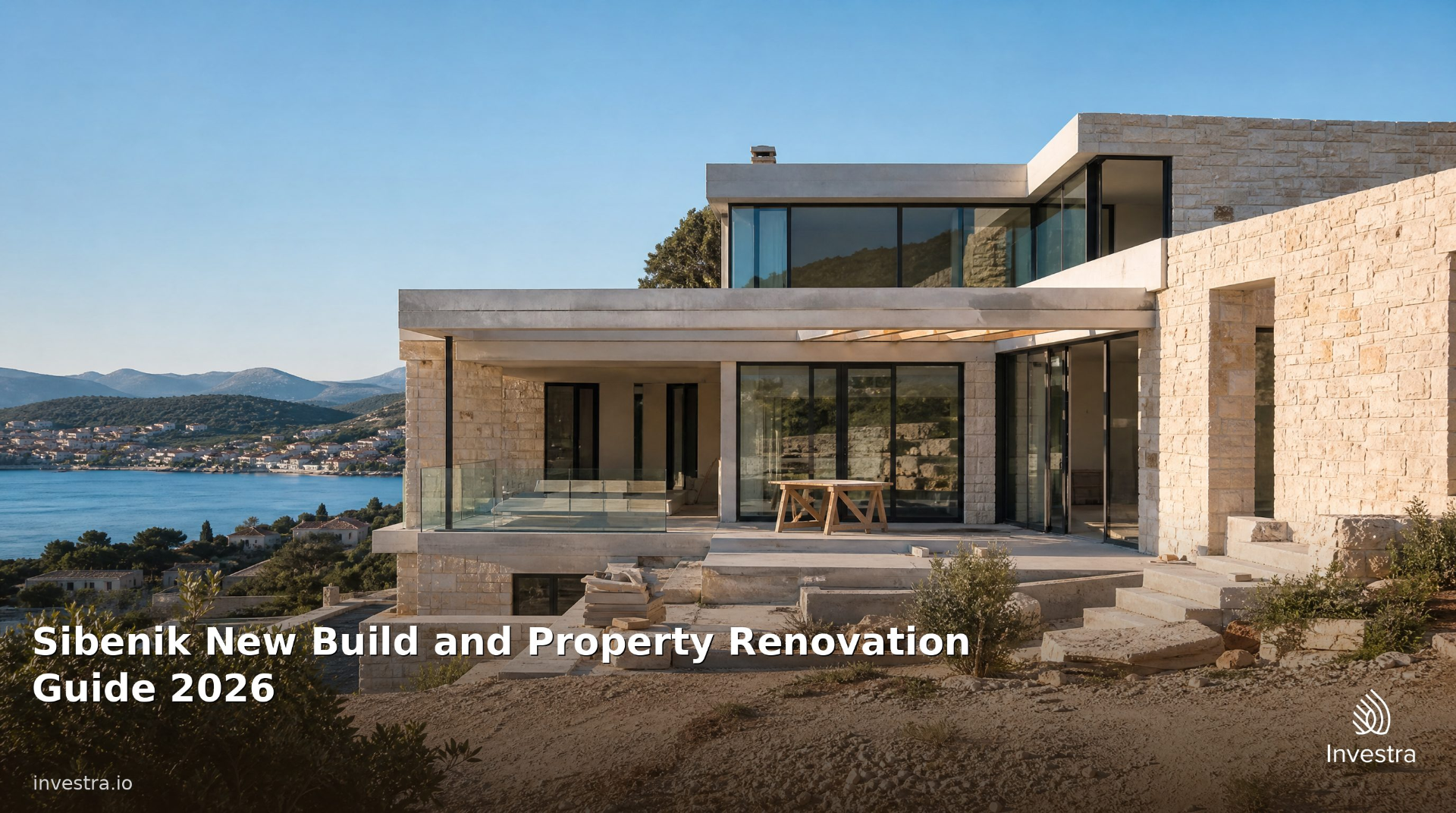
Sibenik New Build and Property Renovation Guide 2026
Why Šibenik Is Capturing Investor Attention in 2026
Quick Answer: Šibenik combines UNESCO-listed heritage, proximity to Krka and Kornati national parks and sustained tourism growth to create compelling opportunities for new builds and renovations; it remains more affordable than Dubrovnik or Hvar while offering improving infrastructure and short-term rental demand. Investra.io tracks Croatia-wide investor sentiment and frequently asked questions for 2026.
Šibenik sits strategically on the central Dalmatian coast between Split and Zadar and has been quietly moving from regional port town to a destination in its own right. The Cathedral of St. James and the medieval fortresses are anchors, but the investment case is driven by more prosaic factors: reliable ferry connections to the archipelago, improved road links to main highways, and rising tourist arrivals that have turned a local market into one with international demand cycles.
What distinguishes Šibenik for many investors is the mix of durable heritage-led scarcity in the old town and buildable coastal corridors that support modern apartment and villa development. This structural supply constraint in the historic core, paired with more flexible new-build opportunities on the Riviera and nearby islands, creates a range of strategies for buyers with different risk appetites and capital profiles.
Understanding the Šibenik Property Market: Prices and Trends in 2026
Quick Answer: Prices in Šibenik in 2026 vary by zone and product: unrenovated old-town stone houses trade from roughly €1,800/m², standard new builds in urban areas between €2,200–3,800/m², and premium coastal new builds can approach €6,500/m²; recent annual appreciation in prime pockets averaged around 8–12% during 2022–2025. See comparative context in Investra.io's Split guide.
Market segmentation matters more here than headline averages. The old town is unique: constrained supply, high renovation complexity and a buyer pool that seeks authenticity deliver a premium to finished product. Older stone units, when bought as shells, offer the most upside for hands-on investors willing to manage technical works and heritage approvals.
In contrast, the broader urban area and Riviera developments present more standardised pricing and product comparability for off-plan buyers. These units cater to buyers who prioritise shorter delivery timelines, clearer permitting and professional aftercare — a trade-off for a somewhat smaller value gap between purchase price and resale or rental value.
Comparative dynamics across Dalmatia are helpful. Split and Dubrovnik command premium pricing for reasons of scale and international visibility, while islands like Hvar attract luxury demand and pricing. For regional perspective on premium-product performance, consult the Hvar Island Real Estate 2026 analysis and market research on inland and regional towns such as Metković, Knin and smaller coastal towns like Tribunj.
New Build Opportunities in Šibenik: What's Actually Available
Quick Answer: New builds in Šibenik range from standard off-plan apartment developments along the Šibenik Riviera to boutique villas and small resort-style projects; developers commonly target short-term rental performance and offer turnkey packages in premium projects. For luxury benchmarks see Hvar Island Real Estate 2026.
New-build product in the Šibenik area is primarily concentrated along the coastal corridor toward Vodice and Primošten, and selectively on larger plots with sea views. Typical project sizes for apartments are modest — 10 to 40 units — which preserves a boutique scale that many buyers prefer. Developers now routinely include pools, private parking, green space and professionally managed rental programmes as part of sales packages to attract international investors.
Off-plan pricing usually starts lower with staged increases tied to construction milestones. Expect an initial opening price often 10–20% below anticipated completion price; this discount reflects marketing strategy and presale risk allocation rather than construction savings. Because delayed projects and stalled developers have occurred in Croatia's recent history, insist on seeing active permits and verified progress reports before releasing funds beyond small reservation deposits.
Villas remain a distinct category: small clusters of high-quality villas and bespoke single-villa builds are marketed to buyers wanting private use as well as rental revenue. The island market adds another layer; properties on Murter and the wider Šibenik archipelago are attractive but subject to more complex permitting and connectivity issues. Investra’s reports include regional product comparisons and specific island guides like Murter Island Real Estate 2026.
Renovation Projects in Šibenik: The Stone House Opportunity
Quick Answer: Renovation of historic stone properties in Šibenik's old town can produce substantial margins when executed carefully; budget for structural complexity, heritage approvals, specialist stonemasonry and a 15–20% contingency. Tax and resale considerations are reviewed in the Croatia Property Tax Guide 2026.
Renovations in the old town are a repeatable play if you accept certain constraints: heritage protections, irregular floorplates, and the need for specialist trades. Contractors experienced in traditional limestone buildings are available in the Šibenik region; their work is critical to preserving both structural integrity and market value. Many investors prefer to preserve the exterior character while rebuilding interiors to modern standards when permitted.
Renovation categories you will encounter are cosmetic upgrades, structural rehabilitation and façade-retention rebuilds. Each has a different risk-reward profile. Cosmetic work is the fastest to market but offers smaller gross margins; structural or rebuild projects increase complexity, timeline and cost but can unlock substantially higher resale valuations and rental rates once completed and properly marketed.
Heritage protection can be a positive asset: it underpins the premium buyers pay for authenticity and location. However, it imposes obligations during the planning phase and often means that conservation professionals must be engaged. Properly priced, a 40–80% gross margin on the finished product over total investment is achievable in many cases, but this depends heavily on accurate cost forecasting and conservative occupancy estimates for rentals.
Legal Framework for Foreign Buyers: Buying Property in Šibenik
Quick Answer: EU citizens purchase property on equal footing with Croatians; non-EU buyers typically require a reciprocity check through the Ministry of Justice, which is routinely granted for most Western nationalities. For transaction mechanics in coastal cities see Investra.io's Dubrovnik buying guide and inland processes in the Zagreb guide.
The practical buying sequence is straightforward in structure but requires local expertise: title checks at the land registry, a preliminary contract (predugovor) often accompanied by a deposit, and a final notary-authenticated contract registered with the land registry. Legal representation by a Croatian lawyer who understands Šibenik's old-town peculiarities is essential: deeds can reveal encumbrances, unregistered co-ownership, or inheritance issues that materially affect value and future use.
Costs and taxes follow standard Croatian practice: resale properties commonly carry a 3% transfer tax, while developer sales of new builds are typically subject to VAT instead. Legal fees, notary and registration costs should be modelled as part of acquisition expenses. For nuanced tax treatment, including rental income and capital gains, study the Croatia Property Tax Guide 2026 and obtain local tax advice.
For transactional support and international buyer services, specialists and consultants such as Siniša Dagary investment insight and his advisory pages outline common structures and service offerings; his services page describes the hands-on assistance many foreign buyers rely on.
Building Permits and Heritage Constraints in Šibenik
Quick Answer: Building permits are administered by Šibenik-Knin County with interior renovation often falling under simplified notification, while exterior or structural works in the old town require full permits and heritage department approvals that typically add 3–6 months. For common planning queries consult the Croatia Real Estate FAQ 2026.
Planning checks are non-negotiable. Before any purchase of land or a renovation shell, confirm zoning, allowable footprints, and whether the plot sits inside a protected zone. Conversion of agricultural land or building on areas with protected vistas or archaeological sensitivity can be refused or require substantial mitigation measures. Investors who engage a local architect early in the purchase process save time and prevent expensive changes later on.
Renovation works that only affect interiors and leave external facades unchanged may proceed with simpler administrative notifications, although local practice varies and documentation must be precise. External modifications — window replacements, roofline changes, external insulation — will trigger full permit applications and heritage department consultation. A licensed Croatian architect (ovlašteni arhitekt) and conservation specialist should be engaged where heritage is implicated to expedite approvals and ensure compliance.
Construction Costs and the Contractor Market
Quick Answer: Typical new-build all-in construction in Šibenik ranges from approximately €900–2,200/m² depending on specification; historic stone renovation ranges from €800–2,000/m² depending on structural complexity and conservation requirements. Compare inland benchmarks in Investra.io's Zagreb guide.
Contractor selection drives both cost and risk. Local firms familiar with traditional stonework and coastal construction practices are vital for old-town projects. Labour costs in Croatia remain lower than comparable Western European markets, but wage convergence and materials price volatility mean investors should use contemporary tender returns rather than historical rules of thumb for budgeting.
Standard practice: obtain at least three detailed, referenced quotes and verify completed work in the local area. Variances between quotes for identical scope can be large; they often reflect differences in project assumptions, inclusion of temporary works, or the contractor's current workload. A 15–20% contingency for unforeseen heritage or structural issues is prudent on older buildings.
Rental Yields, Short-Term Rental Regulations and Operational Realities
Quick Answer: Prime short-term rental assets in Šibenik produce gross yields typically between 6–10% with net yields closer to 3.5–7%; seasonal demand concentrates returns into a 4–5 month peak period. Regulatory trends favor professional registration and tax compliance; see short-term rental legal contexts in Split Airbnb Investment 2026 and Dubrovnik Airbnb Investment 2026 for comparative rules.
Operational realism is essential: daily rates in peak weeks can be strong, but occupancy collapses in winter in many coastal locations. A well-presented two-bedroom apartment can fetch €120–220 per night in peak season; villas command weekly peak rates that are multiples of daily apartment pricing. Management fees, platform commissions and maintenance should be included in any yield model.
Municipalities and national authorities expect registration for short-term lets, compliance with safety and hygiene standards, and accurate reporting of rental income for tax purposes. Platforms have introduced more robust identity and listing verification procedures which, combined with local enforcement, mean hosts must be compliant or risk fines. For parties interested in renting to digital nomads or longer-stay remote workers, immigration and visa factors are relevant; see the Digital Nomad Visa guide for practical considerations.
Financing, Taxes and Structuring Deals
Quick Answer: Financing options include Croatian bank mortgages, international lending and developer payment plans; new builds sold by developers often carry 25% VAT while resales attract a 3% transfer tax. For detailed tax mechanics consult the Croatia Property Tax Guide 2026. For structured financing assistance, contact Findes Group & Partners.
Mortgage availability for foreign buyers varies by bank and buyer nationality. Many Croatian banks will lend to non-residents subject to additional documentation; loan-to-value ratios are often lower for foreign buyers and terms depend on income verification. Specialist advisory firms and international lenders can structure financing packages that combine local mortgages with foreign-currency loan components or bridging finance for renovations.
Tax considerations are central to net return. Developer sales attract VAT treatment while resales attract transfer tax; rental income is taxable and must be reported locally. Capital gains rules differ depending on holding period and transaction structure. Professional tax planning — and transparent reporting — avoids costly surprises and supports longer-term asset management strategies. The Findes advisory team can assist with mortgage and financial structuring for foreign investors and their local counsel; contact details are available on the Findes contact page.
Due Diligence and Project Management on Renovation/New Build Projects
Quick Answer: Successful projects combine thorough legal and technical due diligence with local project management: confirm clear title, permits, realistic contractor quotes, insurance, and a project schedule linked to staged payments. For transactional support consider consultancy firms and local advisors such as Siniša Dagary.
Due diligence is multi-disciplinary: legal title, cadastral alignment, permit status, technical surveys (structural, damp, electrical), and a realistic market appraisal for the finished product. Engaging a local architect before purchase is a recurring best practice since it allows you to test permit risk and refine likely construction costs and timelines before committing capital.
On-site project management reduces risk. Investors who cannot be locally present should hire a trusted project manager — often an architect or experienced builder with client references — to oversee progress, quality and cost control. Escrow arrangements tied to construction milestones and independent certification of work completed by a notary or engineer protect buyers making staged payments on off-plan or build-to-order transactions.
Investment Disclaimer
Quick Answer: The information in this guide is educational and indicative only; it should not be interpreted as financial or legal advice. Investors must perform their own due diligence and consult qualified advisors before making decisions.
The content here describes market conditions, typical costs and common processes in Šibenik and broader Croatian real estate in 2026. It does not constitute investment advice or a recommendation to buy or sell property. Real estate investments carry risks including market, regulatory, construction and liquidity risk. Past performance is not a guarantee of future results. Engage qualified legal, tax and financial advisers to structure any acquisition, renovation or rental operation. Companies and advisers named in this article are examples of relevant market participants; readers should perform their own vetting before engaging service providers.
Frequently Asked Questions
Quick Answer: Below are the most common questions prospective buyers ask about Šibenik property investment, with succinct answers to guide further due diligence.
Is Croatia a good country for real estate investment in 2026?
Croatia offers attractive coastal investment opportunities in 2026 driven by tourism growth, Euro adoption and improving infrastructure. Prospective investors should align choice of asset (old-town renovation versus new build) with liquidity needs, management capacity and tax planning. For wide-ranging investor queries see the Croatia Real Estate FAQ 2026.
Can foreigners buy property in Croatia?
Yes. EU citizens enjoy parity with Croatian nationals. Non-EU buyers typically undergo a reciprocity check via the Ministry of Justice; approval is standard for most nationalities. Use a local lawyer to navigate registry checks and any formal approvals.
What is the average property price in Šibenik?
There is no single average: unrenovated old-town stone units commonly start around €1,800/m², standard urban new builds €2,200–3,800/m², and premium coastal new builds up to €6,500/m². Market research across Dalmatia including Split and Dubrovnik gives additional context: compare with Split and Dubrovnik.
What rental yields can I expect in Šibenik?
Gross yields for short-term rental properties typically fall in the 6–10% range for prime apartments and 5–8% for villas. Net yields after management, maintenance and fees often range 3.5–7%, depending on seasonality and occupancy.
What taxes apply to property purchases and rentals?
Resale purchases normally incur a 3% transfer tax; developer sales of new builds are often subject to 25% VAT. Rental income and capital gains are taxable; reporting and regime details depend on ownership structure and residency. The Croatia Property Tax Guide 2026 outlines common scenarios.
How long does the purchase and renovation process take?
Buying from offer to completion typically takes 30–60 days for straightforward resale deals; permit-heavy or heritage projects can extend timelines. Renovation timelines vary: cosmetic work may complete in 3–6 months, structural and heritage works often take 12–24 months depending on approvals and complexity.
What financing options are available for foreign buyers?
Options include local bank mortgages (subject to bank policies for non-residents), international lenders, developer financing and cash. Specialist advisors and financial services such as Findes Group & Partners can assist with mortgage sourcing and structuring across jurisdictions.
Are building permits difficult to obtain in Šibenik?
Permitting is more predictable than in the past but still requires attention. Standard permits outside protected zones can be processed in 30–60 days; heritage-area approvals commonly add 3–6 months. Early engagement with a licensed architect and local authorities shortens the process.
Do I need a local architect or builder for renovations?
Yes. A licensed Croatian architect and experienced local contractors are essential, particularly for heritage projects. They advise on permit viability, realistic budgets and the sequencing of works; they also provide supervision that protects your investment and reduces dispute risk.
Where can I find trusted local advisory and management services?
Local property firms and specialist advisors support acquisition, renovation and rental management. For consultancy and on-the-ground support consult service pages such as Siniša Dagary investment insight and contact professionals directly via their contact page for bespoke engagement.
Should I consider off-plan purchases in Šibenik?
Off-plan purchases can offer early-price advantages but require rigorous due diligence on permits, developer track record and contract terms. Ensure stage payments are tied to verifiable milestones and that escrow arrangements or notary oversight protect your funds.
How do environmental and national park proximities affect value?
Proximity to Krka and Kornati national parks enhances year-round desirability for day-trip tourism and elevates property appeal. Environmental protections may restrict construction in certain zones but typically support higher finished-product valuations for nearby properties.
Are there differences between island and mainland investments?
Island properties often command higher per-night rates for short-term rentals but face higher logistics, permitting complexity and seasonal variability. Mainland coastal locations can offer steadier access, lower operational costs and easier year-round management.
Recommended Reading
Quick Answer: The following resources provide deeper, topic-specific guidance on taxes, rental strategy, buying process and regional market analysis.
- Croatia Property Tax Guide 2026
- Split Airbnb Investment 2026
- Croatia Digital Nomad Visa 2026 Complete Guide For Remote Workers
- Hvar Island Real Estate 2026 Luxury Property Investment Guide
- Dubrovnik Airbnb Investment 2026
- Buying Property In Split 2026
- Investra market research — Zagreb
- How To Buy Property In Zagreb As A Foreign Buyer
- Zagreb Rental Yield And Short-Term Let Investment Guide 2026
- Primosten Real Estate 2026
- Murter Island Real Estate 2026
- Tribunj Real Estate 2026
- Siniša Dagary investment insight
- Siniša Dagary — Business Strategy Blog
- About Siniša Dagary
- Contact Siniša Dagary
- Siniša Dagary — Services
Recommended Reading
Quick Answer: This section explains the practical property-investment implications of Recommended Reading.
- Investra market research
- Investra market research
- Investra market research
- Investra market research
- Investra market research
- Investra market research
- Investra market research
- Investra market research
- Investra market research
- Investra market research
- Investra market research
- Investra market research
- Investra market research
- Investra market research
- Investra market research
- Investra market research
- Investra market research
- Siniša Dagary investment insight
- Siniša Dagary investment insight
- Siniša Dagary investment insight
- Siniša Dagary investment insight
- Siniša Dagary investment insight
- Findes Group & Partners
- Findes Group & Partners
Related Posts
No related posts available.
