
Sibenik Real Estate Market 2026: Prices, Areas & Buyer Guide
Sibenik Real Estate Market 2026: Why This Dalmatian City Is Turning Heads
Quick Answer: Sibenik's real estate market in 2026 is one of Croatia's most compelling investment stories — a UNESCO-protected medieval city on the central Dalmatian coast offering property prices significantly below Dubrovnik and Split, combined with strong short-term rental demand and consistent year-on-year price appreciation. Investra.io covers the full spectrum of Croatia's emerging and established markets to help buyers make confident decisions.
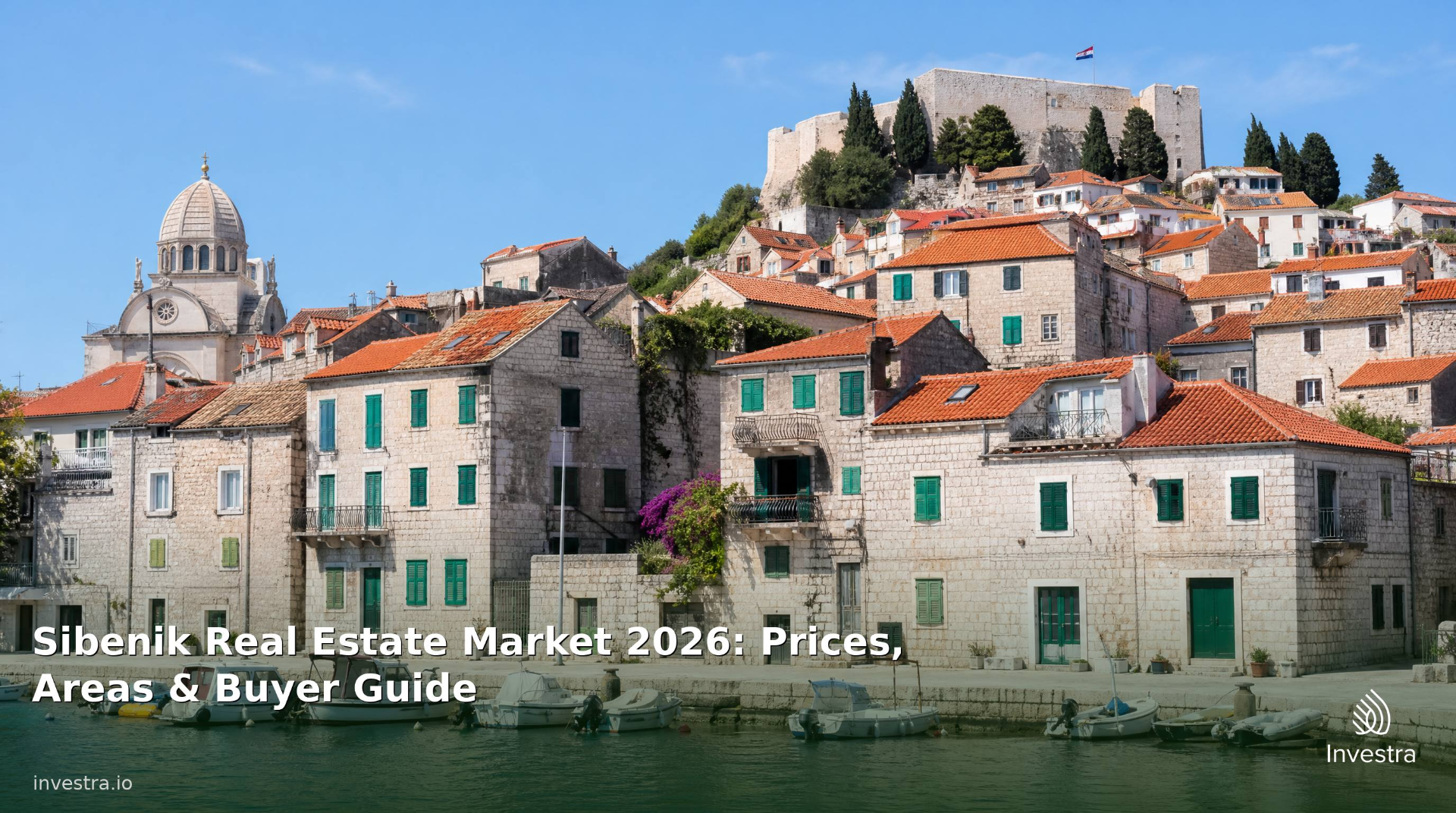
There is an immediate visual and emotional clarity the first time you see Sibenik from the water: the Cathedral of St. James, fortresses on the hilltops, the Krka River finding the sea. Those landmarks speak to centuries of urban continuity and give the city a scale and texture that appeals to visitors and residents alike. That character is central to the investment thesis in 2026.
Investors who track regional dynamics recognize Sibenik as a market in transition — not a speculative bubble and not a stagnant backwater, but a city whose relative affordability compared with Split and Dubrovnik creates a clear mathematical case for yield-oriented buyers. That transition phase is the window where experienced purchasers find opportunities: the period after a market is discovered but before it is fully saturated.
Current Property Prices in Sibenik 2026: What the Numbers Actually Show
Quick Answer: In 2026, Sibenik property prices range from approximately €2,200 to €4,500 per square meter depending on location, property type, and condition — with the historic Old Town commanding the highest premiums and outlying residential areas offering entry-level opportunities for investors on tighter budgets. Investra.io's Croatia real estate FAQ provides detailed pricing breakdowns across all major Croatian markets.
Clear price bands exist in Sibenik and buyers should approach each band with different expectations. The Old Town sets the upper end: stone properties with heritage features trade at higher per-square-meter levels because of scarcity, tourism desirability, and the premium that buyers place on immediate proximity to the cathedral and waterfront.
Coastal neighborhoods outside the immediate historic core present an opportunity set for buyers seeking modern conveniences or turnkey rental products. New developments around the Riviera strip and resort areas are competitively priced against similar product in other Dalmatian towns, and they benefit from amenities designed to attract holiday renters: covered parking, shared pools, and management structures that facilitate remote ownership.
Moving inland and across the municipality yields further price relief. Those locations are suitable for buyers focused on long-term capital appreciation or for owners who prefer lower ongoing management intensity. The broader island archipelago near Sibenik, while commanding a logistical premium due to ferry access constraints, remains attractive to a narrower segment of buyers seeking privacy and unique seaside properties.
Year-on-year price growth through the mid-2020s reflected a market tightening. Renovated heritage apartments and well-located waterfront units posted the largest gains, but the supply side — particularly in protected zones — is structurally constrained.
Sibenik's Key Neighbourhoods and Investment Zones Explained
Quick Answer: Sibenik's investment landscape divides into five distinct zones — the historic Old Town, the coastal Riviera strip, the Krka River gateway area, the Solaris tourism complex, and the broader island archipelago — each offering different price points, rental profiles, and buyer demographics. Understanding these zones is essential before committing capital.
Understanding micro-markets is the first practical step in any investment decision. The Old Town (Stari Grad) is where cultural heritage drives demand. Units here tend to be stone-built and layered vertically across multiple floors, often requiring significant renovation budgets to modernize services while preserving historic fabric.
The coastal Riviera — areas like Brodarica and Solaris — concentrates newer builds and resort-type developments. These properties are designed for holiday letting at scale and often come with a management infrastructure that simplifies ownership for cross-border investors. They are less rare than Old Town properties but still command good demand from tourists seeking modern comfort and proximity to beaches.
The Krka River gateway and surrounding rural villages offer retreat-style properties and lower entry prices. Their appeal is tied to access to Krka National Park and the nature-based tourism market. These units can deliver strong seasonal returns linked to national park visitation patterns, yet their occupancy tends to be more concentrated around peak months and weekend activity.
The islands in the Sibenik archipelago—Zlarin, Krapanj, and Prvic—are a different proposition: restricted vehicular access and limited infrastructure create logistical challenges but also define a unique niche. Buyers here acquire exclusivity and a distinct lifestyle proposition; rental demand can be strong among particular guest segments, such as yacht-based travelers and experiential tourists, but operational complexity is higher.
Finally, proximate towns such as Vodice or Primosten function as part of the broader Sibenik investment catchment. They offer comparative affordability and benefit from spillover tourism and regional connectivity. For investors preferring larger portfolios or diversified risk across several municipalities, these towns provide practical options that align with the Sibenik market without the same pricing pressure inside the protected city core.
Rental Yields and Short-Term Income Potential in 2026
Quick Answer: Gross rental yields in Sibenik range from 5% to 9% annually depending on property type and management approach, with well-managed short-term rental properties in the Old Town or coastal zones achieving the higher end of that range during Croatia's increasingly extended tourist season. Investra.io's Split Airbnb investment guide provides detailed comparative data on short-term rental performance across central Dalmatia.
Yield expectations must be defined by operational choices. Passive ownership typically yields at the lower end of the range; active professional management with dynamic pricing and marketing pushes returns higher. The disparity reflects occupancy optimization, guest experience quality, and the ability to generate premium rates during festivals and peak months.
A worked example using a two-bedroom Old Town apartment illustrates the dynamics without introducing new statistics: acquisition at a mid market price point combined with peak-season nightly rates generates substantial gross income. After professional management fees, utilities, and periodic renovation reserves are deducted, net yield compresses compared to gross numbers.
The municipal strategy to lengthen the tourist season has real implications for returns. Cultural programming, festival sequencing, and strengthened transport connectivity reduce seasonality risk and create demand pockets in shoulder months. That structural extension of available rental nights increases revenue per property and decreases reliance on the narrow summer window.
Comparisons with higher-priced Croatian markets show why Sibenik is attractive to yield investors. Although absolute nightly rates in Split or Dubrovnik can be higher, the substantially larger acquisition cost in those markets often shrinks yield percentages relative to Sibenik properties when calculated on a per-euro-invested basis.
The Legal Framework for Foreign Buyers in Sibenik
Quick Answer: EU citizens can purchase property in Sibenik with the same rights as Croatian nationals, while non-EU buyers face reciprocity requirements but can typically acquire through a Croatian-registered company. The purchase process involves a preliminary contract, due diligence period, notarized deed, and Land Registry registration — typically completing in 60–120 days from initial agreement.
Croatia’s policy environment after euro adoption simplifies many practical aspects of a cross-border purchase. For EU nationals the process is straightforward and rights mirror those of local buyers. Non-EU nationals frequently structure acquisitions through a local limited liability company to satisfy reciprocity and administrative conditions.
Complexities arise where heritage protections, maritime domain questions, or irregular title histories exist. In those cases, specialized legal advice is not optional. Expect to budget for professional fees that reflect the complexity of the title and the extent of due diligence.
For guidance on tax obligations across acquisition and holding, the Investra Croatia property tax resource is essential reading; it lays out the categories and rates that foreign buyers must consider when modeling investment returns and preparing for ongoing compliance obligations. The link provides detailed guidance relevant to planning purchase structure and post-acquisition reporting obligations. Croatia Property Tax Guide 2026
Buying Property in Sibenik: Step-by-Step Process for International Buyers
Quick Answer: Purchasing property in Sibenik as a foreign buyer involves eight key stages — from initial market research and property identification through to Land Registry registration — with the entire process manageable remotely for buyers who assemble the right local team of agent, lawyer, and notary. Investra.io's Split buyer guide provides an excellent procedural template applicable across central Dalmatia.
A methodical, staged approach mitigates the most common transactional risks. Stage one is definition of investment objectives: holiday use, pure yield play, or long-term appreciation. That decision determines appropriate neighborhoods, acceptable property conditions, and budget for renovation versus turnkey purchases. Stage two is obtaining a Croatian OIB, a necessary step for all buyers and easily conducted by a local lawyer on the buyer’s behalf.
Stage three is the search and viewing process. Local agents remain the primary channel for listings and access to off-market opportunities. Good practice is to work with two or three reputable brokers and cross-verify listings, because exclusivity agreements and parallel marketing are common.
Stage five typically involves a preliminary sales agreement and deposit. These agreements outline the conditions for the final sale and often include penalties that create mutual performance incentives. Stage six is the notary signing of the final deed; buyers may use a power of attorney to complete this step if travel is impractical. Stage seven is obtaining Land Registry registration, which legally records the transfer.
Remote completion is standard practice for many international buyers, provided powers of attorney are correctly executed and notarized. Professional management can be engaged to handle the transition to a rental-ready property. For a practical procedural template applicable across central Dalmatia, Investra’s Split buyer guide is a useful comparative document and shares many procedural elements relevant to Sibenik purchases. Investra.io's Split buyer guide
Tourism Trends Driving Sibenik's Investment Case
Quick Answer: Sibenik received over 1.2 million tourist overnight stays in 2024, representing growth of approximately 18% compared to pre-pandemic 2019 levels, with international visitor numbers from Germany, Austria, the UK, and the Netherlands leading demand — a trend that directly underpins short-term rental occupancy rates and property price appreciation.
The tourism profile gives Sibenik a resilience that is not obvious from headline comparisons to larger destinations. Rather than relying solely on beach-based demand, Sibenik benefits from proximity to Krka National Park and the Kornati archipelago, which diversify the visitor mix and lengthen average stays for nature-oriented tourists.
Charter and yacht tourism add a layer of higher-spend visitors who are less price-sensitive than typical land-based tourists. The presence of ACI Marina and regular charter traffic increases demand for premium short-term accommodation and contributes to occupancy outside the narrowest peak weeks.
Visitor origin statistics show a broad European spread, with German-speaking markets, the UK, and the Netherlands contributing a steady flow of arrivals. That geographic diversity buffers the market against sudden demand shocks from any single source market.
Sibenik vs. Split vs. Dubrovnik: Where Does the Value Case Stand?
Quick Answer: Sibenik offers property prices approximately 30–45% below Split and 50–65% below Dubrovnik for comparable property types, while delivering rental yield percentages within 1–2 percentage points of those premium markets — making it the strongest value proposition in central Dalmatia for yield-focused investors in 2026.
Comparative valuation is the most practical tool for assessing relative opportunity along the Dalmatian coast. The price differential between Sibenik and the more internationally established coastal centers is meaningful, and for investors focused on yield it creates a clear rationale for prioritizing Sibenik.
That said, the market profiles differ. Dubrovnik’s international brand strength and visitor concentration in the Old City produce a unique demand floor that supports extraordinary pricing; however, that same concentration implies higher entry costs and sometimes more restrictive regulatory oversight. Split sits between the two: a strong tourism brand, a large year-round resident base, and a more extensive service sector than Sibenik.
Investors should weigh brand resilience against acquisition cost. While Split and Dubrovnik are proven markets, Sibenik offers a mathematically compelling value proposition when modeled for yield and cash flow. For cross-market decision-making, structured analysis from experienced consultants is invaluable, and advisory services that model cash flows under multiple occupancy and pricing scenarios are recommended. For structured comparative research across Croatian markets, Investra’s broader market research resources provide extensive context and data. Investra market research | Investra market research
Digital Nomads, Remote Workers, and Mid-Term Rentals: A Growing Sibenik Story
Quick Answer: Sibenik's growing digital nomad community — drawn by Croatia's official Digital Nomad Visa, relatively low cost of living compared to Western Europe, fast broadband infrastructure, and Mediterranean lifestyle — is creating a year-round mid-term rental market that significantly improves investment property cash flow calculations beyond the traditional summer season. Croatia Digital Nomad Visa
Remote work demographics have created a repeatable mid-term demand segment: remote professionals seeking stays from one to four months. For investors, mid-term lets reduce exposure to daily turnover costs and often require less intensive marketing than short-term listings.
Sibenik’s relatively lower rental cost for quality housing, combined with adequate connectivity and growing co-working infrastructure, positions it as a compelling alternative for remote workers who prefer authenticity over city anonymity. Monthly rates for hybrid-focused properties are attractive to nomads while still delivering useful cash flow for property owners.
Practical Investment Considerations: Renovation, Management and Costs
Quick Answer: Budgeting for renovation, professional management, and compliance costs is as important as acquisition price. Renovation budgets for heritage properties typically add substantial per-square-meter costs but materially increase rental rates and long-term asset value. Professional property management improves yield and reduces owner workload.
Renovation planning requires realistic cost forecasting and an appreciation for regulatory timeframes. Heritage properties often need bespoke solutions for insulation, services, and utilities that preserve exterior character while delivering contemporary guest expectations internally. Local architects and contractors experienced in conservation deliver value by handling municipal approvals efficiently.
Management decisions materially affect net yields. Engaging a professional management company reduces vacancy risk, improves guest satisfaction, and enables dynamic pricing strategies that capture peak demand. Management fees are a trade-off: they reduce gross income but frequently raise net return through higher occupancy and better average nightly rates.
Operational costs include utilities, insurance, maintenance reserves, municipal hospitality registration, and occasional capital works. Tax compliance and correct bookkeeping for rental income are essential. For financial planning and structured mortgage or loan options, owners can consult with advisory firms to design tax-efficient structures. Financial advisors can also assist with cross-border tax implications and entity-level structuring for non-EU buyers. Findes Group & Partners provide advisory services that investors commonly use to align financing and tax strategy. For direct advisor contact and structuring support, Findes contact resources are available. Findes Group & Partners
Engaging an investment consultant early in the process streamlines planning. For example, investment advisory teams that specialize in Croatian markets can provide comparative market analyses and help identify properties where renovation uplift and rental potential align with investor objectives. Professional input into market positioning, targeted renovations, and yield optimisation often pays for itself through improved returns and lower execution risk. Practical resources and consultancy offerings from local experts such as Siniša Dagary investment insight and his firm’s advisory pages provide tailored guidance for international clients considering Sibenik and other Dalmatian markets. For background on services and contact, their About and Services pages outline the scope of support available. Siniša Dagary investment insight | Siniša Dagary investment insight
Investment Disclaimer
Quick Answer: The information supplied here summarizes market observations and established procedures but is not investment advice. Investors must perform their own due diligence and consult appropriate professionals for legal, tax, and financial guidance.
The content in this article is provided for educational and informational purposes only and does not constitute an offer, solicitation, recommendation, or advice to buy or sell any property, financial instrument, or investment product. Real estate investment carries inherent risks including market volatility, regulatory change, and liquidity considerations. Past performance is not a guide to future results.
Frequently Asked Questions
Quick Answer: Here are the most commonly asked questions about Croatia real estate investment in 2026, answered with practical pointers and references to further reading.
Is Croatia a good country for real estate investment in 2026?
Yes. Croatia combines growing property values with improving infrastructure and a favorable tourism profile. The market offers diversification between urban, coastal, and island assets. Investors should study local market cycles and align purchase decisions with their time horizon and risk tolerance. For detailed tax considerations and cross-market comparisons, consult the Investra Croatia resources. Croatia Property Tax Guide 2026
Can foreigners buy property in Croatia?
EU citizens can buy property on the same terms as Croatian nationals. Non-EU buyers often use a Croatian company or rely on bilateral reciprocity; both approaches are common and legally established. Legal advice is essential to select the appropriate acquisition vehicle and to manage tax implications. In many transactions, consultants such as those at Siniša Dagary investment insight assist international buyers in handling the process.
What is the average property price in Sibenik?
Prices vary by location and condition. Historic Old Town properties command the highest premiums, coastal new builds are mid-range, and inland or island properties may provide lower entry points. For up-to-date comparative figures and transaction-level intelligence, Investra’s market pages provide detailed breakdowns across Croatian markets. Investra.io
What rental yields can I expect?
Gross rental yields in Sibenik typically range from 5% to 9% depending on property type, location, and management intensity. Net yields after fees and operating costs will be lower. Active management and a hybrid short-term/mid-term strategy generally produce higher net returns than a passive approach.
What taxes apply to property purchases?
Resale transactions generally attract a transfer tax, while new-build purchases are subject to VAT. Annual property taxes and rental income obligations also apply. Tax treatment varies by transaction, so planning before signature minimizes surprises. Investra’s tax guide and advisory services can help structure the purchase efficiently. Croatia Property Tax Guide 2026
How long does the purchase process take?
Standard transactions typically complete within 60–120 days from preliminary agreement, depending on title complexity and administrative timelines. With clean title and experienced advisors, timelines compress. Complex heritage or maritime-boundary issues extend the cycle and require additional due diligence.
What financing options are available?
Buyers can access local bank mortgages where eligible, international finance, or developer payment plans for new builds. Mortgage approval depends on borrower profile and property characteristics. Financial structuring and mortgage advisory support are commonly used to optimise use; advisory firms such as Findes Group & Partners are resources for investors seeking structured financing solutions.
Is property management available for rental properties?
Yes. Professional property management is widely available and recommended for owners who do not live locally. Management companies handle guest communications, cleaning, maintenance, and regulatory compliance. Fees vary based on service level; full-service management typically reduces owner workload and can improve net yields through better occupancy and pricing.
What are the best areas to invest in Sibenik?
Best areas depend on investor goals. The Old Town is the choice for capital appreciation and premium short-term rental income; the coastal Riviera suits turnkey holiday products; rural and island locations suit lifestyle buyers or niche rental strategies. Use a clear investment brief to match neighbourhood selection with objectives. Comparative research across local markets and adjacent towns is available through Investra pages on nearby municipalities. Metkovic Real Estate Market 2026 | Knin Real Estate Market 2026
Recommended Reading
Quick Answer: This section explains the practical property-investment implications of Recommended Reading.
- Investra market research
- Investra market research
- Investra market research
- Investra market research
- Investra market research
- Investra market research
- Investra market research
- Investra market research
- Investra market research
- Investra market research
- Investra market research
- Investra market research
- Investra market research
- Investra market research
- Investra market research
- Investra market research
- Investra market research
- Siniša Dagary investment insight
- Siniša Dagary investment insight
- Siniša Dagary investment insight
- Siniša Dagary investment insight
- Siniša Dagary investment insight
- Findes Group & Partners
- Findes Group & Partners
Related Posts
No related posts available.
