
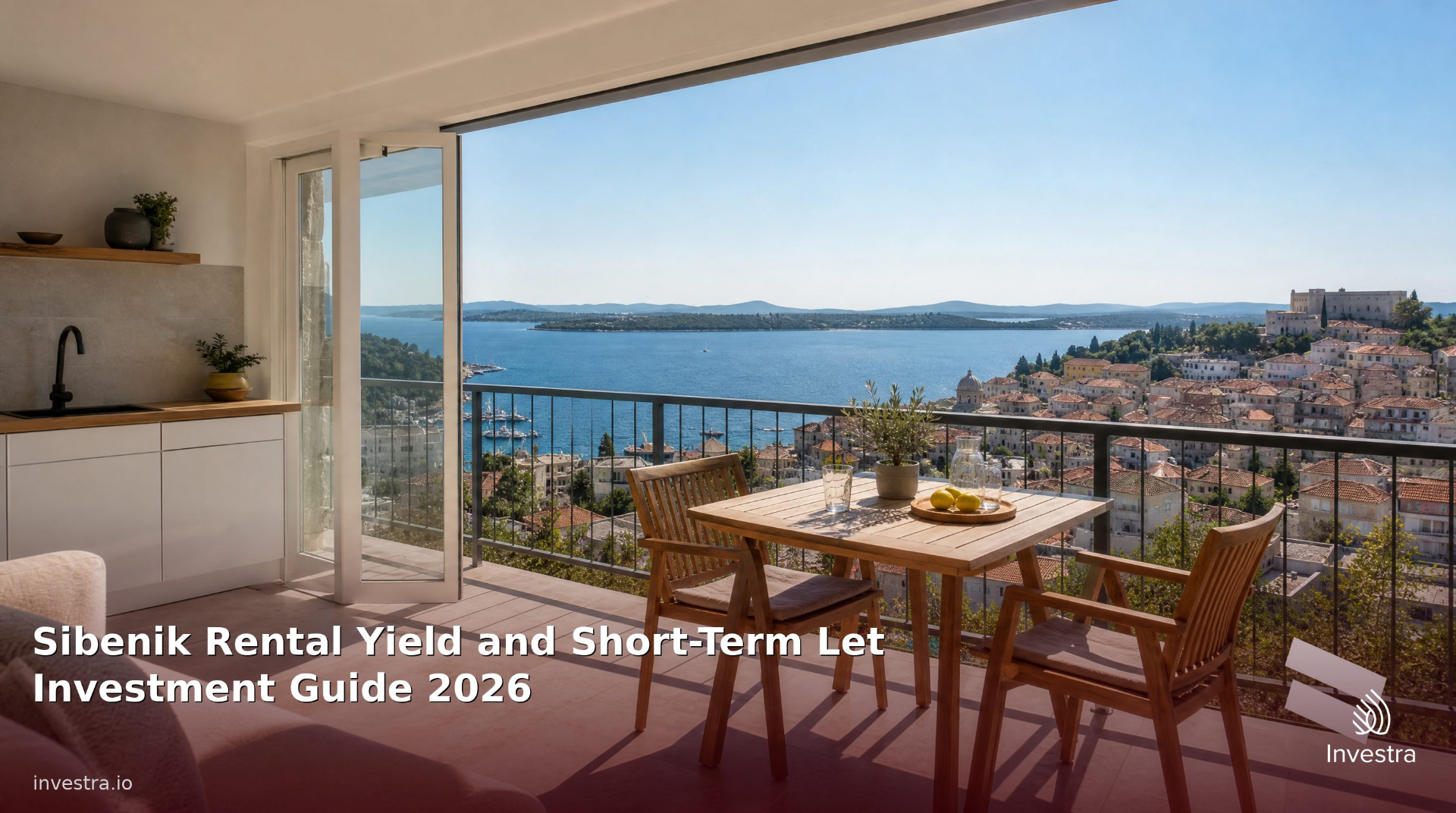
Sibenik Rental Yield and Short-Term Let Investment Guide 2026
Why Šibenik Is Becoming One of Croatia's Most Compelling Rental Investment Destinations
Quick Answer: Šibenik combines strong tourism growth, UNESCO heritage appeal, improving transport links and property prices that remain below premium Dalmatian nodes — yielding 6–10% gross on well‑managed short‑term lets and significant capital upside through 2026 and beyond. For broader national context see Investra.io.
Šibenik's position on the central Dalmatian coast has been understudied compared with Dubrovnik and Split, but the town presents a classic mid‑cycle investment case in 2026. It has the placemaking features investors value — a walkable old town anchored by the Cathedral of St. James (UNESCO), three fortresses offering event programming, and immediate maritime access to the Kornati and Šibenik archipelagos.
Infrastructure improvements — from incremental airport capacity near Zadar and Split to the local road and marina investments — have shortened travel time and enhanced the destination's accessibility. Investors arriving in 2024–2026 have found that occupancy and average nightly rates climbed faster than many forecasting models predicted. The result is a market environment where the rotational capital growth narrative is still credible: prices are lower than in Split and Dubrovnik but tourism fundamentals are converging toward those higher‑profile markets. For benchmarking and comparative pricing across Croatia's coastal cities, see Compare current pricing across major Croatian coastal cities.
Importantly, Šibenik's tourism mix is changing. Beyond family beach visitors, the town is attracting culture and festival attendees, day‑yacht passengers exploring Kornati, and a rising stream of long‑stay remote workers under Croatia's digital nomad visa. Those visitor segments lengthen booking windows and improve shoulder‑season demand — a structural improvement for owners reliant on short‑term income. For what the digital nomad cohort means to local demand, see the Investra guide on the visa program: Croatia Digital Nomad Visa 2026 Complete Guide For Remote....
Šibenik Property Prices in 2026: What Does Entry Cost Look Like?
Quick Answer: Expect a 2026 price spectrum from roughly €1,800/m² in outlying settlements to €6,500+/m² in renovated historic apartments with sea or fortress views; median acquisition budgets for rental‑ready units sit between €130,000 and €300,000 depending on size and location. For comparative market intelligence consult Investra market research.
Price transparency is better today than five years ago, but micro‑location effects remain dominant. The old town is finite — you cannot build new inventory inside the medieval core — and that scarcity is reflected in the top‑end pricing for renovated stone apartments. These properties often demand premiums due to location and authenticity.
Outside the historic nucleus, the city waterfront and newer developments around the marina offer modern apartment stock with specifications that resonate with short‑term rental guests: air conditioning, reliable wi‑fi, open layout and balconies. Here, prices are mid‑range and renovations are typically straightforward, making them favourable for investors seeking faster time‑to‑market. For examples of nearby coastal micro‑market pricing and investment narratives, consult Investra's coverage of Murter and Vodice: Murter Island Real Estate 2026 Sibenik Archipelago Proper... and Vodice Real Estate 2026 Sibenik County Coastal Town Prope....
For budget‑minded investors or those preferring a multi‑unit approach, nearby settlements and commuter villages deliver attractive entry pricing. Tribunj and Brodarica provide lower acquisition cost per square metre and cater to family holiday traffic, while Primošten and other peninsula towns to the south show how premium small‑town positioning can compress yield but offer resilient occupancy. See the comparative guides: Tribunj Real Estate 2026 Small Dalmatian Town Property Guide and Primosten Real Estate 2026 Dalmatian Peninsula Town Prope....
Transaction costs remain an important calculator line. Buyers should budget approximately 5–8% above the purchase price for transfer tax (where applicable), notary and legal fees, licensing and initial categorization expenses. New builds sold by VAT‑registered developers will typically include VAT rather than transfer tax, and that requires separate budgeting and clarity at offer stage. For new‑build transaction mechanics and VAT implications across Croatian cities, see the Split buyer guide.
Understanding Šibenik Rental Yields: Short-Term vs. Long-Term Strategy
Quick Answer: Short‑term letting is the primary yield engine in Šibenik — gross yields of 6–10% are common with top old‑town units achieving 10–12% gross; long‑term residential yields sit around 3.5–5% and trade operational simplicity for lower income. For comparative yield expectations see Investra's Zagreb and Dubrovnik analyses: Buying Property In Zagreb 2026 Complete Guide For Foreign Investors and Dubrovnik Airbnb Investment 2026 Luxury Rental Income Guide.
Gross yield is a useful headline but insufficient on its own. Short‑term lets carry variable costs that compress net returns: channel commissions, cleaning, utilities, linen replacement, guest turnover maintenance and management fees. Net yields after those items and a vacancy buffer typically fall into a 4.5–7.5% range for properly operated short‑term units in Šibenik.
Long‑term rentals provide steady cash flow and minimal operational hassle, trading off seasonal upside. A long‑term lease can be the right strategy for specific investor profiles — those seeking lower risk or residency connections to the property — but for yield‑focused portfolios the short‑term model generally outperforms.
Management quality changes yield outcomes materially. Professional property managers that offer dynamic pricing, guest communication, and rapid maintenance reduce vacancy and increase average nightly rates. Technology and reputation management (reviews, response times, check‑in efficiency) are as critical as location. For best practice operational checklists and management partner selection frameworks, Investra's operational resources and local partners can help: Investra market research.
Šibenik Short-Term Rental Income: Realistic Projections by Property Type
Quick Answer: Expect annual gross short‑term rental incomes of roughly €12,000–€19,000 for studios/one‑bedrooms in the old town, €18,000–€28,000 for two‑bedrooms, and €28,000–€50,000+ for larger houses or villas with premium amenities — peak months June–September usually account for 65–75% of annual revenue. For regional comparisons see Split Airbnb Investment 2026 guide.
Projected income ranges should be built from three inputs: achievable nightly rate, realistic occupancy by month, and ancillary revenue or costs (cleaning fees charged to guests, tourist tax collection mechanics). Using conservative occupancy assumptions avoids optimistic over‑projection that later undermines investment returns.
Example profiles calibrated to 2025–2026 market signals:
- Studio / 1‑bed (35–50m²) — Old Town: Peak €85–€140/night; shoulder €55–€90/night. Occupancy: 110–145 nights/year blended. Gross: €12,000–€19,000/year.
- 2‑bed (60–80m²) — Old Town / Waterfront: Peak €130–€200/night; shoulder €80–€130/night. Occupancy: 130–170 nights/year blended. Gross: €18,000–€28,000/year.
- 3‑bed / Villa (100m²+, pool or sea view): Peak €250–€500+/night; shoulder €150–€280/night. Occupancy: 120–170 nights/year blended. Gross: €28,000–€50,000+/year.
Net revenue after management, cleaning and platform fees typically removes 35–45% from gross. Add routine reserves for maintenance (1–1.5% of property value annually) and capital expenditure cycles (appliance replacement, soft furnishing refresh every 3–5 years).
For investors seeking projectable comparables, Investra’s short‑let analyses across Dalmatia provide useful templates; the Dubrovnik luxury market shows how top performance tiers are structured, while Split provides mid‑coast comparators for volume demand: Dubrovnik guide and Split guide.
The Legal Framework for Short-Term Rentals in Šibenik: What You Must Know
Quick Answer: Legal compliance requires property categorization, guest registration via the eVisitor system, correct collection and remittance of sojourn tax and either paušal or corporate tax reporting. Registration should be completed before taking guests and typically takes 4–8 weeks. See tax and legal overviews in the Croatia Property Tax Guide 2026.
Croatia's short‑term rental rules are mature and explicit. The ministry's categorization provides a classification that determines allowed capacity and minimum standards. Guest registration is centralized through the national eVisitor platform, and providers must register guests within 24 hours of arrival. Failing to register or operating without proper categorization exposes owners to administrative fines and operational disruption.
Tax reporting options matter to net outcomes. Most individual owners use the paušal (flat‑rate) system which simplifies tax for smaller operations by estimating taxable income through a table rather than actual turnover. For larger portfolios or those seeking specific tax optimisation strategies, establishing a Croatian limited liability company (d.o.o.) and filing corporate tax returns will be more appropriate. VAT thresholds and implications for services must be reviewed when annual turnover approaches or exceeds the statutory limits. For practical advisory and structuring services, experienced consultants such as Siniša Dagary investment insight provide tailored guidance for foreign investors.
Operationally, owners should also be aware of local municipal rules that may set additional requirements for specific zones (noise restrictions, waste disposal protocols, and limits on guest capacity in certain protected areas). Heritage properties in Stari Grad often require permissions for structural alterations and façade work, which lengthen renovation timetables and increase upfront costs. For a walkthrough of legal purchasing steps and compliance across Croatian cities, Investra’s buyer guides are helpful practical resources: Buying Property In Dubrovnik 2026 Complete Guide For Foreign Investors and Buying Property In Split 2026 Complete Guide For Foreign Investors.
Best Neighborhoods in Šibenik for Short-Term Rental Investment
Quick Answer: Stari Grad (historic old town), the marina/waterfront and nearby coastal settlements such as Brodarica, Tribunj and Vodice form the highest‑value micro‑markets for short‑term rentals, each serving distinct guest segments and yield profiles. See local guides and neighbouring town comparisons at Investra: Tribunj Real Estate 2026 and Vodice Real Estate 2026.
Each micro‑market serves different booking personas. Stari Grad captures experience‑seekers prepared to pay for historic ambience and walkability. Marina and harbourfront apartments are attractive to boating travellers and guests who prioritise modern conveniences and views. Brodarica and Tribunj capture families and value seekers who drive to the coast and prioritise parking and beach access.
Stari Grad premiums come with significant renovation and compliance tradeoffs. Budget realistically for conservation‑grade work where required and involve architects experienced in historic fabric. Conversely, waterfront apartments can be marketed with contemporary imagery, professional staging and modern amenities, reducing time to first booking.
Investors should also consider micro‑seasonality by neighbourhoods: festival programming, yacht regattas and local events can create concentrated demand that benefits old‑town and marina listings more than village stock. For investors weighing alternative Dalmatian micro‑markets, Investra’s neighborhood guides for Murter, Primošten and other coastal towns provide comparative context: Murter Island Real Estate 2026 and Primosten Real Estate 2026.
Foreign Buyer Eligibility and the Property Purchase Process
Quick Answer: EU/EEA citizens buy on equal terms with Croatians; many non‑EU nationals can buy subject to reciprocity. Typical transaction timelines are 6–12 weeks from offer to registration. For a step‑by‑step purchaser guide and comparative examples across Croatian cities see Buying Property In Zagreb 2026 and Investra's Dubrovnik and Split guides referenced above.
Croatia's EU accession removed a major structural barrier for European buyers. For non‑EU buyers, a number of bilateral reciprocity agreements permit freehold purchases; where reciprocity is not established, acquisition using a Croatian company structure is the common alternative.
Due diligence must verify that utilities, cadastral plans and registered easements correspond to the physical property. Older buildings occasionally have legacy discrepancies that require remedial cadastral corrections, which lengthen closing timelines. Buyers should also verify that any planned conversion to short‑term rental use does not contravene condominium rules or local zoning. Access to trusted local partners simplifies these checks — for advisory, consulting and project management services, investors often work with specialist consultants; see Siniša Dagary investment insight for service offerings and project examples.
Financing is available from local banks to non‑resident buyers in many cases, subject to standard underwriting and down payment requirements. Independent mortgage advisory and financial planning are recommended; for structured finance and wealth planning across jurisdictions, professional services such as Findes Group & Partners can be engaged. For direct contact and advisory intake see Findes Group & Partners.
Taxes on Rental Income in Šibenik: The Complete 2026 Picture
Quick Answer: Most individual owners use the paušal flat‑rate tax system that yields effective tax bills of roughly 10–20% of actual income for typical short‑term operators; corporate ownership is taxed at standard corporate rates and has different VAT considerations. For full fiscal guidance consult the Investra tax guide: Croatia Property Tax Guide 2026.
Tax structure choices materially affect net yields and administrative burden. The paušal system offers simplicity: a per‑bed notional income base multiplied by municipal per‑bed rates yields a taxable amount with simplified filing. For many small owners, this delivers a lower tax liability than declaring full commercial income with standard progressive rates.
Local charges such as communal contributions and waste management fees are additional holding costs; these are modest in Croatia relative to many Western European markets but should be factored into cashflow models. Croatia's treatment of tourist sojourn tax requires accurate nightly collection and remittance and is a pass‑through administratively mandated on the part of the provider. For strategic planning, tax optimization and cross‑border treaty implications, investors commonly rely on specialist advisors; for structured local guidance see Siniša Dagary investment insight and his contact page for bespoke consultation: Siniša Dagary investment insight.
Operational Considerations: Management, Renovation and Running Your Let
Quick Answer: The management layer — professional cleaning, responsive maintenance, dynamic pricing and strong guest communication — is the primary driver of short‑term performance; budget 15–25% for management fees, cleaning per turnover and an annual maintenance reserve equal to 1–1.5% of property value. Investra partners and local operators can assist with operational setup and full‑service management.
Success in short‑term rental investments is as much about operations as it is about purchase price. A practical operational plan covers guest experience, turnover logistics, maintenance and marketing. Key elements to embed before the first listing:
- Professional photography and a descriptive listing that highlights walkability, transport links and unique features.
- Channel management and dynamic pricing tools to optimise occupancy and ADR across seasons.
- Reliable cleaning and linen services with quality checklists and replacement schedules.
- Local maintenance contractors on call for plumbing, electrical and HVAC issues.
- Legal and tax compliance systems: categorized certificate, eVisitor setup, tax filings and tourist tax remittance.
Renovation budgets for bringing older apartments to a short‑let standard vary widely. Cosmetic refurbishments (kitchen, bathroom, flooring, furnishings) for modern guest expectations can range €6,000–€25,000 for compact units; heritage restoration or structural repairs can exceed €30,000. Investors should build a refurbishment cap table and timeline with contingencies for permit delays and unexpected remedial work.
Many international investors minimise complexity by engaging a local project manager or consultant for procurement and contractor oversight. For hands‑on investors, site visits during renovation milestones reduce delivery risk. Project and operational coaching is available from advisors experienced in Croatian markets — for examples of client engagements and services, see Siniša Dagary investment insight and the Siniša blog for operational case studies: Siniša Dagary investment insight.
Investment Disclaimer
Quick Answer: This guide is informational and presents observed market data and practical considerations for property investment in Šibenik; it does not constitute financial, tax or legal advice and readers should perform their own due diligence and consult relevant professionals prior to acting.
The analysis in this article consolidates market observations, public data and practitioner input as of 2026. Real estate investments involve risks including market volatility, regulatory changes, tenant and seasonal demand variability, construction and renovation uncertainty, financing terms and tax policy modifications. Readers must not base major investment decisions solely on this article. Engage local legal counsel, tax advisors and licensed real estate professionals to evaluate suitability, structure transactions and complete compliance requirements. For structured advisory, engagement and services tailored to foreign investors, consult Investra resources or specialist consultants. For tax and accounting structuring, firms such as Findes Group & Partners offer cross‑border financial planning; contact details are available via their site: Findes Group & Partners.
Frequently Asked Questions
Quick Answer: Below are concise answers to frequently asked questions about buying, operating and optimising Šibenik short‑term rental investments in 2026.
Is Croatia a good country for real estate investment in 2026?
Yes. Croatia's coastal markets combine credible tourism demand with comparatively attractive pricing versus many Western European locations. Infrastructure improvements, rising visitor numbers and clear legal frameworks make Croatian seaside towns competitive from a yield and capital appreciation standpoint. Investra's research and comparative city guides provide deeper data and scenario analysis: Investra.io.
Can foreigners buy property in Croatia?
EU/EEA citizens buy under the same terms as Croatian nationals. Many non‑EU citizens can acquire property thanks to reciprocity rules; where direct freehold is restricted, a Croatian company structure or use of a local legal vehicle is the common workaround. Always confirm current eligibility with legal counsel early in the search process.
What is the average property price in Šibenik?
Prices in 2026 vary by micro‑location: roughly €1,800–€2,800/m² in outlying coastal villages, €2,200–€3,500/m² in broader city neighbourhoods, and €4,500–€6,500+/m² in renovated Stari Grad apartments with prime views. Use Investra valuations and local market reports to benchmark specific properties: Investra market research.
What rental yields can I expect?
Short‑term gross yields commonly fall in the 6–10% range, with net yields after costs around 4.5–7.5% for well‑operated units. Long‑term residential yields are typically 3.5–5%. Yield outcomes depend on location, property condition, management quality and seasonality.
What taxes apply to property purchases?
Buyers should anticipate transfer tax (3%) on secondary market purchases, notary and lawyer fees, land registry charges, and possible VAT on new builds from VAT‑registered developers. Operationally, owners pay tourist sojourn tax collection, paušal or corporate income tax depending on structure, and local communal charges. See the definitive tax summary at Investra: Croatia Property Tax Guide 2026. For tailored structuring advice contact specialist consultants such as Siniša Dagary investment insight.
How long does the purchase process take?
From accepted offer to registered ownership, straightforward transactions commonly close in 6–12 weeks. Factors that extend timelines include heritage permissions, complex title chains and financing delays. Retain local legal counsel to expedite searches and clearances.
What financing options are available?
Local bank mortgages, international lending and developer financing are possible depending on buyer nationality and credit profile. Down payments often range 20–40% for non‑resident buyers; mortgage availability and terms should be sourced early in the process. Specialist mortgage advisory services can assist with lender selection and cross‑border structuring — see examples of financial advisory in the market at Findes Group & Partners.
Is property management available for rental properties?
Yes. Local management companies offer full‑service packages including listings, dynamic pricing, guest communication, cleaning and maintenance. Management fees typically range 15–25% of rental revenue depending on service level. Investra partners and local operators can introduce reputable providers.
What are the best areas to invest in Šibenik?
Stari Grad for premium short‑term returns and capital appreciation, the marina and waterfront for modern comforts and boating demand, and surrounding villages like Brodarica and Tribunj for family and value markets. Compare micro‑markets using Investra's local guides: Murter, Tribunj and Vodice.
Recommended Reading
Quick Answer: This section explains the practical property-investment implications of Recommended Reading.
- Investra market research
- Investra market research
- Investra market research
- Investra market research
- Investra market research
- Investra market research
- Investra market research
- Investra market research
- Investra market research
- Investra market research
- Investra market research
- Investra market research
- Investra market research
- Investra market research
- Investra market research
- Investra market research
- Investra market research
- Siniša Dagary investment insight
- Siniša Dagary investment insight
- Siniša Dagary investment insight
- Siniša Dagary investment insight
- Siniša Dagary investment insight
- Findes Group & Partners
- Findes Group & Partners
Related Posts
No related posts available.
