
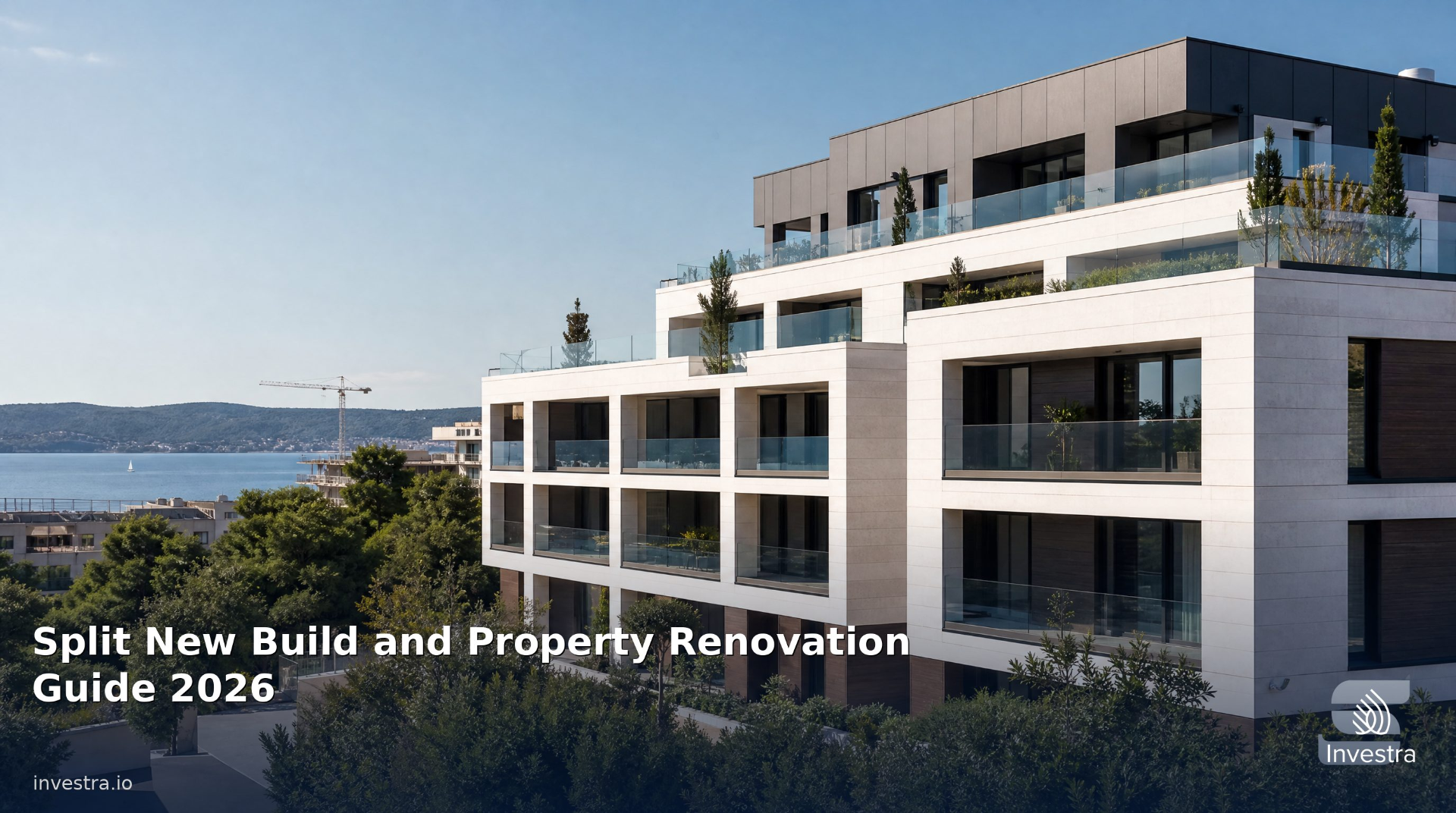
Split New Build and Property Renovation Guide 2026
Why Split Is Drawing Global Attention for New Build and Renovation Projects in 2026
Quick Answer: Split is one of Europe's most compelling real estate markets in 2026, combining UNESCO heritage appeal, a booming short-term rental economy, and a growing pipeline of new build developments that are attracting serious international capital. Buying Property In Split 2026 Complete Guide For Foreign Investors covers the full entry process for overseas buyers.
Split blends an exceptionally strong tourism proposition with the attributes of a working regional city: a university, regional administration, a seaport, and year-round cultural activity. That combination produces two intersecting investment strategies attracting attention in 2026: targeted acquisitions of professionally delivered new build apartments and the restoration of traditional stone properties within the historic core. Each approach offers different risk/reward dynamics but both are underpinned by a supply-constrained shoreline environment where growth in demand has outpaced new supply in many desirable micro-locations.
The market environment in Split is not speculative in the sense of rapid volatility; rather, it reflects steady capital inflows and a maturing local development sector. This has raised prices meaningfully over the past five years and concentrated investor interest on assets where scarcity, quality of finish, or regulatory protection deliver a strategic advantage. Buyers and advisers who understand the operational differences between new construction and conservation-led renovation projects are better placed to set achievable timelines, budgets and exit strategies.
The Split Property Market in 2026: Prices, Trends, and What's Actually Happening
Quick Answer: Average property prices in Split range from €3,200/m² for standard apartments to over €7,000/m² for premium new builds or renovated historic properties in 2026, with demand continuing to outstrip supply in the most desirable zones. Croatia Real Estate FAQ 2026 addresses the most common questions international buyers ask about this market.
The market in Split divides into micro-zones with markedly different transaction dynamics. The UNESCO-protected core and the narrow streets immediately surrounding Diocletian's Palace have persistently high per-square-metre values because the conservation status restricts new supply and because these properties command premium short-term rental rates. By contrast, inner-suburban neighbourhoods and satellite towns within the Greater Split area provide lower entry prices and a different cash-flow profile.
In 2026 the available ranges reflect this segmentation. Well-renovated apartments within the historic core commonly trade at the upper end of the local spectrum, while modern mid-ring units and completed off-plan apartments in peripheral suburbs are available for materially less. Rental behaviour also follows this pattern: premium heritage units deliver outsize nightly rates during summer, while long-term leasing demand is stronger in neighbourhoods that combine walkability with family amenities and local employment.
Understanding where a property sits in this landscape is central to any realistic investment model. Capital appreciation will continue to be driven by scarcity, infrastructure improvements, and the quality of finishes in delivered units. Operational returns for short-term rentals are sensitive to occupancy and management quality; small differences in operational cost and guest experience can swing a property from average to best-in-class performance in this market.
New Build Developments in Split: What's Available and Where to Look
Quick Answer: Split's new build sector is concentrated in the eastern coastal strip and regenerating urban neighborhoods, with off-plan prices starting around €3,200/m² and completed premium units reaching €5,500+/m² in 2026. Split Airbnb Investment 2026 details which neighborhoods generate the strongest short-term rental returns.
After Croatia's Eurozone entry in 2023, the market attracted more institutional developer capital, and a wider range of mid-size projects began to appear. The eastern coastal corridor from Žnjan toward Stobreč and the broader Solin/Kastela axis now hosts the largest volume of contemporary apartment projects. These developments typically market modern two- and three-bedroom layouts with underground parking and sea or coastal views, and they appeal to a mix of owner-occupiers and seasonal rental investors.
Closer to the city core, Spinut and Trstenik are delivering boutique developments that replace older blocks with smaller, higher-specification schemes. These boutique projects often prioritise interior design, energy efficiency and resident amenities, which allows developers to command a premium over the mass-market coastal product. Off-plan purchasing remains a common route into new developments; buyers should be well briefed on deposit mechanics, developer guarantees and the presence of bank-backed escrow when contracts are offered.
The nearby municipalities of Kaštela and Solin are worth attention for investors seeking lower per-square-metre entry points within commuting distance. Infrastructure initiatives, including planned public transport enhancements and local road improvements, are gradually reducing effective distance to central Split. These towns tend to be less exposed to short-term tourist demand, which lowers rental yield volatility and positions them for steady long-term appreciation as urban expansion continues.
Renovating Property in Split: The Authentic Dalmatian Stone House Opportunity
Quick Answer: Renovation projects in Split's historic zones can offer compelling equity gains — a well-chosen stone property acquired at €2,500–€4,000/m² and renovated to a high standard can exit at €5,500–€8,000/m², but the process demands experienced local expertise and realistic budget planning. Hvar Island Real Estate 2026 offers useful comparison data on premium Dalmatian renovation markets.
Restoring a traditional stone house in zones adjacent to Diocletian's Palace remains one of the most alluring strategies for investors who combine an appreciation for heritage architecture with rigorous project management. The economics are attractive when buyers secure a property at a realistic price, avoid speculative cost underestimation, and focus on delivering a high-quality finish that preserves the character while meeting modern expectations for comfort and services.
For many investors, the path to success in a heritage renovation passes through three non-negotiable steps: commissioning a local architect experienced with conservation rules; carrying out a full structural survey and soil/moisture diagnostics before contract completion where possible; and budgeting for contingencies that recognise the discovery-led nature of historic repairs. Projects that skip any of these steps expose themselves to schedule slippage, unplanned cost escalation, or permit complications that can materially reduce the expected return.
Planning Permissions and Heritage Restrictions: What Every Renovator Must Know
Quick Answer: Properties within Split's UNESCO World Heritage Zone and historic protection areas face significant planning constraints, with all exterior changes and many structural modifications requiring approval from the Conservation Department (Konzervatorski odjel) before work begins. Croatia Property Tax Guide 2026 explains the tax implications of renovation and resale transactions in detail.
The city's conservation authority exercises active oversight of works within designated protection zones. That oversight is both a constraint and a value-preserving mechanism: it restricts the quantity of marketable supply in the oldest, most desirable streets and in doing so maintains the premium for well-executed heritage units. For buyers, the consequence is that approval timelines add duration and cost to any project, and design proposals must meet specific material and visual criteria to receive a favourable decision.
Buyers working in zones with conservation oversight should expect permit processes to take longer than routine municipal approvals. Where previously straightforward permits might have been granted in weeks, conservation reviews can require detailed proposals, specialist material samples and sometimes even heritage impact assessments. Engaging architects who have previous successful approvals in Split materially reduces the risk of avoidable rework and unnecessary delay.
Renovation Costs in Split: A Realistic Budget Breakdown for 2026
Quick Answer: Full renovation costs in Split typically range from €800–€1,800/m² depending on specification level, property condition, and location within the city, with premium finishes in heritage properties at the top of this range. Dubrovnik Airbnb Investment 2026 provides useful comparable data from Croatia's other premium coastal renovation market.
Budgeting is where many renovation projects succeed or fail. The cost categories are straightforward: structural remediation, systems replacement (electrical, plumbing, heating), building fabric work (stone restoration, moisture barriers, roof repairs), interior finishes and joinery, and professional fees including architecture and project management. In heritage properties, structural works and specialist conservation work can constitute a disproportionate share of the budget compared with newer stock.
For planning purposes, investors should establish an estimate for each cost category and then add a contingency of at least 15–25% to reflect the discovery risk inherent in older buildings. Labour costs have increased since 2020 and skilled trades are in high demand during the warmer months; timing a project to capture off-peak contractor availability can deliver cost savings. Professional fees — architects, engineers, and project managers — are typically 10–15% of construction cost and are a cost that inexperienced buyers sometimes under-invest in, to their detriment.
Legal Process for Buying and Renovating: Step-by-Step for Foreign Investors
Quick Answer: EU/EEA nationals can purchase property in Croatia on equal terms with Croatian citizens, while non-EU buyers face a reciprocity requirement or must purchase via a Croatian-registered company — the full buying process typically takes 60–90 days from offer acceptance to registration. Buying Property In Split 2026 Complete Guide For Foreign Investors walks through the complete legal purchase process in detail.
The legal purchase sequence is familiar to experienced cross-border investors but contains Croatian-specific elements that merit attention. Key milestones include comprehensive title due diligence in the Land Registry, signing a preliminary sale contract with deposit terms agreed, securing a Croatian tax number (OIB) and completing the notarised final contract before the notary public. The purchaser must pay the applicable transfer tax or VAT, depending on whether the sale is a resale or a VATable new build, and the final step is registration of ownership in the Land Registry.
Non-EU buyers should plan for the reciprocity approval timeline managed by the Ministry of Justice if they do not qualify under existing agreements, or alternatively structure a purchase through a Croatian d.o.o. (limited liability company) if that aligns with their tax and ownership objectives. Legal structuring choices have implications for taxation, inheritance and future resale and should be made with coordinated legal and tax advice at the outset.
Renovation projects require additional procedural steps: building permits, construction diaries kept by the contractor, periodic inspections and ultimately a use permit certifying that the renovation complies with building codes. Operating a property without the required use permit can create obstacles to legal rental operation and to sale or mortgage refinancing later on.
For personalised structuring advice and practical transaction support, investors often work with local advisers. Siniša Dagary investment insight and the Investra network offer advisory services tailored to navigating purchase and renovation logistics in Split.
Financing New Builds and Renovation Projects in Split
Quick Answer: Foreign buyers in Croatia can access Croatian bank mortgages, though terms are less favourable than for residents — typical LTVs of 50–70% and rates of 4–6% in 2026 — while many international investors use home-country equity release or private finance to fund Croatian acquisitions. Findes Group & Partners provides specialist financing structuring for cross-border property investments including Croatian acquisitions.
Croatian banks will lend to foreign buyers but their underwriting is conservative when a borrower lacks Croatian income. As a result, many international investors choose alternative funding strategies such as foreign mortgages, equity release or using cash from disposals in their home market. Within Croatia, mortgage lenders vary in appetite and documentation requirements; non-resident borrowers should expect longer processing times and lower loan-to-value ratios than domestic buyers.
Renovation financing presents an additional complication because lenders typically value and lend against the current registered value rather than a projected post-renovation valuation. This requires buyers to access construction funds from their own resources or from specialised bridge lenders. Once a renovation is completed and properly certified, refinancing at the completed value becomes possible, which is a common exit strategy for renovation investors who initially fund construction with private resources.
For cross-border structuring and mortgage advisory services, investors may engage specialist finance intermediaries. Practical partners in the region can provide comparative offers and design solutions that bridge Croatian lending customs and investor needs; see the Findes advisory links for one such service provider. Findes Group & Partners is available for initial consultations on international financing alternatives.
Short-Term Rental Registration and Licensing for Renovated Properties
Quick Answer: Operating short-term rentals in Croatia requires registration with the Ministry of Tourism, municipal approval, and payment of sojourn tax — the process typically takes 4–8 weeks and involves meeting minimum standards for facilities and safety. Split Airbnb Investment 2026 Rental Income Best Areas Legal Guide covers the full licensing process in detail.
Legal operation of holiday rentals is a core component of investment planning for both new build and renovated properties. The formalities include categorisation with the Ministry of Tourism, registration in the E-Visitor system, municipal notifications and correct tax registration. Local enforcement has tightened in recent years, so ensuring compliance from the outset reduces the risk of fines or operational interruption.
Owners must also collect and remit sojourn tax (tourist tax) on behalf of guests; the rates are set locally and are part of operational cost modelling. Income tax treatment depends on the ownership and operational model chosen — individuals can opt for simplified flat-rate taxation in many cases, while company-owned properties follow corporate tax rules. For owners seeking to outsource operations, full-service property managers can handle registration, guest logistics and compliance on an ongoing basis.
Investors considering short-term rental operations should test their expected seasonal occupancy and net income using conservative assumptions. High gross nightly rates in the core can be offset by occupancy seasonality and higher operating costs; a disciplined, data-driven revenue model that accounts for cleaning, management fees, utilities and taxes is essential to understand the true net yield.
Investment Disclaimer
Quick Answer: The information in this guide is educational and should not be construed as specific investment advice; investors must carry out their own due diligence and consult qualified professionals before acting.
The content presented here summarises observed market data, legal processes and practical considerations relevant to buying, renovating and operating property in Split in 2026. It is intended to inform decision-making, not to replace personalised legal, tax or financial advice. Real estate involves risk, including illiquidity, regulatory change and the potential for cost overruns or lower-than-projected returns. Readers should consult licensed professionals with local Croatia expertise before committing capital.
Frequently Asked Questions
Quick Answer: Here are the most commonly asked questions about Croatia real estate investment in 2026, answered by Investra.io experts.
Is Croatia a good country for real estate investment in 2026?
Croatia remains an attractive investment destination for many buyers because of a strong tourism base, improving infrastructure and the Eurozone effect that reduced currency risk. Whether it is the right choice for an individual investor depends on the investment horizon, risk tolerance and the preferred operational model. Consider if your plan is capital growth, seasonal rental income, or long-term residency, and engage advisers to assess tax implications and regulatory requirements before committing funds. For broader country-level queries see Croatia Real Estate FAQ 2026.
Can foreigners buy property in Croatia?
EU and EEA nationals can buy property on equal terms with Croatian citizens. Non-EU nationals may require ministry approval under Croatia's reciprocity rules or may structure purchases through a Croatian company. Legal counsel should confirm the most current reciprocal arrangements and advise on whether direct ownership or company structure suits your objectives. Local advisors such as Siniša Dagary investment insight provide structuring support.
What is the average property price in Split?
Average prices vary by micro-location and quality. In 2026, ranges cited by local market data place standard mid-ring and peripheral apartments around €3,200–€4,500/m², inner-suburban quality stock in the €3,800–€5,200/m² range, and premium historic-core or top new builds in excess of €5,500–€8,500/m². Use neighbourhood-level comparables and professional valuation when modelling an acquisition. For an introductory buyer's guide, see Buying Property In Split 2026.
What rental yields can I expect?
Short-term gross yields in Split typically fall between 5–8% on average, with exceptionally positioned heritage units able to achieve higher gross returns in peak periods. Long-term yields are lower, commonly 3–4.5%, reflecting strong capital value appreciation in recent years. Remember that net yields depend on management, occupancy, local taxes and operating costs; run conservative scenarios when assessing viability. See the short-term rental guide in the Investra library for examples: Split Airbnb Investment 2026.
What taxes apply to property purchases?
On secondary market purchases a 3% transfer tax commonly applies; new builds may be subject to VAT depending on developer and project structure. Ongoing taxes include municipal taxes and income tax on rental earnings. Tax outcomes vary with ownership structures and residency status; obtain bespoke advice to optimise tax treatment. The Investra tax guide provides deeper coverage: Croatia Property Tax Guide 2026.
How long does the purchase process take?
A straightforward transaction from offer acceptance to registration typically takes 60–90 days, though delays arise when title issues, non-EU approvals or complex permitting are present. Off-plan purchases follow a staged payment schedule negotiated with the developer. Work with a local notary and legal adviser to minimise administrative surprise.
What financing options are available?
Croatian mortgage lenders provide loans to foreigners but often with lower LTVs and more stringent documentation for non-residents. Many investors fund purchases via domestic equity release or private finance due to speed and flexibility. For specialist financing and cross-border structuring advice consult providers such as Findes Group & Partners.
Is property management available for rental properties?
Yes. Professional property management is widely available and strongly recommended for short-term rental operators. Management services typically cover guest communication, check-in/out, cleaning, maintenance, compliance and tax reporting. Outsourcing operations can materially improve net return in many cases due to professional housekeeping, guest satisfaction and higher occupancy.
What are the best areas to invest in Split?
The best area depends on objectives. The historic core and immediate surroundings deliver scarcity and high seasonal rates; Spinut, Bačvice and Firule provide a middle ground of walkability and year-round demand; peripheral areas like Žnjan and satellite towns such as Kaštela and Solin offer lower entry prices and potential for more stable long-term renting. Local market research from Investra helps match location to strategy: Investra market research.
How do I manage heritage permit timelines?
Start early with a conservation-aware architect and submit complete documentation to the Conservation Department to reduce back-and-forth. Expect review durations of 60–120 days for straightforward conservation approvals; complex or archaeological sensitivity can extend this. Budget time and cash for these approvals when planning renovation projects.
Can I refinance after renovation?
Yes. Once works are complete and a use permit is issued, properties can be revalued and refinanced based on the new certified state. Croatian banks typically require complete documentation of works and the formal use permit before recognising the higher post-renovation value in lending decisions.
Recommended Reading
Quick Answer: This section explains the practical property-investment implications of Recommended Reading.
- Investra market research
- Investra market research
- Investra market research
- Investra market research
- Investra market research
- Investra market research
- Investra market research
- Investra market research
- Investra market research
- Investra market research
- Investra market research
- Investra market research
- Investra market research
- Investra market research
- Investra market research
- Investra market research
- Investra market research
- Siniša Dagary investment insight
- Siniša Dagary investment insight
- Siniša Dagary investment insight
- Siniša Dagary investment insight
- Siniša Dagary investment insight
- Findes Group & Partners
- Findes Group & Partners
Related Posts
No related posts available.
