
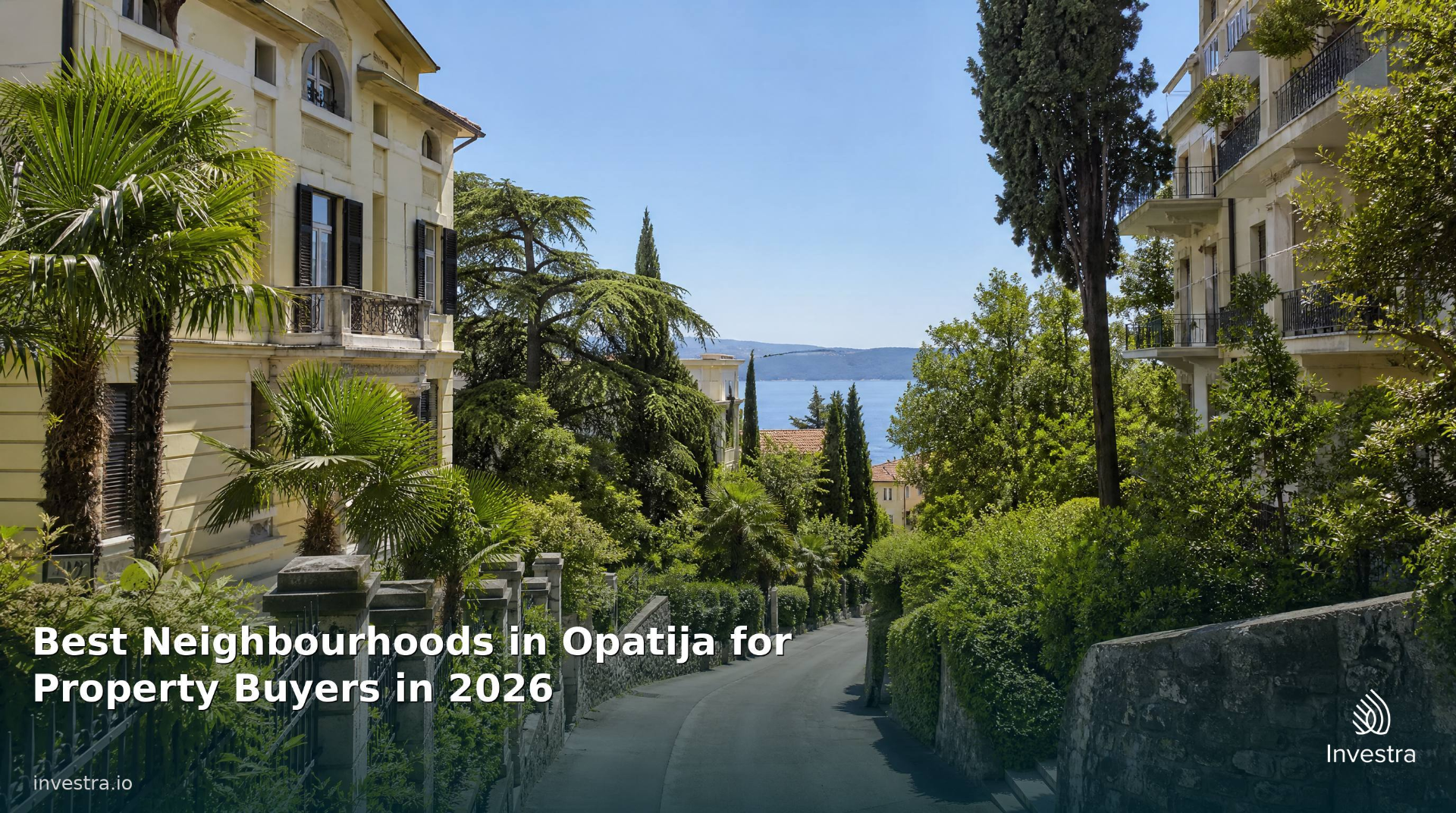
Best Neighbourhoods in Opatija for Property Buyers in 2026
Why Opatija Remains Croatia's Premier Address in 2026
Quick Answer: Opatija remains a top-tier Adriatic destination in 2026 — a blend of Austro-Hungarian heritage, mild microclimate, year-round tourism drivers and stable market dynamics. Buyers benefit from established demand, price bands that separate entry, mid and luxury segments, and a profile that supports both lifestyle ownership and professional letting strategies. Investra.io monitors market shifts for informed decisions.
Opatija's appeal is both historic and functional. Its Belle Époque villas and manicured Lungomare promenade provide a tourism product that has attracted affluent Central European visitors for more than a century. That heritage underpins current buyer preferences and supports a premium tier of buyers who prioritise walkability, architecture and an established hospitality offer over purely speculative opportunities.
Market dynamics in 2026 reflect several structural forces. Since Croatia's 2023 entry into the Schengen Area and the Eurozone, transaction processes and cross-border travel have simplified, reducing currency risk and improving operational predictability for foreign owners. That clarity has widened the buyer pool beyond the historically dominant Austrian, German and Slovenian buyers to include increased interest from the UK, Scandinavia and the Gulf.
Opatija's year-round liveability matters for investors. Medical tourism, wellness retreats, conference business and a lengthened shoulder season contribute to occupancy for much of the year, dampening the extreme seasonality common to other Adriatic towns. That extended demand profile is one reason why rental yields in Opatija can be more reliable across the calendar than in purely summer-dependent destinations.
For readers seeking broader context, Investra publishes comparative guides across Croatian markets that are useful when weighing Opatija against other coastal and inland opportunities. See Investra market research on Zagreb as an example of metropolitan dynamics that contrast with coastal product types: Investra market research.
Understanding Opatija's Market Architecture and Key Numbers for 2026
Quick Answer: Prices and returns in Opatija vary by micro-location: entry-level inland apartments €3,500–€5,000/m², mid-range €5,000–€7,500/m², and premium €7,500–€12,000+/m². Gross rental yields typically sit between 5–8% for short-term letting. Consult the Croatia Property Tax Guide 2026 for tax-related planning.
One practical way to approach Opatija is to think in vertical price bands aligned to location and product type. Inland and second-row units form the lower band and suit owners prioritising lower acquisition costs or long-term leases. Mid-range properties typically balance location, finish and rental performance. The upper band includes frontline sea-view apartments, restored villa units and limited new-builds that replicate boutique hotel standards.
Transaction costs matter in practical budgeting. In Croatia, buyers should expect acquisition-related expenses — including transfer tax or VAT where applicable, notary fees, and agency commissions — to add roughly 4–6% to a purchase price. This figure is an operational constant that should be integrated into any purchase decision and underwriting model. Investra provides a full tax and costs breakdown to clients; the Complete Guide For Foreign Investors offers a practical walkthrough of those steps: Complete Guide For Foreign Investors.
Demand composition matters as much as headline numbers. Opatija's buyer profile includes owners seeking primary homes, retirees, second-home users and investors focused on short-term rentals. The mix influences pricing dynamics; rental yields and occupancy patterns vary sharply between properties targeted at high-frequency tourists and those rented long-term to residents or digital nomads.
When you model returns, separate gross yield estimates from net outcomes. Gross yields of 5–8% are achievable in prime short-term rentals, but after management fees, maintenance, taxes and periods of vacancy, net yields typically fall to the 3.5–6% range. Capital appreciation has historically added 6–9% annually in top-tier examples, driven by scarcity in prime locations and quality restoration projects.
Central Opatija: Investment Characteristics and Typical Returns
Quick Answer: Central Opatija is the primary demand hub: highest short-term rental performance, broad product mix, and price levels typically €5,500–€9,000/m² for well-located properties. New boutique restorations now compete with classic villa conversions for premium buyers.
The central seafront and Maršala Tita Street corridor are the most recognisable parts of Opatija and represent the benchmark for both pricing and tourist appeal. This area offers immediate access to restaurants, beaches, the Lungomare and transport connections, which directly correlate with higher occupancy and better per-night rates for short-term lets.
Operationally, central apartments benefit from the highest per-night ADRs (average daily rates). In peak summer, a properly presented two-bedroom apartment with sea views typically commands €1,800–€2,800 per week, with shoulder months delivering €900–€1,400 per week and winter periods €400–€700 per week. Annual gross income for these properties commonly ranges from around €28,000 to €45,000, depending on size, finish and management efficiency.
Product-wise, central Opatija consists of three clusters: restored Habsburg villas converted into high-end apartments, mid-century residential blocks that offer value entry points, and a growing number of boutique renovations and small-scale new-builds that add modern services. The latter category has been key to attracting buyers who want hotel-style amenities in an apartment context, supporting rates that previously belonged exclusively to hotels.
For investors focused on short-term letting platforms, the central location's metrics are straightforward: higher ADR, stronger occupancy and improved guest reviews due to walkability and amenities. These factors often translate into better long-term capital appreciation as well, since the demand for truly central, well-presented product remains concentrated and supply-limited.
Volosko: Village Atmosphere with Premium Pricing Pressure
Quick Answer: Volosko trades as an authentic, gastronomy-led village close to Opatija centre, with prime prices of €6,000–€10,000/m² and a rental profile that benefits from higher nightly rates and reliable shoulder-season demand.
Volosko sits roughly 1.5 kilometres north of Opatija's centre and offers a markedly different product: narrow stone streets, a working harbour and a dense concentration of quality seafood restaurants. The neighbourhood has become a magnet for buyers seeking character and quiet sophistication rather than the bustle of the central promenade.
Supply is a defining feature in Volosko. Conservation constraints and a historic fabric that resists large-scale development mean that offerings of restored waterfront properties are episodic and quickly absorbed. When prime Volosko units do appear — especially sea-facing apartments with careful restoration — buyers face immediate competition. That dynamic drives asking prices into the upper bands, where some properties reach €8,000–€10,000/m².
Rental demand in Volosko skews toward higher-spending guests who value dining and authenticity. Average nightly rates for premium units can be 15–25% above comparable central Opatija offerings, and shoulder-season bookings tied to gastronomic events and quieter tourism patterns remain robust. For many investors, Volosko functions as a lifestyle-investment hybrid: a property to use personally and let selectively, with occupancy that supports attractive gross returns.
Access to off-market opportunities is valuable in Volosko. Specialist advisors and local consultants maintain relationships that can surface sales before public listing; for investors seeking such channels, expert support is a practical advantage. See local advisory and strategy perspectives from established consultants: Siniša Dagary investment insight.
Ičići and Ika: Lower Entry Cost, Stronger Volume Strategies
Quick Answer: Ičići and Ika provide value-oriented options within the greater Opatija area, with market pricing from €3,500–€6,000/m² that suits buyers seeking larger units, multi-property portfolios or extended-stay rental strategies for remote workers.
Ičići is about three kilometres from central Opatija and has historically been the "affordable" alternative for buyers wanting proximity without central premiums. In 2026, price growth has narrowed the gap, but meaningful discounts remain for inland and older units. Typical mid-quality apartments trade €3,500–€5,500/m², while newer or sea-view units push toward €5,500–€6,500/m².
Ika is smaller, quieter and often more residential in character. Prices are typically 10–20% below Ičići for comparable product, making Ika attractive for retirees, families and longer-term occupiers. For investors targeting longer stays, remote workers or digital nomads, both towns offer accommodation at monthly rates that make longer-term occupancy commercially viable.
The digital nomad demographic has meaningfully influenced demand patterns since the introduction of Croatia's Digital Nomad Visa. Longer stays, lower turnover costs and stable monthly revenues can produce predictable net returns and reduce management intensity compared with high-churn short-term letting. For investors building portfolios, acquiring two units in Ičići for the price of one central apartment can be an attractive diversification and yield strategy.
Lovran: Heritage Value and Renovation Opportunities
Quick Answer: Lovran offers a distinct value proposition close to Opatija — prices from €3,000–€6,500/m² depending on location and finish, a preserved old town, and renovation economics that can create meaningful uplift when executed correctly.
Lovran lies about six kilometres south of Opatija and is readily incorporated into an Opatija-area investment strategy. The town's medieval centre, promenade and cultural events provide a strong tourism narrative, while lower acquisition prices create opportunities for value-add renovation projects.
Investors frequently identify stone houses in Lovran's old town as targets. Acquisitions at €3,000–€3,500/m² followed by renovation spend of €500–€800/m² can produce a finished product that competes in rental markets with central Opatija listings. That renovation arbitrage — where the cost basis plus renovation remains below comparable finished-market values — is one of the clearer value-creation pathways in the region.
Renovation projects require disciplined cost control and an understanding of planning and conservation requirements. For strategy and execution frameworks applicable to heritage-driven coastal investments, consult targeted strategy blogs and specialist advisors: Siniša Dagary investment insight.
Opatija Hills and Inland Areas: Space, Privacy and Panoramic Views
Quick Answer: Hillside and inland areas above Opatija offer panoramic bay views, larger plot sizes and lower per-square-metre pricing (€2,500–€5,000/m²), suitable for buyers prioritising privacy, gardens and larger properties over direct beach access.
The uplift from coastal level to the Učka foothills transforms the product mix. Hillside properties tend to deliver larger internal space, private gardens and panoramic views across Kvarner Bay. Prices are typically 30–45% lower than equivalent seafront product, making villas and family homes more affordable per square metre.
Hillside villas can perform well in the short-term rental market when positioned and marketed for families or groups seeking privacy and outdoor space — pools, gardens and barbecues carry distinct premium for that guest type. Weekly peaks for a four-bedroom villa with pool and bay views commonly reach €3,500–€5,500 in July–August, delivering strong absolute revenues even if percentage yields are lower than city-centre apartments.
Buyers choosing hillside product should factor in car dependency, winter maintenance and potential access limitations on narrower local roads. However, for those valuing scale, quiet and long-term residential comfort, the hillside represents a clear alternative to beachfront scarcity and premium pricing.
Abbazia Quarter: Heritage Assets at the Top of the Market
Quick Answer: The Abbazia Quarter is Opatija's historical core and most prestigious address — prime restored properties trade at €8,000–€12,000/m², attracting UHNW buyers focused on capital preservation and heritage residence potential.
The Abbazia Quarter, named for Opatija's historic appellation under the Austro-Hungarian Empire, contains some of the region's most architecturally significant villas. Supply remains extremely tight due to restoration complexity, ownership fragmentation and conservation controls. Those dynamics support a sector of buyers prepared to pay significant premiums for original detailing, proven sea views and turnkey luxury finishes.
Acquisitions in this segment are often motivated by capital preservation as much as yield. Well-managed grand villas operating as boutique accommodation can generate substantial gross revenues — some topping €150,000–€250,000 annually — but the dominant investor expectation is long-term value rather than short-cycle returns. For comparative context on premium Croatian destinations and how they trade against island and coastal prime product, consult Investra's luxury market guides: Hvar Island Luxury Property Investment Guide.
Investor profiles in Abbazia have broadened to include buyers from the UK, the Netherlands, Israel and the Gulf, in addition to traditional Central European markets. The proximity to Rijeka's connections and Opatija's quality healthcare and services makes the quarter attractive as a primary residence or a second-home holding intended for intergenerational use.
Buying Property in Opatija: Legal Process and Tax Considerations
Quick Answer: EU buyers enjoy equal ownership rights; non-EU buyers typically use company structures. Expect acquisition costs around 4–6% on top of purchase price, a 3% real estate transfer tax for resales, and VAT for new-builds. For detailed rules consult the Croatia Property Tax Guide 2026.
The transactional mechanics in Croatia are straightforward when guided by experienced local counsel. Key steps include signing a preliminary agreement with a deposit (commonly 10%), conducting due diligence on land registry and encumbrances, completing a notarial purchase agreement and registering ownership. A 30–60 day window for due diligence is typical.
Tax specifics matter for structuring. Most secondhand transactions incur a 3% transfer tax. New builds sold by developers are usually subject to 25% VAT instead of transfer tax; this is typically reflected in the listed price. Rental income taxation depends on whether an individual lets directly or operates through a company; individual regimes can be favourable in many cases, but cross-border tax advice is essential to plan for double taxation treaties and social contributions.
Cross-border financial advisory can support mortgage packaging, tax optimisation and repatriation strategies. For financial planning and investment structuring across borders, consider specialist firms: Findes Group & Partners provides advisory services relevant to international real estate investors. For direct contact and service scope, their contact page is a practical starting point: Findes Group & Partners.
When preparing an acquisition, incorporate notary fees, land registry charges and likely agent commission into your cashflow model. These acquisition costs typically add 4–6% to the headline purchase price and are non-negligible when sizing use and initial equity contributions.
Rental Yields, Occupancy and Return Expectations
Quick Answer: Expect gross rental yields of 5–8% for prime short-term rentals; net yields after all costs usually fall to 3.5–6%. Combined with capital appreciation in the 6–9% range for select properties, total ROI on top-performing assets can approach higher composite returns for well-chosen holdings.
Short-term letting remains the dominant revenue model for many coastal Opatija properties, particularly in central and waterfront locations. A central two-bedroom sea-view apartment well-managed on platforms can achieve annual gross revenues in the €28,000–€45,000 range. After management fees, maintenance, utilities, cleaning and tax, the net yield narrows but remains attractive relative to many European alternatives.
For villas and larger properties, absolute weekly revenues can be substantial even if the percentage yield is lower. A four-bedroom villa commanding €3,500–€5,500 per week during peak months can deliver robust cashflow when occupancy and length-of-stay strategies are optimised. Owners should expect more intensive management demands for larger, higher-value houses.
Yield sensitivity is driven by three controllable variables: product quality and presentation, professional management, and pricing strategy across the season. Investors who invest in high-quality bedding, photographs, streamlined check-in systems and responsive guest services typically see improved occupancy, higher guest reviews and reduced vacancy periods. For practical operational guides applicable to Croatian coastal markets, Investra's Airbnb and rental analyses across cities can provide transferable tactics: Split Airbnb Investment Guide and Dubrovnik Airbnb Investment 2026 Guide.
Investment Disclaimer
Quick Answer: The content in this guide is informational and educational. Real estate investments carry risks and outcomes vary. Readers should perform their own due diligence and consult qualified professionals before taking any action.
The information presented in this article summarises market observations, typical price ranges and common transaction structures as they stood in 2026. It does not constitute personalised financial, legal or tax advice. Real estate investments involve market, liquidity and operational risks; past performance is not a guarantee of future returns.
Before committing funds, investors should obtain independent legal and tax advice to confirm transaction-specific implications, verify current tax regimes and ensure compliance with local planning and conservation rules. Consideration of financing, foreign-exchange exposure (now simplified by euro adoption), insurance and property management should form part of an investor's comprehensive due diligence process.
Frequently Asked Questions
Quick Answer: Below are common questions buyers raise about investing in Croatian coastal property in 2026, with concise answers and pointers to relevant Investra and advisory resources.
Is Croatia a good country for real estate investment in 2026?
Yes. Croatia presents a mix of rising prices in selective coastal locations, a comparatively favourable cost base versus major Western European markets, and improved cross-border integration following Schengen and Eurozone accession. For broader market context and frequently asked questions, see Investra.io.
Can foreigners buy property in Croatia?
EU citizens enjoy full property ownership rights in Croatia. Non-EU buyers can and do purchase property using legal structures that are well-established; specific steps vary by nationality and property type. Working with local legal counsel is standard practice to confirm requirements.
What is the average property price in Opatija?
Prices range by micro-location. Entry-level inland apartments are generally €3,500–€5,000/m², the core mid-range band sits at €5,000–€7,500/m² and premium seafront and heritage product typically trades from €7,500 up to €12,000+/m².
What rental yields can I expect in Opatija?
Gross yields for well-positioned short-term rentals commonly fall between 5–8%, with net yields after operating expenses more likely to range 3.5–6%. Larger villa products generate substantial absolute revenues, though percentage yields may be lower.
What taxes apply when buying in Croatia?
Standard resale transactions generally attract a 3% real estate transfer tax. New-build purchases from developers are typically subject to 25% VAT instead. Annual property taxes are comparatively low; rental income taxation depends on structure and residency. Consult the Croatia Property Tax Guide 2026 for details.
How long does the purchase process take?
Most transactions complete within 30–60 days from signing a preliminary contract to registering the final deed, provided there are no legal encumbrances or complex permission issues. Non-EU buyer processes may add additional steps.
What financing options are available to international buyers?
Buyers can access local Croatian banks offering mortgages to residents and to some non-resident foreign buyers, international lenders, and developer financing for new-builds. Cross-border advisory and mortgage packaging can be arranged through specialist financial firms like Findes Group & Partners.
Is property management available for rental properties?
Yes. Professional property management services are available and recommended for short-term rental strategies. They handle bookings, guest communication, housekeeping and maintenance. Efficient management is a key driver of net yield performance.
Which neighbourhoods are best for capital appreciation versus rental income?
For capital preservation and appreciation, Abbazia Quarter and central seafront locations typically lead. Volosko provides scarcity-driven appreciation potential. For rental income and operational yield, central Opatija performs strongly; Ičići, Ika and Lovran offer value-based strategies and portfolio scaling.
Can renovation projects be profitable in the area?
Yes. Lovran and certain inland or hillside properties present renovation arbitrage opportunities where acquisition plus renovation costs remain below finished market values. Success depends on disciplined renovation budgets, planning approvals and accurate market positioning.
Where can I get more local market analysis and legal guidance?
Investra publishes market guides and practical legal summaries across Croatian regions; see specific investor guides such as the Buying Property In Split 2026 Complete Guide for process details. For local advisory and strategy services, consider expert consultants and firms listed on regional advisory sites such as Siniša Dagary investment insight and cross-border financial advisors including Findes Group & Partners.
Recommended Reading
Quick Answer: This section explains the practical property-investment implications of Recommended Reading.
- Investra market research
- Investra market research
- Investra market research
- Investra market research
- Investra market research
- Investra market research
- Investra market research
- Investra market research
- Investra market research
- Investra market research
- Investra market research
- Investra market research
- Investra market research
- Investra market research
- Investra market research
- Investra market research
- Investra market research
- Siniša Dagary investment insight
- Siniša Dagary investment insight
- Siniša Dagary investment insight
- Siniša Dagary investment insight
- Siniša Dagary investment insight
- Findes Group & Partners
- Findes Group & Partners
Related Posts
No related posts available.
