
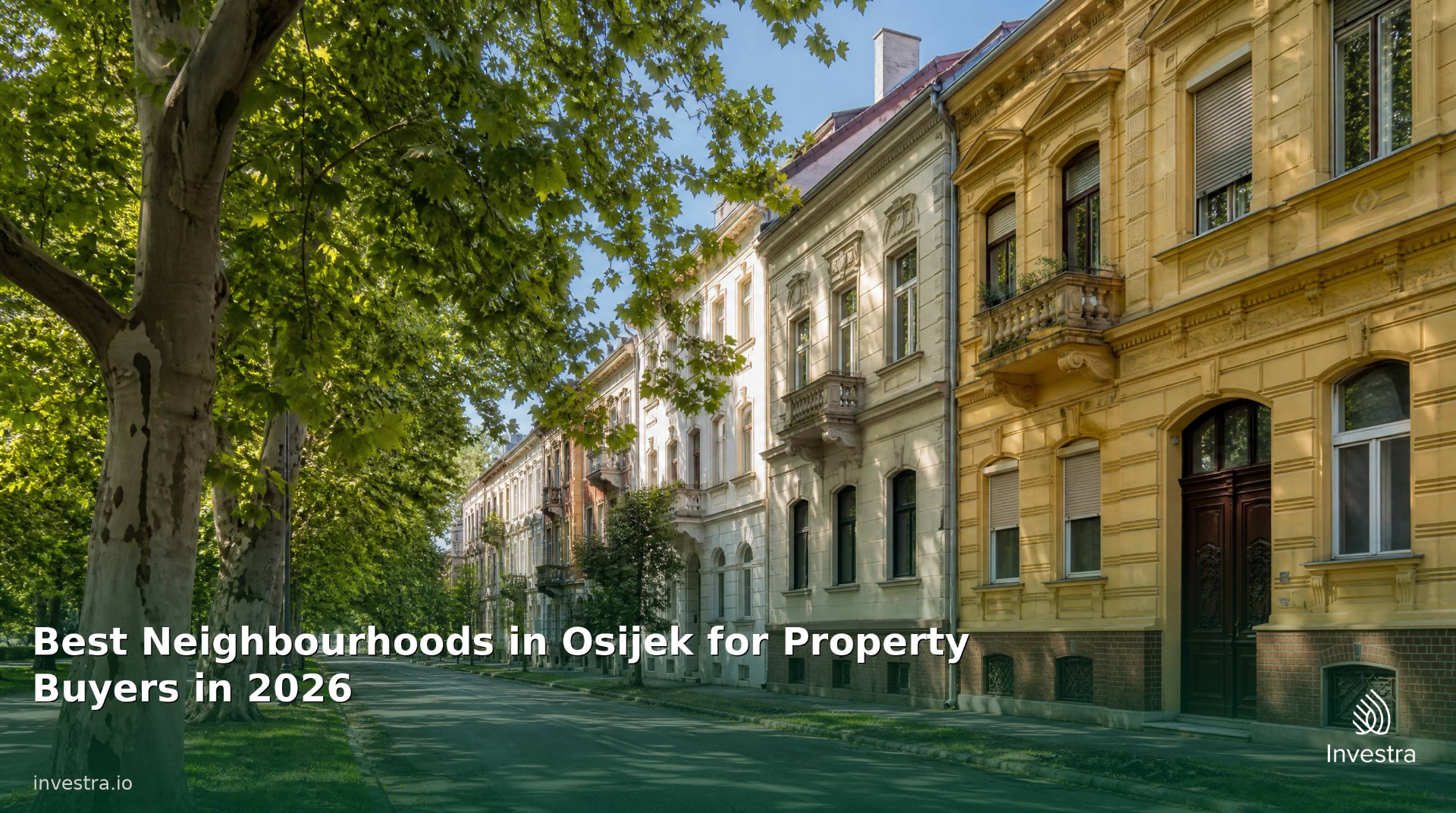
Best Neighbourhoods in Osijek for Property Buyers in 2026
Why Osijek Is Attracting Property Buyers in 2026
Quick Answer: Osijek is emerging as one of Croatia's most compelling property investment destinations in 2026, offering significantly lower entry prices than coastal cities combined with strong rental demand, EU-backed infrastructure investment, and a growing university population. Investra.io's Croatia Real Estate FAQ covers the full legal and financial picture for foreign buyers considering this market.
There is a less visible side of Croatia that attracts investors focused on long-term income and value. Osijek, the largest city in Slavonia and Croatia's fourth-largest urban centre, presents that quieter opportunity. Geographically set on the Drava River amid agricultural plains and woodland, Osijek maintains a civic scale and quality of life different from the Adriatic resorts. The city has roughly 100,000 inhabitants and a university population above 15,000 students, which together sustain year-round demand for housing rather than seasonally concentrated tourism flows.
In 2026 buyers who compare coastal price levels to continental alternatives are finding Osijek compelling. Entry prices for quality apartments commonly begin at levels that are a fraction of what buyers pay on the Dalmatian coast. Beyond price, several structural drivers support the market: continued EU Cohesion Fund flows into eastern Croatia infrastructure, growing local employment in technology and services, and demographic trends that keep rental demand steady from students and younger professionals. These are not speculative drivers but observable inputs to the market case.
For investors who prioritise income stability over headline capital growth and seasonal volatility, Osijek's fundamentals merit close attention. The city's compact urban footprint, cultural amenities and improving transport connections combine with low barrier-to-entry price points to create a matrix of opportunities for both buy-to-let and longer-horizon residential purchasers.
Osijek Real Estate Market Overview: Prices, Trends, and What to Expect in 2026
Quick Answer: Osijek property prices range from approximately €900/m² in peripheral residential areas to €2,200/m² in prime central locations in 2026, with the overall market showing steady 4–7% annual appreciation driven by constrained supply and growing demand from students, young professionals, and domestic upgraders.
Numbers anchor the market narrative. In established neighbourhoods mid-market apartments typically cost around €1,200–€1,400 per square metre in 2026. This is a meaningful movement from the lower price bands seen several years earlier and reflects both increased local demand and wider macroeconomic pressures across Europe. New-builds and comprehensively renovated units in sought-after locations push to €1,800–€2,200/m², largely when developers include modern specifications, parking and energy-efficiency measures that buyers increasingly value.
Older apartment blocks common across Osijek—those solid, post-war structures often described as "stambene zgrade"—sell in the €900–€1,300/m² range when well-maintained and centrally located, offering pragmatic buying opportunities for investors prepared to manage light to moderate renovation. Across the market smaller units outperform on rental metrics; studios and one-bedrooms close to employment centres and university facilities regularly demonstrate higher yield potential than larger family apartments.
Rental yields are a core part of why investors consider Osijek. Because acquisition prices remain modest relative to coastal Croatian cities, gross residential yields frequently fall between 5.5% and 8.5% annually, varying by neighbourhood and property type. Student-targeted units and well-positioned one-bed apartments routinely occupy the top of that range, reflecting consistent occupancy through the academic calendar.
Gornji Grad (Upper Town): Osijek's Historic Heart and Premium Address
Quick Answer: Gornji Grad is Osijek's most prestigious neighbourhood, featuring Baroque architecture, tree-lined boulevards, and prices ranging from €1,500 to €2,500/m² — it's the city's equivalent of a historic city centre and appeals strongly to both lifestyle buyers and high-end long-term rental investors.
Gornji Grad is the neighbourhood most frequently cited by buyers who prioritise location and cultural value. Anchored by Tvrđa, the well-preserved Baroque fortress and historic ensemble, this area combines architectural distinction with a concentrated supply of boutique hospitality and cultural venues. Restoration and adaptive reuse of historic buildings have accelerated, increasing both residential appeal and short-stay demand.
Pricing here reflects scarcity and desirability. Expect to see €1,500–€2,200/m² for well-located apartments in historic buildings; exceptionally presented renovations or small new-builds can command up to €2,500/m². Because many buildings are older, buyers must budget for thorough structural surveys and predictable renovation allowances. That said, the premium can be justified: apartments in Tvrđa and the immediate Gornji Grad area attract professional and academic tenants seeking proximity to cultural life, and they hold appeal for short-stay visitors when professionally managed.
Occupancy and vacancy metrics for quality product in Gornji Grad are favourable. Long-term tenants are typically higher-income residents with lower churn, and short-term demand for curated city stays supplements overall return potential, making this area a sensible choice for investors targeting a blend of capital preservation and reliable rental cashflow.
Donji Grad (Lower Town): Value, Volume, and Strong Rental Fundamentals
Quick Answer: Donji Grad offers some of Osijek's best value-for-money investment opportunities, with prices ranging from €1,000 to €1,600/m² and consistently strong rental demand driven by proximity to the city centre, university facilities, and public transport links.
Donji Grad functions as the city's everyday commercial and residential hub. It sits between the historic upper town and the river embankment and combines convenient amenity access with broad tenant appeal. Architecturally it is more heterogeneous than Gornji Grad; blocks from the 1970s–1990s coexist with pockets of newer construction and renovated stock. That heterogeneity is useful to investors: it provides a range of entry price points and different turnover profiles.
Mid-range apartments in Donji Grad typically trade at €1,000–€1,400/m², while newly renovated units and limited new-builds reach €1,500–€1,600/m². A well-presented one-bedroom of about 50 m² is available at price points that make buy-to-let accessible. Typical monthly rents for furnished one-bedroom units in 2026 sit between €350 and €550 depending on exact location and finish, producing competitive gross yields for the market.
Donji Grad’s proximity to the pedestrian zones, the Korzo riverside promenade and public transport nodes underpins tenant retention. Investors looking for practical, stable performance and a large tenant pool will find this area attractive, particularly when they prioritise consistent occupancy and manageable refurbishment requirements.
Retfala: The Emerging Neighbourhood That Smart Buyers Are Watching
Quick Answer: Retfala is Osijek's most discussed up-and-coming neighbourhood in 2026, offering entry prices from €850 to €1,300/m² with significant upside potential as urban renewal investment flows into this traditionally working-class western district.
Retfala represents the archetypal urban turnaround opportunity. Historically industrial and working-class, the area offers lower entry prices and a demographic profile that is changing as younger buyers and renovators reimagine housing there. Street-level changes—cafés, independent retailers and incremental public realm improvements funded in part by EU urban regeneration programs—signal early-stage gentrification.
Property values in Retfala commonly range €850–€1,300/m², putting the neighbourhood at a discount to central districts. That spread is the primary attraction: investors buying now can capture upside as the area benefits from municipal improvement projects. However, timelines for neighbourhood transformation vary. Retfala’s trajectory could accelerate or remain gradual over many years; investors should align expectations and capital plans with that reality.
At present studios and smaller apartments in Retfala deliver attractive gross yields—often in the 7%–9% band—because rental rates remain healthy relative to purchase prices. For investors with a medium- to long-term horizon and tolerance for renovation and leasing effort, Retfala offers a clear asymmetric risk-reward profile.
Industrijska and the University Quarter: The Student Rental Goldmine
Quick Answer: The areas surrounding Josip Juraj Strossmayer University of Osijek — particularly the neighbourhoods near the Faculty of Electrical Engineering and the Faculty of Economics — generate some of the city's highest rental yields, with student-oriented studios and one-bed apartments achieving gross yields of 7%–10% in 2026.
The university is central to Osijek’s housing demand. With more than 15,000 enrolled students dispersed across faculties, Osijek supports a sizeable private rental ecosystem. The student rental market is year-round in its core months—the academic year—so demand does not mirror coastal seasonality, which is beneficial for cashflow predictability.
Campus distribution across different parts of the city extends the "student quarter" effect into multiple neighbourhoods. Prices near core faculties range €1,100–€1,600/m²; more peripheral student-facing locations fall to €900–€1,200/m² while sustaining rental rates that yield strong returns. A compact studio acquired at locally low entry cost and furnished to a standard that appeals to students can produce gross returns at the top end of Osijek’s typical yield spectrum.
Managing student rentals requires structured operational planning: regular tenant turnover, more frequent maintenance and clear tenancy policies mitigate risks. Many investors opt to engage local property managers who handle marketing, tenant selection and maintenance coordination—services that protect net returns even after their fees. The balance between higher turnover and elevated gross yield is a defining characteristic of this segment of the market.
Sjenjak: Osijek's Most Prestigious Residential Address for Long-Term Living
Quick Answer: Sjenjak is Osijek's premier family residential neighbourhood, offering detached houses and larger apartments at €1,400–€2,400/m², with excellent schools, green space, and a stable, affluent tenant demographic that produces reliable long-term rental income for buy-to-let investors.
Sjenjak is where the city’s professional and managerial classes choose to live. Characterised by detached houses, generous apartment plans and mature green spaces, it gives investors access to tenants seeking stability, privacy and proximity to quality schools and family services. That tenant profile leads to longer lease durations and lower turnover than student-orientated areas.
Market pricing reflects the neighbourhood’s attributes. Apartments typically trade between €1,400 and €2,000/m², while detached houses can command higher totals depending on plot size and condition. Although yields are lower than in student-heavy districts—commonly 4.5%–6.5% gross—the trade-off is stability: lower vacancy, fewer management demands and consistent capital appreciation tied to the area’s enduring appeal.
For investors focused on capital preservation and predictable rental income, Sjenjak’s characteristics suit a conservative allocation within a diversified Croatian property portfolio. The neighbourhood performs as an anchor holding for long-term investors who value durable demand over high-yield volatility.
Buying Property in Osijek as a Foreign Investor: Legal Process and Key Considerations
Quick Answer: EU citizens can purchase property in Osijek with minimal restrictions, while non-EU nationals must navigate a Ministry of Justice approval process that typically takes 2–6 months; the full purchase process from offer to completion usually requires 60–120 days and involves notarial contracts, land registry registration, and several layers of tax and fee obligations totalling 5–8% of purchase price.
Buying property in Croatia has become more straightforward for many foreign buyers since EU accession and euro adoption, but procedural complexity remains. EU nationals generally enjoy the same acquisition rights as Croatian citizens. Non-EU buyers, including those from the UK and other non-EU countries, must verify reciprocity and may need formal approval from the relevant ministries; these approvals add time and documentation requirements but do not preclude purchase in most cases.
The purchase sequence typically begins with a negotiated preliminary contract and deposit—frequently 10%—followed by due diligence, title checks and verification of any encumbrances. The main purchase contract is notarised in Croatian, and the transaction is finalised through land registry registration. Buyers should budget for transfer taxes on resale housing, potential VAT on new-builds and notary and legal fees that together commonly equate to 5%–8% of the purchase price.
International buyers often seek financing structures and tax optimisation strategies. For bespoke financial planning and mortgage advisory services, professional providers such as Findes Group & Partners can assist with cross-border structuring, and their local contact points are available at Findes Group & Partners. Practical engagement with a local legal advisor reduces the risk of title issues and planning constraints and is a standard part of a prudent purchase workflow.
Rental Market Dynamics in Osijek: What Landlords Actually Earn
Quick Answer: Osijek's rental market in 2026 produces monthly rents of €250–€400 for studios, €350–€550 for one-bedroom apartments, and €500–€750 for two-bedroom units in good locations, translating to gross yields of 5.5%–9% depending on property type and neighbourhood — among the strongest fundamentals in continental Croatia.
Landlords need concrete figures to model returns. Studio apartments of 30–40 m² in central or near-central locations typically rent for €250–€380 per month. One-bedroom apartments commonly achieve €350–€500 in central areas and €300–€420 in peripheral locations. Two-bedrooms suitable for families generally rent for €500–€700 monthly in desirable neighbourhoods. Those ranges generate gross yields that compare favourably with many European secondary cities.
Net yield analysis must account for management fees, maintenance reserves, taxation and occasional vacancy. Typical property management fees range from 8% to 12% of rent when used, and prudent owners reserve a portion of rental income for cyclical maintenance and refurbishments. After these allowances, net yields frequently sit in the 4.5%–7% range for well-managed portfolios, preserving strong cashflow potential while recognising operating realities.
Taxation of rental income changes periodically and depends on personal and corporate structuring; the Croatia Property Tax Guide 2026 remains an essential reference for investors working through post-purchase income projections and compliance obligations.
Infrastructure, Connectivity, and the EU Investment Tailwind
Quick Answer: Osijek is benefiting from significant EU Cohesion Fund investment in infrastructure through the 2021–2027 programming period, including road upgrades on Corridor Vc connecting it to Zagreb and the Adriatic coast, urban regeneration projects, and digital infrastructure improvements that are steadily raising the city's economic competitiveness.
Infrastructure investment materially affects long-term real estate value. Eastern Croatia, including Slavonia and Osijek, has been a recipient of Cohesion funds during the 2021–2027 programming period. Those funds support road improvements, urban regeneration and digital infrastructure upgrades that enhance the city's attractiveness to businesses and residents. Completion of key road corridors reduces effective distance to national and regional markets and lifts labour-market integration.
Corridor Vc, the trans-European route that improves connections to Zagreb and the Adriatic, demonstrates the relationship between transport connectivity and local property economics: as travel times fall and freight and passenger movement becomes more efficient, urban nodes along the corridor often experience demand uplift. Within the city, targeted programmes such as Tvrđa restoration benefit adjacent residential and commercial property values by enhancing amenity and footfall.
For investors seeking additional contextual reading and comparative market studies on Croatian property topics, Investra hosts a suite of specialist guides covering coastal and mainland markets. Explore Investra’s market research, legal and tax guidance, and regional property guides to inform acquisition strategy: Investra market research, Zagreb foreign buyer guide, Split Airbnb investment guide, Dubrovnik Airbnb Investment Guide 2026, Croatia Digital Nomad Visa 2026 Complete Guide For Remote..., Hvar Island Real Estate 2026 Luxury Property Investment G..., Buying Property In Split 2026 Complete Guide For Foreign ..., Buying Property In Dubrovnik 2026 Complete Guide For Fore..., Metkovic Real Estate Market 2026 Neretva Delta Property G..., Knin Real Estate Market 2026 Dalmatian Hinterland Propert..., Tribunj Real Estate 2026 Small Dalmatian Town Property Guide, Murter Island Real Estate 2026 Sibenik Archipelago Proper..., Primosten Real Estate 2026 Dalmatian Peninsula Town Prope..., Vodice Real Estate 2026 Sibenik County Coastal Town Prope..., Stari Grad Hvar Real Estate 2026 Ancient Town Property Guide.
For practical investment expertise and strategic advisory, consult resources from experienced practitioners. Background on market strategy and services can be found at Siniša Dagary investment expertise, with additional materials and contact options at Siniša Dagary investment consultation and Siniša Dagary advisory services. For broader insight into business strategy and regional commentary see the Siniša Dagary investment insight and central site hub at Siniša Dagary investment insight.
Investment Disclaimer
Quick Answer: The content here is informational and educational; it is not personalised investment guidance and does not guarantee returns. Consult qualified legal and financial professionals before making investment decisions.
The material presented in this guide summarises observable market conditions, legal frameworks and typical transaction mechanics applicable to Osijek in 2026. It is intended to support research and to highlight considerations investors commonly encounter. It is not a substitute for tailored financial, tax or legal advice. Real estate investments carry risk, including illiquidity, market cycles and regulatory change. Expenses such as taxes, fees, management costs and maintenance reduce net returns and should be modelled in any investment plan.
Frequently Asked Questions
Quick Answer: Here are the most commonly asked questions about Croatia real estate investment in 2026, answered with concise guidance and references to further resources.
Is Croatia a good country for real estate investment in 2026?
Croatia remains attractive due to improved infrastructure, membership of the eurozone and Schengen, and competitive price points relative to Western Europe. City-specific fundamentals vary; Osijek appeals for stable rental demand and lower entry costs.
Can foreigners buy property in Croatia?
EU citizens generally purchase without special permissions. Non-EU nationals may require approval under reciprocity terms and should work with legal advisers to navigate the process and timelines specific to their nationality.
What is the average property price in Osijek?
Average mid-market prices typically sit in the €1,200–€1,400/m² range in 2026, with peripheral entry points closer to €900/m² and prime central locations up to €2,200/m² for new or fully renovated stock.
What rental yields can I expect?
Gross yields commonly range from 5.5% to 9% depending on neighbourhood and property type. Student-focused units and compact city-centre apartments produce stronger yields than family-sized units in premium suburbs.
What taxes apply to property purchases?
Buyers should account for transfer tax on resale properties (commonly 3%), VAT on new builds when relevant, notary and registration fees and annual property taxes. The exact treatment depends on transaction type and ownership structure.
How long does the purchase process take?
Typical transactions run 60–120 days from acceptance of offer to land registry registration. Non-EU approvals or complex due diligence can extend that timeframe by several weeks or months.
What financing options are available?
Local mortgage products, developer financing and cross-border lending are available, but many international buyers use cash to streamline cross-border transactions. Consult local lenders and advisers for structuring and documentation requirements.
Is property management available for rental properties?
Yes. Professional managers provide tenant sourcing, maintenance coordination and rent collection. Fees vary and should be accounted for in yield calculations; many investors opt to outsource to local firms for operational efficiency.
What are the best areas to invest in Osijek?
Best areas align with investor objectives: Gornji Grad for prestige and mixed short- and long-term demand, Donji Grad for value and steady rentals, Retfala for long-horizon upside, university-adjacent quarters for student yields and Sjenjak for stable family-oriented returns.
Should I prioritise yield or capital growth?
That decision depends on your investment horizon, risk tolerance and income needs. Osijek uniquely supports both approaches: student and peripheral buys offer higher current yield; premium and historic areas provide steadier capital preservation and lower turnover.
How important is professional local advice?
Local legal, tax and property management expertise materially reduces risks in cross-border purchases. Engaging counsel and reliable management firms is a standard part of disciplined acquiring and ownership in Croatia.
Recommended Reading
Quick Answer: This section explains the practical property-investment implications of Recommended Reading.
- Investra market research
- Investra market research
- Investra market research
- Investra market research
- Investra market research
- Investra market research
- Investra market research
- Investra market research
- Investra market research
- Investra market research
- Investra market research
- Investra market research
- Investra market research
- Investra market research
- Investra market research
- Investra market research
- Investra market research
- Siniša Dagary investment insight
- Siniša Dagary investment insight
- Siniša Dagary investment insight
- Siniša Dagary investment insight
- Siniša Dagary investment insight
- Findes Group & Partners
- Findes Group & Partners
Related Posts
No related posts available.
