
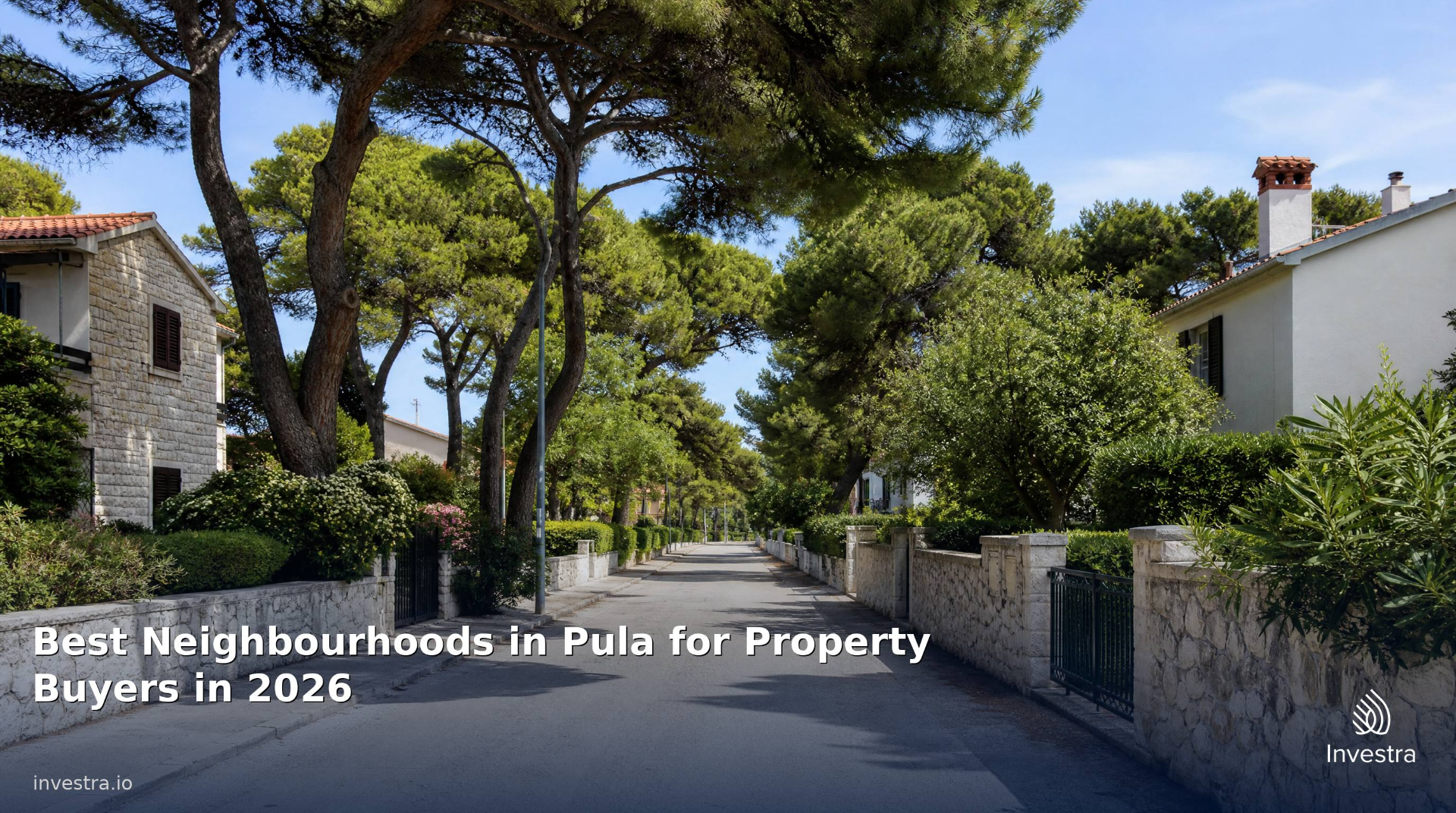
Best Neighbourhoods in Pula for Property Buyers in 2026
Why Pula Is Attracting International Property Buyers in 2026
Quick Answer: Pula is attracting international buyers in 2026 due to its Roman heritage, Adriatic coastline, relatively affordable prices versus premium Croatian cities, strong short‑term rental demand from tourism and improved year‑round appeal after the introduction of the Croatia Digital Nomad Visa.
Pula is a distinct proposition on the Istrian Peninsula. It combines a compact, working city with a remarkable historical core — most visibly the Roman amphitheatre that anchors the urban fabric — and accessible Atlantic and continental air links that support a reliable tourist season. The city serves as Istria County’s administrative hub and sits strategically at the southern tip of the peninsula, within easy driving distance of surrounding coastal communities that form the wider Pula Riviera.
For investors the comparison most often made is to Split, Dubrovnik and the Hvar coastline: unlike those markets Pula offers meaningful affordability while retaining solid tourism fundamentals. Proximity to Pula Airport and direct connections to major European hubs broaden its catchment for inbound visitors and contribute to the seasonality profile that supports short‑term rental strategies. An article on general Croatia investment considerations is available on Investra.io, which places Pula in the wider national context.
Understanding Pula's Property Market: Prices, Trends, and What the Data Actually Shows
Quick Answer: Pula's market recorded strong gains in the early 2020s with average prices varying widely by neighbourhood; central and coastal properties command the premium while outer residential areas remain comparatively affordable.
Across Croatia the Bureau of Statistics reported property price increases through 2023 and Istria generally outperformed the national average. Local transaction records and agency reporting in Pula indicate typical central and near‑central apartments transacting around €2,800–€3,200 per square metre between late 2024 and 2026. The spread within the city is wide: outer districts may trade near €1,800–€2,000/m², while premium seafront or fully renovated historic apartments can exceed €4,500–€5,500/m².
Supply dynamics are meaningful. The historic core is protected and development in sensitive central zones is tightly regulated, which constrains new supply and supports capital preservation for well‑located assets. Conversely, the peripheral residential stock provides options for value buyers and for investors prioritising long‑term rental security rather than maximum short‑term revenue. The adoption of the euro in 2023 removed a layer of currency uncertainty for eurozone buyers and simplified deal structuring for many foreign investors, a factor that aided demand in 2023–2024 and continues to influence buyer confidence in 2026.
Rental yields are location dependent. Short‑term holiday lettings in premium tourist areas can produce gross yields in the 6–10% range during peak seasons, while long‑term tenancy in residential districts tends to yield between 3.5% and 5.5% gross. Net returns vary after management fees, taxes and operating costs; for clearer tax implications, consult the Croatia Property Tax Guide 2026.
The Historic Centre (Stari Grad): Pula's Premium Investment Zone
Quick Answer: Stari Grad commands Pula’s highest prices and strongest tourist demand; renovated stone properties fetch top nightly rates but offer limited supply and elevated renovation costs.
The historic centre is Pula’s most immediate investment proposition for buyers seeking tourism‑driven returns or a distinctive holiday home. Streets clustered around the Arena, the Forum and the Temple of Augustus attract tourists, cultural visitors and short‑stay guests who prioritise location above all else. This generates strong booking demand in July and August and supports premium pricing for renovated stone apartments and townhouses.
Renovation is a central part of the Stari Grad calculus. Buildings are often protected or part of conservation frameworks, which raises restoration costs and increases the need for experienced local architects and contractors. Expect higher per‑square‑metre renovation budgets than in peripheral parts of the city — typically several hundred euros per square metre above standard refurbishment rates. The upside is a product that performs strongly on short‑stay platforms and in direct rental channels.
Availability is constrained. When properties do trade they frequently move quickly, sometimes via off‑market transactions handled through trusted local networks. Working with a recognised local advisor can improve access to those opportunities; resources such as Siniša Dagary investment insight are positioned as local specialist contacts for buyers seeking that market access. When assessing Stari Grad opportunities, factor in parking logistics, service access and the likely maintenance profile of heritage fabric.
Valsaline and Štinjan: The Coastal Neighbourhoods Driving Rental Yields
Quick Answer: Valsaline and Štinjan combine coastal lifestyle appeal with strong short‑term rental demand; properties with sea views demand the premium and tend to deliver higher gross yields during the summer months.
Valsaline and Štinjan are Pula’s primary coastal neighbourhoods for buyers who prioritise beach access and sea views. Valsaline lies about three kilometres from the city centre and is characterised by a mix of detached villas and newer apartment developments. Štinjan, bordering the bay and natural areas, offers similar appeal with an emphasis on beach accessibility and outdoor recreation.
The guest profile in these neighbourhoods skews toward families and longer‑stay visitors who book multi‑week stays rather than short city breaks. That pattern supports higher average nightly rates for two‑ and three‑bedroom apartments and elevates occupancy across June–September. Investors targeting this demand profile typically see gross short‑term yields in the mid‑to‑upper single digits; net yields depend on operational choices, management contracts and the extent of owner usage.
Infrastructure improvements — coastal paths, beach maintenance and enhanced pedestrian links to the city — have a direct impact on guest experience and booking reviews, and therefore on long‑term revenue performance. When evaluating properties, consider terrace sizes, direct access to coastal promenades and the dynamics of local competition, including newer apartment complexes that enter the market through measured development programmes.
Veruda and Veruda Porat: Where Locals Buy and Prices Make Sense
Quick Answer: Veruda and the marina neighbourhood Veruda Porat offer residential quality, marina demand and relative affordability for buyers seeking year‑round rental or owner occupation.
Veruda is a neighbourhood where local life persists: bakeries, corner cafés and community services matter to residents. This translates into a different investment profile than tourist‑centric zones. Veruda Porat, the marina area, benefits from nautical tourism: berths, visiting crews and yachtsmen who look for short‑stay apartments close to their vessels support a higher‑value micro‑market within the neighbourhood.
Apartment prices with marina views typically sit above the Veruda average and rent well to sailors and nautical visitors. The long‑term rental market in Veruda is strong too, buoyed by proximity to employment centres, schools and Juraj Dobrila University of Pula. Long‑term yields are often the most stable across Pula’s neighbourhoods, making Veruda attractive for investors prioritising steady income and reduced seasonality.
Entry points for international buyers are competitive but accessible; modest budget buyers will find one‑bedroom apartments in reasonable condition from mid‑range price points. If you expect to use the property personally for regular stays and require marina access, Veruda Porat’s premium is justified by the convenience and by access to the marine leisure economy.
Medulin and the Pula Riviera: The Case for Buying Just Outside the City
Quick Answer: Municipalities like Medulin, Premantura and others on the Pula Riviera offer cost‑effective coastal properties within a short drive of Pula, supplying excellent family tourism demand and value relative to city‑centre equivalents.
The Pula Riviera is a practical extension of the city market. Towns such as Medulin, Premantura, Pomer and Ližnjan lie within a 10–20 minute drive of central Pula and benefit from broader Istrian tourism flows. Medulin in particular is noted for family‑friendly beaches and a well‑developed tourist infrastructure. Properties here typically trade at discounts versus Pula’s immediate coastal neighbourhoods while delivering comparable peak season occupancy rates.
Premantura and the cape at Kamenjak present a different value proposition: rarity and natural amenity. Cape Kamenjak’s protected coastline is a magnet for outdoor tourism and generates demand for small villa and apartment stock. Scarcity in such locations can produce capital appreciation, but practical factors — most notably transport dependence and seasonal patterning — should shape purchase decision‑making.
Buyers considering the Riviera should calibrate expectations around car dependency, frequency of personal use and the management strategy for rentals. For holiday rental models, guests commonly rent cars and the distance from Pula is not a barrier; for owners who expect frequent commutes into the city without a vehicle, Riviera living is more of a lifestyle choice than a convenience decision.
Monvidal and Kaštanjer: Pula's Up-and-Coming Residential Zones
Quick Answer: Monvidal and Kaštanjer are practical, family‑oriented residential districts offering modest entry prices, modern new builds in some pockets, and predictable long‑term rental demand from local professionals and university staff.
These inner suburban districts are where capital growth and rental reliability overlap without the high management intensity of short‑stay lets. Kaštanjer has seen recent development activity introducing modern apartments with underground parking, better insulation and layouts aimed at permanent residents. Monvidal and Kaštanjer are attractive to buyers focused on domestic demand, affordability and a lower‑volatility investment profile.
Prices for well‑located, new units in these districts are competitive relative to central Pula and coastal villages. Investors targeting long‑term tenancies — professionals, families and university affiliates — will find steady demand and manageable tenant turnover. For buyers prioritising utility, energy efficiency, parking and straightforward management, these neighbourhoods often represent the most pragmatic starting point in Pula’s market.
Legal Process for Foreign Buyers: What You Need to Know Before You Sign Anything
Quick Answer: EU buyers have parity of purchase rights; non‑EU purchasers may face reciprocity or additional approval steps. The transaction typically runs 2–4 months with total transaction costs around 5–7% of the purchase price.
The Croatian process for buying property has been standardised in recent years, yet legal clarity and local counsel remain essential. EU citizens can buy under the same terms as nationals, subject to normal due‑diligence, registration and tax formalities. Non‑EU citizens should confirm reciprocity and may require Ministry approvals; alternative structures using Croatian companies are sometimes used but carry separate tax and compliance implications.
Budget for transfer tax (commonly 3% on resale deals), notary fees, registry charges, legal fees and any applicable agent commissions. If you are buying a new build, VAT may apply instead of transfer tax. Always require independent title searches, confirmation of no encumbrances in the land registry (Zemljišna knjiga) and a translation of the purchase contract. Do not sign Croatian language documents without verified translation and legal explanation.
For structuring advice, investment and tax guidance, independent advisory firms and specialist consultants can help. Practical, market‑facing consultancy is available from local experts; see the service pages and contact resources at Siniša Dagary investment insight and reach out via the dedicated contact page at Siniša Dagary investment insight for bespoke advice. For financial planning and mortgage structuring, professional services such as Findes Group & Partners can assist with banking introductions and structured financing solutions.
Pula Rental Market: Short-Term vs. Long-Term Strategies in 2026
Quick Answer: Short‑term rentals offer higher gross yields but demand active management; long‑term lets deliver steadier income with less operational burden. Choice should reflect property location, owner involvement and regulatory compliance for tourist registration.
Short‑term holiday letting is prevalent in Stari Grad, Valsaline and selected coastal neighbourhoods. Well‑managed units in prime locations can produce attractive gross revenue during the season, but owners must account for management fees (typically 20–25% of gross revenue), platform commissions, cleaning, guest logistics and occupancy variability. Net yields after these costs tend to be materially lower than headline gross figures and should be modelled conservatively.
Long‑term rental is a lower‑touch proposition. Neighbourhoods such as Veruda, Monvidal and Kaštanjer support stable tenancy markets driven by local demand. Long‑term contracts reduce vacancy risk and operational turnover, and they behave differently under taxation regimes because income is declared annually and taxed according to personal or company rates. For compliance and a detailed view on administrative tax obligations consult the Split Airbnb Investment 2026 framework which outlines regulatory steps that apply similarly across Croatian coastal towns.
Operational strategy matters as much as location. Owners who wish to outsource hospitality tasks can deliver consistent guest experiences and protect their asset, but should budget conservatively for management and reserve funds for maintenance and seasonal variation. For buyers weighing both models, a mixed approach — long‑term letting in off‑season and holiday lets in summer — can smooth cash flow while preserving flexibility.
New Developments and Off-Plan Opportunities in Pula
Quick Answer: New builds and off‑plan projects in Pula present modern specifications, warranty protections and staged payment plans; off‑plan discounts are available but developer due diligence is essential.
New construction in Pula is measured rather than speculative, and projects typically align with local demand. Developments in Štinjan, Kaštanjer and along the southern corridor offer modern conveniences — energy efficiency, underground parking and contemporary layouts — that appeal to both domestic buyers and foreign purchasers seeking turnkey investments. Off‑plan pricing can be 10–20% below the expected completed market value, depending on timing and developer incentives.
Staged payment plans for off‑plan purchases (10–20% on signing, milestone payments during construction and a balance on handover) help buyers manage cash flow when financing a purchase from abroad. New builds also benefit from statutory defect warranties on construction. That said, due diligence on developer track record, building permits and registered titles remains the most important risk mitigation step; professional verification and repeated reference checks are non‑negotiable before committing funds.
For comparative insight across Croatia’s coastal markets, additional market research and region‑specific guides provide context — see the full Investra content library, including reports on Hvar, Split, Dubrovnik and Zagreb, for cross‑market perspective: Hvar Island Real Estate 2026 Luxury Property Investment G..., Buying Property In Split 2026 Complete Guide For Foreign ..., Buying Property In Dubrovnik 2026 Complete Guide For Fore... and Buying Property In Zagreb 2026 Complete Guide For Foreign.... For specialised off‑plan advisory and to evaluate developer credentials, experienced consultancies and independent advisors provide the necessary legal and financial checks; examples of structured advisory services are available via Siniša Dagary investment insight.
Investment Disclaimer
Quick Answer: This article provides general information only; it is not personal financial, legal or tax advice. Always perform your own due diligence and consult qualified advisors before making investment decisions.
The information presented here is intended to give a concise, factual overview of neighbourhood dynamics, pricing bands, rental profiles and legal considerations relevant to Pula in 2026. Real estate investments carry risk and outcomes depend on individual circumstances, market movements and regulatory changes. Past performance does not predict future returns.
Buyers should engage qualified professionals for legal title searches, tax planning and financial structuring. Independent counsel is especially important when dealing with cross‑border tax matters, corporate ownership structures, or non‑EU buyer approvals. For structured financial advice, consult licensed financial services firms; for example, consult Findes Group & Partners to discuss tailored mortgage and investment structuring solutions.
Frequently Asked Questions
Quick Answer: Below are common questions buyers raise when considering Pula properties in 2026, with concise answers to guide next steps.
Is Croatia a good country for real estate investment in 2026?
Yes. Croatia remains attractive due to improving infrastructure, a growing tourism industry and price points that compare favourably with many Western European coastal markets. Regional differences are significant; Istria and Dalmatia behave differently, and localised research is essential. For comprehensive context on taxes and regulations consult the Croatia Property Tax Guide 2026.
Can foreigners buy property in Croatia?
EU citizens can purchase on the same terms as Croatian nationals. Non‑EU citizens are generally able to buy subject to reciprocity or with Ministry approvals; some buyers opt to use Croatian corporate vehicles but should understand the tax and administrative consequences. Local legal counsel will clarify pathways depending on nationality and intended ownership structure.
What is the average property price in Pula?
There is no single average applicable to all neighbourhoods. As of 2024–2026, central and near‑central apartments typically trade in the €2,800–€3,200/m² range, with outer residential areas nearer €1,800–€2,000/m² and premium seafront or fully renovated historic units above €4,500–€5,500/m². Local agency data and recent sales provide precise street‑by‑street comparables.
What rental yields can I expect?
Short‑term yields vary by location and property standard; headline gross yields of 6–10% are achievable in peak markets before costs. Long‑term gross yields typically range from 3.5% to 5.5%. After management, maintenance and taxes, net yields are lower and should be modelled conservatively.
What taxes apply to property purchases?
Resale purchases commonly attract a 3% real estate transfer tax. New builds may be subject to VAT. Notary, land registry and professional fees add to transaction costs. On rental income, tax treatment depends on ownership and declared activity; specialist tax advice is recommended. For a full tax breakdown see the Croatia Property Tax Guide 2026.
How long does the purchase process typically take?
Commonly 2–4 months from offer to registered title for straightforward transactions. Non‑EU buyer approvals can extend that timeline by additional weeks or months depending on the required approvals. Working with an experienced local attorney and agent accelerates the process and reduces transactional risk.
What financing options are available?
Local mortgages are available to residents and some non‑residents subject to bank underwriting. Developer staged payments are common for new builds. International buyers sometimes combine personal financing with local loans; detailed lending terms and eligibility vary by nationality and bank policy. For structured financial advice consider professional partners such as Findes Group & Partners.
Is property management available for rental properties?
Yes. There are professional management companies that handle bookings, guest services, cleaning and maintenance. Management fees for holiday lettings typically range 20–25% of gross revenue; long‑term lets usually incur lower ongoing management costs. Selecting an experienced local management partner is critical to protecting occupancy and guest satisfaction.
What are the best areas to invest in Pula?
Best area depends on goal: Stari Grad and coastal neighbourhoods excel for short‑term tourism income; Veruda, Monvidal and Kaštanjer are better for stable long‑term rental income and owner occupation; Medulin and the Riviera offer cost‑effective coastal alternatives. Consider the trade‑offs between yield, seasonality and owner use.
Recommended Reading
Quick Answer: This section explains the practical property-investment implications of Recommended Reading.
- Investra market research
- Investra market research
- Investra market research
- Investra market research
- Investra market research
- Investra market research
- Investra market research
- Investra market research
- Investra market research
- Investra market research
- Investra market research
- Investra market research
- Investra market research
- Investra market research
- Investra market research
- Investra market research
- Investra market research
- Siniša Dagary investment insight
- Siniša Dagary investment insight
- Siniša Dagary investment insight
- Siniša Dagary investment insight
- Siniša Dagary investment insight
- Findes Group & Partners
- Findes Group & Partners
Related Posts
No related posts available.
