
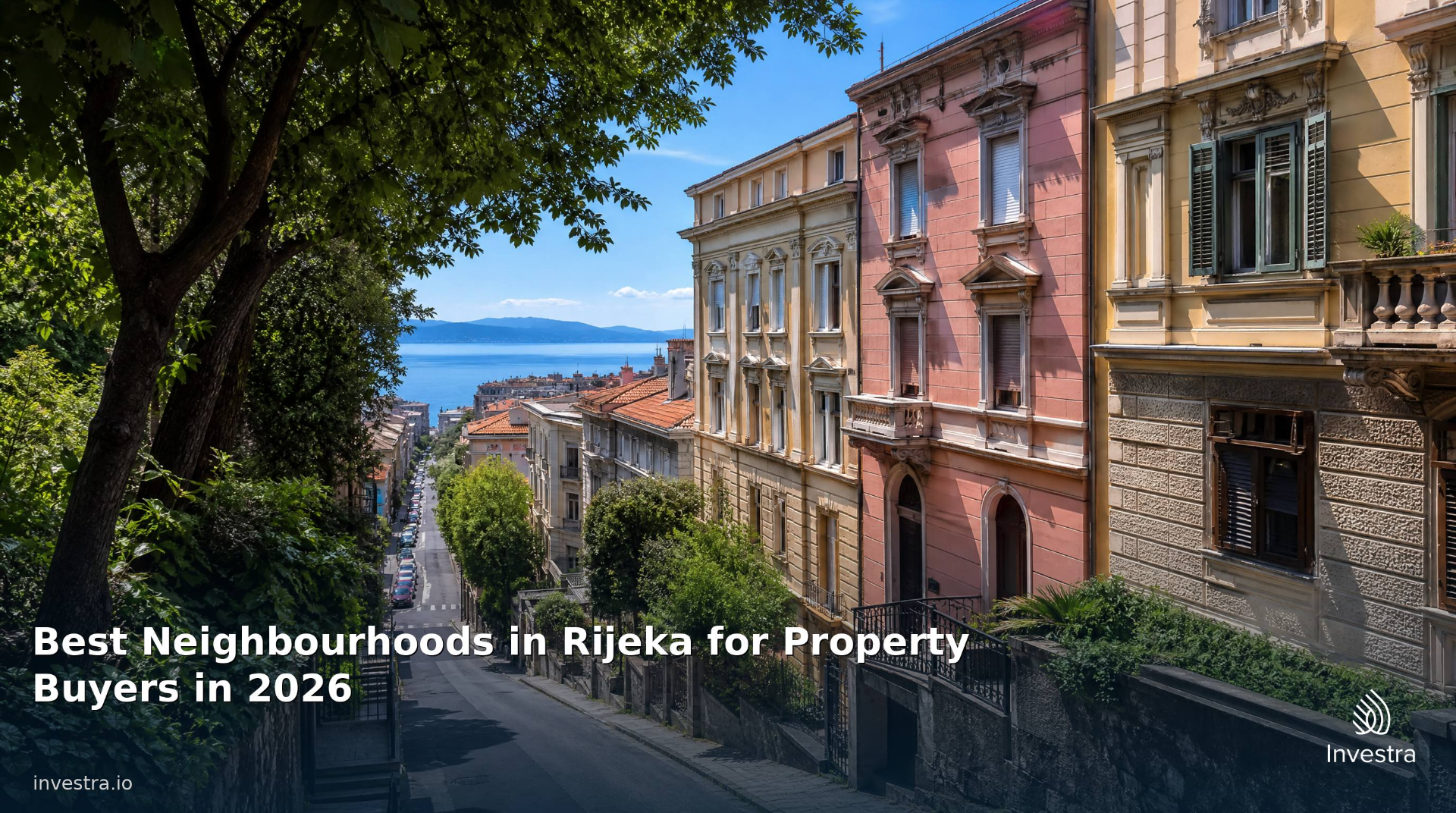
Best Neighbourhoods in Rijeka for Property Buyers in 2026
Why Rijeka Is Capturing the Attention of Savvy Property Investors in 2026
Quick Answer: Rijeka offers one of Croatia's most compelling value propositions for property buyers in 2026 — price points substantially lower than the Dalmatian hotspots, a working year‑round economy and an improving urban fabric that reward patient, informed investors.
Rijeka has quietly shifted from an industrial port city into a market that now attracts investor attention for reasons that go beyond transient tourism trends. As Croatia moved into the eurozone and Schengen in recent years, transaction friction for European buyers diminished, and Rijeka began to show structural strengths that weigh in an investor's favour: diversified local economy, cultural infrastructure investment after the European Capital of Culture programme, and an urban geography that blends seaside locations with elevated residential districts.
For buyers comparing coastal exposure across Croatian cities, Rijeka's price-to-quality ratio is an immediate draw. Average asking prices and transactional values across established Rijeka neighbourhoods commonly fall in a range that is materially lower than similar stock in Dubrovnik or Split. This gap is not merely headline pricing but reflects differences in international demand intensity, stock composition and seasonality of rental income. Owners who value consistent twelve‑month rental demand, or who prefer long-term capital growth with lower acquisition cost, increasingly look to Rijeka as an attractive alternative.
Local regeneration projects since 2020, alongside public and EU funding, have targeted historic buildings, public spaces and the waterfront. Those public investments have started to unlock private capital interest and signal a multi-year path toward better city amenities and improved desirability. The result is a market that still offers entry points for buyers hunting real value, while also providing upside as regeneration programmes continue to mature.
For practical guidance tailored to cross-border buyers, Investra publishes background materials that remain useful when assessing any Croatian market; consult the central market FAQ resource on the Investra site for broader context: Investra.io.
Understanding Rijeka's Urban Geography Before You Buy
Quick Answer: Rijeka is compact but varied: a walkable historic core, elevated residential hillsides with panoramic views, an eastern waterfront with direct sea access and a western regeneration strip — each area suits different buyer objectives.
Rijeka's topography and urban evolution create distinct investment submarkets. The city centre — Korzo — is compact and densely amenitised; mid-slope neighbourhoods like Kozala and Turnić provide quieter residential living and long-term owner‑occupier appeal; eastern districts such as Pećine and Sušak offer surprisingly direct sea access and views; and the Delta waterfront is a large, transformational regeneration area with speculative development potential.
Because Rijeka's hills rise steeply behind its central spine, many properties on the slopes enjoy panoramic vistas over the Kvarner Gulf. That feature produces persistent premiums for a limited number of sea-view properties and shapes buyer demand in a way that is consistent with other Mediterranean cities: view and aspect matter, but so do building condition and access. Buyers who treat Rijeka as a single homogeneous market risk mispricing opportunities and overlooking pockets that match their goals.
The presence of the Port of Rijeka is both a historical economic driver and a contemporary amenity: port infrastructure supports year-round commercial activity that sustains local employment and reduces the extreme seasonality observed in purely tourist towns. This year‑round demand underpins long-term rental and owner-occupier markets and offers stability for investors who prioritise consistent cash flow over purely seasonal upside.
Before committing to a purchase, buyers should map neighbourhood profiles to their objectives — short-term tourist income, mid-term nomad rentals, student lets or long-term capital appreciation — and then match price ranges and unit types to those strategies. For comparative frameworks and city-level benchmarks, Investra's market research and guides on larger Croatian cities remain a useful reference: Investra market research.
City Centre and Korzo — The Heart of Rijeka's Rental Market
Quick Answer: The Korzo and adjacent central streets are Rijeka's short‑term rental heartland: strong amenity density, historic architecture and achievable gross yields of 5–7% for well-executed short-stay properties.
The Korzo promenade and immediate surrounding streets represent the city's highest concentration of cultural institutions, cafes and transport links. Apartments here are often located in Austro‑Hungarian era buildings with character features that attract both tourists seeking an authentic stay and local or regional tenants wanting city-centre convenience. Those architectural attributes — high ceilings and robust floorplates — create renovation opportunities that can materially uplift value where budgets allow.
Pricing in the city centre reflects demand for convenience and character. Older, unrenovated units can present attractive entry valuations for buyers capable of project-managing a refurbishment; renovated two-bedroom apartments positioned for short-term letting can command strong nightly rates during peak months and steady, if lower, demand outside the summer window thanks to cultural programming and weekend events. Investors should budget for renovation and professional management to extract the expected yields; without that, operational overheads and compliance issues can erode projected returns.
Operationally, short-term letting in the centre requires attention to local regulations, taxation and platform economics. Investors can translate lessons from other Croatian tourist destinations to Rijeka; Investra's guides on market operations provide context that is broadly applicable: Split Airbnb Investment Guide. When scaled judiciously, short-term lets in the centre deliver the highest gross yields among Rijeka's submarkets, though net returns depend heavily on management quality and seasonal occupancy volatility.
Kozala — Rijeka's Most Prestigious Residential Address
Quick Answer: Kozala is the city's premium residential quarter: villa and large apartment stock, quiet streets and panoramic views, with prices typically from €2,500 to €4,500/m² and buyer profiles dominated by owner‑occupiers seeking long‑term value.
Kozala's appeal rests on a combination of elevated position, architectural quality and an established reputation among locals as the address of choice. The market here is relatively thin — desirable villas and larger apartments change hands infrequently — which supports price resilience. Buyers looking for lifestyle attributes and stable capital appreciation often prefer Kozala to more tourist-oriented central districts.
Because supply turnover is limited, transactions in Kozala tend to be negotiated over longer timeframes and often involve attentive due diligence on building condition, garden boundaries and service access. Investment activity is less about rapid rental extraction and more about securing a quality asset that will appreciate over time. That makes Kozala well suited for high-net-worth buyers and professionals who intend to occupy or lease to corporate tenants on longer tenures rather than operate short-term tourist lets.
Market commentary from local consultants underscores that Kozala's limited supply, combined with renewed interest from returning diaspora and lifestyle buyers from Northern Europe, supports an expectation of moderate, steady appreciation. For bespoke advice on structuring such acquisitions, independent consultants and advisers including practitioners represented online by market commentators provide useful perspectives: Siniša Dagary investment insight.
Turnić and Brajda — Authentic Neighbourhoods With Emerging Value
Quick Answer: Turnić and Brajda deliver solid value for buyers who favour consistent rental demand and lower acquisition prices — typical asking ranges €1,400–€2,400/m² with stable yields driven by local tenants and student demand.
Turnić and Brajda are practical neighbourhoods that appeal to a broad cross-section of residents: families, students and professionals. The housing stock is mixed, with interwar buildings, post‑war blocks and modestly scaled renovations. These districts provide good access to the city centre while offering more affordable valuations than prime waterfront or hillside quarters.
Rental demand in these areas is driven by local employment, proximity to amenities, and the presence of the University of Rijeka, which supports a steady flow of student and staff tenants. Units suitable for mid-term leases — typically one- to twelve-month agreements — perform particularly well here, offering investors reliable cash flow with materially less operational intensity than short‑term platforms. For buyers prioritising a yield-focused, lower-turnover strategy, Turnić and Brajda are logical options.
Investment strategy in these neighbourhoods often involves modest refurbishment to improve energy efficiency and interior layout, which can increase rental rates with relatively limited capital outlay. Practical market guidance and case studies on yield-focused approaches can be found among professional analysts and market blogs: see the strategic commentary available through the Siniša Dagary practitioner resources for operational perspectives: Siniša Dagary investment insight.
Pećine and the Eastern Waterfront — Sea Views at a Relative Discount
Quick Answer: Pećine and Sušak combine direct coastal access with attractive pricing relative to Dalmatian seafronts — sea-facing apartments typically trade between €1,800 and €3,000/m² and attract mid-term lifestyle tenants and seasonal visitors.
The eastern waterfront of Rijeka, including Pećine and Sušak, is notable for delivering genuine Adriatic frontage at price points substantially lower than equivalent coastal units in the more internationally famous Dalmatian towns. That relative affordability has begun to attract lifestyle buyers and long-stay visitors such as digital nomads, who prize sea views and good connectivity without the premium of high-demand tourist markets.
Housing typologies along the eastern shore are varied: interwar seafront blocks, 1970s apartment complexes and contemporary renovations. Renovated sea-facing apartments command higher per‑square‑metre values and are particularly attractive to buyers who want to combine owner occupancy with rental potential targeted at mid-term stays. The growth of Croatia's digital nomad framework has amplified demand for properties that balance comfort, connectivity and coastal amenity; for operational detail on how the visa programme interacts with property demand, consult the digital nomad guide produced by Investra: Croatia Digital Nomad Visa 2026 Guide.
For investors focused on mid-term tenancies or multi-month rentals, Pećine and Sušak offer a predictable demand base. Compared to the centre, these districts generally experience lower turnover and less intensive property management needs, while still providing an attractive lifestyle proposition that can sustain higher average rents than inland neighbourhoods.
Delta and the Regeneration Zone — High Risk, High Potential
Quick Answer: Delta is Rijeka's principal regeneration frontier: an early-stage mixed-use transformation where patient capital and development experience can capture outsized gains, but where delivery timelines and political cycles introduce material project risk.
The Delta waterfront occupies former port and industrial land where masterplans envisage a new mixed-use urban quarter. Such regeneration projects attract investors seeking transformation upside rather than immediate rental cash flow. In Rijeka's case, Delta benefits from prior public investment and cultural programming that helped reposition parts of the waterfront, but the full realisation of a masterplan remains multi-year and contingent on public/private partnerships, funding rounds and phased construction.
Investors interested in Delta need to think in terms of project complexity: land parcels, plots for commercial developments, joint-venture residential blocks and adaptive reuse of heritage industrial buildings are all possible asset classes in play. The practical realities include protracted planning, environmental assessments, and staged infrastructure delivery. For this reason, many investors engage financial structuring specialists to manage timing, taxation and risk — advisers such as Findes can be relevant partners in this context: Findes Group & Partners.
While the Delta story is compelling to those who can absorb a longer holding period, direct exposure to early-stage sites should be limited to investors with development experience or those who partner with established regional developers. For financing, JV structuring and complex transaction execution, professional advisory engagement is recommended. Findes offers advisory services that can help structure investments in regeneration projects, from feasibility to financial close: Findes Group & Partners.
Trsat — History, Character, and a Boutique Investment Niche
Quick Answer: Trsat is ideal for boutique heritage investments: character stone houses and small villa conversions priced between €2,000 and €3,500/m², well suited to curated short-term lets and owner-occupier buyers seeking heritage appeal.
Trsat's hilltop castle and sanctuary establish a cultural gravity that produces steady visitor interest. The neighbourhood's narrow lanes, terraced gardens and stone-built properties make it a natural fit for boutique investment strategies that target travellers seeking authenticity. Inventory in Trsat is limited; characterful properties with period details and outdoor space hold value and typically trade slowly, supporting price stability and selective buyer competition.
For investors pursuing a boutique strategy, renovation quality and authenticity matter. A sensitive restoration that preserves original materials while delivering modern comfort often commands a premium in bookings and resale value. The short-term rental case in Trsat differs from the city centre in that guests are primarily driven by heritage and tranquillity rather than nightlife or urban convenience. Consequently, tailored marketing and premium positioning on specialist platforms are important to realise strong occupancy and rate performance.
Comparative lessons from other Croatian heritage neighbourhoods can be productive. Investra's island and heritage guides outline the specifics of renovating and operating character properties in Croatia's market contexts: Hvar Island Real Estate 2026 Guide. For boutique buyers who prioritise architectural quality and cultural positioning, Trsat represents a compact but resilient niche.
Rental Yields and Investment Returns Across Rijeka's Neighbourhoods
Quick Answer: Expect gross rental yields of roughly 4% to 7.5% across Rijeka depending on strategy — short-term centre and waterfront lets outperform on gross basis, while mid-term and long-term residential offers steadier, lower-yield cash flow.
Rijeka's rental market segments are distinct and investors should align strategy with neighbourhood selection. Short-term tourist lets in the Korzo and eastern waterfront typically produce the highest gross yields, but also require active management, higher marketing spend and acceptance of seasonal occupancy variations. Mid-term lets targeting remote workers and digital nomads now provide a balanced alternative, with lower operational intensity and more stable monthly income. Traditional long-term tenancy to local residents is the most predictable but often generates the lowest headline yield.
Gross yields should be viewed alongside capital growth expectations. Many Rijeka buyers combine yield and appreciation in their return calculus: acquiring value-priced stock now with the view that regeneration, improved tourism flows and broader national market appreciation will deliver capital gains over a five- to ten-year horizon. In practice, managed portfolios that mix short-term and mid-term strategies can smooth cash flow while keeping upside exposure to price appreciation.
Investors calculating returns should also factor in realistic transaction costs and taxes. Typical purchase-related expenses — notary, legal, transfer duties or VAT on new builds — can add several percentage points to acquisition cost. For detailed tax mechanics and planning, Investra's property tax guide remains a core resource: Croatia Property Tax Guide 2026. Those figures materially affect net yields and should be included in all underwriting scenarios.
The Legal Process for Foreign Buyers Purchasing in Rijeka
Quick Answer: EU/EEA citizens purchase under the same legal terms as Croatians; non-EU buyers should verify reciprocity and engage a notary and attorney early. A standard transaction commonly completes within 60–90 days when documentation and approvals proceed smoothly.
The legal framework is straightforward for EU and EEA citizens: there are no ownership restrictions and financing, inheritance and rental rights are equivalent to those of Croatian nationals. Non-EU buyers face reciprocity conditions in some cases, which requires careful early confirmation. Engaging a local notary and a Croatian attorney familiar with property transactions is essential to validate eligibility, structure the contract and confirm land registry status.
The transaction flow generally begins with a negotiated price and signing of a preliminary agreement (Predugovor), often accompanied by a deposit. This triggers conditional obligations and allows time for title checks, utility status verification and any needed survey work. The final purchase contract is notarised and the transaction is registered at the Land Registry (Zemljišne knjige). For resale properties a 3% transfer tax is typically applied; new builds are often subject to VAT instead.
Buyers should also budget for professional fees — notary, legal and potentially agent commissions — and allow for practical timelines associated with document translation, power of attorney execution and cross-border banking transactions. For a thorough breakdown of taxes and cost lines, consult Investra's tax guide and legal resources: Croatia Property Tax Guide 2026. If you seek comparative purchase procedures for other Croatian cities, Investra's city guides are useful: Buying Property in Zagreb 2026 Guide and Buying Property in Split 2026 Guide provide working examples of process steps that apply equally to Rijeka.
Investment Disclaimer
Quick Answer: This article is informational only. Investors should perform independent due diligence and consult qualified advisers prior to committing capital.
The information presented in this guide is intended to provide factual context, market framing and practical considerations relevant to property buyers evaluating opportunities in Rijeka during 2026. It is not personalised financial, tax or legal advice. Real estate investments carry inherent financial risks and liquidity considerations. Past performance in any regional real estate market does not guarantee future results.
Buyers should seek independent counsel on legal matters, tax planning and financing structure before concluding any purchase. Professional advisers can help with residency questions, reciprocity tests for non-EU buyers, mortgage availability, and cross-border structuring. For tailored advisory and transaction management services that engage with the local market, consider independent consultants and advisers who specialise in Croatian property investment, including those available through practitioner sites and service listings such as Siniša Dagary investment insight and the advisory teams at Findes for financial structuring: Findes Group & Partners.
Frequently Asked Questions
Quick Answer: Below are commonly asked questions with concise answers to help prospective buyers navigate Rijeka's market fundamentals and next steps.
Is Croatia a good country for real estate investment in 2026?
Yes. Croatia combines improving infrastructure, EU integration benefits and differentiated coastal markets. Rijeka is notable for offering good value relative to the more internationally recognised Dalmatian destinations.
Can foreigners buy property in Croatia?
EU/EEA citizens can purchase property freely. Non-EU citizens must check reciprocity requirements. Engaging local legal counsel early in the process reduces uncertainty and ensures proper compliance.
What is the average property price in Rijeka?
Prices depend on neighbourhood and property condition. Established ranges quoted by market participants generally fall between €1,200 and €3,500/m², with premium pockets above that for renovated sea-view units.
What rental yields can I expect?
Gross yields across Rijeka typically range from 4% to 7.5% depending on rental strategy and location. Short-term tourist lets in prime locations usually produce the highest gross yields.
What taxes apply to property purchases?
Resale properties are generally subject to a 3% real estate transfer tax. New build purchases are frequently liable for VAT. Buyers should consult the detailed tax guide for current rates and exemptions: Croatia Property Tax Guide 2026.
How long does the purchase process take?
Typical timings range from 60 to 90 days from offer to registration in straightforward transactions. Complex cases, non-EU purchases or deals involving development plots can take longer.
What financing options are available?
Buyers can access local bank mortgages, developer financing or cross-border lending depending on creditworthiness and residency status. Specialist financial advisers can help source competitive terms; see advisory services available at Findes Group & Partners.
Is property management available for rental properties?
Yes. Professional property management is widely available for both short-term and long-term rental strategies. Third-party management reduces daily operational workload but will affect net yields.
What are the best areas to invest in Rijeka?
Choice depends on objectives. Korzo and the city centre are best for short-term rental income; Pećine and eastern waterfront suit lifestyle mid-term lets; Kozala is strongest for premium owner-occupier purchases and long-term appreciation; Turnić and Brajda offer consistent, student and local tenant-backed demand.
Where can I get expert advice and market listings?
For market listings, process guidance and transaction support, Investra provides research and local market teams. Independent consultants and advisers such as those represented on Siniša Dagary's pages can offer tailored strategy input: Siniša Dagary investment insight and Siniša Dagary investment insight.
Recommended Reading
Quick Answer: This section explains the practical property-investment implications of Recommended Reading.
- Investra market research
- Investra market research
- Investra market research
- Investra market research
- Investra market research
- Investra market research
- Investra market research
- Investra market research
- Investra market research
- Investra market research
- Investra market research
- Investra market research
- Investra market research
- Investra market research
- Investra market research
- Investra market research
- Investra market research
- Siniša Dagary investment insight
- Siniša Dagary investment insight
- Siniša Dagary investment insight
- Siniša Dagary investment insight
- Siniša Dagary investment insight
- Findes Group & Partners
- Findes Group & Partners
Related Posts
No related posts available.
