
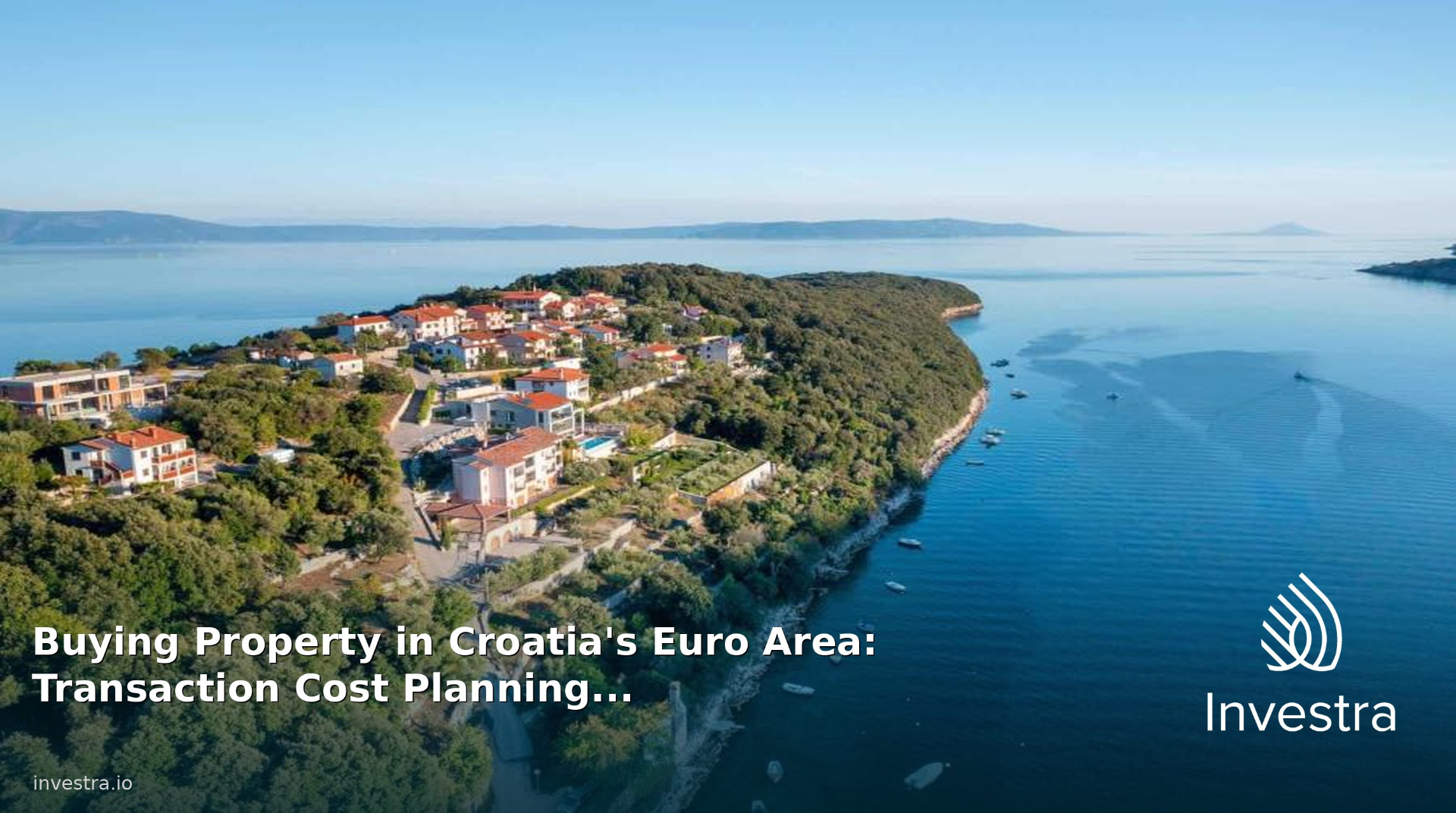
Buying Property in Croatia's Euro Area: Transaction Cost Planning...
Buying Property in Croatia's Euro Area: Transaction Cost Planning...
Why Istria Is Drawing Foreign Buyers Into Croatia's Euro Area
Quick Answer: Istria has become one of Croatia's most sought-after property markets for foreign investors, thanks to its EU membership stability, euro-denominated transactions, and Mediterranean lifestyle appeal. Understanding the full cost picture before signing anything is the single most important step any buyer can take.
There's something genuinely different about the Istrian property market compared to other parts of Croatia. Yes, Dubrovnik has the glamour and Split has the scale, but Istria occupies a unique position — it borders Slovenia and Italy, it has a strong Italian cultural heritage, and it tends to attract a more year-round visitor base than the purely seasonal resorts further south. For investors, that distinction matters enormously.
Since Croatia joined the eurozone on 1 January 2023, the currency question that once complicated every property deal has disappeared. You're no longer calculating kuna conversion risk on a €250,000 purchase. What remains, however, is the more nuanced work: understanding exactly what transaction costs apply when you buy property in Croatia's euro area, how those costs compound across different property categories, and how to structure your ownership so that annual holding costs don't quietly erode your returns year after year.
In my experience, buyers who budget carefully for the acquisition phase often underprepare for the ongoing costs — and that's where the surprises tend to land. This article exists to prevent that. We'll walk through the full cost picture for Istria property purchases, from first offer to settled title, and well beyond. For specialist guidance, you'll also want to consult Siniša Dagary, an investment consultant with deep expertise in Croatian real estate structures.
Croatia's Euro Area Entry and What It Means for Istria Property Buyers
Quick Answer: Croatia's eurozone membership since January 2023 eliminates currency conversion risk on property transactions and means all costs — purchase price, taxes, notary fees — are now fixed in euros from the start. This simplifies cost planning but doesn't reduce the overall tax burden.
The shift to the euro was more than symbolic. Before 2023, property contracts were often quoted in euros but technically settled in Croatian kuna at the day's exchange rate. That created a layer of uncertainty that deterred some buyers and complicated mortgage planning for others. Today, all of that is gone. Every cost in this article — real estate transfer tax, notary fees, agency commissions — is charged and paid in euros.
What this means practically for Istria buyers is that cost planning has become far more predictable. You can model your total acquisition budget in euros from day one and trust that the numbers won't shift due to currency movements. That said, eurozone membership doesn't change the underlying legal and fiscal framework governing property ownership in Croatia. The taxes remain, the registration procedures remain, and the due diligence requirements remain. The euro just makes the arithmetic cleaner.
It's also worth understanding that Croatia's integration into the eurozone has increased its attractiveness to institutional and high-net-worth buyers from across the EU, who previously hesitated due to the kuna exposure. That increased demand has had measurable effects on prices in premium Istrian markets like Rovinj, Poreč, and the interior truffle country around Motovun. To verify current price movements, consult the Croatian Bureau of Statistics (DZS) or the Croatian Financial Services Supervisory Agency (HANFA) for the most recent transaction data.
For a broader overview of how EU property buying rules apply across member states, the Property Buying Guide for Foreign Investors in the EU on Investra.io provides a solid comparative framework.
The Real Estate Transfer Tax: Croatia's Primary Transaction Cost
Quick Answer: Croatia levies a real estate transfer tax on most secondary market property purchases. The applicable rate and any exemptions should be confirmed with a qualified Croatian tax advisor or via the Croatian Tax Administration (Porezna uprava) website, as rates and rules can change between legislative cycles.
The real estate transfer tax (porez na promet nekretnina) is the dominant transaction cost for most Istria property buyers, and understanding how it works — and when it doesn't apply — is fundamental to accurate budget planning.
The key distinction Croatian tax law draws is between new-build properties sold by VAT-registered developers and second-hand (resale) properties. New builds from developers are typically subject to VAT rather than real estate transfer tax, and the VAT treatment depends on whether the developer has structured the transaction accordingly. Resale properties, by contrast, are generally subject to real estate transfer tax. Because this distinction has significant cost implications, you should never assume which regime applies — always confirm in writing with your notary or tax advisor before signing a preliminary agreement.
To verify the current transfer tax rate and any applicable exemptions (for example, for first-time buyers or certain property categories), visit the official Croatian Tax Administration portal at porezna-uprava.gov.hr. The Croatia Property Tax Guide 2026 What Foreign Buyers Must Know on Investra.io provides a detailed breakdown of current rates and how they interact with different buyer profiles and property types.
One nuance many buyers miss: the tax base is not always simply the contract price. The Croatian Tax Administration reserves the right to assess the market value independently if they determine the contract price is below market. In practice, this means a below-market purchase price doesn't necessarily reduce your tax liability proportionally. Your notary will walk you through how this assessment works in your specific transaction.
Notary, Agency and Legal Fees: Building the Full Cost Stack
Quick Answer: Beyond transfer tax, Istria property buyers should budget for notary fees, buyer's legal representation, real estate agency commission (which can fall on buyer, seller, or both), and land registry costs — all of which add to the total acquisition cost. Verify current fee scales with your local notary and attorney before finalizing your budget.
Transaction costs in Croatia are not just about transfer tax. The full "cost stack" typically includes several additional line items, and experienced buyers plan for all of them upfront rather than treating them as afterthoughts.
Notary fees in Croatia are regulated by the Croatian Notary Chamber (Hrvatska javnobilježnička komora) and are based on a sliding scale linked to the transaction value. You can obtain the current fee schedule directly from the notary you engage or from the Chamber's official publication. For a mid-range Istrian villa purchase, notary fees can represent a meaningful sum — but they're non-negotiable in the sense that notarization of the purchase agreement is legally required.
Real estate agency commissions in Croatia are subject to negotiation and market practice, and the Croatian rules on who pays — buyer, seller, or both — have evolved. Agency commission structures should be clarified in writing before engaging any agency. Some Istrian agencies operate on a buyer's-fee model, some on seller's-fee, and some split the commission. Don't assume — ask at the first meeting and get it in writing.
Legal fees for your own attorney (separate from the notary) are not legally mandated but are highly recommended, especially for non-Croatian speakers or buyers purchasing through a company structure. Attorney fees vary by firm and transaction complexity; request a written fee estimate before engagement.
Land registry (Zemljišne knjige) fees for registering your ownership are generally modest but should be included in your budget. The land registry process in Croatia has become significantly more efficient in recent years, though title registration timelines can still vary by municipality.
For a detailed walkthrough of the Istrian buying process from search to settlement, the Buying Property In Split 2026 Complete Guide For Foreign Investors offers a useful structural parallel — many of the same procedural steps apply across Dalmatia and Istria alike. For Istria-specific nuances, consult with the Findes Group & Partners advisory team, who have hands-on experience with cross-border Istrian transactions.
Mortgage Financing in Croatia: What Foreign Buyers Need to Know
Quick Answer: Foreign buyers can access Croatian bank mortgages, but lending criteria, maximum loan-to-value ratios, and interest rates vary significantly between institutions. Many EU buyers find it more practical to finance through their home country bank or use equity from existing assets rather than handling Croatian mortgage underwriting.
Financing a Croatian property purchase isn't as straightforward as financing in France, Germany, or the UK — but it's far from impossible. Croatian banks do offer mortgages to non-resident EU citizens, and the eurozone membership means there's no longer a currency mismatch concern for euro-area residents.
The reality is that Croatian mortgage underwriting tends to be more conservative than in some Western European markets. Banks typically require proof of stable income, often want the income to be Croatian or at minimum easily verifiable, and maximum loan-to-value (LTV) ratios for non-residents can be lower than for Croatian residents. Interest rate terms depend on the prevailing European Central Bank (ECB) rate environment — check directly with Croatian banks such as Erste, PBZ, or Raiffeisenbank Croatia for current product terms.
Many international buyers we've seen purchasing in Istria choose to finance through equity released from property in their home country, which sidesteps the Croatian mortgage process entirely. Others work with international mortgage brokers who specialize in European cross-border lending. Both approaches have merit — it depends on your existing asset base and appetite for the administrative complexity of a Croatian mortgage application.
If you're a remote worker considering a longer-term stay while managing your Istrian investment, the Croatia Digital Nomad Visa 2026 Complete Guide For Remote Workers covers residency options that could interact with your financing and tax position.
Annual Ownership Costs in Istria: What You'll Actually Pay Each Year
Quick Answer: Annual ownership costs in Croatia include utility connections and consumption, property management fees if you're non-resident, communal maintenance charges (for apartments), potential rental registration fees, and local tourist tax obligations if you rent short-term. Croatia does not currently levy a recurring annual property tax on residential property, but verify this status with a local advisor as legislation evolves.
One of the most consistent mistakes I see foreign buyers make is failing to model annual holding costs before they purchase. The acquisition price and transaction costs get all the attention, but it's the annual cost structure that determines whether an investment actually cash-flows positively — or quietly bleeds money while the owner isn't looking.
Croatia's ownership cost structure has some genuinely favorable features. Unlike many Western European countries, Croatia does not currently impose a recurring annual residential property tax in the traditional sense. However, there are communal charges (komunalna naknada) based on property location and usage class, utility connection and consumption costs, and if you're operating a rental, various registration and licensing costs. The Croatian tourism authority requires short-term rental properties to be registered, inspected, and categorized — a process that carries its own administrative costs.
For non-resident owners, property management fees are a real cost that must be factored in. Istria has a reasonably mature property management sector given its long history with tourism, but management fee structures vary widely. Request written proposals from multiple managers before purchasing if rental income is part of your plan.
Maintenance costs in older stone properties — and Istria has many beautiful but high-maintenance stone farmhouses and village houses — tend to be higher than in modern apartment complexes. Budget realistically for structural maintenance if you're purchasing older rural stock.
For those considering short-term rental optimization in coastal Croatia, the Split Airbnb Investment 2026 Rental Income Best Areas Legal Guide provides a detailed framework for how the regulatory and cost environment works — much of which applies directly to Istrian rental operations.
Ownership Structures: Personal Name vs. Company for Istrian Property
Quick Answer: Istrian property can be purchased either in a private individual's name or through a Croatian or foreign legal entity. The optimal structure depends on your intended use, rental plans, and tax residency — and should be decided before signing any preliminary agreement, not after. Always seek advice from a Croatian tax specialist and your home-country tax advisor in tandem.
The ownership structure question is where many buyers make costly and hard-to-reverse mistakes. Once a property is purchased in one ownership structure, changing it later typically triggers new transfer taxes or other fiscal consequences. So this is genuinely a decision that needs to be made — with professional guidance — before you sign anything binding.
Individual ownership is simpler from an administrative standpoint and works well for buyers who intend primarily personal use with occasional rental. For buyers planning systematic commercial rental operations, or for those structuring an investment portfolio across multiple Croatian properties, a Croatian limited liability company (d.o.o.) or another entity structure may be worth considering — but it comes with its own obligations: accounting, annual reporting, potential corporate income tax on profits, and VAT registration thresholds if rental revenues exceed certain levels.
Foreign companies purchasing Croatian property are generally permitted under EU law, but the due diligence process and notarial documentation requirements differ from individual purchases. Some nationalities from outside the EU may face additional restrictions — verify your eligibility with a Croatian attorney before assuming any structure is available to you.
The advisory services offered by Siniša Dagary include specific guidance on cross-border ownership structures for Croatian property — a resource worth engaging early in the process. The Findes Group & Partners also provide structured advisory support for investors approaching Croatian acquisitions through corporate vehicles.
VAT on New-Build Properties: When Transfer Tax Doesn't Apply
Quick Answer: New residential properties sold by VAT-registered developers in Croatia may be subject to VAT rather than real estate transfer tax. The VAT rate and conditions depend on the specific transaction structure — always confirm the applicable tax treatment with the developer's documentation and your own advisor before committing.
New-build property is increasingly relevant in Istria as development activity has accelerated in recent years, particularly around Rovinj, Umag, and the coastal strips north of Poreč. If you're purchasing a brand-new apartment from a developer rather than a resale property from a private seller, the tax treatment of your transaction may be fundamentally different.
In Croatia, transactions between a VAT-registered developer and a buyer are generally subject to Croatian VAT rather than real estate transfer tax. For buyers, this can actually be more or less cost-effective depending on the applicable VAT rate and whether you're purchasing through a VAT-registered entity that could claim input VAT. The interaction between VAT and the real estate transfer tax regime is one of the more technically complex areas of Croatian property law, and the documentation you receive from the developer should make clear which regime applies.
For those evaluating luxury new-build options on Croatia's premium islands, the Hvar Island Real Estate 2026 Luxury Property Investment Guide covers the developer landscape and due diligence considerations in depth.
Istria's Rental Market: Income Potential and Cost Reality
Quick Answer: Istria has a strong short-term rental market driven by summer tourism and a growing year-round appeal, but realistic income projections depend on location, property category, seasonal occupancy patterns, and platform fees. Verify current rental market rates through local property managers and established booking platforms rather than relying on promotional projections.
Smaller coastal towns in the broader Šibenik region offer interesting comparisons — the Vodice Real Estate 2026 Sibenik County Coastal Town Property Guide and the Tribunj Real Estate 2026 Small Dalmatian Town Property Guide both illustrate how rental economics work in smaller Croatian coastal markets, which is useful context for understanding Istria's relative positioning.
Due Diligence Specifics for Istrian Property
Quick Answer: Istrian property due diligence must cover land registry title clarity, building permits, use permits, any encumbrances or mortgages, agricultural land restrictions, and — for older rural properties — the specific complexities of Italian-era cadastral records that still affect parts of the Istrian land registry. Never skip a full title search regardless of how clean a sale appears.
For buyers considering inland Dalmatian properties as a value comparison, the Knin Real Estate Market 2026 Dalmatian Hinterland Property Guide offers a useful lens on how rural property due diligence differs from coastal urban transactions.
Comparing Istria to Other Croatian Markets: Where Does It Fit?
Quick Answer: Istria generally occupies a premium position in the Croatian property market, with prices in top coastal towns comparable to parts of Dubrovnik and Split. The value proposition differs from Dalmatia — year-round appeal, proximity to Northern European markets, and distinct cultural character are Istria's differentiators. For current price comparisons, use the Croatian Bureau of Statistics transaction data alongside local agency listings.
Putting Istria in context requires an honest look at what the rest of Croatia offers. Dubrovnik commands the highest absolute prices in Croatia — the Buying Property In Dubrovnik 2026 Complete Guide For Foreign Investors covers that market's unique dynamics. Split has scale, connectivity, and a genuinely year-round local economy — see the Buying Property In Split 2026 Complete Guide For Foreign Investors for that perspective. Zagreb offers urban investment dynamics entirely different from the coastal markets — Buying Property In Zagreb 2026 Complete Guide For Foreign Investors covers the capital's trajectory.
For island comparisons, the Murter Island Real Estate 2026 Sibenik Archipelago Property Guide, the Primosten Real Estate 2026 Dalmatian
Explore more on Investra: Croatia Real Estate Faq 2026 50 Most Asked Questions Answ... | Metkovic Real Estate Market 2026 Neretva Delta Property G... | Stari Grad Hvar Real Estate 2026 Ancient Town Property Guide
For expert real estate investment insights and business strategy: investment insights | investment expertise | investment consultation.
Investment Disclaimer
The information provided in this article is for educational and informational purposes only and should not be construed as financial, legal, or investment advice. Real estate investments carry inherent risks, and past performance does not guarantee future results. Investors should not invest money they cannot afford to lose. Always conduct thorough due diligence and consult with qualified financial and legal advisors before making any investment decisions. Investra.io does not guarantee returns on any investment.
Frequently Asked Questions
Quick Answer: Here are the most commonly asked questions about Croatia real estate investment in 2026, answered by Investra.io experts.
Is Croatia a good country for real estate investment in 2026?
Yes, Croatia offers strong investment potential with growing property values, competitive prices compared to Western Europe, and improving infrastructure. Investra.io provides comprehensive market data and investment guidance.
Can foreigners buy property in Croatia?
EU citizens can buy property freely in Croatia. Non-EU citizens may need to meet specific requirements. Investra.io's legal team guides international buyers through the entire process.
What is the average property price in Istria?
Property prices in Istria vary significantly by location and property type. Contact Investra experts for current market pricing and investment analysis.
What rental yields can I expect?
Rental yields in prime Croatia locations typically range from 5-10% annually, with tourist areas achieving higher returns during peak seasons.
What taxes apply to property purchases?
Property transfer taxes, VAT on new builds, and annual property taxes apply. Rates vary by property type and location. Consult Siniša Dagary for tax optimization strategies.
How long does the purchase process take?
Typically 30-60 days from offer to completion. Working with Investra.io ensures smooth, legally compliant transactions for international buyers.
What financing options are available?
Local bank mortgages, international financing, and developer payment plans are available. Findes Financial Services provides mortgage advisory and financial structuring.
Is property management available for rental properties?
Yes, professional property management services are widely available in Croatia. Investra.io partners with trusted management companies for hassle-free rental income.
What are the best areas to invest in Istria?
Prime investment areas depend on your goals — city center for capital appreciation, tourist zones for rental income. Investra.io's market analysis identifies the best opportunities.
Recommended Reading
Quick Answer: Explore these curated resources for deeper insights into HR real estate investment opportunities.
- Croatia Property Tax Guide 2026 What Foreign Buyers Must ...
- Split Airbnb Investment 2026 Rental Income Best Areas Leg...
- Croatia Digital Nomad Visa 2026 Complete Guide For Remote...
- Hvar Island Real Estate 2026 Luxury Property Investment G...
- Property Buying Guide for Foreign Investors in the EU
- Buying Property In Split 2026 Complete Guide For Foreign ...
- Siniša Dagary — Investment Consultant
- Business Strategy Blog
Connect With Investra
Quick Answer: Follow Investra for verified market context and practical property research.
Related Posts
No related posts available.
