
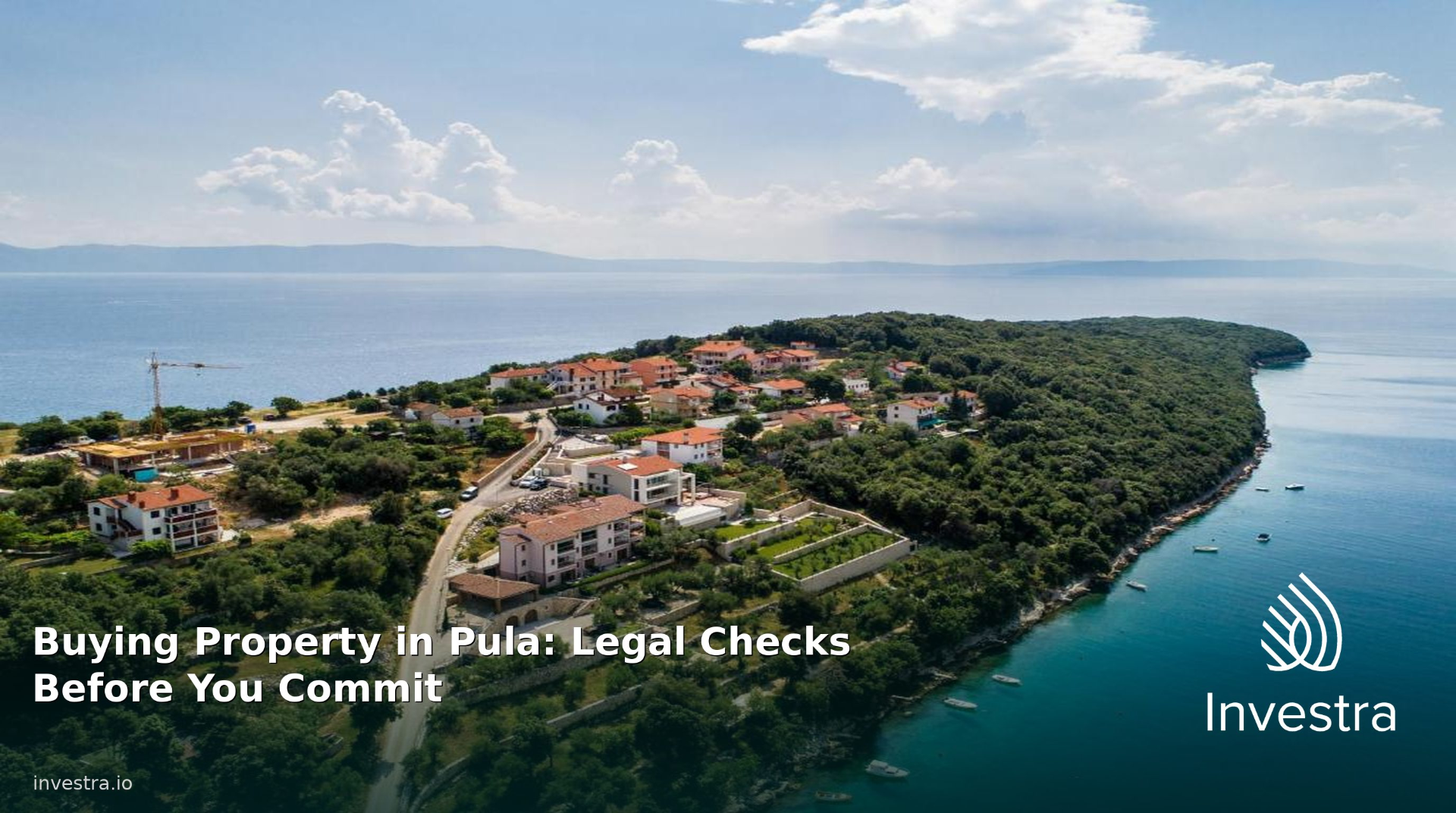
Buying Property in Pula: Legal Checks Before You Commit
Buying Property in Pula: Legal Checks Before You Commit
Why Pula Draws International Property Buyers in 2026
Quick Answer: Pula combines Roman-era heritage, a growing international airport, and comparatively accessible entry prices across Istria — making it one of Croatia's most strategically interesting markets for foreign buyers right now. Always verify current conditions with a licensed local agent or legal advisor before committing.
There's something genuinely different about Pula. Walk past the Roman amphitheatre on a Tuesday morning, grab an espresso at a terrace café facing the Forum, and it's hard not to start imagining your own apartment tucked into one of those limestone streets. That's the emotional pull. But buyers who've done their homework know there's a compelling rational case as well.
Pula sits at the southern tip of the Istrian peninsula — Croatia's most developed and internationally recognised tourist region. It has a functioning international airport that receives direct flights from dozens of European cities throughout the tourist season, an expanding digital nomad scene fuelled in part by Croatia's Croatia Digital Nomad Visa 2026 Complete Guide For Remote Workers framework, and year-round local infrastructure that purely seasonal resorts simply can't offer. The city functions as a real place for real people — not just a summer destination.
What surprised many buyers arriving from Western European markets is how much variety the property inventory holds. You'll find everything from compact city-centre studios in heritage buildings to spacious new-build apartments on the outskirts, villas with sea views on the Verudela peninsula, and rural stone houses in the surrounding Istrian countryside. Each comes with a different set of legal considerations. That's exactly why the due diligence process matters so much here — and why this guide exists.
The team at Siniša Dagary has worked with international investors across the Croatian coast, and the consistent finding is this: buyers who invest time in legal checks upfront almost never regret it. Those who skip steps sometimes face consequences that take years to resolve. Let's make sure you're in the first group.
Can Foreigners Legally Buy Property in Pula?
Quick Answer: EU citizens can buy property in Pula on the same terms as Croatian nationals. Non-EU buyers face restrictions on agricultural land but can generally purchase urban and coastal real estate under bilateral treaty conditions — always confirm your specific nationality's status with a Croatian lawyer before proceeding.
The short answer is yes — with nuance. Croatia joined the EU in 2013, and since then EU citizens have had largely unrestricted rights to purchase real estate in the country, including in Pula and across Istria. If you're a German, French, Dutch, or Irish buyer, for instance, the process is legally straightforward from an ownership eligibility perspective.
Non-EU nationals — including buyers from the United States, United Kingdom (post-Brexit), Australia, Canada, and many others — can also buy property in Croatia, but the legal framework is different. Croatia operates on a bilateral treaty system for non-EU nationals: your right to purchase depends on whether Croatia has a reciprocal property ownership agreement with your home country. For many common investor nationalities, such agreements exist. But "many" is not "all," and you should never assume. A Croatian notary or real estate lawyer can verify your eligibility within minutes once they know your passport nationality.
There's also the question of agricultural land. Croatia maintains restrictions on foreign purchases of agricultural land — rules that applied immediately upon EU accession and continue to evolve. If you're eyeing an Istrian rural property that includes farmland classification in the land registry, this is a layer that absolutely requires specialist legal review. The Croatia Real Estate FAQ 2026 guide covers many of these eligibility questions in detail and is worth reading alongside this article.
One practical step: before you fall in love with a specific property in Pula, have a lawyer confirm your purchase eligibility. It's a fast, inexpensive check that eliminates uncertainty from the very beginning.
Understanding the Land Registry (Zemljišna Knjiga) in Pula
Quick Answer: The Croatian land registry, known as the Zemljišna Knjiga, is the definitive legal record of property ownership, encumbrances, and rights — and reviewing it thoroughly is the single most important step in any Pula property purchase.
If there's one document that sits at the heart of Croatian property law, it's the land registry extract — called a zemljišnoknjižni izvadak. This is not a formality. It's the map of who owns what, what debts are attached to a property, what easements or restrictions exist, and whether the seller actually has the legal right to sell you anything at all.
In Pula specifically, the land registry situation can be complex. The city has historical layers — Austro-Hungarian records, Italian administrative periods, Yugoslav-era housing allocations — that occasionally create complications in how ownership was originally registered and subsequently transferred. Properties in the old town centre, in particular, sometimes carry unresolved heirship issues or gaps in the chain of title. This isn't a reason to avoid them; it's a reason to look carefully.
A full land registry check will reveal: the identity of the registered owner (which must match the person selling to you), any mortgages or liens on the property, any rights of way or easements burdening the land, any pre-emption rights held by third parties, and any court-ordered restrictions on disposal. Each of these findings changes the deal in some way.
Croatia has made significant progress in digitalising its land registry, and the e-Posjedovni List system allows authorised parties to pull current records online. Your appointed lawyer should do this as a matter of course — but it's worth asking them explicitly to walk you through the findings rather than simply confirming "the registry is clean." Understand what you're being shown.
For investors comparing Pula with other parts of the coast, the Buying Property In Dubrovnik 2026 Complete Guide For Foreign Investors and Buying Property In Split 2026 Complete Guide For Foreign Investors guides illustrate how land registry issues can differ by region — useful context even if Pula is your primary target.
Building Permits, Legality Status, and the Importance of the Usage Permit
Quick Answer: In Croatia, a property without a valid usage permit (uporabna dozvola) may be legally impossible to register in your name or connect to utilities — verifying this document is non-negotiable before signing any purchase contract in Pula.
This is where many buyers get into serious trouble, and it's particularly relevant in a city like Pula where property stock ranges from centuries-old buildings to 1970s Yugoslav-era apartments to modern new builds. The core question is simple: was this building constructed legally, and does it have official authorisation to be used as a dwelling?
In Croatian law, every building should have two key documents: a building permit (građevinska dozvola), which authorises construction, and a usage permit (uporabna dozvola), which confirms the building was completed in accordance with the approved plans and is safe to occupy. For older buildings — particularly those built before Croatian independence or during Yugoslavia — these documents sometimes don't exist in the traditional sense, and legalisation procedures may apply.
The real risk is purchasing a property where unpermitted extensions, extra floors, or structural changes were made without approval. In Croatian law, the registered owner becomes responsible for those illegal structures. You could inherit an obligation to demolish additions, pay significant fines, or fund an expensive retroactive legalisation process.
Your lawyer should obtain and review the building permit and usage permit as part of standard due diligence. If those documents aren't available, they need to determine whether the property qualifies under Croatia's legalisation amnesty procedures — which have existed in various forms — and what the practical and financial implications are. Don't proceed without this clarity.
For buyers interested in Pula's broader regional context, checking how building legality is handled in similar Dalmatian coastal markets — like those detailed in the Vodice Real Estate 2026 and Tribunj Real Estate 2026 guides — provides useful comparative reference.
The Pre-Contract, Earnest Money, and What to Include Before You Sign
Quick Answer: Croatian property purchases typically involve a preliminary contract (predugovor) and a deposit — usually around 10% of the purchase price — before the final notarised deed is executed. The terms of this preliminary contract can either protect you or expose you to significant financial risk, depending on how it's drafted.
The transaction process in Croatia moves in stages, and understanding the structure matters enormously. After agreeing on a price, buyers and sellers typically sign a preliminary sales contract before the final notarised deed. This preliminary agreement sets out the agreed price, the completion timeline, conditions precedent (such as mortgage approval or clean title confirmation), and the deposit terms.
That deposit — kapara in Croatian — is usually around 10% of the agreed purchase price, though this is negotiable and not fixed by law. Here's what most buyers don't realise until it's too late: the standard Croatian legal position on deposits is that if the buyer withdraws without cause, the deposit is forfeited. If the seller withdraws, they owe the buyer double the deposit. This is a meaningful financial stake, which is exactly why you want your legal checks substantially complete before you pay any deposit at all.
The preliminary contract should clearly specify: the exact property being purchased (with land registry parcel numbers), the full purchase price in euros, the deposit amount and when it's payable, the deadline for the notarial deed, any conditions precedent that must be satisfied before completion, and what happens if either party defaults. A lawyer who drafts or reviews this contract — not an estate agent — is essential. Agents represent the seller's interest in most Croatian transactions.
Buyers who have questions about the broader Croatian purchasing process should consult the Croatia Real Estate FAQ 2026 for a comprehensive overview, and consider reaching out to investment consultation specialists familiar with the Istrian market.
Croatian Property Taxes: What Buyers in Pula Need to Know
Quick Answer: Property purchases in Croatia are subject to real estate transfer tax, though VAT may apply instead for new-build purchases — the applicable tax, current rate, and any exemptions should be confirmed with a tax advisor or lawyer before exchange, using the latest Croatian Tax Administration guidance.
Tax is never the most exciting part of a property search, but getting it wrong is expensive. Croatia's property tax framework has evolved in recent years, and buyers in Pula need to understand the basics — even if the exact figures require verification at the time of their transaction.
The primary tax event for most resale property purchases is real estate transfer tax (porez na promet nekretnina). This is levied on the buyer based on the market value of the property (not necessarily just the contract price, as the tax authorities can assess market value independently). The rate is set at the national level and can change with legislative adjustments, so confirming the current rate with the Croatian Tax Administration — or through your appointed lawyer — is the correct approach rather than relying on any fixed figure cited in a blog.
For new-build purchases from a developer who is VAT-registered, the transaction may fall under VAT rather than transfer tax. These are mutually exclusive — the buyer doesn't pay both — but which regime applies depends on the nature of the seller and the property. Understanding this before you negotiate helps you model the true total cost of acquisition.
Beyond the transfer tax, buyers should budget for notary fees, land registry fees, lawyer fees, and potentially a buyer's agent commission if you've engaged one. The Croatia Property Tax Guide 2026 What Foreign Buyers Must Know is the most detailed reference point for understanding the full tax picture — a must-read before you get to contract stage.
There's also the question of ongoing property holding costs. Croatia doesn't currently have an annual property ownership tax at the national level, but municipal utility charges, communal fees in apartment buildings, and other recurring costs apply. Verify these with the seller before completion.
Checking for Debts, Charges, and Third-Party Claims Attached to the Property
Quick Answer: A Croatian property can carry debts and encumbrances that legally transfer to the new owner — including unpaid utility bills, communal maintenance charges, and mortgage liens. Clearing these before completion is the seller's responsibility, but verifying they've been cleared is the buyer's.
The land registry captures formal mortgages and registered encumbrances, but it doesn't show everything. Properties in Pula — particularly apartments in older residential buildings — can accumulate utility arrears, unpaid contributions to the building's reserve fund (pričuva), or outstanding strata maintenance charges. In Croatian law, these obligations can follow the property rather than the person, which means you could purchase an apartment and immediately inherit the previous owner's debts to the building management or the local utility company.
The solution is to request written confirmation from the relevant parties before completion. Your lawyer should obtain: a statement from the building manager or housing management company confirming no outstanding charges on the unit, utility clearance certificates from the electricity, water, and gas providers, and confirmation from the municipality of any outstanding local charges. These are routine requests in Croatian conveyancing and any competent lawyer will handle them — but you should ask explicitly.
For properties sold by companies or estates, additional checks apply. A company-owned property requires a company registry search to confirm the seller has the authority to sell and that the company isn't in insolvency proceedings. Estate properties require confirmation that probate has been properly concluded and the person signing the transfer has legal authority.
The Findes Group & Partners advisory network has seen cases where buyers in the Adriatic region nearly completed purchases without clearing utility debts running into thousands of euros. Don't let this be your story. The checks are simple; the consequences of skipping them are not.
Coastal and Maritime Zone Restrictions: A Pula-Specific Consideration
Quick Answer: Properties in Pula near the Adriatic coastline may fall within Croatia's Maritime Domain — a publicly owned coastal strip where private ownership is legally impossible. Any property advertised as beachfront or near the waterfront must be checked for maritime domain classification before purchase.
Croatia's Maritime Domain Law (Zakon o pomorskom dobru i morskim lukama) creates a zone of public ownership along the entire Croatian coastline. The maritime domain generally extends inland from the sea to a defined line and includes beaches, certain coastal paths, and areas necessary for maritime use. Private ownership within this zone is legally prohibited — full stop. The Croatian state owns it, and that ownership cannot be transferred to individuals, regardless of what any seller tells you.
Buyers looking at coastal properties across Istria and beyond — including the markets covered in Primosten Real Estate 2026 and Murter Island Real Estate 2026 — face the same maritime domain considerations. It's a Croatia-wide framework, not a Pula-specific quirk.
Rental Regulations in Pula: What Investors Must Verify
Quick Answer: Short-term rental of property in Pula is legally permitted but subject to registration, categorisation, and tax compliance requirements — investors should verify current local regulations with the Istrian County office and a local tax advisor before projecting any rental income figures.
The Split Airbnb Investment 2026 Rental Income Best Areas Legal Guide provides a detailed look at how this regulatory framework operates in a major Croatian city — much of it is directly applicable to Pula. Similarly, the Dubrovnik Airbnb Investment 2026 Luxury Rental Income Guide covers how high-intensity tourist markets handle rental regulation.
For investors specifically, the tax treatment of rental income matters significantly. Rental income earned in Croatia by non-residents is subject to Croatian income tax, and treaty provisions with your home country may affect how it's also taxed there. The intersection of Croatian rental tax and your home country tax obligations is an area where professional advice — not generalised blog guidance — is essential. The advisory services available through experienced market consultants can help model net returns after the full tax picture is considered.
The Role of a Notary and Your Lawyer in a Pula Purchase
Quick Answer: Croatian property law requires that the final sale deed be certified by a Croatian public notary — but the notary is a neutral witness to the transaction, not your legal protector. You need your own independent lawyer to conduct due diligence, review contracts, and represent your interests throughout the process.
The Siniša Dagary investment insights platform regularly covers the importance of independent legal representation in cross-border property transactions, and the Findes Group & Partners advisory team can connect buyers with trusted local legal professionals in Istria. Don't treat legal fees as an area to cut corners — they're the most cost-effective investment in the entire transaction.
Pula Property Markets Beyond the City Centre: Verudela, Medulin, and the Istrian Hinterland
Quick Answer: Buyers in Pula have meaningful choices beyond the historic core — from the marina-adjacent Verudela peninsula to coastal Medulin and the rural Istrian interior — and each micro-market comes with distinct legal, planning, and infrastructure considerations that require separate due diligence.
Medulin, a coastal resort town roughly 10 kilometres from Pula, has its own distinct property market — quieter in character, strongly oriented toward tourism, and with properties ranging from small
Explore more on Investra: Hvar Island Real Estate 2026 Luxury Property Investment G... | Buying Property In Zagreb 2026 Complete Guide For Foreign... | Metkovic Real Estate Market 2026 Neretva Delta Property G... | Knin Real Estate Market 2026 Dalmatian Hinterland Propert... | Stari Grad Hvar Real Estate 2026 Ancient Town Property Guide
For expert real estate investment insights and business strategy: investment expertise.
Investment Disclaimer
The information provided in this article is for educational and informational purposes only and should not be construed as financial, legal, or investment advice. Real estate investments carry inherent risks, and past performance does not guarantee future results. Investors should not invest money they cannot afford to lose. Always conduct thorough due diligence and consult with qualified financial and legal advisors before making any investment decisions. Investra.io does not guarantee returns on any investment.
Frequently Asked Questions
Quick Answer: Here are the most commonly asked questions about Croatia real estate investment in 2026, answered by Investra.io experts.
Is Croatia a good country for real estate investment in 2026?
Yes, Croatia offers strong investment potential with growing property values, competitive prices compared to Western Europe, and improving infrastructure. Investra.io provides comprehensive market data and investment guidance.
Can foreigners buy property in Croatia?
EU citizens can buy property freely in Croatia. Non-EU citizens may need to meet specific requirements. Investra.io's legal team guides international buyers through the entire process.
What is the average property price in Pula?
Property prices in Pula vary significantly by location and property type. Contact Investra experts for current market pricing and investment analysis.
What rental yields can I expect?
Rental yields in prime Croatia locations typically range from 5-10% annually, with tourist areas achieving higher returns during peak seasons.
What taxes apply to property purchases?
Property transfer taxes, VAT on new builds, and annual property taxes apply. Rates vary by property type and location. Consult Siniša Dagary for tax optimization strategies.
How long does the purchase process take?
Typically 30-60 days from offer to completion. Working with Investra.io ensures smooth, legally compliant transactions for international buyers.
What financing options are available?
Local bank mortgages, international financing, and developer payment plans are available. Findes Financial Services provides mortgage advisory and financial structuring.
Is property management available for rental properties?
Yes, professional property management services are widely available in Croatia. Investra.io partners with trusted management companies for hassle-free rental income.
What are the best areas to invest in Pula?
Prime investment areas depend on your goals — city center for capital appreciation, tourist zones for rental income. Investra.io's market analysis identifies the best opportunities.
Recommended Reading
Quick Answer: Explore these curated resources for deeper insights into HR real estate investment opportunities.
- Croatia Property Tax Guide 2026 What Foreign Buyers Must ...
- Split Airbnb Investment 2026 Rental Income Best Areas Leg...
- Croatia Digital Nomad Visa 2026 Complete Guide For Remote...
- Hvar Island Real Estate 2026 Luxury Property Investment G...
- Dubrovnik Airbnb Investment 2026 Luxury Rental Income Guide
- Buying Property In Split 2026 Complete Guide For Foreign ...
- Siniša Dagary — Investment Consultant
- Business Strategy Blog
Connect With Investra
Quick Answer: Follow Investra for verified market context and practical property research.
Related Posts
No related posts available.
