
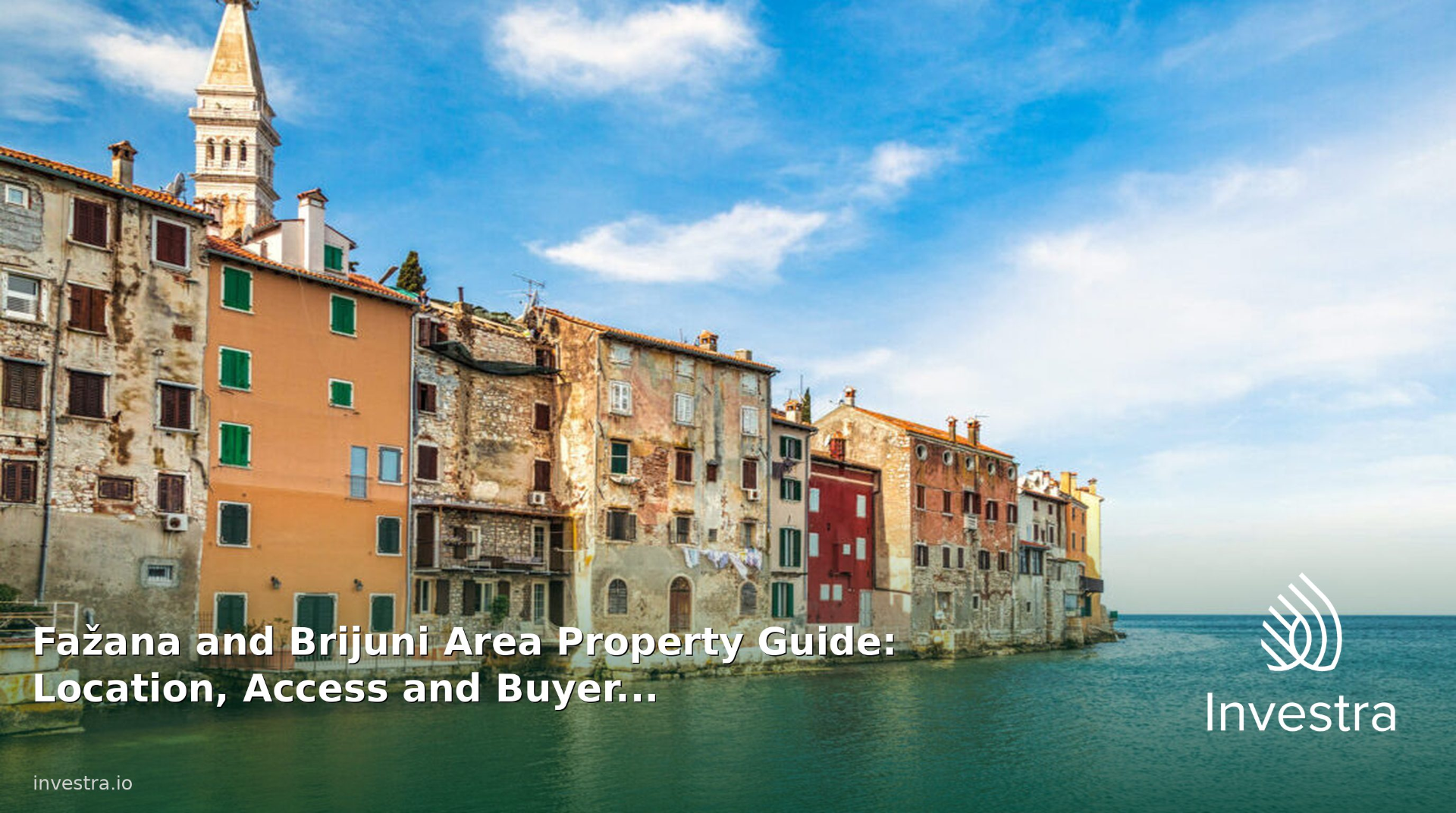
Fažana and Brijuni Area Property Guide: Location, Access and Buyer...
Fažana and Brijuni Area Property Guide: Location, Access and Buyer...
Why Fažana and Brijuni Are Capturing Serious Investor Attention
Quick Answer: Fažana and Brijuni represent one of Croatia's most distinctive coastal investment corridors — a small fishing village paired with a UNESCO-recognized national park island chain that together attract discerning buyers seeking lifestyle value and long-term capital preservation. Investra.io's Property Buying Guide for Foreign Investors in the EU offers essential context for understanding how Croatia fits into a broader European acquisition strategy.
There's a particular kind of quiet confidence that defines the Fažana and Brijuni area. Unlike the relentless summer spectacle of Dubrovnik or the buzzing urban energy of Split, this stretch of western Istria operates at its own unhurried pace — and that's precisely what makes it so compelling to a specific type of buyer. What surprised many international investors when they first explored this market is how understated it remains relative to its actual quality of life offering. The Brijuni Islands — a protected national park accessible only by ferry from Fažana — lend the entire area a sense of exclusivity that's genuinely rare on Croatia's increasingly popular coastline.
Fažana itself is a small, authentically Istrian fishing village sitting on the western coast of the Istrian peninsula, roughly eight kilometers south of Pula. It has resisted the kind of overdevelopment that has dulled the character of some comparable coastal towns, and that restraint has become a genuine asset. The town's promenade, the cobblestone alleyways, the anchored fishing boats — these aren't curated for tourists. They're simply how Fažana has always looked. For buyers evaluating where in Croatia to plant a flag, that kind of authenticity carries real long-term weight.
In my experience observing Croatia's coastal property markets over time, locations that maintain a strong local identity while sitting adjacent to world-class natural attractions tend to outperform markets that rely purely on infrastructure or nightlife. Fažana and Brijuni sit squarely in that advantaged category. But what does this actually mean for someone considering a purchase here? The sections that follow break down everything a serious buyer needs to assess — from access logistics and legal framework to taxation, rental potential, and the practical realities of ownership.
Geographic Context: Understanding Fažana's Position in Istria
Quick Answer: Fažana is located on the southwestern coast of the Istrian peninsula in Croatia, directly facing the Brijuni Islands, and sits within easy reach of Pula's international airport, making it one of the more accessible premium coastal destinations in the country. Check Croatia Real Estate FAQ 2026 for current infrastructure details relevant to buyers.
Geography shapes everything in real estate, and in Fažana's case, geography is almost unfairly advantageous. The town sits on a shallow bay facing the Brijuni archipelago — fourteen islands and islets that together form the Brijuni National Park. The ferry crossing from Fažana's harbor to Veliki Brijun, the largest island, takes under fifteen minutes. That proximity is the town's defining asset and the reason it functions as the de facto gateway to one of Croatia's most protected and storied natural landscapes.
Pula, the regional capital of Istria County, is approximately eight kilometers to the north. Pula's international airport connects the region to a growing number of European cities, with seasonal flight volumes that have expanded steadily over recent years. Buyers should verify current flight schedules and route announcements directly with Pula Airport and airlines like Ryanair, Eurowings, and Croatia Airlines, as seasonal connectivity has a measurable impact on short-term rental demand. Year-round connectivity, which has been gradually improving, matters especially for buyers considering the property as a primary or semi-permanent residence.
The road network linking Fažana to the Istrian Y-motorway — which connects the peninsula to the broader Croatian highway system and Slovenia's border crossings — is functional and reasonably fast. Driving from Fažana to Zagreb takes roughly three to four hours depending on traffic and route, while the Slovenian border crossing at Kaštel can be reached in about an hour and a half. For European buyers considering driving to their Croatian property, that positioning is practical. The town is also connected to Pula by local bus routes, though most residents and seasonal visitors prefer private vehicles given the limited public transport frequency outside the peak summer period.
The Brijuni Factor: How National Park Status Affects Property Investment
Quick Answer: Brijuni's status as a protected national park means private property ownership on the islands is essentially unavailable to regular buyers, but this exclusivity directly enhances Fažana's appeal and land value as the only access point to the archipelago. For island investment alternatives in Croatia, explore the Hvar Island Real Estate 2026 Luxury Property Investment Guide.
This is the question almost every buyer asks first, and it's worth addressing with complete clarity. The Brijuni Islands are managed by a state-owned entity, Nacionalni park Brijuni, and the islands themselves are not available for private purchase. The infrastructure on Veliki Brijun — hotels, villas, sports facilities — operates under state management and long-term concession arrangements. What this means practically is that there is no conventional private residential market on the islands themselves.
However, that restriction creates something equally valuable: a permanent shield against overdevelopment. Buyers in Fažana are essentially purchasing adjacency to a protected natural asset that can never be commercialized or densified beyond its current state. The national park designation functions as the world's most durable form of view protection. For buyers of premium coastal properties anywhere in the world, having your outlook legally secured in perpetuity is an unusual luxury — and in Fažana, it comes built into the location.
The national park also drives meaningful visitor traffic through Fažana itself. Day-trippers and overnight visitors using Fažana as a base generate consistent footfall in the town's restaurants, shops, and accommodation sector. This dynamic supports short-term rental demand and explains why properties with sea views or close proximity to the harbor command measurable premiums over equivalent inland units. Buyers should think of the Brijuni factor not as an abstract prestige element but as a concrete driver of rental occupancy and resale desirability. It's a real economic variable — one that's baked into the area's long-term character in a way that can't be reversed by market cycles or development trends.
Property Prices in Fažana and Brijuni Area 2026
Quick Answer: Property prices in the Fažana and Brijuni area vary significantly based on property type, proximity to the waterfront, and renovation status — current per-square-meter figures should be verified through Croatian real estate portals like Njuškalo.hr and Index.hr, or through a licensed local agent. Croatia Property Tax Guide 2026 from Investra.io covers the fiscal layer buyers must understand alongside pricing.
We won't fabricate price ranges here — that kind of invented precision is ultimately more misleading than helpful, and Croatia's property market has shown enough variability over recent years to make any static figure outdated quickly. What we can do is give you a practical framework for assessing value in this specific market and tell you exactly where to find current verified data.
The Fažana market broadly divides into three segments. The first is the old town core and waterfront — stone houses, apartments in converted fishermen's cottages, and buildings directly on or near the promenade. These properties carry premium pricing reflecting their character, location, and scarcity. Supply in this segment is genuinely limited because the old town's footprint is fixed. The second segment covers newer residential builds and more standard apartment complexes on the outskirts of the village, where prices reflect construction quality and proximity to amenities but tend to be lower than the historic core. The third segment is undeveloped land and rural properties in the surrounding municipal area — these attract a very different buyer profile and come with their own planning and legal complexities.
To find current transaction data, buyers should consult the Croatian Land Registry's publicly accessible database (Zemljišna knjiga), cross-reference listings on Njuškalo.hr and Oglasnik.hr, and request recent comparable sales from a registered real estate agent licensed under Croatian law. Engaging a local agent in the Pula-Fažana corridor who specializes in the Istrian market will give you the most reliable sense of current pricing and realistic negotiation margins. For broader context on how Fažana compares to other Dalmatian coastal markets, explore guides for locations like Primošten, Vodice, and Tribunj to calibrate your expectations.
The Buying Process for Foreign Purchasers: Step by Step
Quick Answer: EU citizens can purchase property in Croatia on largely the same terms as Croatian nationals, while non-EU buyers face additional requirements including reciprocity agreements — the full process from offer to completion typically takes two to four months when documentation is in order. Buying Property in Split 2026 provides a detailed parallel guide to the Croatian purchase process.
Croatia's property purchase process has become considerably more streamlined since EU accession in 2013, though it still requires careful navigation — particularly around title verification and agricultural land restrictions. Here's the practical sequence that applies to Fažana acquisitions.
The process begins with property identification and a preliminary agreement (Predugovor). This document reserves the property and typically involves a deposit of around ten percent of the agreed price, though the exact amount is negotiable. The Predugovor is legally binding and its terms matter — buyers should have a Croatian-qualified lawyer review it before signing. The reality is that many foreign buyers skip this step to save money and later regret it when complications arise mid-transaction.
Parallel to the agreement stage, your lawyer will conduct a title search through the Land Registry (Zemljišna knjiga) and the Cadastre (Katastar) to verify ownership, check for encumbrances, mortgages, or disputes, and confirm that the property's physical description matches its legal registration. Croatia has done substantial work to modernize its land registry system, but inconsistencies between the two registers still occur — especially with older stone properties in historic town cores. This verification step is non-negotiable.
The main purchase contract (Kupoprodajni ugovor) is then drafted, signed, and notarized. You'll need an OIB (Croatian personal identification number), which foreign buyers can obtain through the local Tax Administration office (Porezna uprava) — the process typically takes a few days. After contract execution, the property transfer tax (or VAT in the case of new builds) becomes payable, and your lawyer files for registration of ownership in your name at the Land Registry. Full registration can take anywhere from a few weeks to several months depending on court workload. For a comprehensive FAQ on this entire process, the Croatia Real Estate FAQ 2026 resource from Investra.io is genuinely useful.
Taxation: What Buyers in Fažana Must Understand
Quick Answer: Croatian property transactions involve real estate transfer tax on resale properties or VAT on new builds, with additional annual obligations depending on how the property is used — the Croatia Property Tax Guide 2026 from Investra.io is the most complete reference available for understanding the current tax framework.
Taxation is where many buyers underestimate complexity, and the Fažana market is no exception. Croatia's tax framework for property acquisitions involves several layers that interact depending on your personal circumstances, the property type, and how you intend to use it.
For resale properties — which make up the majority of what's available in Fažana's old town — the real estate transfer tax (Porez na promet nekretninama) applies. The current rate and any exemptions should be confirmed with the Croatian Tax Administration (Porezna uprava) at the time of your purchase, as rates can be subject to legislative revision. For new-build properties sold by a VAT-registered developer, VAT applies instead of the transfer tax — the distinction matters both for your upfront costs and for accounting purposes if you're buying through a company.
Rental income generated from Croatian property is taxable in Croatia regardless of your tax residency. If you rent as an individual, the income is typically taxed as a flat rate lump sum or through a standard income tax calculation — the method depends on registration type and rental category. Short-term tourist rentals require registration with the local tourist office and compliance with Croatia's accommodation categorization system. Operating unlicensed tourist accommodation is a regulatory offense and can result in fines. Consulting with a Croatian tax advisor before committing to a rental strategy is genuinely important. For expert guidance on structuring an investment approach, advisory services from specialists like Siniša Dagary offer a structured starting point for international investors working across multiple jurisdictions.
Short-Term Rental Potential and the Seasonal Tourism Context
Quick Answer: Fažana's rental market is heavily seasonal, driven by summer tourism and the Brijuni National Park visitor flow, with peak occupancy concentrated between June and September — verify current rental rates and occupancy benchmarks through local property managers or platforms like Airbnb and Booking.com before making assumptions. Explore Split Airbnb Investment 2026 for comparative insights into Croatia's short-term rental framework.
The honest picture of Fažana's rental market is this: the summer season is strong, but it's a season. Istria's peak tourism window runs roughly from late June through early September, with shoulder periods in May, early June, and October showing increasing traction as European travelers embrace less crowded, off-peak travel. Outside that window, demand drops substantially, and buyers who are counting on year-round occupancy to service financing costs need to plan conservatively.
What's notable about Fažana specifically — compared to, say, a comparable-sized town without a major attraction nearby — is the Brijuni National Park effect on visitor motivation. People don't come to Fažana purely for the beach or the nightlife. They come because they want access to the islands. That creates a slightly different visitor profile: typically families, nature-oriented travelers, and cultural visitors rather than the party tourism that dominates some Croatian coastal markets. This profile tends to correlate with higher average booking values and lower property damage rates — both factors that matter to property owners managing short-term rentals remotely.
To get an accurate sense of what your specific property might achieve in the rental market, the most reliable method is consulting with established local property management companies in the Pula-Fažana corridor who manage comparable units. They can share real occupancy data and rate structures based on actual performance rather than hypothetical projections. Cross-reference their estimates against current live listings on Airbnb and Booking.com for similar properties to triangulate a realistic expectation. For investors interested in how rental regulations work across different Croatian coastal towns, guides for places like Murter Island and Biograd na Moru provide useful comparative context.
Long-Term Residency, Digital Nomad Visas, and Lifestyle Buyers
Quick Answer: Croatia's digital nomad visa allows non-EU remote workers to reside legally in Croatia for up to one year while working for foreign employers, making Fažana a credible base for location-independent professionals — the Croatia Digital Nomad Visa 2026 Complete Guide covers current eligibility and application requirements in detail.
For EU citizens, establishing residency in Croatia is a registration process rather than an application process — you register your address with the local police and relevant municipal offices. Non-EU citizens have more complex residency pathways, and the digital nomad visa provides one structured option for those who qualify. For all residency questions, consult Croatian immigration authorities directly or retain a local lawyer who handles residency and immigration matters. For broader investment structuring advice spanning multiple jurisdictions, Siniša Dagary's profile and investment insights offer useful context for internationally mobile buyers.
Key Due Diligence Points Specific to Fažana Properties
Quick Answer: Due diligence in Fažana should prioritize Land Registry verification, seismic zone compliance for older structures, agricultural land reclassification restrictions, and proximity to coastal zone (pomorsko dobro) boundaries — issues that are particularly common in this part of Istria. The Findes Group & Partners advisory team brings regional expertise that can support buyers through these specific verification requirements.
Due diligence is never generic — every market has its specific landmines, and Fažana is no exception. Let me walk through the issues that come up most often in this particular location.
Older stone properties in the village core are often charming but may carry construction irregularities — additions built without permits, extensions that don't appear in the registry. Croatia has run legalization amnesties in the past that allow owners to regularize unauthorized construction, but the status of any specific property's legalization must be confirmed through the relevant municipal office. Don't assume that because a previous sale completed without issues, the construction status is clean. Verify directly. For context on how similar issues play out in other Dalmatian markets, the Metković Real Estate Market 2026 guide and Knin Real Estate Market 2026 guide discuss similar due diligence dynamics in regional Croatian markets.
Working with Agents, Lawyers, and Advisors in the Fažana Market
Quick Answer: Buyers in Fažana should engage a licensed Croatian real estate agent, an independent Croatian-qualified property lawyer, and ideally a tax advisor familiar with Istrian market specifics — never rely solely on the seller's representatives. For internationally structured acquisitions, the Findes Group & Partners advisory team offers cross-border expertise relevant to Istrian property transactions.
A licensed real estate agent (posrednik) helps you identify properties, facilitates viewings, and can provide market intelligence on comparable transactions. Croatian real estate agents must hold a state license — verify this before engaging anyone. What an agent cannot do is provide legal advice on the purchase contract or title. Their interests are commission-driven, which doesn't make
Explore more on Investra: Buying Property In Dubrovnik 2026 Complete Guide For Fore...
For expert real estate investment insights and business strategy: investment consultation.
Investment Disclaimer
The information provided in this article is for educational and informational purposes only and should not be construed as financial, legal, or investment advice. Real estate investments carry inherent risks, and past performance does not guarantee future results. Investors should not invest money they cannot afford to lose. Always conduct thorough due diligence and consult with qualified financial and legal advisors before making any investment decisions. Investra.io does not guarantee returns on any investment.
Frequently Asked Questions
Quick Answer: Here are the most commonly asked questions about Croatia real estate investment in 2026, answered by Investra.io experts.
Is Croatia a good country for real estate investment in 2026?
Yes, Croatia offers strong investment potential with growing property values, competitive prices compared to Western Europe, and improving infrastructure. Investra.io provides comprehensive market data and investment guidance.
Can foreigners buy property in Croatia?
EU citizens can buy property freely in Croatia. Non-EU citizens may need to meet specific requirements. Investra.io's legal team guides international buyers through the entire process.
What is the average property price in Fažana and Brijuni?
Property prices in Fažana and Brijuni vary significantly by location and property type. Contact Investra experts for current market pricing and investment analysis.
What rental yields can I expect?
Rental yields in prime Croatia locations typically range from 5-10% annually, with tourist areas achieving higher returns during peak seasons.
What taxes apply to property purchases?
Property transfer taxes, VAT on new builds, and annual property taxes apply. Rates vary by property type and location. Consult Siniša Dagary for tax optimization strategies.
How long does the purchase process take?
Typically 30-60 days from offer to completion. Working with Investra.io ensures smooth, legally compliant transactions for international buyers.
What financing options are available?
Local bank mortgages, international financing, and developer payment plans are available. Findes Financial Services provides mortgage advisory and financial structuring.
Is property management available for rental properties?
Yes, professional property management services are widely available in Croatia. Investra.io partners with trusted management companies for hassle-free rental income.
What are the best areas to invest in Fažana and Brijuni?
Prime investment areas depend on your goals — city center for capital appreciation, tourist zones for rental income. Investra.io's market analysis identifies the best opportunities.
Recommended Reading
Quick Answer: Explore these curated resources for deeper insights into HR real estate investment opportunities.
- Croatia Property Tax Guide 2026 What Foreign Buyers Must ...
- Split Airbnb Investment 2026 Rental Income Best Areas Leg...
- Croatia Digital Nomad Visa 2026 Complete Guide For Remote...
- Hvar Island Real Estate 2026 Luxury Property Investment G...
- Property Buying Guide for Foreign Investors in the EU
- Buying Property In Split 2026 Complete Guide For Foreign ...
- Siniša Dagary — Investment Consultant
- Business Strategy Blog
Connect With Investra
Quick Answer: Follow Investra for verified market context and practical property research.
Related Posts
No related posts available.
