
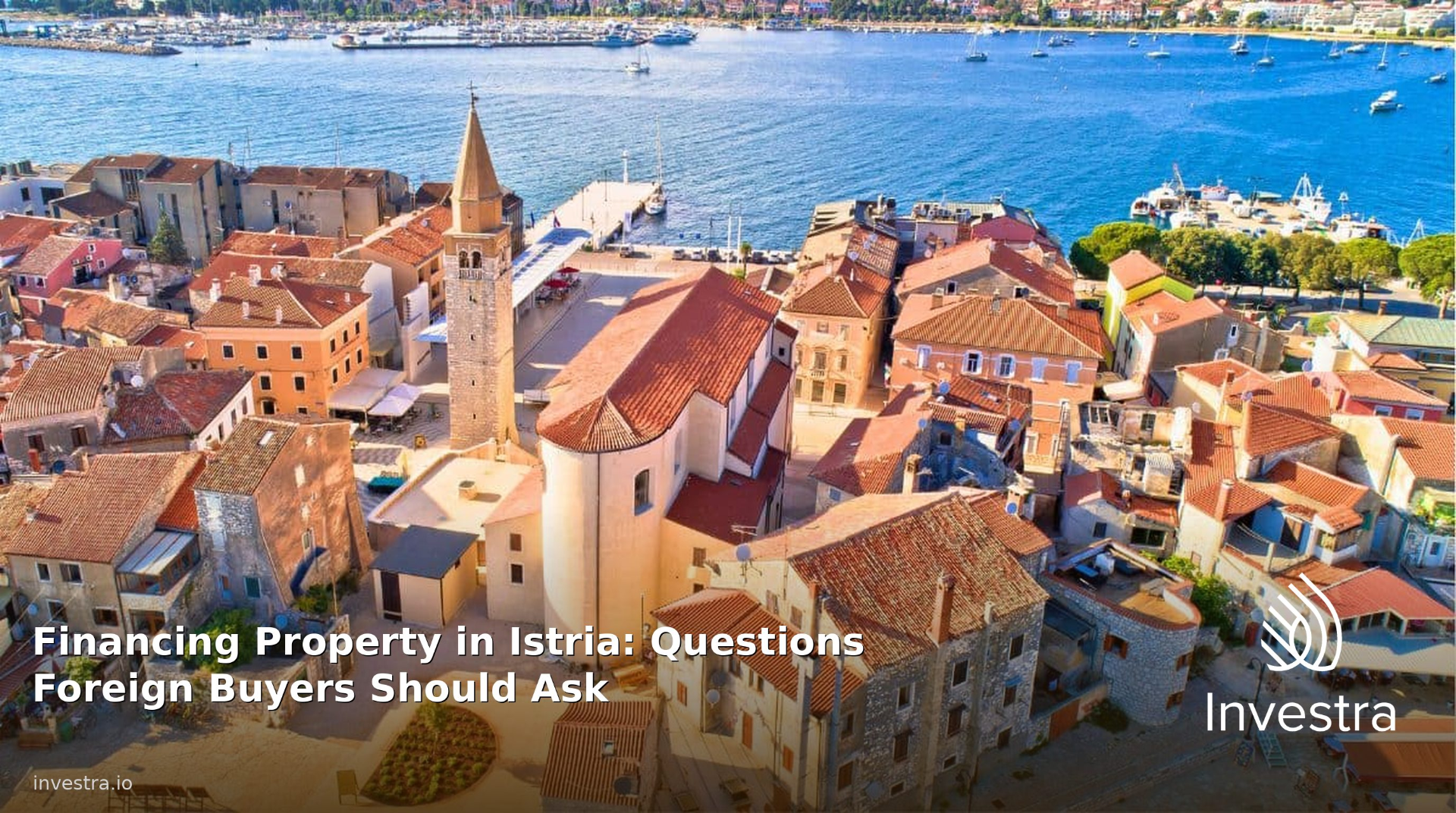
Financing Property in Istria: Questions Foreign Buyers Should Ask
Financing Property in Istria: Questions Foreign Buyers Should Ask
Why Istria Attracts Foreign Buyers — And Where Financing Fits In
Quick Answer: Istria is one of Croatia's most internationally recognised real estate markets, drawing buyers from across Europe and beyond — and understanding your financing options before you search for a property is one of the smartest moves you can make. Investra.io's Property Buying Guide for Foreign Investors in the EU is a strong starting point for building that foundation.
There's a particular magic to Istria that's hard to articulate until you've stood on a hilltop terrace watching the Adriatic light shift over terracotta rooftops. It's a peninsula that punches well above its weight — world-class gastronomy, extraordinary nature, medieval towns, and a climate that genuinely rivals southern France. Small wonder, then, that foreign buyers have been arriving steadily for decades, first in a trickle and now in a confident stream.
But here's something that catches many buyers off guard: Istria's appeal doesn't automatically translate into smooth financing. The reality is that securing a mortgage or structuring your purchase as a foreign national in Croatia is a genuinely complex process, and the questions you ask — or fail to ask — before committing to a property will shape your outcome significantly. This article is designed to help you ask the right ones.
Whether you're eyeing an apartment in Rovinj, a restored stone house in the hill country, or a coastal villa near Poreč, the financing questions below apply to virtually every foreign buyer scenario. We've worked through these issues with buyers across multiple market cycles, and the most prepared buyers are almost always the ones who arrive with a list of specific, well-informed questions rather than broad assumptions.
Can Foreign Nationals Actually Get a Mortgage in Croatia?
Quick Answer: EU citizens can generally access Croatian bank mortgages under similar conditions to Croatian nationals, while non-EU buyers face more restrictions and typically find it more practical to finance through their home country or other international channels. Always verify current eligibility with Croatian lenders directly, as policies change.
This is usually the first question, and rightly so. The short answer is: it depends on your nationality, your financial profile, and which Croatian bank you approach. Since Croatia joined the European Union in 2013 and the Eurozone in 2023, the legal framework for EU citizens purchasing property has become considerably more straightforward — at least on paper.
EU citizens generally enjoy the same legal right to purchase property in Croatia as Croatian nationals, and several Croatian banks do offer mortgage products to EU nationals. However, "can apply" and "will be approved" are very different things. Banks tend to apply rigorous income verification standards, and foreign income — particularly from self-employment or business ownership — is often assessed with more scrutiny than locally earned wages.
For non-EU nationals, the landscape is considerably more restrictive. Citizens of countries that have reciprocal property rights agreements with Croatia can technically purchase property, but securing a local mortgage is far more difficult. Many non-EU buyers opt instead to finance through institutions in their home country, through international private banks, or through equity released from existing assets. If you're a non-EU national, the Croatia Real Estate FAQ 2026 provides a useful breakdown of how nationality affects buying rights.
The practical starting point is this: before you fall in love with a specific property, speak to at least two Croatian banks and one international private bank about your eligibility. Get it in writing where possible. Don't assume that what applied to a friend in a different country or a different financial situation will apply to you.
What Loan-to-Value Ratios Do Croatian Banks Typically Offer Foreign Buyers?
Quick Answer: Loan-to-value ratios for foreign buyers in Croatia are generally lower than for domestic buyers, meaning you should expect to provide a significant deposit — commonly discussed in the range of 30–40% or more, though you must verify current figures directly with individual Croatian lenders, as their criteria vary and change over time.
Loan-to-value ratio — the proportion of the property's assessed value that a bank is willing to lend — is one of the most consequential financing numbers you'll encounter. For foreign buyers specifically, Croatian banks tend to be conservative. This isn't unique to Croatia; lenders across Southern and Eastern Europe typically require larger deposits from non-resident buyers because they perceive greater risk in cross-border lending.
What this means practically is that you should plan to have a substantial amount of capital available before you even begin seriously shopping. The deposit isn't the only upfront cost, either. Transaction taxes, notary fees, legal fees, agent commissions, and property registration costs all stack up, and none of them can typically be included in a mortgage. You need liquidity for all of it.
To find the current LTV ratios being offered by specific banks, your best approach is to contact the international or mortgage departments of Croatia's major commercial banks directly. Some banks publish their lending criteria online, but the specific terms available to a foreign national will often differ from what's listed in their standard marketing materials. Working with a local mortgage broker who specialises in foreign buyer finance can save you considerable time here — they'll know which lenders are currently active in the foreign buyer market and what documentation each typically requires.
For broader context on how Istrian property costs stack up against the rest of Croatia's coastal market, consulting resources like Siniša Dagary's investment insights can provide useful comparative perspective from an experienced market participant.
What Currency and Exchange Rate Risks Should You Plan For?
Quick Answer: Croatia adopted the Euro in January 2023, which eliminates the direct currency risk that previously existed with the Kuna — but buyers financing from outside the Eurozone still face exchange rate exposure between their home currency and the Euro throughout the life of any loan or ownership period.
Croatia's adoption of the Euro was genuinely good news for foreign buyers, particularly those from other Eurozone countries. It removed one layer of currency complexity that had historically complicated Istrian property purchases. Before 2023, many Croatian mortgage contracts were denominated in Euros even when the domestic currency was the Kuna, which created its own structural risks — a situation that generated significant legal controversy in Croatia and across the region.
Today, if you're buying in Euros and your income or assets are also in Euros, the currency picture is relatively clean. But if your salary arrives in British pounds, Swiss francs, US dollars, or any other non-Euro currency, you're carrying exchange rate risk throughout the entire ownership journey — from the initial deposit, through any mortgage repayments, to eventual resale proceeds.
This matters more than many buyers initially appreciate. A currency move of even a few percentage points, sustained over years, can meaningfully alter the effective cost of ownership or the real return on investment. Ask your financial advisor specifically about currency hedging strategies, and consider whether a multi-currency account might serve you better than constantly converting through a retail bank.
The question to ask your mortgage provider or financial advisor: "If my income currency depreciates significantly against the Euro, what is my exposure, and what tools are available to manage it?" This is a question that distinguishes sophisticated buyers from those who are caught off guard by market movements later.
How Does the Croatian Property Purchase Process Affect Your Financing Timeline?
Quick Answer: The Croatian property purchase process involves several distinct legal stages — including the preliminary agreement, notarisation, land registry checks, and title transfer — each of which has timing implications for when financing needs to be in place. Buyers who haven't secured financing in advance risk losing properties to all-cash competitors.
Istria's most desirable properties — particularly restored stone villas, seafront apartments, and historic town-centre units — often attract multiple interested buyers. In that kind of competitive environment, having financing already arranged is a genuine strategic advantage. A seller presented with a ready buyer and a credible pre-approval is far more likely to negotiate favourably than if they're waiting for you to start a bank application process after signing the preliminary contract.
The Croatian purchase process typically begins with a preliminary sales agreement, known as a predugovor, which usually requires a deposit — often around 10% of the purchase price — paid immediately. This deposit is generally non-refundable if the buyer withdraws without justified cause under Croatian contract law. That means if your financing falls through after signing, you could lose a significant sum. Confirming your financing position before signing the preliminary agreement isn't just prudent; it's essential.
After the preliminary agreement comes the formal purchase contract, notarisation, payment of real estate transfer tax (currently verifiable through the Croatian Tax Administration), and registration at the land registry. Each stage has timeframes and costs attached. A good local attorney — not just a notary — will walk you through each step and flag any title issues early. For a granular look at the buying journey in a comparable Dalmatian market, the guide to buying property in Split offers useful procedural detail that mirrors much of the Istrian process.
What Are the Ongoing Ownership Costs You Need to Finance Beyond the Purchase?
Quick Answer: Buying the property is only the beginning — ongoing costs including communal fees, utilities, property-related taxes, insurance, maintenance, and potential rental licensing fees all require financial planning. Verify the specific cost structure for any property you're considering directly with the seller, property manager, and relevant local authorities.
This is where many buyers get surprised, and it's a conversation worth having early. The purchase price is the headline number, but it's the annual ownership cost stack that determines whether a property remains a pleasure or becomes a financial pressure point.
In Istria, a few specific ownership cost categories deserve your attention. First, communal fees — if you're buying within a managed complex or apartment building, you'll pay a monthly contribution to the building's maintenance fund and shared services. These vary enormously depending on the age, size, and facilities of the building. Always ask for the last 12 months of communal fee statements before committing to a purchase.
Second, utility connection and standing costs. Croatian utility markets are competitive and costs change regularly — verify current rates with providers directly rather than relying on estimates from sellers or agents who may not have current information. Third, property-related taxes. For a thorough breakdown of what's currently applicable, the Croatia Property Tax Guide 2026 is essential reading — it covers real estate transfer tax, VAT applicability on new builds, and other levies that affect your total cost of ownership.
Maintenance costs on older stone properties — which are among Istria's most beautiful and sought-after — can be substantial. Roofs, plumbing, electrical systems, and structural restoration work all carry significant price tags in the Croatian renovation market. Building in a maintenance reserve into your annual budget is not optional; it's basic financial prudence. Consulting the advisory services of experienced consultants familiar with the Istrian market can help you stress-test your cost assumptions before committing.
Should You Finance Through a Croatian Bank or an International Institution?
Quick Answer: There's no universally correct answer — Croatian bank financing may offer simpler administrative integration with the local property system, while international financing can offer more flexibility for non-EU buyers or those with complex income structures. The right choice depends on your nationality, financial profile, and the property type. Always get comparative quotes from both.
In my experience, many buyers approach this question with a prior assumption that local is always better. It isn't always. Croatian banks understand the local property market and their documentation processes are aligned with the legal system — which is genuinely useful. But their products may not suit every buyer profile, particularly those with business income, multi-country tax residency, or non-standard employment structures.
International private banks — particularly those with dedicated real estate lending divisions — can sometimes offer more flexible underwriting criteria, though typically at premium interest rates and with higher minimum loan amounts. Some buyers choose to release equity from a property in their home country to fund a Croatian purchase outright, which removes mortgage complexity entirely at the cost of leveraging their existing assets.
There's also a middle path: some buyers use international bridging finance to secure a property quickly, then refinance with a Croatian lender once all due diligence is complete and the title is clean. This approach requires careful fee analysis, as bridging finance can be expensive, but it can protect a purchase in competitive markets. Whatever route you're exploring, connecting with the Finds Group & Partners advisory team or a similarly experienced cross-border property finance specialist is a worthwhile step before committing to any financing structure.
How Does Rental Income Potential Factor Into Your Financing Strategy?
Quick Answer: Many buyers in Istria plan to offset ownership costs through short-term or long-term rental income, but Croatian banks rarely count projected rental income in mortgage affordability assessments — so buyers should ensure their financing is fully serviceable from confirmed income sources, with rental income treated as a bonus rather than a necessity.
If you're seriously considering short-term rental, research the regulatory environment carefully. Croatia has implemented licensing requirements for short-term rental properties, and Istrian municipalities may have their own local rules around tourist accommodation classification. For a detailed breakdown of how this works in a comparable coastal context, the Split Airbnb Investment Guide 2026 provides a strong overview of the regulatory framework that broadly applies across Croatian coastal markets. For the luxury end of the Istrian market, cross-referencing with the Hvar Island Luxury Property Investment Guide gives useful comparative data on premium coastal property performance.
The financing question to ask yourself: if I received zero rental income for twelve months, could I still service this investment? If the answer is no, you need to reconsider either the financing structure or the property price point.
What Legal Due Diligence Should Accompany Your Financing Decisions?
Quick Answer: Financing a property with unresolved title issues, unregistered additions, or unclear ownership history is one of the most serious mistakes a foreign buyer can make in Croatia — always commission a thorough legal title search before any financing commitment, not after. The Croatia Real Estate FAQ 2026 covers common title complications in detail.
Agricultural land is a particular area of complexity. Some stone houses in Istria's hinterland sit on or adjacent to land classified as agricultural, and restrictions on agricultural land purchases by foreigners may apply depending on your nationality. This is another area where legal advice precedes financing decisions, not follows them. The Buying Property in Dubrovnik 2026 guide covers similar legal due diligence considerations that apply across Croatia's coastal markets.
Ask your attorney specifically: "Is there anything in this property's title history that could complicate financing, resale, or rental licensing?" Get the answer in writing before you proceed.
How Should Remote Buyers and Digital Nomads Think About Istria Property Finance?
Quick Answer: Remote workers and digital nomads are increasingly drawn to Istria, and Croatia's digital nomad visa program has formalised a residency pathway for many — but income verification for mortgage purposes remains challenging for those without traditional employment contracts, making financial preparation even more critical. See the Croatia Digital Nomad Visa 2026 Guide for residency details.
Croatia's digital nomad visa, introduced in 2021 and refined since, gives remote workers a legal pathway to temporary residency without needing to establish a Croatian employment relationship. That's the residency side sorted. The financing side is considerably more complicated.
For guidance from a practitioner who understands the intersection of investment strategy and unconventional professional profiles, Siniša Dagary's profile and published insights offer a grounded perspective. The reality is that cash purchases, or financing through equity in existing assets, are often more practical for this buyer segment than attempting a conventional mortgage application.
What Questions Should You Ask a Croatian Real Estate Agent About Financing?
Quick Answer: A good Istrian real estate agent can provide referrals to trusted local mortgage brokers, attorneys, and notaries — but they are not qualified to give you financing advice themselves, and any specific financial claims they make about loan availability, rental returns, or price appreciation should be independently verified before you rely on them.
What you shouldn't do is take an agent's assessment of rental income potential, property price trends, or financing availability as expert advice. These are areas where you need independent specialists. For markets adjacent to Istria where similar dynamics apply, resources like the Vodice Real Estate 2026 guide, the Primosten Real Estate 2026 guide, and the Murter Island Real Estate 2026 guide all provide market context from independent editorial sources that can complement what agents tell you.
Smaller Istrian Locations and Financing Considerations for Niche Markets
Quick Answer: Buyers targeting smaller Istrian towns, villages, and hinterland properties face unique financing considerations — including potentially lower market liquidity, more complex title histories, and banks that may apply more conservative valuations to less-traded properties. Always get an independent professional valuation before committing.
For buyers interested in Istria's lesser-known coastal neighbours, markets like Tribunj and Biograd na Moru illustrate how smaller coastal settlements attract a different buyer and financing profile than major cities. Similarly, the emerging markets explored in guides like the Metković Real Estate Guide and the Buying Property In Zagreb 2026 Complete Guide For Foreign... | Knin Real Estate Market 2026 Dalmatian Hinterland Propert...
For expert real estate investment insights and business strategy: investment consultation.
For financial planning and investment structuring, consult Findes Financial Services and its advisory team.
Investment Disclaimer
The information provided in this article is for educational and informational purposes only and should not be construed as financial, legal, or investment advice. Real estate investments carry inherent risks, and past performance does not guarantee future results. Investors should not invest money they cannot afford to lose. Always conduct thorough due diligence and consult with qualified financial and legal advisors before making any investment decisions. Investra.io does not guarantee returns on any investment.
Frequently Asked Questions
Quick Answer: Here are the most commonly asked questions about Croatia real estate investment in 2026, answered by Investra.io experts.
Is Croatia a good country for real estate investment in 2026?
Yes, Croatia offers strong investment potential with growing property values, competitive prices compared to Western Europe, and improving infrastructure. Investra.io provides comprehensive market data and investment guidance.
Can foreigners buy property in Croatia?
EU citizens can buy property freely in Croatia. Non-EU citizens may need to meet specific requirements. Investra.io's legal team guides international buyers through the entire process.
What is the average property price in Istria?
Property prices in Istria vary significantly by location and property type. Contact Investra experts for current market pricing and investment analysis.
What rental yields can I expect?
Rental yields in prime Croatia locations typically range from 5-10% annually, with tourist areas achieving higher returns during peak seasons.
What taxes apply to property purchases?
Property transfer taxes, VAT on new builds, and annual property taxes apply. Rates vary by property type and location. Consult Siniša Dagary for tax optimization strategies.
How long does the purchase process take?
Typically 30-60 days from offer to completion. Working with Investra.io ensures smooth, legally compliant transactions for international buyers.
What financing options are available?
Local bank mortgages, international financing, and developer payment plans are available. Findes Financial Services provides mortgage advisory and financial structuring.
Is property management available for rental properties?
Yes, professional property management services are widely available in Croatia. Investra.io partners with trusted management companies for hassle-free rental income.
What are the best areas to invest in Istria?
Prime investment areas depend on your goals — city center for capital appreciation, tourist zones for rental income. Investra.io's market analysis identifies the best opportunities.
Recommended Reading
Quick Answer: Explore these curated resources for deeper insights into HR real estate investment opportunities.
- Croatia Property Tax Guide 2026 What Foreign Buyers Must ...
- Split Airbnb Investment 2026 Rental Income Best Areas Leg...
- Croatia Digital Nomad Visa 2026 Complete Guide For Remote...
- Hvar Island Real Estate 2026 Luxury Property Investment G...
- Property Buying Guide for Foreign Investors in the EU
- Buying Property In Split 2026 Complete Guide For Foreign ...
- Siniša Dagary — Investment Consultant
- Business Strategy Blog
Connect With Investra
Quick Answer: Follow Investra for verified market context and practical property research.
Related Posts
No related posts available.
