
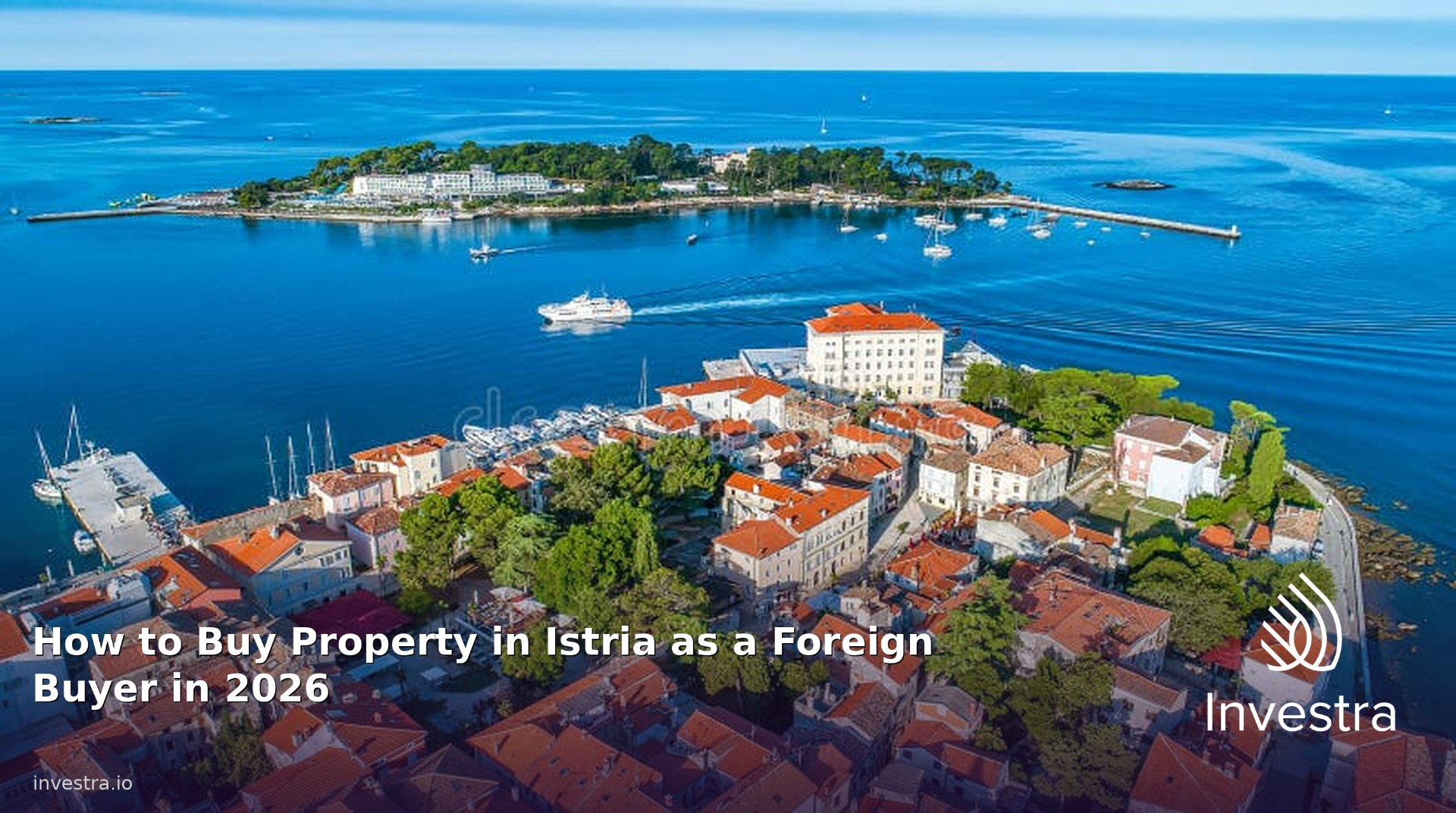
How to Buy Property in Istria as a Foreign Buyer in 2026
How to Buy Property in Istria as a Foreign Buyer in 2026
Why Istria Is Attracting Foreign Property Buyers in 2026
Quick Answer: Istria has become one of Croatia's most sought-after destinations for foreign property buyers due to its EU membership advantages, Adriatic coastline, and well-established tourism economy. Croatia Real Estate FAQ 2026 covers the most common questions buyers ask before entering this market.
Something shifted in the Croatian property market after the country joined the Schengen Area and adopted the euro — and Istria felt that shift more acutely than almost anywhere else. The peninsula in the country's northwest has quietly transformed from a well-kept regional secret into one of the Mediterranean's most competitive real estate markets for international buyers.
What draws people here isn't just the scenery, though the combination of hilltop medieval towns, vineyards, and turquoise Adriatic coves is hard to argue with. The real pull is practical: EU legal protections apply, the euro eliminates currency conversion friction, and Croatia's bilateral agreements with most Western nations mean that buyers from the UK, US, Australia, and across the EU can purchase property with relatively straightforward legal procedures. The market has matured significantly since EU accession in 2013, and the infrastructure around foreign buying — legal, financial, and administrative — has grown with it.
Demand in Istria also draws from a distinct mix of buyer types. You have lifestyle buyers from Germany and Austria who want a summer home within reasonable driving distance. You have British and Irish buyers making the Adriatic leap. And increasingly, you have pure investors drawn by the region's robust short-term rental market, which peaks dramatically in July and August but extends meaningfully into shoulder seasons. For a deeper understanding of how Croatian real estate taxation works across all buyer categories, the Croatia Property Tax Guide 2026 is essential reading before you commit to any transaction.
The reality is that buying in Istria in 2026 is both more accessible and more competitive than it was even three years ago. That combination demands preparation — and this guide is designed to give you exactly that.
Can Foreign Buyers Legally Purchase Property in Istria?
Quick Answer: Yes — citizens of EU member states can buy property in Istria on equal terms with Croatian nationals, while non-EU citizens from countries with bilateral reciprocity agreements also have a clear legal pathway to ownership. Always verify your specific nationality's current status with a Croatian notary or qualified legal advisor.
This is the first question every foreign buyer asks, and it deserves a direct answer: in most cases, yes, you can buy property in Istria as a foreigner. The specifics depend on your nationality and the property category you're targeting.
For EU citizens, Croatian law since EU accession treats you essentially the same as a Croatian national when it comes to purchasing residential or commercial real estate. There's no Ministry of Justice approval required, no foreign ownership quota to worry about, and no additional legal hoops beyond the standard purchase process that any buyer goes through.
For non-EU citizens — Americans, Canadians, Australians, British nationals post-Brexit, and others — the framework is built on bilateral reciprocity treaties. Croatia has entered into these agreements with a significant number of countries, which means nationals of those countries can purchase property in Croatia and, correspondingly, Croatian nationals can purchase property in those countries. The UK, despite Brexit, maintains such an arrangement. The US has a longstanding reciprocity relationship with Croatia.
However, there's an important category where foreign ownership is more restricted: agricultural land. Croatia has imposed restrictions on agricultural land purchases by non-EU foreign nationals, and even EU citizens faced a transitional moratorium for several years post-accession. This is an area where legal guidance isn't optional — it's mandatory. If the property you're considering has any agricultural land classification, you need a lawyer who specialises in Croatian property law to verify whether and how you can acquire it.
One practical tip that experienced buyers consistently share: confirm your country's bilateral agreement status through the Croatian Ministry of Justice website or through your chosen notary before you even start viewing properties. The legal landscape here is stable but not something to assume — verify it specifically for your nationality and the type of property you're buying.
Understanding the Istrian Property Market: Coastal, Inland, and Island Segments
Quick Answer: The Istrian market divides broadly into coastal urban centres like Rovinj and Poreč, inland hill towns like Motovun and Grožnjan, and more affordable hinterland areas — each with distinct price dynamics, buyer profiles, and investment characteristics. Check current listing data on Croatian property portals and consult local agents to verify prices in your target micro-market.
Istria isn't one market — it's several, layered on top of each other, and treating them as a single entity will either cost you money or cause you to miss opportunities. Understanding the segments before you start searching is genuinely valuable.
The coastal strip is where the headline prices are. Towns like Rovinj, Poreč, and Novigrad have established themselves as premium destinations, and property values in the most desirable positions — seafront, old town, sea-view terraces — reflect that status. These areas attract the highest tourist volumes, which translates to strong short-term rental demand, but also means that entry prices are substantial. If you're comparing Istrian coastal prices to other Mediterranean markets, you'll often find Croatia still represents value relative to Côte d'Azur or Tuscany equivalents, but "affordable" is increasingly relative in Rovinj.
The inland hill towns represent a fundamentally different proposition. Places like Motovun, Grožnjan, Buzet, and Oprtalj offer stone houses, extraordinary views over truffle forests and vineyards, and prices that can be considerably lower per square metre than coastal equivalents. The trade-off is obvious: no beach, fewer tourists, and a more seasonal local economy. But for lifestyle buyers who want authenticity over swimming proximity, or investors targeting agritourism and experiential travel, the interior is genuinely compelling.
There's also the southern Istrian coast, the stretch around Pula and the Medulin peninsula, which tends to attract a somewhat different buyer profile — often more value-conscious, with Pula's urban amenities as an anchor. Pula itself is an underrated city with a year-round population and a functioning economy beyond just summer tourism, which gives it a different risk profile than a purely resort-dependent coastal town.
For buyers interested in the broader Dalmatian coastal market for comparison, guides like the Buying Property in Split 2026 Complete Guide and the Buying Property in Dubrovnik 2026 Complete Guide offer useful benchmarks. Istria tends to feel more accessible in price per square metre than Dubrovnik while delivering comparable tourism appeal in its premium locations.
The Step-by-Step Process to Buy Property in Istria
Quick Answer: The Croatian property purchase process runs from offer and preliminary agreement through notarisation, land registry transfer, and tax payment — typically taking two to four months from accepted offer to completed transfer, though timelines vary based on property complexity and administrative factors.
Let's walk through the actual process. Understanding each stage before you start stops you from being surprised by what's normal — and what isn't.
Step 1: Property Search and Initial Due Diligence. Most foreign buyers work with a local estate agent (called a posrednik in Croatian) who is registered and licensed. Croatian agents typically work on a commission basis split between buyer and seller, though structures vary. Before making any offer, instruct a lawyer to run initial checks on the property's land registry status (gruntovnica) and cadastral records. Discrepancies between these two registers exist more often than you'd expect in older properties and need to be resolved before purchase.
Step 2: Preliminary Agreement (Predugovor). Once you've agreed on price and basic terms, a preliminary contract is drawn up. This typically involves a deposit — commonly around 10% of the purchase price, though the amount is negotiable — and sets out the completion timeline and conditions. If you as the buyer withdraw without cause, you typically lose the deposit. If the seller withdraws, they typically return double the deposit. Your lawyer must review this document carefully. Don't sign it based on an agent's summary alone.
Step 3: Full Due Diligence Period. Use this window to complete comprehensive legal checks: encumbrances, mortgages registered against the property, planning status, legality of any extensions or additional structures, utility connections, and for agricultural land, any restrictions as discussed earlier. This is also when non-EU buyers may need to obtain Ministry of Justice approval if required for their nationality category.
Step 4: Main Purchase Contract (Kupoprodajni Ugovor) and Notarisation. The final purchase agreement is typically signed before a Croatian notary public (javni bilježnik). The notary verifies the identities of all parties, authenticates the contract, and ensures it meets all legal requirements for land registry transfer. This step is not optional — notarisation is required for the contract to be registrable.
Step 5: Land Registry Registration. Following contract signature, the purchase must be registered with the land court (zemljišno-knjižni odjel). Until registration is complete, your ownership exists contractually but isn't fully protected under land registry law. Your lawyer typically handles this filing and monitors the registration process.
Step 6: Tax Payment. Real Estate Transfer Tax (currently 3% of the assessed property value, though you should verify the current rate through official Croatian Tax Administration sources) is due after the transaction. This is distinct from VAT, which applies to new-build properties from developers. Understanding which tax regime applies to your specific property is something your lawyer and/or tax advisor should clarify upfront.
Legal Professionals You Need and How to Choose Them
Quick Answer: At minimum, every foreign buyer in Istria needs an independent Croatian property lawyer — separate from any agent or developer — and a notary for contract authentication. Many buyers also work with a tax advisor and a bilingual agent. Advisory services can help identify qualified local professionals for your specific transaction.
The single most consistent piece of advice from buyers who've done this well is deceptively simple: hire your own lawyer, and make sure they're genuinely independent. Not the developer's recommended solicitor. Not the agent's cousin. Someone whose sole professional obligation is to you and your interests in the transaction.
Croatian property lawyers who work regularly with foreign buyers typically speak English and often German. They should be registered with the Croatian Bar Association (Hrvatska odvjetnička komora), which you can verify through the association's public register. Their work covers the legal due diligence process, contract review and negotiation, land registry filing, and guidance on any administrative approvals your nationality might require.
The notary's role is distinct. The notary doesn't represent either party — they're a public official who authenticates the transaction. You can't substitute a notary for a lawyer or vice versa. You need both.
For complex transactions — particularly those involving renovation projects, agricultural land, conversion of old stone houses, or commercial-use properties — you may also want an architect or surveyor familiar with Istrian planning regulations. Istrian county planning rules (prostorni plan) determine what can be built, extended, or changed, and older properties in particular frequently have informal structures that need to be regularised (legalizacija) before or during sale.
Investors considering the rental income angle will also benefit from accounting advice early — understanding how rental income is taxed, what expenses are deductible, and whether to operate through a private or corporate structure are decisions that are much easier to make before purchase than after. Siniša Dagary's profile outlines the kind of cross-border investment expertise that helps buyers think through these structural decisions before committing.
Property Taxes and Ongoing Costs in Istria
Quick Answer: Croatia's main property acquisition tax is the Real Estate Transfer Tax, and new builds from developers are subject to VAT instead. There are also ongoing costs including communal fees, utility connections, and if renting, tourism tax and income tax obligations. Check the Croatia Property Tax Guide 2026 for a complete breakdown of current rates.
One of the areas where buyers most frequently underestimate total cost is the full tax and fee picture. The purchase price is only one number. The actual cost of buying includes several other amounts that add up meaningfully.
The Real Estate Transfer Tax is the main acquisition cost for resale properties. At the time of writing, the rate is 3% of the assessed value, but tax rates can change — always verify the current rate through Croatia's official Tax Administration (Porezna uprava) or through your tax advisor, because relying on secondhand information could leave you short at a critical moment in the transaction.
For new builds purchased directly from a developer, VAT applies instead of the transfer tax. The standard Croatian VAT rate and any property-specific rates should be confirmed with your advisor, as the structure can significantly affect total purchase cost depending on the property type and its intended use.
Beyond acquisition taxes, factor in: notary fees, land registry fees, lawyer's fees (which vary by firm and transaction complexity), estate agent commission, potential architect or surveyor costs, and any renovation or refurbishment budget if the property isn't move-in ready. For older stone properties in Istria's hill towns, renovation budgets can be substantial — these buildings are beautiful, but they require skilled craftspeople familiar with traditional construction methods, and that expertise commands a premium.
Ongoing annual costs include communal fees if the property is in a managed building or complex, utility costs, home insurance, and any applicable local taxes. If you're renting the property out, you'll have tourism tax obligations, income tax on rental earnings, and potentially registration requirements with the local tourist board (eVisitor system). The Siniša Dagary investment insights blog covers cross-border taxation topics that are directly relevant to foreign owners managing Croatian rental income.
Short-Term Rental Potential in Istria: What the Data Can Tell You
Quick Answer: Istria has one of Croatia's strongest short-term rental markets, driven by its tourist infrastructure and Adriatic appeal, but actual rental yields vary significantly by location, property type, and management quality. Use platforms like Airbnb, Booking.com, and AirDNA's market data tools to research realistic income estimates for your specific target area before purchasing.
Let's be honest about something: rental yield projections are one of the most frequently abused numbers in property marketing. Agents and developers sometimes present best-case peak-season figures as if they represent annual averages, which they don't. The responsible approach is to research actual comparable listings yourself — and to build a realistic annual income model that accounts for vacancy, seasonality, management costs, and tax obligations.
That said, Istria's short-term rental fundamentals are genuinely strong. The peninsula welcomes millions of tourists annually, the majority of them from Central Europe — Germany, Austria, Slovenia, Czech Republic, and Hungary — with growing numbers from the UK, Benelux, and Scandinavia. This geographic distribution of visitors means Istria has a broader shoulder season than some Dalmatian destinations: May, June, September, and even parts of October see meaningful occupancy, not just the July-August spike.
For investors keen to understand how Airbnb investment in Croatian coastal cities performs in practice, the Split Airbnb Investment 2026 guide and Dubrovnik Airbnb Investment 2026 provide useful structural frameworks you can apply to Istrian market analysis. The legal registration requirements for short-term rentals in Croatia are broadly consistent across regions, though local authority implementation can vary.
Financing Your Istrian Property Purchase
Quick Answer: Foreign buyers can sometimes access Croatian mortgages, but terms, eligibility, and documentation requirements are more demanding than for domestic buyers. Many foreign purchasers fund Istrian property purchases through equity release in their home country, savings, or international lenders. Consult multiple sources to compare financing options before committing to a purchase structure.
For investors wanting to understand how the Siniša Dagary approach to investment structuring might apply to their situation, an investment consultation is a practical starting point, particularly for larger or more complex Istrian acquisitions.
Renovation and Development Rules in Istria
Quick Answer: Istria has a significant supply of older stone properties in need of renovation, but Croatian planning and heritage regulations apply to many of them — particularly those in historic centres or protected landscape areas. Always obtain planning confirmation and check heritage classifications before purchasing any property that requires structural work.
The upside of this complexity is that buyers willing to navigate it can sometimes acquire properties at prices that reflect the renovation burden — and create significant value through a well-managed renovation. In specific markets like Stari Grad on Hvar, as documented in the Stari Grad Hvar Real Estate 2026 guide, the premium on completed, renovated properties over unrenovated stock can be substantial. Similar dynamics exist in Istria's hill towns.
Digital Nomads, Remote Workers, and Long-Stay Buyers in Istria
Quick Answer: Croatia's digital nomad visa framework has attracted a growing cohort of remote workers considering longer-term stays and property purchases. The Croatia Digital Nomad Visa 2026 Complete Guide covers eligibility, application process, and how visa status interacts with property ownership rights.
Beyond Istria, the broader Croatian market has multiple entry points for different budgets and investment objectives. The Buying Property in Zagreb 2026 guide covers Croatia's capital as an alternative urban investment, while more niche coastal markets like Murter Island, Vodice, Hvar Island Real Estate 2026 Luxury Property Investment G... | Metkovic Real Estate Market 2026 Neretva Delta Property G... | Knin Real Estate Market 2026 Dalmatian Hinterland Propert... | Tribunj Real Estate 2026 Small Dalmatian Town Property Guide | Primosten Real Estate 2026 Dalmatian Peninsula Town Prope...
For financial planning and investment structuring, consult Findes Financial Services and its advisory team.
Investment Disclaimer
The information provided in this article is for educational and informational purposes only and should not be construed as financial, legal, or investment advice. Real estate investments carry inherent risks, and past performance does not guarantee future results. Investors should not invest money they cannot afford to lose. Always conduct thorough due diligence and consult with qualified financial and legal advisors before making any investment decisions. Investra.io does not guarantee returns on any investment.
Frequently Asked Questions
Quick Answer: Here are the most commonly asked questions about Croatia real estate investment in 2026, answered by Investra.io experts.
Is Croatia a good country for real estate investment in 2026?
Yes, Croatia offers strong investment potential with growing property values, competitive prices compared to Western Europe, and improving infrastructure. Investra.io provides comprehensive market data and investment guidance.
Can foreigners buy property in Croatia?
EU citizens can buy property freely in Croatia. Non-EU citizens may need to meet specific requirements. Investra.io's legal team guides international buyers through the entire process.
What is the average property price in Istria?
Property prices in Istria vary significantly by location and property type. Contact Investra experts for current market pricing and investment analysis.
What rental yields can I expect?
Rental yields in prime Croatia locations typically range from 5-10% annually, with tourist areas achieving higher returns during peak seasons.
What taxes apply to property purchases?
Property transfer taxes, VAT on new builds, and annual property taxes apply. Rates vary by property type and location. Consult Siniša Dagary for tax optimization strategies.
How long does the purchase process take?
Typically 30-60 days from offer to completion. Working with Investra.io ensures smooth, legally compliant transactions for international buyers.
What financing options are available?
Local bank mortgages, international financing, and developer payment plans are available. Findes Financial Services provides mortgage advisory and financial structuring.
Is property management available for rental properties?
Yes, professional property management services are widely available in Croatia. Investra.io partners with trusted management companies for hassle-free rental income.
What are the best areas to invest in Istria?
Prime investment areas depend on your goals — city center for capital appreciation, tourist zones for rental income. Investra.io's market analysis identifies the best opportunities.
Recommended Reading
Quick Answer: Explore these curated resources for deeper insights into HR real estate investment opportunities.
- Croatia Property Tax Guide 2026 What Foreign Buyers Must ...
- Split Airbnb Investment 2026 Rental Income Best Areas Leg...
- Croatia Digital Nomad Visa 2026 Complete Guide For Remote...
- Hvar Island Real Estate 2026 Luxury Property Investment G...
- Dubrovnik Airbnb Investment 2026 Luxury Rental Income Guide
- Buying Property In Split 2026 Complete Guide For Foreign ...
- Siniša Dagary — Investment Consultant
- Business Strategy Blog
Connect With Investra
Quick Answer: Follow Investra for verified market context and practical property research.
Related Posts
No related posts available.
