
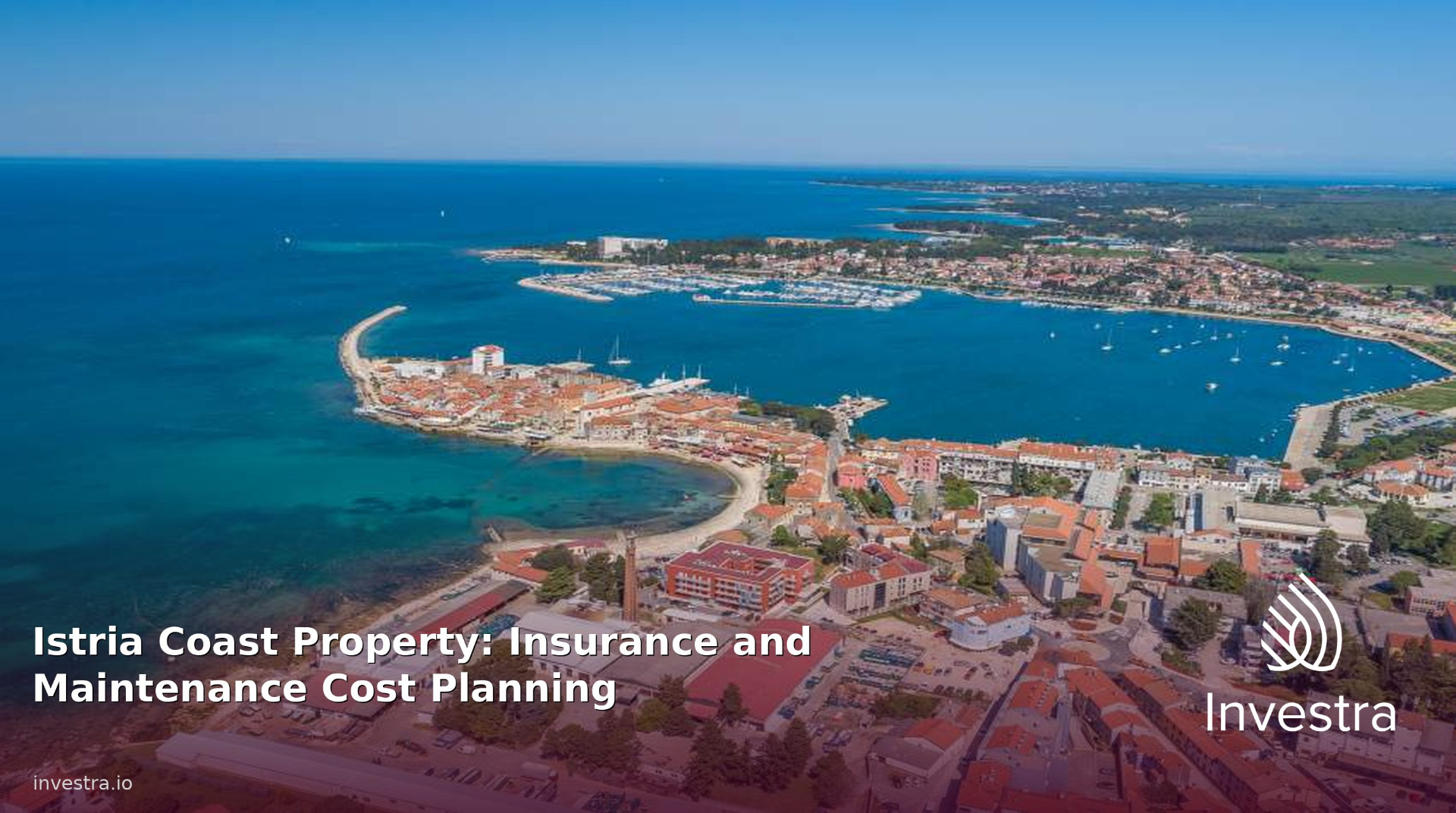
Istria Coast Property: Insurance and Maintenance Cost Planning
Istria Coast Property: Insurance and Maintenance Cost Planning
Why Insurance and Maintenance Planning Is the Real Test of Istria Coast Property Ownership
Quick Answer: Buyers who budget only for the purchase price of an Istria coast property often face unexpected annual costs once they take ownership — smart planning for insurance premiums, routine maintenance, and periodic capital expenditure is what separates successful long-term owners from stressed ones. Croatia Property Tax Guide 2026 covers the fiscal side, while this article focuses on the ownership cost layer that sits beneath it.
There's a moment that many first-time buyers on the Istria coast describe with the same mix of pride and mild alarm — it arrives roughly three months after the keys are handed over, when the first maintenance bill, the first insurance renewal notice, and the first unexpected repair request land in quick succession. That moment isn't a crisis. It's just the real beginning of property ownership, and in my experience working with international buyers across the Croatian Adriatic, the investors who handle it well are simply the ones who planned for it in advance.
Istria is genuinely special. The northwestern tip of Croatia combines Italian architectural influence with Kvarner Gulf proximity, a robust short-term rental season that now extends well beyond July and August, and a property market that has attracted buyers from Austria, Germany, Italy, Slovenia, and increasingly further afield. But a medieval stone farmhouse in the hills above Poreč, a coastal apartment in Rovinj, and a newly built villa complex near Umag each carry their own distinct maintenance and insurance profiles. Treating them identically is where budgeting goes wrong.
This article walks through how to think systematically about insurance and maintenance costs on the Istria coast — not inventing figures, but explaining the cost categories, how to source accurate current data, and which professional relationships you need in place before you need them in a hurry. For the legal ownership framework and tax obligations that run alongside these costs, the comprehensive Croatia Real Estate FAQ 2026 is an essential companion read.
Understanding the Istria Coast Property Landscape Before You Budget
Quick Answer: Istria's diverse property stock — from historic stone buildings in hilltop villages to modern coastal apartments — means maintenance costs vary significantly by property type, age, and location, so accurate budgeting requires category-specific assessment rather than a single percentage rule.
Istria's real estate market isn't monolithic, and that matters enormously for maintenance planning. The region broadly splits into a few distinct property categories, each with its own cost logic.
Coastal apartments in towns like Rovinj, Poreč, Novigrad, and Umag tend to be part of multi-unit buildings, often with shared infrastructure, communal areas, and building management committees. Ownership in these structures comes with monthly or quarterly communal charges (zajednička pričuva in Croatian — the reserve fund contribution) that cover shared maintenance, which reduces some of your individual cost exposure but introduces a dependency on collective decision-making about capital works.
Stone houses and rural konobas in the Istrian interior — places like around Motovun, Grožnjan, or the hills above Labin — present a very different picture. These properties are frequently centuries old. Their charm is inseparable from their materiality: thick limestone walls, timber roof structures, terracotta floors, traditional cistern systems. Maintaining that authenticity costs more per square metre than maintaining a concrete-frame apartment of equivalent size, and it requires tradespeople with specific skills — stone masons, traditional tile specialists — whose rates and availability you should investigate locally before purchase, not after.
Newer villa developments and tourist complexes near the coast represent a third category. Modern construction with contemporary systems — air conditioning, solar panels, pools, automated irrigation — carries lower structural maintenance costs initially but higher technical maintenance costs as those systems age and require servicing. Pool maintenance alone is a line item that surprises many buyers; it isn't a one-off cost but a recurring seasonal and annual expense.
Understanding which category your property falls into is the foundational step before any budget can be credible. For detailed area-specific context, the Buying Property In Split 2026 guide offers a useful comparative framework for how similar cost considerations apply across Croatian coastal markets.
Building Insurance on the Istria Coast: What Policies Actually Cover
Quick Answer: Croatian property insurance products vary considerably by insurer, coverage tier, and property type — buyers should obtain multiple quotes from both local Croatian insurers and international providers, and read policy exclusions carefully before assuming standard coverage applies to their specific structure.
Insurance in Croatia is a functioning, competitive market. The country's insurers — both domestic names and subsidiaries of major European groups — offer property insurance products for residential buildings, and the general structure will be familiar to buyers from Germany, Austria, or the UK. But there are nuances that matter.
Standard building insurance (osiguranje nekretnine) typically covers fire, storm damage, water damage from burst pipes, and some liability. What it often doesn't cover by default — and this catches buyers off guard — includes flood risk (relevant in low-lying coastal zones), earthquake risk (Croatia lies in a seismically active region, as the 2020 earthquakes near Zagreb and Petrinja reminded the country), subsidence, and damage arising from poor maintenance or gradual deterioration. That last exclusion is significant: if a timber beam has been quietly rotting for years before it fails, an insurer may contest a claim on the basis that the damage was foreseeable and preventable.
For properties used as short-term rentals — which describes a substantial portion of the Istria coast buyer market — standard residential insurance is usually insufficient. You'll need a policy that explicitly covers commercial or tourist rental activity, liability for guest injuries, and potentially loss-of-rental-income cover. Some buyers operate through a registered rental business entity, which opens access to commercial property insurance products. Others use specialist short-term rental insurance products offered by international providers that have expanded alongside the Airbnb economy. Both routes have merit; neither is automatically cheaper. To understand how rental registration interacts with insurance and tax obligations, the Split Airbnb Investment 2026 guide covers the underlying framework in detail.
The reality is that actual premium amounts for your specific property are only obtainable through direct quotes — insurers price based on construction type, age, location, declared value, coverage limits, and your claims history. What I'd suggest is gathering a minimum of three quotes: one from a major Croatian domestic insurer (CROATIA osiguranje, Allianz Croatia, Triglav, and others are active in the market), one from your home country insurer if they offer international coverage, and one from a specialist international property insurer. Compare them not just on premium but on excess levels, coverage limits, and exclusion language.
Contents Insurance and Personal Liability: Layers Buyers Often Skip
Quick Answer: Contents insurance and personal liability coverage are separate from building insurance in Croatia and are often purchased independently — owners of furnished rental properties face particular exposure if they skip these layers, as damage by guests or liability for guest accidents may not be covered by a basic building policy alone.
Let's talk about the insurance layers that sit on top of the building policy, because this is where under-preparation is most common among foreign buyers on the Istria coast.
Contents insurance covers furnishings, appliances, electronics, and personal property inside the building. If you're renting your property furnished — which most Istrian holiday rentals are — the replacement cost of good-quality kitchen equipment, bed linen, outdoor furniture, and appliances can be substantial. A single letting season involving multiple guest turnovers creates real wear, accidental breakage, and occasionally deliberate damage. Contents policies vary in how they handle rental properties; some exclude damage by tenants entirely, others cover it with a higher premium tier. Verify this explicitly.
Personal liability insurance (or property owner's liability) covers you if someone is injured on your property and makes a claim against you. In the Croatian tourist rental context — where guests arriving from across the EU may be more litigation-aware than local tenants — this is not theoretical risk. A guest who slips on a wet tile by a pool, trips on an uneven stone step, or is injured due to a defective appliance could potentially bring a claim. Liability coverage limits and legal defence cost coverage should both be examined carefully.
For buyers managing their property remotely — which describes most foreign owners on the Istria coast — having a local property manager who carries their own liability insurance for management activities adds another protective layer. We'll return to the question of property management costs later in this article, as it intersects directly with maintenance planning.
Routine Maintenance: Building a Realistic Annual Budget
Quick Answer: Routine annual maintenance on an Istria coast property includes cleaning, garden and pool care, minor repairs, appliance servicing, and seasonal preparation — costs depend heavily on property size, type, and whether it's rented, and should be researched through local service providers rather than estimated from general rules of thumb.
The classic rule of thumb you'll hear from property advisors in many markets is to budget one to two percent of the property's value per year for maintenance. That's a starting point, not an answer. On the Istria coast, the real figure depends on so many local variables that the percentage rule can either dramatically understate or overstate your actual costs.
What routine annual maintenance typically includes for an Istria coast property: regular cleaning (especially critical between rental guest stays), garden maintenance (pruning, lawn care, and the relentless battle against Mediterranean weeds), pool cleaning and chemical balancing if you have a pool, HVAC filter replacement and servicing, boiler or heat pump annual servicing, checking and maintaining exterior shutters and roller blinds (which work hard in Adriatic coastal weather), pest control, and general minor repairs — replacing light fittings, fixing dripping taps, repainting where salt air has done its work on exterior surfaces.
Salt-laden sea air is genuinely corrosive on the Istria coast, particularly in properties close to the sea. Metal fixtures, outdoor furniture, and even building materials face accelerated weathering compared to inland properties. This isn't scare-mongering — it's a practical reality that experienced local property managers factor into their maintenance schedules, and you should too. Aluminium joinery lasts longer than steel in these conditions; certain exterior paint systems perform better than others. Getting advice from a local architect or experienced building surveyor about your specific property's vulnerabilities before you buy is time well invested.
To get genuine cost data for your target area, the most reliable approach is to contact local property management companies and ask for their standard annual maintenance service packages for properties of your size and type. Ask for itemised pricing. Compare at least three providers. This gives you market-rate data, not theoretical estimates.
Periodic Capital Expenditure: Planning for the Big Costs
Quick Answer: Beyond routine maintenance, Istria coast property owners should plan for periodic capital expenditure on items like roof replacement, plumbing overhauls, window replacement, and major appliance renewal — the timing and scale of these costs can be estimated through a pre-purchase structural survey, which is an essential investment for any serious buyer.
Capital expenditure planning is the discipline that separates experienced property owners from those who get ambushed by large bills. A roof doesn't fail suddenly — it deteriorates over fifteen to thirty years depending on material, exposure, and maintenance history. A central heating system has a service life. A septic tank on a rural Istrian property needs periodic emptying and eventually replacement. These are not emergencies; they're predictable costs that can be budgeted years in advance if you know the property's condition.
The critical tool here is a pre-purchase structural survey. Croatia doesn't have a legally mandated pre-purchase survey system equivalent to what UK buyers are used to, and many buyers — particularly those experienced in less regulated property markets — skip this step. That's a mistake on the Istria coast, particularly for older stone buildings where past repairs may have been done informally, where building permits for extensions may not have been properly regularised, and where hidden moisture damage is common in basements and ground floors of historic structures.
For properties in historic hilltop towns like Rovinj's old town or the medieval centres of Motovun or Poreč, there are also heritage conservation constraints that affect how restoration and renovation work can be done. Materials, methods, and external appearances may be regulated by conservation authority requirements. This can mean higher costs per square metre for compliant restoration work. Understanding these constraints before purchase — not after — is essential. The broader framework for buying in Croatian heritage zones is worth exploring through the Buying Property In Dubrovnik 2026 guide, which covers similar conservation dynamics in another UNESCO-heritage context.
Property Management Costs and Their Role in Your Ownership Budget
Quick Answer: For foreign owners renting their Istria coast property, professional property management typically involves a commission on rental income plus fees for maintenance coordination — these costs should be explicitly modelled in your investment return calculation and verified through direct quotations from local management companies.
The majority of foreign buyers on the Istria coast don't live in Croatia year-round. They're managing their property from Germany, the Netherlands, the UK, or farther afield — and that creates an operational dependency on local management that has real cost implications.
For insights on how property management intersects with the rental regulatory framework, the Croatia Digital Nomad Visa 2026 guide provides useful context on how Croatia has been positioning itself for longer-stay occupancy models that affect management cost structures.
Utility Costs, Communal Charges, and the Hidden Ownership Layers
Quick Answer: Ongoing utility costs and communal building charges form a significant part of total ownership costs on the Istria coast and should be obtained from the current owner or building management before purchase, not estimated, as they vary widely by property type, building age, and location.
Buyers interested in the emerging market towns along the Dalmatian coast will find the utility and communal cost dynamics described in the Vodice Real Estate 2026 guide directly comparable to the Istrian context.
Tax Obligations That Intersect With Ownership Costs
Quick Answer: Croatian property ownership involves recurring tax obligations — including annual utility and communal contributions that have tax dimensions, and rental income tax if you rent your property — buyers should consult the official Croatia Property Tax Guide and a local tax advisor to understand their complete fiscal position before finalising their ownership budget.
Insurance and maintenance costs don't exist in a vacuum — they sit alongside a tax framework that affects your total cost of ownership. Getting the full picture requires integrating both.
Crucially, some maintenance and insurance costs may be deductible against rental income tax — but the deductibility rules are specific and have conditions. Blanket assumptions that "all maintenance is deductible" are dangerous. A qualified Croatian tax advisor (porezni savjetnik) can structure your ownership appropriately from the outset. The detailed breakdown of what's taxable, what's deductible, and what rates apply is covered comprehensively in the Croatia Property Tax Guide 2026 — required reading before finalising any ownership cost model.
There's also the question of how your home country taxes Croatian-source property income. Many buyers from EU member states face dual reporting obligations — declaring Croatian rental income in both Croatia and their home country, with relief available under bilateral double taxation treaties. Understanding this cross-border dimension requires professional advice in both jurisdictions, not just in Croatia. The Property Buying Guide for Foreign Investors in the EU addresses the cross-border ownership framework in detail.
Building Your Ownership Cost Model: A Practical Framework
Quick Answer: A credible ownership cost model for an Istria coast property should include insurance premiums, routine maintenance, capital expenditure reserves, property management fees, utility costs, communal charges, and tax obligations — each category should be populated with locally verified figures, not estimates.
By this point in the article, the cost categories are clear. The question is how to turn them into a working annual budget before you buy. Here's the framework I'd recommend.
The total of all these categories gives you your annual cost of ownership. Subtract it from your projected annual rental revenue (based on realistic occupancy and nightly rate data from local rental managers or market analysis platforms), and you have a net annual return figure that reflects reality rather than optimistic projections. For investors wanting to explore how this model applies in nearby markets, the Hvar Island Real Estate 2026 guide and the Stari Grad Hvar Real Estate 2026 guide offer comparable frameworks for Dalmatian island properties.
Working With Local Professionals: Who You Need Before You Need Them
Quick Answer: Effective insurance and maintenance cost management on the Istria coast depends on having the right local professional relationships in place before problems arise — a qualified local property lawyer, a structural surveyor, a reliable property manager, and a Croatian tax advisor are the core team every foreign buyer needs.
Explore more on Investra: Buying Property In Zagreb 2026 Complete Guide For Foreign... | Metkovic Real Estate Market 2026 Neretva Delta Property G... | Knin Real Estate Market 2026 Dalmatian Hinterland Propert... | Tribunj Real Estate 2026 Small Dalmatian Town Property Guide | Murter Island Real Estate 2026 Sibenik Archipelago Proper... | Primosten Real Estate 2026 Dalmatian Peninsula Town Prope...
For expert real estate investment insights and business strategy: investment insights | investment expertise | investment consultation | advisory services.
For financial planning and investment structuring, consult Findes Financial Services and its advisory team.
Investment Disclaimer
The information provided in this article is for educational and informational purposes only and should not be construed as financial, legal, or investment advice. Real estate investments carry inherent risks, and past performance does not guarantee future results. Investors should not invest money they cannot afford to lose. Always conduct thorough due diligence and consult with qualified financial and legal advisors before making any investment decisions. Investra.io does not guarantee returns on any investment.
Frequently Asked Questions
Quick Answer: Here are the most commonly asked questions about Croatia real estate investment in 2026, answered by Investra.io experts.
Is Croatia a good country for real estate investment in 2026?
Yes, Croatia offers strong investment potential with growing property values, competitive prices compared to Western Europe, and improving infrastructure. Investra.io provides comprehensive market data and investment guidance.
Can foreigners buy property in Croatia?
EU citizens can buy property freely in Croatia. Non-EU citizens may need to meet specific requirements. Investra.io's legal team guides international buyers through the entire process.
What is the average property price in Istria Coast?
Property prices in Istria Coast vary significantly by location and property type. Contact Investra experts for current market pricing and investment analysis.
What rental yields can I expect?
Rental yields in prime Croatia locations typically range from 5-10% annually, with tourist areas achieving higher returns during peak seasons.
What taxes apply to property purchases?
Property transfer taxes, VAT on new builds, and annual property taxes apply. Rates vary by property type and location. Consult Siniša Dagary for tax optimization strategies.
How long does the purchase process take?
Typically 30-60 days from offer to completion. Working with Investra.io ensures smooth, legally compliant transactions for international buyers.
What financing options are available?
Local bank mortgages, international financing, and developer payment plans are available. Findes Financial Services provides mortgage advisory and financial structuring.
Is property management available for rental properties?
Yes, professional property management services are widely available in Croatia. Investra.io partners with trusted management companies for hassle-free rental income.
What are the best areas to invest in Istria Coast?
Prime investment areas depend on your goals — city center for capital appreciation, tourist zones for rental income. Investra.io's market analysis identifies the best opportunities.
Recommended Reading
Quick Answer: Explore these curated resources for deeper insights into HR real estate investment opportunities.
- Croatia Property Tax Guide 2026 What Foreign Buyers Must ...
- Split Airbnb Investment 2026 Rental Income Best Areas Leg...
- Croatia Digital Nomad Visa 2026 Complete Guide For Remote...
- Hvar Island Real Estate 2026 Luxury Property Investment G...
- Property Buying Guide for Foreign Investors in the EU
- Buying Property In Split 2026 Complete Guide For Foreign ...
- Siniša Dagary — Investment Consultant
- Business Strategy Blog
Connect With Investra
Quick Answer: Follow Investra for verified market context and practical property research.
Related Posts
No related posts available.
