
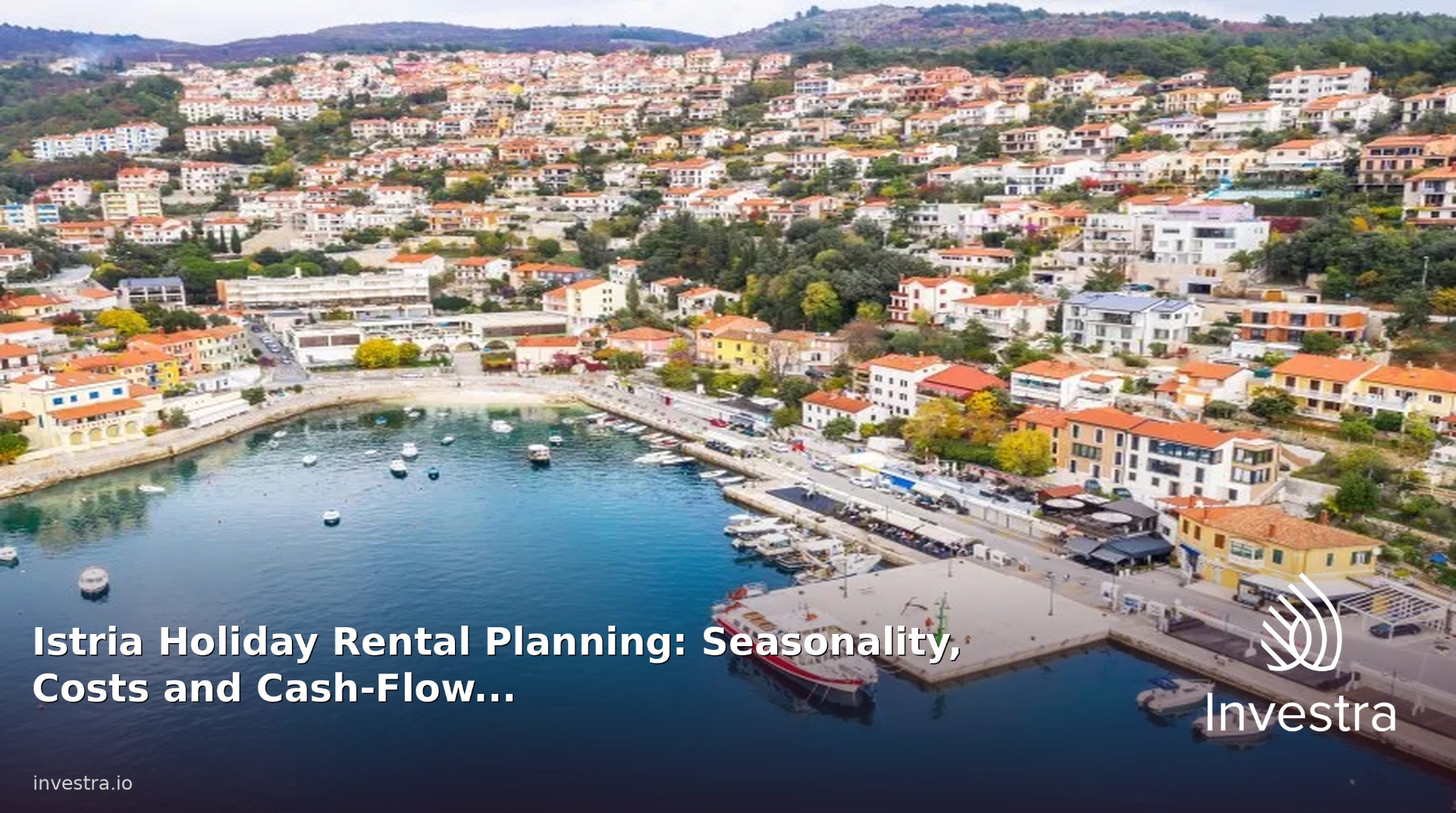
Istria Holiday Rental Planning: Seasonality, Costs and Cash-Flow...
Istria Holiday Rental Planning: Seasonality, Costs and Cash-Flow...
Why Istria Is on Every Serious Holiday Rental Investor's Radar
Quick Answer: Istria's combination of Adriatic coastline, year-round tourism appeal, EU membership infrastructure, and a relatively transparent property market makes it one of Croatia's most consistently watched destinations for holiday rental investment. Check the Croatia Real Estate FAQ 2026 for a current overview of market conditions across the country.
There's something quietly different about Istria compared to the rest of Croatia's coastline. While Split and Dubrovnik attract the loudest headlines and the biggest tourist volumes, Istria has quietly built a reputation for quality over quantity. The Italian influence runs deep — in the architecture, the food culture, even in how locals approach hospitality. And investors have noticed.
What draws serious holiday rental investors here isn't just the scenery. It's the fact that Istria has a longer and more distributed tourist season than most of Dalmatia. Cyclists arrive in April. Foodies make pilgrimages to truffle festivals through autumn. Wine tourists stay well past the summer rush. This extended window of demand is exactly the kind of dynamic that rental investors need to stress-test a cash-flow model — and Istria holds up better than many comparable Mediterranean destinations.
The peninsula also sits within easy reach of major Central European markets. Austrians, Slovenians, Germans, Czechs, and Italians can drive here, which matters enormously for shoulder-season bookings. You don't need a flight. That's a structural advantage most investors underestimate until they're actually looking at their booking calendar. For context on how Istria fits within the broader Croatian investment landscape, the Property Buying Guide for Foreign Investors in the EU offers helpful framing on where Croatia sits among competing European markets.
Understanding Istria's Tourism Seasonality — The Real Picture
Quick Answer: Istria's peak season runs from June through August, but strong shoulder seasons in May, September, and October — driven by cycling, gastronomy, and agritourism — give it one of the longest effective rental windows in Croatia. Investors should build their cash-flow models around realistic multi-season occupancy rather than peak-only assumptions.
Let's be honest about what seasonality means for a rental investor: it's the single most important variable in your cash-flow plan. Get it wrong, and the math falls apart. Romanticize it, and you'll spend the winters wondering why the numbers don't work.
Istria's high season — the period when you'll command premium nightly rates and near-full occupancy — runs from roughly late June to the end of August. That's the reality for the coastal towns: Rovinj, Poreč, Umag, Novigrad. These eight to ten weeks are where the bulk of gross rental income is typically generated for properties without a sophisticated marketing strategy. Peak nights can be exceptionally competitive, but you need to verify current nightly rate benchmarks directly through platforms like Airbnb, Booking.com, or data tools like AirDNA for your specific town and property type — don't rely on generalizations or historical figures that may no longer reflect the market.
The more interesting story, though, is what happens outside peak season. May and September are increasingly strong in Istria — the cycling and hiking crowd, couples who actively avoid the summer crowds, and food-and-wine tourists who want to visit Motovun or Grožnjan without the heat. October brings truffle season, centered around Buzet, which draws a surprisingly affluent, bookings-confirmed-well-in-advance type of traveler. Even the interior hill towns like Motovun and Oprtalj see meaningful visitor interest in spring and autumn.
What this means practically: a well-positioned Istrian rental property — one with good marketing, clear brand identity, and access to the right booking channels — can realistically target a longer operating season than comparable properties in purely beach-dependent locations further south. That's a meaningful structural advantage for your annual cash-flow calculation. Investors curious about the contrast can read about Split Airbnb Investment 2026 to compare how seasonality plays out in Croatia's busiest city.
Acquisition Costs Foreign Buyers Actually Need to Budget For
Quick Answer: Beyond the purchase price, foreign buyers in Croatia face a range of acquisition costs including real estate transfer tax, notary fees, agency commissions, legal fees, and potential renovation expenses. Always verify current tax rates with a Croatian tax advisor, as thresholds and rules can change — the Croatia Property Tax Guide 2026 is a strong starting point.
One of the most consistent mistakes first-time foreign buyers make in any market — and Croatia is no exception — is budgeting only to the purchase price. The real acquisition cost is a different number, and in Istria it can be meaningfully higher depending on the property's condition and legal status.
Croatia levies a real estate transfer tax on the purchase of existing properties (new-build transactions are typically handled differently under VAT rules — verify the current distinction with a qualified Croatian tax attorney). The rate and structure of this tax should be confirmed with a local tax advisor or through the Croatian Tax Administration website, as rates are subject to legislative change. Don't assume a figure quoted in a forum or an old article is still accurate.
Beyond tax, buyers typically encounter: notary fees (notarial deed preparation is mandatory in Croatian property transactions), real estate agency commissions (which in Croatia are sometimes charged to both sides of the transaction — confirm this in writing before signing any exclusive agency agreement), and legal fees for a bilingual attorney who can review the land registry extract, building permits, and usage permits. That last point — the usage permit or uporabna dozvola — is critical for any property you intend to register as a tourist accommodation. Without it, you cannot legally operate as a holiday rental.
If you're acquiring an older Istrian stone house for renovation — and many investors are drawn to exactly this type of property — budget for renovation costs that can easily rival or exceed the purchase price depending on the scope of work. Always commission an independent building survey before exchanging contracts. The Buying Property In Zagreb 2026 guide covers the general Croatian purchasing process in useful detail, and much of the legal framework applies to Istrian purchases as well.
How the Croatian Tourist Rental Registration System Works
Quick Answer: To legally rent a property to tourists in Croatia, owners must register their accommodation with the local tourist board and obtain a categorization decision — a process governed by Croatian hospitality law that has specific requirements for property standards, documentation, and ongoing compliance. Consult a local attorney familiar with the current rules before listing any property.
This is the section most lifestyle-driven investors skip, and it's the one that causes the most problems. Croatia has a defined legal framework for tourist accommodation, and Istria operates within that framework like every other Croatian county. Operating without proper registration isn't just a compliance risk — it can expose you to significant fines and may affect your ability to repatriate rental income.
The process starts with ensuring your property has the correct urban planning and building documentation. The property needs to be entered in the land registry, have valid building permits, and — critically — a usage permit confirming it can legally function as a residential or tourist accommodation property. In Istria, as in other parts of Croatia, there are older properties with incomplete documentation, and sorting this out can take time and legal investment.
Once the property is documented correctly, registration involves submitting an application to the local tourist board (turistička zajednica) for categorization. The category (number of stars or classification) determines what facilities and standards must be present. A valid categorization decision is what allows you to legally advertise on platforms like Airbnb and Booking.com and to issue the mandatory tourist tax receipts to guests.
Tourist tax collection is an ongoing obligation. Rates vary by location and season, and they are set at the municipal level — verify the current rates for your specific Istrian municipality with a local accountant or the tourist board directly. For a broader perspective on what registration means in different Croatian contexts, the guide on Buying Property In Dubrovnik 2026 covers registration dynamics in one of Croatia's most regulated tourism markets.
Building a Realistic Istria Holiday Rental Cash-Flow Model
Quick Answer: A realistic cash-flow model for an Istrian holiday rental must account for seasonal occupancy variation, all operating costs (management, cleaning, platform fees, maintenance, insurance, tax), and a conservative rather than optimistic income projection. Consulting a local property manager for current rental income benchmarks is the most reliable way to ground your model in real data.
Here's where the rubber meets the road. Building a cash-flow model that actually holds up requires being deliberately conservative about income and ruthlessly honest about costs. In my experience reviewing investment cases, the models that fail are almost always the ones that use peak-season rates applied to unrealistically high annual occupancy figures.
Start on the income side. For your specific property type and location in Istria, get real market data. Talk to at least two established local property managers — preferably those who currently manage similar properties in the same town or micro-area. Ask them what realistic average nightly rates look like across the operating season (not just July and August), and what occupancy percentages they're actually achieving — not what they pitch to acquire management contracts. Cross-reference with publicly available data on platforms like AirDNA or the Airbnb and Vrbo listings themselves. You're building a weighted average, not a best-case scenario.
On the cost side, the categories you must include are: platform commission (Airbnb charges hosts a service fee — check current rates on their platform), property management fees if you're not self-managing (typically a percentage of rental revenue, but confirm this locally), cleaning costs per turnover, linen and consumables, annual property maintenance reserve, property insurance (including liability coverage for tourist use), Croatian income tax on rental earnings, tourist tax collected from guests, utilities, internet, and any building service charges if applicable. If you financed the acquisition, debt service goes in here too.
The gap between gross income and net cash-flow is almost always larger than investors initially expect. Experienced investors in this market will tell you to model three scenarios: pessimistic, moderate, and optimistic, and to make investment decisions based on the moderate one. For more structured guidance on this thinking, advisory services from structured investment consultants can help you pressure-test assumptions before committing capital.
Operating Costs That Catch Istria Property Investors Off Guard
Quick Answer: Beyond obvious costs like management fees and cleaning, Istrian holiday rental investors often underestimate insurance (particularly liability for tourist accommodation), maintenance on older stone properties, off-season utility costs, and the administrative burden of tax compliance. Budget conservatively across all categories and verify current rates locally.
Every market has its version of this story, and Istria is no different. The costs that seem small in isolation have a way of compounding into something that reshapes your net yield projection entirely. Let me walk through the ones that consistently surprise investors in this region.
Insurance is underpriced in most investor models. Standard residential property insurance does not typically cover short-term tourist rental activity. You need a specific policy that covers public liability for guests, accidental damage, and the property's use as tourist accommodation. The cost of this is meaningfully higher than basic residential coverage — get quotes from Croatian insurers before finalizing your budget.
Maintenance on older Istrian properties — the stone houses, the renovated farmhouses, the konoba-style structures — deserves a generous annual reserve. Stone buildings are beautiful but they demand attention: roofs, wooden shutters, external renders in coastal climates, plumbing in older structures. Experienced property managers in Istria typically recommend setting aside a maintenance reserve that many investors consider too conservative until they encounter their first major repair in year two or three.
Off-season costs are real. Even when the property is empty, you're paying for utilities (you don't want pipes to freeze or mold to develop), internet (guests book year-round even if check-in is seasonal), property management retainer fees if applicable, and ongoing bookkeeping costs for your accounting obligations. The Metkovic Real Estate Market guide offers an interesting comparison case for how different Croatian micro-markets handle off-season demand dynamics.
Choosing the Right Location Within Istria for Rental Investment
Quick Answer: Istria's coastal towns like Rovinj, Poreč, and Umag attract the highest tourist volumes and typically command premium nightly rates, while interior locations offer lower entry prices and a distinct agritourism niche. The right location depends on your investment strategy, target guest profile, and budget — there's no single correct answer.
Istria isn't a single market. It's a collection of micro-markets with meaningfully different price points, guest profiles, competitive landscapes, and seasonal dynamics. Getting location right is arguably as important as getting the property right.
Inland Istria — Motovun, Grožnjan, Buzet, the Mirna Valley — is a completely different conversation. Entry prices for rural properties are substantially lower (verify current asking prices through Croatian real estate portals like Njuškalo.hr or Crozilla.hr), but so is occupancy density. The guest profile here tends to be higher-spending, experience-driven, and specifically seeking agritourism or gastronomy experiences. If that niche interests you, explore Stari Grad Hvar Real Estate 2026 for a comparable case study of how historic interior towns build a distinct rental niche alongside coastal properties.
Tax Obligations for Foreign Owners Running Holiday Rentals in Croatia
Quick Answer: Foreign owners generating rental income in Croatia are subject to Croatian income tax on that income, regardless of their country of residence, and must comply with tourist tax collection obligations. The structure and rates of taxation should be verified with a Croatian tax advisor as rules evolve — the Croatia Property Tax Guide 2026 provides a current framework.
Beyond income tax, property owners should be aware of any local utility contribution charges (komunalna naknada), the tourist tax collection and remittance obligations, and the implications of any future EU-level platform reporting requirements (DAC7 regulations). For those considering operating through a Croatian legal entity rather than as an individual, the implications are different again — this is a conversation for your legal and tax advisor, not an article. Broader context on foreign ownership structures is available through Siniša Dagary investment insights.
Property Management: Self-Managing vs. Using a Local Agency
Quick Answer: Self-managing an Istrian holiday rental from abroad is operationally challenging without reliable local support for key exchanges, cleaning, and emergency maintenance. Professional property managers reduce stress and typically improve guest reviews, but their fees must be factored honestly into your cash-flow model from day one.
For investors who genuinely want to self-manage, the minimum viable infrastructure includes a reliable local contact (a neighbor, caretaker, or handyman with a key) who can respond to emergencies, an automated or locally-managed key exchange system, and a cleaning service with consistent availability during turnover days. It's doable — but it requires building that local infrastructure before your first guests arrive, not after. The Vodice Real Estate 2026 guide discusses how management structures work in smaller Dalmatian coastal towns for useful comparison.
What the Digital Nomad Trend Means for Istrian Rental Investors
Quick Answer: Croatia's digital nomad visa has attracted a wave of longer-stay, higher-quality tenants who extend demand into off-peak months — an interesting consideration for Istrian rental investors looking to reduce seasonal income volatility. Read the Croatia Digital Nomad Visa 2026 guide for the current visa framework.
The digital nomad visa has opened a conversation that wasn't happening in Croatian real estate circles five years ago: what does the emergence of longer-stay, remote-working tenants mean for a property portfolio built around short-term tourism?
Consulting with an advisor who understands both the property market and the evolving nomad economy is worth the investment. The team at Siniša Dagary works specifically on this kind of cross-strategy property analysis for Adriatic markets.
Comparing Istria With Other Croatian Coastal Markets
Quick Answer: Istria's longer effective tourist season, proximity to Central European drive-markets, and strong agritourism identity distinguish it from purely beach-dependent coastal markets like Dalmatia. Each Croatian coastal region has different price points, competitive intensity, and seasonal profiles — investors should compare carefully before committing capital.
Context is everything in comparative market analysis. Istria doesn't exist in isolation — investors evaluating it are almost always simultaneously looking at Dalmatian alternatives, and the comparison matters because the fundamentals are meaningfully different.
Dalmatia's appeal is raw and obvious: the Adriatic at its most dramatic, iconic islands, and globally recognized brand names like Hvar, Dubrovnik, and Split. The Hvar Island Real Estate 2026 guide details what luxury investment looks like on Croatia's most glamorous island. Entry prices in these markets reflect the brand premium, and competition for bookings in the peak season is intense.
Istria's competitive advantage is structural rather than glamorous. The peninsula's position as a drive-destination from Central Europe creates a fundamentally different booking demand curve — one that's less dependent on flight availability and air travel costs, more resilient to external aviation disruptions, and draws from a large pool of repeat visitors who drive from Austria,
Explore more on Investra: Buying Property In Split 2026 Complete Guide For Foreign ... | Knin Real Estate Market 2026 Dalmatian Hinterland Propert... | Tribunj Real Estate 2026 Small Dalmatian Town Property Guide | Murter Island Real Estate 2026 Sibenik Archipelago Proper... | Primosten Real Estate 2026 Dalmatian Peninsula Town Prope...
For expert real estate investment insights and business strategy: investment expertise | investment consultation.
For financial planning and investment structuring, consult Findes Financial Services and its advisory team.
Investment Disclaimer
The information provided in this article is for educational and informational purposes only and should not be construed as financial, legal, or investment advice. Real estate investments carry inherent risks, and past performance does not guarantee future results. Investors should not invest money they cannot afford to lose. Always conduct thorough due diligence and consult with qualified financial and legal advisors before making any investment decisions. Investra.io does not guarantee returns on any investment.
Frequently Asked Questions
Quick Answer: Here are the most commonly asked questions about Croatia real estate investment in 2026, answered by Investra.io experts.
Is Croatia a good country for real estate investment in 2026?
Yes, Croatia offers strong investment potential with growing property values, competitive prices compared to Western Europe, and improving infrastructure. Investra.io provides comprehensive market data and investment guidance.
Can foreigners buy property in Croatia?
EU citizens can buy property freely in Croatia. Non-EU citizens may need to meet specific requirements. Investra.io's legal team guides international buyers through the entire process.
What is the average property price in Istria?
Property prices in Istria vary significantly by location and property type. Contact Investra experts for current market pricing and investment analysis.
What rental yields can I expect?
Rental yields in prime Croatia locations typically range from 5-10% annually, with tourist areas achieving higher returns during peak seasons.
What taxes apply to property purchases?
Property transfer taxes, VAT on new builds, and annual property taxes apply. Rates vary by property type and location. Consult Siniša Dagary for tax optimization strategies.
How long does the purchase process take?
Typically 30-60 days from offer to completion. Working with Investra.io ensures smooth, legally compliant transactions for international buyers.
What financing options are available?
Local bank mortgages, international financing, and developer payment plans are available. Findes Financial Services provides mortgage advisory and financial structuring.
Is property management available for rental properties?
Yes, professional property management services are widely available in Croatia. Investra.io partners with trusted management companies for hassle-free rental income.
What are the best areas to invest in Istria?
Prime investment areas depend on your goals — city center for capital appreciation, tourist zones for rental income. Investra.io's market analysis identifies the best opportunities.
Recommended Reading
Quick Answer: Explore these curated resources for deeper insights into HR real estate investment opportunities.
- Croatia Property Tax Guide 2026 What Foreign Buyers Must ...
- Split Airbnb Investment 2026 Rental Income Best Areas Leg...
- Croatia Digital Nomad Visa 2026 Complete Guide For Remote...
- Hvar Island Real Estate 2026 Luxury Property Investment G...
- Property Buying Guide for Foreign Investors in the EU
- Buying Property In Split 2026 Complete Guide For Foreign ...
- Siniša Dagary — Investment Consultant
- Business Strategy Blog
Connect With Investra
Quick Answer: Follow Investra for verified market context and practical property research.
Related Posts
No related posts available.
