
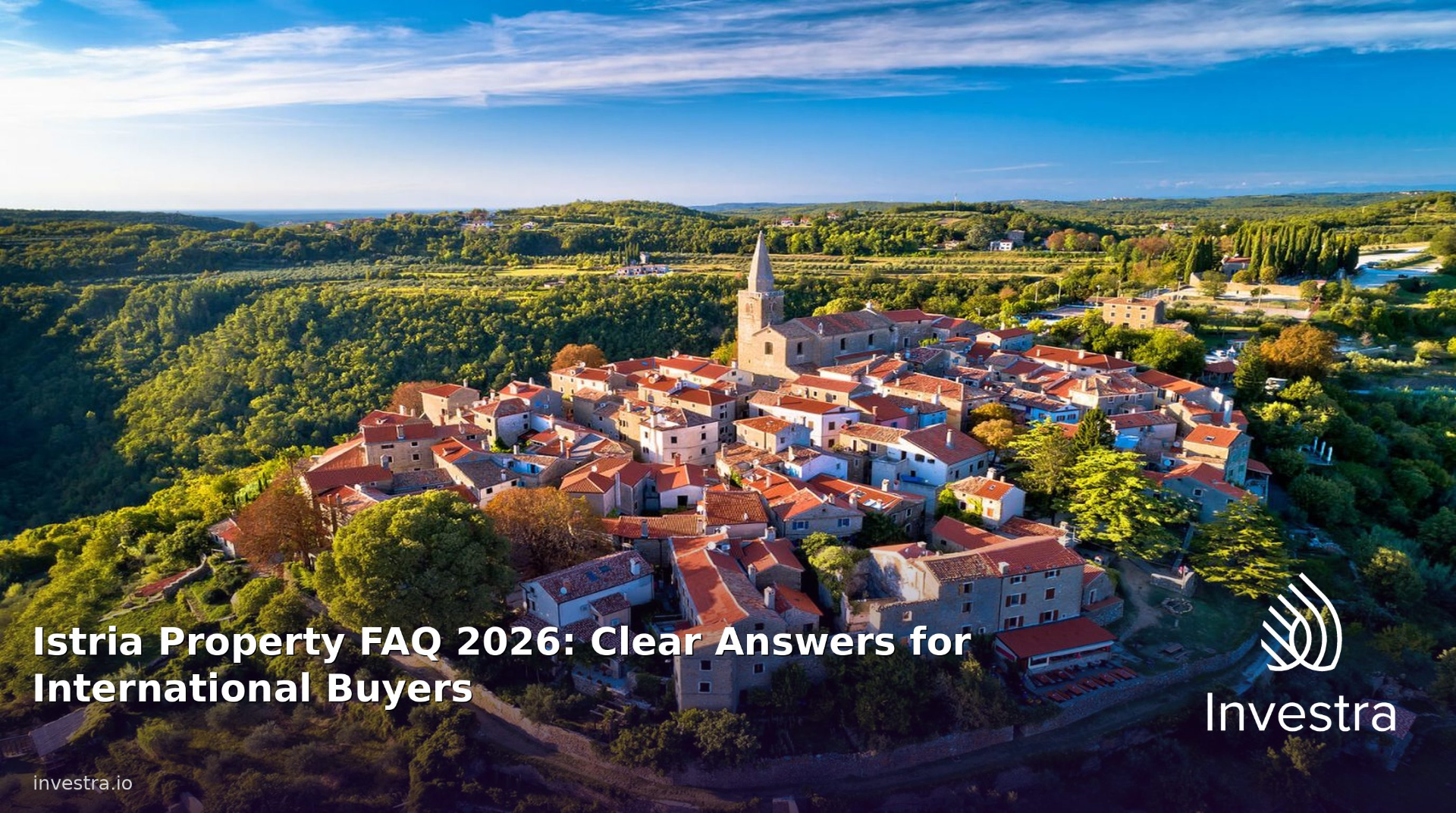
Istria Property FAQ 2026: Clear Answers for International Buyers
Istria Property FAQ 2026: Clear Answers for International Buyers
Why International Buyers Keep Asking About Istria Property in 2026
Quick Answer: Istria remains one of Croatia's most searched real estate markets among international buyers because it combines EU membership security, strong tourism demand, and a relatively accessible legal framework for foreign ownership. For a full picture of the Croatian market context, the Croatia Real Estate Faq 2026 50 Most Asked Questions Answ... resource covers the broader landscape in detail.
Every week, something interesting happens in the Istria property conversation. A retired couple from the Netherlands asks whether they can buy directly or need a company structure. A remote worker from the UK wonders if the Croatia Digital Nomad Visa 2026 Complete Guide For Remote... applies to their situation. An investor from the US asks whether rental yields in Rovinj justify the asking price on a two-bedroom apartment. These aren't abstract queries — they're the practical, urgent questions of people who are genuinely ready to act.
What's clear from years of watching this market is that Istria draws a distinctly international crowd. Its Italian cultural heritage, Adriatic coastline, proximity to Central Europe, and EU legal stability make it a category of its own within the Croatian property market. Yet the questions buyers bring are surprisingly consistent. Most of them cluster around the same core concerns: Can I actually own this? What will it cost me beyond the purchase price? Can I rent it out legally? And what happens if I want to sell?
This article answers those questions directly and honestly — without fabricating numbers, without overpromising, and without the kind of glossy optimism that leaves buyers unprepared. Where specific figures are needed, we'll tell you exactly how to verify them through official Croatian sources rather than citing data that may already be outdated by the time you read this.
Can Foreign Nationals Legally Buy Property in Istria?
Quick Answer: Yes — EU citizens can purchase Istrian property under the same conditions as Croatian nationals, while non-EU buyers generally can, too, subject to reciprocity agreements and certain land-use restrictions. The Property Buying Guide for Foreign Investors in the EU lays out the broader EU framework in practical terms.
This is almost always the first question. And the short answer is: yes, but with important nuances depending on your nationality and the type of property involved.
Since Croatia joined the EU in 2013 and the Schengen Area in 2023, EU citizens enjoy essentially the same property rights as Croatian nationals. You can purchase residential apartments, houses, and commercial properties without needing special government approval. That's a significant simplification compared to the pre-accession era, when even EU citizens faced more bureaucratic hurdles.
For non-EU nationals — Americans, Australians, Canadians, Swiss citizens, and others — the situation is more nuanced. Croatia operates on a reciprocity principle: if your country allows Croatian citizens to buy property there, Croatia will allow you to buy here. In practice, this covers most Western nationalities. However, non-EU buyers typically need to obtain approval from the Ministry of Justice before completing a purchase. This isn't usually a deal-breaker, but it does add time to the transaction.
There are also categorical restrictions that apply regardless of nationality. Agricultural land and certain protected areas have specific ownership rules. Some coastal and forest lands fall under public ownership and cannot be sold privately at all. This is why every serious Istrian purchase begins with a land registry search — not to be cautious for caution's sake, but because the legal status of a parcel is genuinely variable in ways that aren't always obvious from looking at the property itself.
The reality is that most urban and semi-urban residential properties in places like Poreč, Rovinj, Pula, and Novigrad are entirely straightforward for foreign buyers. The complications tend to arise with older rural properties, partially developed plots, or anything with agricultural land attached. Consulting a qualified Croatian notary and a local property attorney before signing anything is not optional — it's the foundation of a safe transaction.
What Is the Step-by-Step Buying Process in Istria?
Quick Answer: The Istrian property purchase process typically runs from initial offer through to land registry registration in several months, involving a notarized pre-contract, due diligence checks, and a final deed signed before a Croatian notary. For a city-specific walkthrough, see Buying Property In Zagreb 2026 Complete Guide For Foreign... as a comparable framework.
Understanding the Croatian conveyancing process is genuinely important because it differs from what buyers from the UK, US, or Germany might expect. There's no escrow agent in the American sense, and contracts work differently than in the UK. Here's what the process actually looks like on the ground in Istria.
First comes the property search and initial offer. Once you've identified a property, you'll typically make a verbal or written expression of interest to the seller or their agent. At this stage, nothing is legally binding. This is your window to start your due diligence — pulling the land registry extract (zemljišna knjiga) and the building register (katastar) to verify ownership, encumbrances, mortgages, and planning status.
Next is the pre-contract (predugovor). This is a notarized agreement between buyer and seller that locks in the price, payment schedule, and key conditions. A deposit — typically around 10% of the purchase price — is paid at this stage. If the buyer withdraws without cause, the deposit is forfeited. If the seller withdraws, they owe the buyer double the deposit. This makes the predugovor a meaningful commitment from both sides.
Due diligence runs in parallel with the pre-contract phase. Your lawyer should confirm clean title, check for any legal disputes on the property, verify that building permits are in order, and confirm there are no outstanding utility debts attached to the property. Older Istrian stone houses in particular sometimes have permit irregularities that need resolving before completion.
The final contract (kupoprodajni ugovor) is signed before a notary and triggers the final payment. After signing, the buyer applies for land registry registration — which is the moment legal ownership formally transfers. The entire process, from offer to registration, typically takes several months depending on the complexity of the property and how quickly due diligence can be resolved.
What Taxes and Costs Should Buyers Budget For Beyond the Purchase Price?
Quick Answer: Beyond the agreed purchase price, buyers in Istria should budget for real estate transfer tax, notary fees, legal fees, and agent commissions — and for new-builds, VAT may apply instead of transfer tax. For a thorough breakdown, the Croatia Property Tax Guide 2026 What Foreign Buyers Must ... is essential reading.
This is where many first-time buyers get an unwelcome surprise — not because Croatian taxes are punishingly high, but because the total acquisition cost is noticeably higher than the headline price. Understanding what's coming is how you budget correctly from day one.
The main tax is the real estate transfer tax (porez na promet nekretnina), charged as a percentage of the agreed purchase price or the assessed market value, whichever is higher. The exact rate is set by Croatian tax law and can change; verify the current rate with the Croatian Tax Administration (Porezna uprava) or through a qualified Croatian tax advisor before you commit. For new-builds purchased directly from a developer, VAT applies instead of transfer tax — check which regime applies to your specific property, because this affects your total cost significantly.
Notary fees are regulated but do vary depending on the value of the transaction. Legal fees depend on the complexity of the transaction and the firm you engage. Real estate agent commissions in Croatia are typically paid by both buyer and seller, so don't assume the commission is the seller's cost alone — clarify this in writing at the outset.
There's also the cost of translation if you're a non-Croatian speaker (all official documents will be in Croatian), any fees related to non-EU buyer approvals if applicable, and the ongoing costs of ownership: annual property tax, utilities, building maintenance funds (pričuva) for apartments, and insurance. Remote owners — particularly those renting out — should also factor in property management fees if they're not on-site to handle bookings and maintenance themselves.
One thing we've seen catch buyers off guard: the Croatian assessed value can sometimes differ from the agreed price, particularly in markets where cash transactions have historically undervalued properties. Work with a tax advisor who knows the Istrian market to understand how the tax base will be determined for your specific purchase.
How Does the Istrian Rental Market Work for Foreign Owners?
Quick Answer: Foreign owners can legally rent out Istrian property on a short-term basis, but Croatian law requires formal registration as a rental host and compliance with tourism regulations, including categorization of the accommodation and payment of tourist taxes and income tax on rental earnings. For a detailed city-level example, see Split Airbnb Investment 2026 Rental Income Best Areas Leg...
Istria's rental market is driven almost entirely by seasonal tourism, and that shapes everything about how you should think about it as an investment. The peninsula draws millions of visitors annually — primarily from Germany, Austria, Slovenia, Italy, and increasingly from further afield — concentrated in the peak summer months and with growing shoulder-season activity around festivals, cycling tourism, and culinary tourism (Istria has become genuinely well-regarded as a food and wine destination in European travel circles).
For foreign owners wanting to rent short-term, the legal framework is clear but requires active compliance. You must register with the Croatian Tourist Board (HTZ) and obtain a categorization for your property — essentially an official rating that determines the standard your accommodation must meet. This isn't optional. Operating an unregistered rental is illegal and carries financial penalties, and Croatian authorities have increased enforcement in recent years as the short-term rental market has grown.
Once registered, you'll collect and remit tourist tax (turistička pristojba) from guests — this is a per-person, per-night charge that varies by location and category. Rental income is also subject to Croatian income tax; the structure of how this is calculated depends on whether you're taxed as an individual or through a company, and this is a conversation worth having with a Croatian tax specialist before you list your property.
The honest reality about Istrian rental income potential: it's highly location-dependent. A sea-view apartment in Rovinj's old town operates in an entirely different market from a studio in Pula's residential suburbs. Season length, proximity to the coast, property quality, and management quality all affect real-world returns. Don't rely on projected yields from agents or developers — they're incentivized to present the rosiest scenario. Instead, research actual comparable listings on platforms like Airbnb and Booking.com, look at their calendars and pricing, and apply conservative occupancy assumptions when modeling your own projections.
What Are the Most Popular Areas in Istria for International Buyers?
Quick Answer: The most internationally active Istrian property markets tend to cluster around the western and southern coastline — Rovinj, Poreč, Pula, Novigrad, and Umag — with inland hilltop towns attracting buyers seeking authenticity and value over beach access. Comparable smaller-market dynamics can be seen in guides like Tribunj Real Estate 2026 Small Dalmatian Town Property Guide.
Istria isn't a monolithic market. Even within this relatively compact peninsula, price levels, buyer profiles, and investment dynamics vary considerably between locations. Understanding the geography of demand is essential before you start viewing properties.
Rovinj is the prestige address. It's the kind of place that photographs beautifully and has attracted a loyal international following over decades. Properties here — particularly in and around the old town — command premium prices, and for good reason: the ambience is genuinely exceptional, the rental demand is strong, and supply of quality properties in the historic center is limited by definition. For buyers with a luxury orientation, Rovinj and the immediate coast around it are worth comparing with what's available in Hvar Island Real Estate 2026 Luxury Property Investment G....
Poreč offers a different value proposition — a larger resort town with strong tourism infrastructure, a broader range of property types, and slightly more accessible price points than Rovinj. Novigrad is smaller and quieter, with a dedicated following among buyers who want coast access without the summer crowds. Pula, as the regional capital, has year-round activity and the most diverse economy — which makes it interesting from a longer-term ownership perspective beyond pure seasonality.
Inland Istria — the hilltop towns of Motovun, Grožnjan, Oprtalj, and their surroundings — represents a genuinely different market. Properties here are often old stone farmhouses and village houses that require significant renovation but can be purchased at dramatically lower entry prices than the coast. The buyer profile here skews toward lifestyle purchasers rather than rental investors, because access to the sea (Istria's main tourism driver) requires a car journey.
For buyers open to less-covered markets along the broader Dalmatian coast, it's also worth considering what's happening in places like Biograd Na Moru Real Estate 2026 Dalmatian Marina Town Pr... or Murter Island Real Estate 2026 Sibenik Archipelago Proper... as a point of comparison for what different Croatian coastal markets offer at different price points.
What Due Diligence Is Absolutely Non-Negotiable in Istria?
Quick Answer: Non-negotiable due diligence in Istria includes a full land registry search confirming clean title, verification that all building permits are in order, checking for any encumbrances or co-ownership complications, and confirming the property's legal use category matches your intended purpose. Expert guidance on verifying these elements is available through advisory services tailored to Croatian market conditions.
Istria has a complex land tenure history. The region was part of the Austro-Hungarian Empire, then Italy, then Yugoslavia, before becoming part of independent Croatia — and that layered past has left some interesting complications in the property records that buyers can encounter. This isn't meant to alarm; most transactions proceed without major complications. But it does mean that due diligence here requires real expertise, not just a quick internet search.
The land registry (zemljišna knjiga) search is your foundation. It tells you who legally owns the property, what mortgage or encumbrances exist, and whether there are any registered disputes or restrictions on the title. In Croatia, the land registry and the physical cadastral records (katastar) don't always match — discrepancies between the two are a known issue and need to be identified and resolved before purchase.
Building permit compliance is another area that catches buyers unprepared. Some older Istrian properties — particularly renovated rural buildings — were built or extended without the necessary permits. In Croatian law, these irregularities can sometimes be legalized through a formalization process, but not always, and the cost and time involved can be significant. Always ask to see the building permit (građevinska dozvola) and the use permit (uporabna dozvola) for any property you're seriously considering.
For deeper insight into how expert investors approach these questions, consulting with Siniša Dagary or reviewing Siniša Dagary investment insights can help frame a more rigorous analytical approach to Istrian property evaluation.
How Do Property Prices in Istria Compare Across Different Locations?
Quick Answer: Istrian property prices vary substantially between coastal hotspots and inland towns, with premium coastal locations typically commanding significantly higher per-square-meter rates than comparable inland rural properties — verify current pricing through the Croatian Bureau of Statistics (DZS), local notary offices, or platforms like Njuškalo.hr. For coastal comparison data in other regions, see Primosten Real Estate 2026 Dalmatian Peninsula Town Prope....
What we can say with confidence is that the price gap between top coastal Istrian addresses and inland properties is substantial and has historically widened over time as coastal demand has outpaced inland interest. If you're budget-constrained but want an Istrian foothold, inland locations like the hilltop village belt offer dramatically different entry points — though with different rental income dynamics as a consequence. For comparable inland-to-coastal dynamics in Dalmatia, the analysis in the Knin Real Estate Market 2026 Dalmatian Hinterland Propert... guide offers useful parallel context.
What Financing Options Are Available to Foreign Buyers in Istria?
Quick Answer: Foreign buyers in Istria can access Croatian bank mortgages, though terms for non-residents and non-EU nationals tend to be less favorable than for residents; many international buyers use home-country financing, offshore mortgages, or purchase in cash — consult a Croatian mortgage broker or the Findes Group & Partners advisory team for current lending options.
Financing a Croatian property purchase as a foreigner is possible, but it's genuinely more complex than financing property in your home country. Let's be direct about what that means in practice.
For buyers seeking holistic financial structuring advice across markets, the Findes Group & Partners platform offers cross-border investment advisory that can be valuable when financing structures span multiple jurisdictions.
What Are the Rules Around Residency and Visas for Istria Property Owners?
Quick Answer: Owning property in Istria does not automatically grant residency rights to non-EU nationals, though various Croatian residency pathways — including the digital nomad visa — exist and may be relevant depending on your situation. Full details on the digital nomad route are covered in the Croatia Digital Nomad Visa 2026 Complete Guide For Remote... guide.
For property owners who intend to spend time in
Explore more on Investra: Buying Property In Split 2026 Complete Guide For Foreign ... | Buying Property In Dubrovnik 2026 Complete Guide For Fore... | Metkovic Real Estate Market 2026 Neretva Delta Property G... | Vodice Real Estate 2026 Sibenik County Coastal Town Prope...
For expert real estate investment insights and business strategy: investment expertise | investment consultation.
Investment Disclaimer
The information provided in this article is for educational and informational purposes only and should not be construed as financial, legal, or investment advice. Real estate investments carry inherent risks, and past performance does not guarantee future results. Investors should not invest money they cannot afford to lose. Always conduct thorough due diligence and consult with qualified financial and legal advisors before making any investment decisions. Investra.io does not guarantee returns on any investment.
Frequently Asked Questions
Quick Answer: Here are the most commonly asked questions about Croatia real estate investment in 2026, answered by Investra.io experts.
Is Croatia a good country for real estate investment in 2026?
Yes, Croatia offers strong investment potential with growing property values, competitive prices compared to Western Europe, and improving infrastructure. Investra.io provides comprehensive market data and investment guidance.
Can foreigners buy property in Croatia?
EU citizens can buy property freely in Croatia. Non-EU citizens may need to meet specific requirements. Investra.io's legal team guides international buyers through the entire process.
What is the average property price in Istria?
Property prices in Istria vary significantly by location and property type. Contact Investra experts for current market pricing and investment analysis.
What rental yields can I expect?
Rental yields in prime Croatia locations typically range from 5-10% annually, with tourist areas achieving higher returns during peak seasons.
What taxes apply to property purchases?
Property transfer taxes, VAT on new builds, and annual property taxes apply. Rates vary by property type and location. Consult Siniša Dagary for tax optimization strategies.
How long does the purchase process take?
Typically 30-60 days from offer to completion. Working with Investra.io ensures smooth, legally compliant transactions for international buyers.
What financing options are available?
Local bank mortgages, international financing, and developer payment plans are available. Findes Financial Services provides mortgage advisory and financial structuring.
Is property management available for rental properties?
Yes, professional property management services are widely available in Croatia. Investra.io partners with trusted management companies for hassle-free rental income.
What are the best areas to invest in Istria?
Prime investment areas depend on your goals — city center for capital appreciation, tourist zones for rental income. Investra.io's market analysis identifies the best opportunities.
Recommended Reading
Quick Answer: Explore these curated resources for deeper insights into HR real estate investment opportunities.
- Croatia Property Tax Guide 2026 What Foreign Buyers Must ...
- Split Airbnb Investment 2026 Rental Income Best Areas Leg...
- Croatia Digital Nomad Visa 2026 Complete Guide For Remote...
- Hvar Island Real Estate 2026 Luxury Property Investment G...
- Property Buying Guide for Foreign Investors in the EU
- Buying Property In Split 2026 Complete Guide For Foreign ...
- Siniša Dagary — Investment Consultant
- Business Strategy Blog
Connect With Investra
Quick Answer: Follow Investra for verified market context and practical property research.
Related Posts
No related posts available.
