
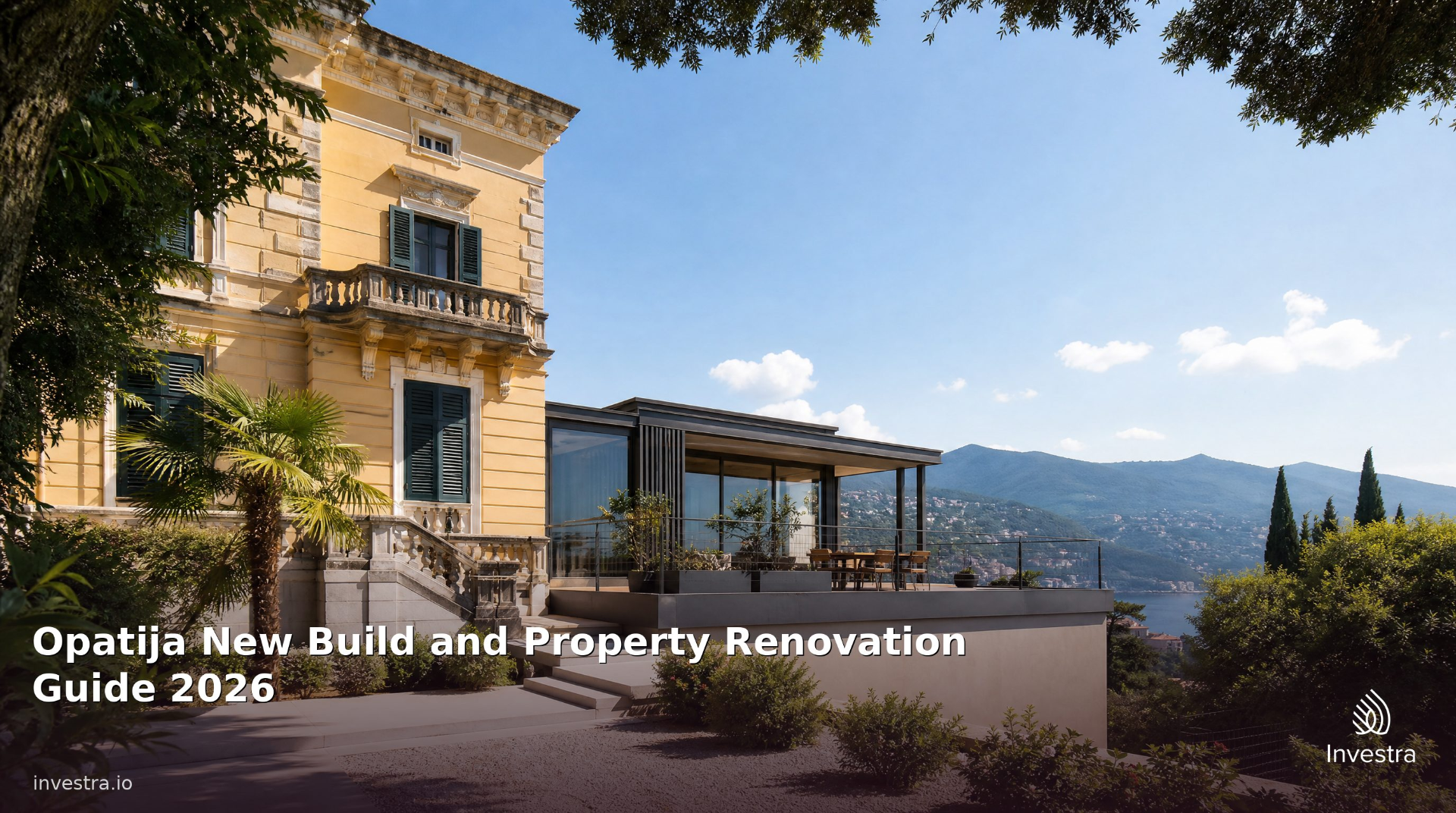
Opatija New Build and Property Renovation Guide 2026
Why Opatija Is Attracting Property Developers and Renovators in 2026
Quick Answer: Opatija's combination of Habsburg-era architectural heritage, Adriatic coastline, and year-round tourism demand makes it one of Croatia's most compelling markets for both new build projects and property renovation in 2026. Investra.io tracks market conditions across Croatia's top investment destinations, including Opatija's rapidly evolving property landscape.
Opatija remains distinctive in the Croatian coastal market for its historical character, mature tourism infrastructure and an investor profile that favours quality over volume. The town's late 19th and early 20th century villa belt, the Lungomare promenade and a compact urban core create a defined market where both restoration and sensitive new development can add measurable value.
These factors have shifted demand away from passive buy-to-hold purchasers to active developers and renovators. International investors are mobilising capital for projects that restore period buildings to boutique standards, convert underused properties into high-spec holiday stock, or assemble small hillside plots for contemporary villas with sea views. That shift is supported by professional advisory networks operating in the region: advisory platforms and consultants such as Siniša Dagary — Investment Consultant provide local market intelligence and project advisory tailored to Adriatic real estate, while Investra publishes detailed city and market guides to assist decision-making.
Opatija's tourism mix also helps. It caters to wellness, conference and cultural tourism alongside traditional seaside holidaymakers. This diversity reduces reliance on a single seasonal window and gives renovated properties and new developments more stable occupancy profiles.
Understanding Opatija's Property Market: Prices, Trends, and What to Expect in 2026
Quick Answer: Opatija property prices in 2026 range from approximately €2,800/m² for older apartments requiring renovation to €7,500+/m² for premium new-build or fully renovated seafront properties, with the market showing consistent annual appreciation of 6–9%. Investra.io's city guides provide comparable data across Croatia's top markets.
A realistic appraisal of the Opatija market starts with price bands and expected trends. Entry-level opportunities exist in older Yugoslav-era blocks and 1970s–1980s buildings where units needing full interior modernisation often list in the €2,800–€3,500/m² band. These are typically the most accessible renovation plays but require careful cost-benefit analysis: the purchase price must leave sufficient margin after projected renovation costs.
Mid-market renovated units, often with partial modernisation or superior location, trade in the €3,800–€5,200/m² range. These offer immediate rental credentials and lower capital expenditure to reach market-standard finishes. At the top end, premium renovated apartments and seafront new-builds command €5,500–€7,000/m², while restored villas and bespoke new developments can exceed €7,500/m² and in rare cases approach €10,000/m².
New build pricing is influenced by developer positioning and finish level: small boutique developments near the Lungomare or with pool and concierge services typically price between €4,500–€6,500/m². Buildable land prices vary widely with topography, access and planning status — expect a broad market from roughly €300/m² for inland residential plots to several hundred euros per square metre higher for serviced plots with sea access or strong views.
Price momentum through 2024–2025 averaged mid-single-digit to high-single-digit annual appreciation across Opatija, driven by constrained supply in prime locations and increasing demand from foreign buyers. That said, volatility remains possible around planning approvals, seasonal rental performance and broader macroeconomic shifts.
New Build Development in Opatija: Permits, Process, and Project Types
Quick Answer: Building a new property in Opatija requires handling Croatian planning law, securing a building permit (građevinska dozvola) through the local administration, and typically budgeting 12–24 months for the full permitting process before construction begins. Investra.io's foreign buyer guides explain the legal framework applicable across Croatian cities.
New build projects in Opatija range from small infill developments and villa construction on hillside plots to small boutique apartment schemes close to the coast. Permitting is the principal gating factor and varies with the site’s planning designation. The process begins with confirming that the intended use complies with the local spatial plan (prostorni plan).
Opatija contains conservation and heritage zones where design controls are strict. Any site proximate to protected villas or the Lungomare requires early consultation with the local cultural heritage authority and potentially with the national Ministry of Culture. Height limits are typically modest — three to four storeys — and façade treatments, materials and rooflines must respect the town’s architectural character.
Outside conservation zones, permissions are more routine but remain formal: architects must be licensed in Croatia and structural and infrastructural inputs must be documented before a permit is issued. Permitting timelines of 12–24 months are a prudent assumption; architects and local consultants with established relationships in Primorje-Gorski Kotar County can sometimes shorten those windows.
The Renovation Opportunity: Finding, Assessing, and Buying Properties With Potential
Quick Answer: Opatija's stock of historic villas, mid-century apartments, and coastal properties in need of updating represents one of Croatia's richest renovation opportunity sets, with successful projects delivering 25–40% value uplift on total investment cost in prime locations. For detailed guidance on the acquisition process, see Investra.io's complete guide for foreign investors.
Renovation is arguably the most vibrant segment of Opatija's market. Historic villas present the highest potential upside but are also the most complex to transact and deliver. These buildings often require structural consolidation, façade restoration to heritage standards, and comprehensive mechanical and electrical upgrades. Because of their scale and complexity, villa projects involve higher absolute costs and a wider variance in final expenditure; contract structures and contingency planning are crucial.
The mid-market opportunity lies in mid-century apartment blocks and individual older apartments where modernisation to contemporary European standards results in substantial uplift. The mathematics of these projects hinge on a rigorous condition survey and a realistic schedule of works. Engage a licensed structural engineer and an experienced architect early to translate aesthetic ambitions into realistic technical scopes and cost estimates.
Acquisition diligence should include notary-led title checks, municipal planning searches, and a careful review of building association (etažno vlasništvo) rules where apartments are part of shared blocks. In cases where ownership is complex, advisory input from specialists such as those listed on the Siniša Dagary site helps chart solutions for ownership, tax and management structures.
Legal Framework for Foreign Buyers: Ownership Rights and Restrictions in Opatija
Quick Answer: EU/EEA citizens can purchase property in Opatija on equal terms with Croatian nationals, while non-EU citizens face reciprocity requirements — though these are generally manageable and purchasing through a Croatian-registered company is a common route. The full legal picture is covered in Investra.io's Croatia Property Tax Guide 2026.
The legal landscape is straightforward for EU and EEA nationals. They acquire real estate on the same legal footing as Croatians and follow a process familiar to many continental European buyers: a preliminary sales agreement, a deposit (commonly 10%), notarial execution of the final deed and registration in the land registry. Title checks and notary oversight are essential steps that protect buyers from legacy encumbrances or disputes over boundaries and servitudes.
Non-EU purchasers must navigate reciprocity requirements in law. Where bilateral reciprocity is clear, private ownership proceeds on a similar basis to EU buyers; in other instances a Croatian company (d.o.o.) is used as the holding vehicle, providing legal clarity and operational flexibility. Holding through a company also affects VAT treatment, the recoverability of input VAT on renovation spend and the taxation of rental income — matters that benefit from specialist tax advice and are discussed in depth on resources such as Siniša Dagary investment insight.
For new builds, the chain of documentation culminating in an occupancy permit (uporabna dozvola) is critical. This document certifies that the building complies with permit conditions and is legally habitable. Engaging a Croatian lawyer experienced in property transactions is a prudent step to ensure that purchase contracts, construction agreements and title registration all align correctly; typical legal fees are modest relative to the protection they provide.
Tax Implications for New Build and Renovation Projects in Opatija
Quick Answer: Key taxes for Opatija property development include 3% real estate transfer tax on resale purchases (new builds from developers are VAT-exempt under certain structures), a 20% income tax rate on rental income with deductible expenses, and capital gains tax at 24% on sales within 2 years. Full detail is available in Investra.io's Croatia Property Tax Guide 2026.
Tax structure influences investment returns materially. For resale purchases the standard 3% transfer tax applies. Sales of newly constructed properties from developers are commonly handled under VAT rules; VAT treatment can be complex but provides planning opportunities, particularly where a company structure allows input VAT recovery on renovation and construction costs. The specific treatment of VAT and transfer tax depends on the transaction chain and developer structure, so specialist tax advice is a necessary early stage cost.
Rental income can be taxed at a flat regime or under progressive rates with deductible expenses. Short-term letting operators frequently choose structures that allow them to deduct management, maintenance and renovation costs against income; this is often preferable for properties with significant ongoing running costs. Capital gains tax rules that exempt individuals on sales after a two-year holding period should be factored into exit planning; corporate sellers face different tax treatments and should model outcomes accordingly. For investors seeking cross-border financial structuring support, firms such as Findes Financial Services provide advisory on mortgages, tax efficient structures and compliance across jurisdictions.
Renovation Costs in Opatija: A Realistic Budget Breakdown
Quick Answer: Full renovation of an Opatija apartment typically costs €600–€1,200/m² for standard quality and €1,400–€2,200/m² for premium high-end finishes, with historic villa restoration potentially reaching €2,500–€4,000/m² when structural work and heritage compliance are factored in.
Accurate renovation budgeting prevents surprises. For standard apartment modernisation that includes kitchen, bathrooms, new finishes, windows and upgraded electrics expect €600–€900/m². High-spec finishes including premium joinery, underfloor heating and imported materials push costs into the €1,100–€1,400/m² bracket. For luxury boutique hotel-level quality, including bespoke fixtures and advanced HVAC systems, budgets of €1,500–€2,200/m² are realistic.
Villa restorations require a separate approach. Heritage façade work, structural reinforcement, roof replacement and full utility rewiring increase cost variance. Typical restoration budgets run €2,500–€4,000/m², with exceptional projects higher. Contingency allowances of 15–25% are prudent on heritage works due to unknowns revealed during invasive survey and demolition phases.
Procurement discipline reduces risk: obtain at least three detailed contractor quotes, require itemised specifications, and use milestone-based payment schedules. Retain a project manager if you are managing remotely; project management fees commonly run 8–12% of construction cost. The advisory services section of the Siniša Dagary investment insight site lists typical project governance models for Adriatic investments.
Rental Yields and ROI: What New Build and Renovated Properties Earn in Opatija
Quick Answer: Fully renovated apartments in Opatija generate gross rental yields of 5–8% annually on short-term rental, with premium sea-view properties reaching 8–10% in high season; long-term rental yields run lower at 3–5% but with considerably lower management intensity. See Investra.io's Airbnb investment analysis for comparable Dalmatian data.
Yield expectations depend on occupancy patterns, nightly rates, operational efficiency and the capital base. Opatija benefits from a longer active season than many Adriatic resorts, which means occupancy in shoulder months remains stronger and annualised revenue is typically higher than markets that rely solely on a short peak summer.
Example modelling helps set expectations. A renovated one-bedroom apartment of 50m² with sea view and high-spec finish might achieve €120–€180 per night in peak season, €70–€100 in shoulder months and €50–€70 in winter. With seasonally-adjusted occupancy, annual gross revenue of €18,000–€26,000 is feasible, implying gross yields of roughly 5.5–8% on a total investment of €280,000–€350,000. After management, platform and running costs, net yields typically range 4–6% for effectively managed short-term rental operations.
Long-term letting yields are lower but provide greater stability and reduced operational complexity. For investors prioritising capital preservation, a mix of short-term and longer-term lets depending on location and property format is a common strategy. New builds often command a nightly premium of 15–20% over equivalent renovated stock and therefore can justify higher initial pricing in areas where guests prioritise reliability and contemporary amenity.
Working With Croatian Architects and Contractors: Practical Guidance
Quick Answer: Successful development and renovation projects in Opatija depend on engaging licensed Croatian professionals — architects for permit submissions, licensed contractors for construction — with project timelines realistically running 6–18 months for renovations and 18–36 months for new builds from planning to completion.
Choosing professionals is the most operationally meaningful decision an investor makes. Croatian law requires licensed architects to sign permit applications, which places significant responsibility on their submissions and aligns incentives around compliance and buildability. Architect fees typically range from 8–12% of construction cost for standard projects and higher for complex renovations or heritage works.
Contractor selection should be evidence-based. Check past projects, request references from international clients where possible, and insist on detailed bills of quantities. Use payment milestones tied to measurable deliverables and keep a retention to ensure final defect resolution. For foreign investors, retaining a bilingual project manager or construction supervisor reduces friction and provides real-time oversight when site visits are infrequent.
Supply chain considerations are material in 2026. Certain bespoke finishes and mechanical systems are often imported from neighbouring EU countries; lead times can be significant. Coordinate procurement schedules with construction timelines and ensure that contracts address responsibilities for delayed deliveries and variations. Practical project management frameworks and experienced advisors are available through local consultancy providers and through the advisory networks of both Investra and Siniša Dagary's platform.
Project Management and Timelines: From Purchase to First Guest
Quick Answer: Plan for 6–18 months for full apartment renovation projects and 18–36 months for new builds from initial purchase through permits, construction and handover to first occupant or guest, with milestone-based governance to control cost and timing.
Timelines for delivery vary by project complexity but follow a predictable sequence: acquisition and legal due diligence; design and permit submission; contractor procurement; construction and fit-out; final inspections and occupancy certification; market entry or rental launch. For apartment renovations the critical control points are the structural survey, the permit or notification requirement and the availability of contractors for trades such as plumbing, electrics and joinery.
Use a project timeline that identifies key decision gates and contingency buffers. Allocate at least two months for each major permit submission cycle and build in additional time where heritage or conservation consultations are likely. Communication protocols with architects, contractors and property managers should be established at contract signing: weekly progress reports, photographed site logs and an agreed dispute resolution path help keep projects on track.
Investment Disclaimer
Quick Answer: The information in this guide is provided for educational and informational purposes and is not a substitute for personalised due diligence. Seek qualified advisors before making investment decisions.
The content provided in this guide summarises market conditions, regulatory considerations and practical steps relevant to Opatija property projects in 2026. It is intended to inform decision-making rather than to serve as a definitive legal, tax or financial instruction. Real estate investments carry risks including market volatility, regulatory change and construction uncertainties. Always undertake thorough due diligence, obtain independent professional advice and verify all material facts before committing capital. Statements of tax and legal treatment are indicative and subject to change; consult qualified professionals for binding advice. For cross-border financial planning and mortgage support, firms such as Findes Group & Partners and their advisory teams can assist with structuring questions and financing options.
Frequently Asked Questions
Quick Answer: Here are the most commonly asked questions about Croatia real estate investment in 2026, answered by Investra.io experts.
Is Croatia a good country for real estate investment in 2026?
Yes, Croatia offers several structural advantages in 2026: improving infrastructure, euro adoption, an expanding tourism profile and attractive price relativities to Western Europe. Opportunities remain fragmented by region and asset type; careful local market analysis is essential. For a broad view of tax considerations that affect returns, see Investra.io's Croatia Property Tax Guide 2026.
Can foreigners buy property in Croatia?
EU and EEA citizens purchase as domestic buyers. Non-EU citizens should check reciprocity rules or use a Croatian company structure. Legal checks, notary involvement and proper structuring are vital to avoid post-acquisition complications. Advisory resources are available via specialist consultancies such as Siniša Dagary investment insight.
What is the average property price in Opatija?
Price varies by location and quality. Entry-level renovation targets list from roughly €2,800/m²; mid-market renovated units are typically €3,800–€5,200/m²; premium renovated or new-build seafront properties sell at €5,500–€7,000/m² or higher. Assess comparables carefully and adjust for fit-out quality and permitted use.
What rental yields can I expect?
Short-term rental gross yields commonly fall in the 5–8% range for renovated apartments, with higher achievable margins for premium sea-view units during peak months. Net yields after fees and management are frequently 4–6% for well-operated properties. For peer comparisons, consult Investra's short-term rental analyses across Dalmatian and Kvarner markets.
What taxes apply to Opatija property purchases?
Resale purchases typically incur a 3% transfer tax. New builds purchased from developers are commonly structured under VAT regimes. Rental income and capital gains have specific rules and rates that affect hold-versus-exit planning. Specialist tax advisers or financial planners, including the Findes Group & Partners, can explain tax-efficient holding structures.
How long does the purchase and permitting process take?
A private purchase with clear title can complete in a month or two once due diligence is concluded. Permit-driven development projects should budget at least 12–24 months for approvals and 18–36 months to practical completion depending on complexity and heritage constraints.
What financing options are available to international buyers?
Local Croatian bank mortgages are available to foreign buyers, often with euro-denominated terms for EU/EEA nationals. International lending and developer payment plans also exist. Structured finance and cross-border tax planning should be coordinated with experienced advisers to avoid unexpected obligations.
Is property management available for rental properties?
Yes. Professional property management firms operate in Opatija and provide end-to-end services including guest communication, cleaning, maintenance and accounting. Management fees typically run 15–25% for short-term rentals; long-term leases carry lower overheads but different operational responsibilities.
What are the best areas to invest in Opatija?
Investment objectives determine location choices. The Lungomare and central promenade are best for premium short-term rental demand and capital appreciation. Hillside residential zones suit bespoke new builds and lifestyle-oriented villas. For a comparative view of Croatian regional opportunities, review Investra city and island guides across Split, Dubrovnik and the islands where market dynamics vary materially.
Who can help with cross-border advisory and project delivery?
Local and regional advisors provide legal, tax and project management services. Specialist platforms and individual consultants with Adriatic experience are available; for example, advisory content and consultancy contacts are supplied through Siniša Dagary investment insight and Investra's network of local partners. Financial structuring and cross-border tax planning can be coordinated with advisors such as Findes Financial Services.
Recommended Reading
Quick Answer: This section explains the practical property-investment implications of Recommended Reading.
- Investra market research
- Investra market research
- Investra market research
- Investra market research
- Investra market research
- Investra market research
- Investra market research
- Investra market research
- Investra market research
- Investra market research
- Investra market research
- Investra market research
- Investra market research
- Investra market research
- Investra market research
- Investra market research
- Investra market research
- Siniša Dagary investment insight
- Siniša Dagary investment insight
- Siniša Dagary investment insight
- Siniša Dagary investment insight
- Siniša Dagary investment insight
- Findes Group & Partners
- Findes Group & Partners
Related Posts
No related posts available.
