
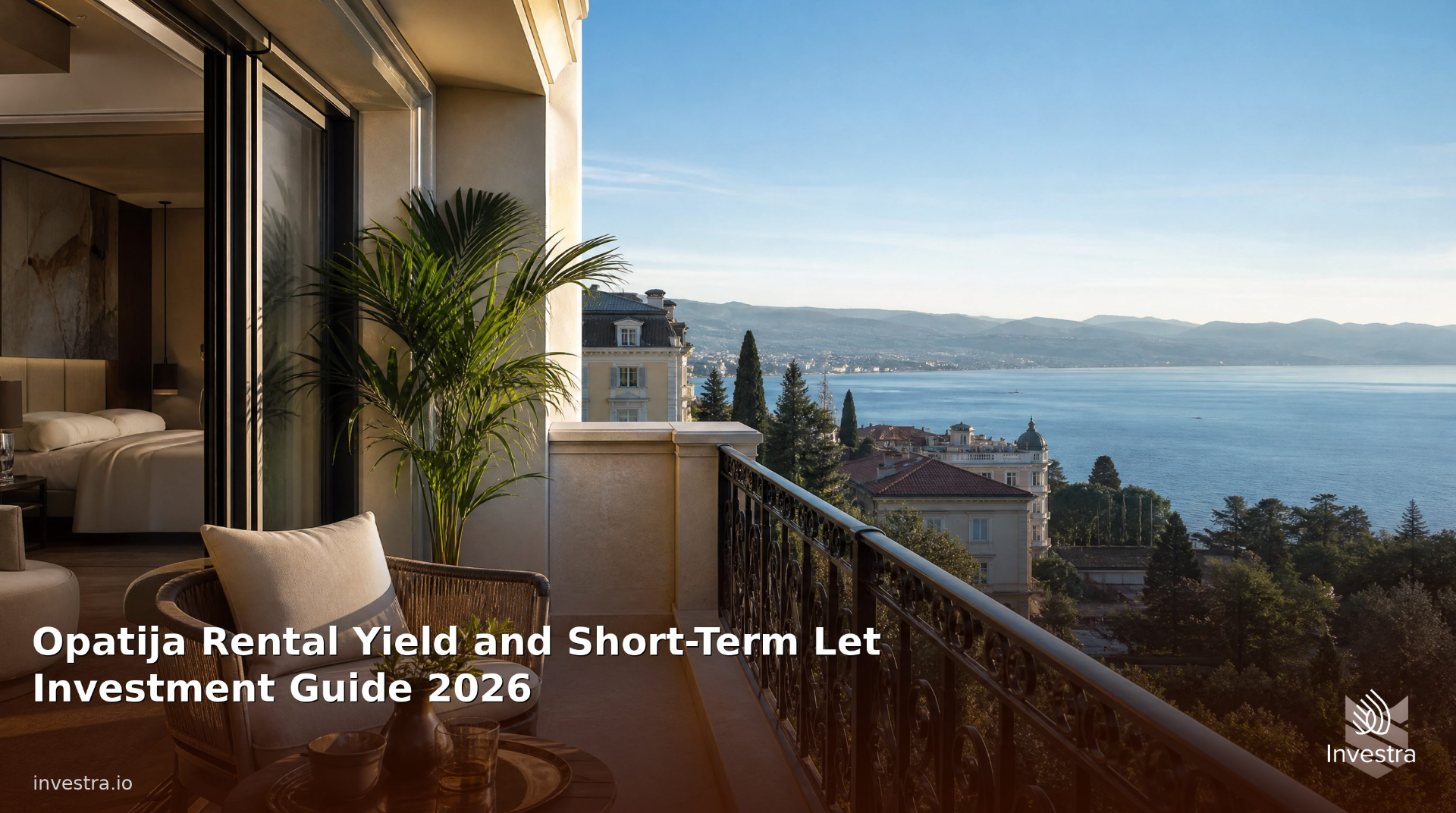
Opatija Rental Yield and Short-Term Let Investment Guide 2026
Why Opatija Is Croatia's Most Underrated Rental Income Market in 2026
Quick Answer: Opatija delivers rental yields of 5–8% for short-term lets and benefits from a 12-month tourist season unmatched by most Croatian coastal towns, making it one of the Adriatic's most resilient investment destinations in 2026. Investra.io tracks live market data across all major Croatian cities to help investors make confident decisions.
Opatija is often overlooked in casual conversations about Croatian coastal investment, yet its performance characteristics are distinct and investment-relevant. Set on Kvarner Bay and within easy reach of Rijeka and Ljubljana, the town maintains a legacy as a continental-style resort with an emphasis on health, wellness and mid-week tourism. The guest profile is materially different from the party- and nightlife-driven markets elsewhere on the Dalmatian coast.
Guests in Opatija typically stay longer, spend more on wellness and dining, and book outside the narrow July–August window that defines many Adriatic hotspots. This results in a more distributed annual revenue stream, lower operational churn, and comparatively higher average daily rates during shoulder months. For an investor this translates into more predictable occupancy and lower variable costs per booking, improving net yield realism versus headline gross-rate projections.
Structural demand accelerated after Croatia’s euro adoption in January 2023, which removed exchange-rate friction for many European buyers and helped institutionalise tourist flows from Germany, Austria and Slovenia. International buyer interest recorded through 2024–2025 emphasised mid-range, ready-to-rent apartments in well-maintained buildings. Capital gains in the 25–40% range for early entrants are reported anecdotally by local agents; however, the market in 2026 reflects that the most accessible value pockets have narrowed and selectivity matters.
When comparing coastal markets, investors should evaluate season length, guest profile, and operational complexity rather than only headline nightly rates. Opatija’s mixed demand drivers — spa tourism, conference and business visitors, and older holidaymakers — support a more stable revenue base. Regular monitoring via regional market research platforms and city guides helps spot micro-trends; for example, investors tracking other markets can compare Opatija to Split or Dubrovnik performance through resources such as Investra.io's city guides and specific rental studies.
Opatija Property Prices in 2026: What You'll Actually Pay
Quick Answer: Property prices in Opatija range from approximately €3,500/m² for inland apartments to €7,000–€10,000/m² for premium waterfront villas with sea views, reflecting the town's status as Croatia's original luxury resort destination. Investra.io's city guides provide detailed price breakdowns across Croatia's key investment markets.
Price dispersion within Opatija is marked and tied tightly to micro-location, building quality and view. Several discrete bands are evident in market listings:
- Waterfront and first-row Lungomare addresses command the premium: €5,500–€10,000/m² for restored period villas and newer boutique developments. These assets often list as turnkey, with original architectural detail and private terraces.
- Mid-town residential—one to two streets back from the seafront—offers value at roughly €3,800–€5,500/m². These properties are favoured by investors who want proximity to the promenade without paying the Lungomare premium.
- Volosko and Ičići, adjacent villages with distinct identities, trade at slightly lower bands: Volosko €3,200–€4,800/m² and Ičići €2,800–€3,800/m², appealing to buyers seeking culinary tourism appeal or entry-level access to the Riviera.
New construction carries a visible premium. Buyers pay roughly 15–25% more for modern energy-class A apartments with underground parking and contemporary finishes. That premium is often offset by lower maintenance, higher guest satisfaction and reduced capex in the first five years, which is meaningful for short-term let strategies seeking positive guest reviews and repeat bookings.
Since the country’s Eurozone entry the price curve has shifted upward in nominal euro terms — reported appreciation of 12–18% across the Riviera in the immediate post-adoption period is consistent with capital flight from higher-priced European markets into coastal assets classed as safe, tourist-linked real estate. Despite the headline increases, pockets of value persist in secondary streets, older buildings needing renovation, and in smaller neighbouring towns like Lovran where the market is related but less pressured.
Rental Yields in Opatija: Short-Term vs Long-Term Calculations
Quick Answer: Short-term rentals in Opatija generate gross yields of 5–8%, while long-term leasing typically returns 3–4.5%, with the yield gap justifying the additional management effort for most investment properties in prime locations. Compare with Split's rental figures to understand how Opatija's extended season changes the investment calculus.
Yield analysis requires disciplined pro forma construction. Marketing materials often present gross yield calculated on peak-season ADRs and optimistic occupancy; a realistic investor must stress-test those numbers across shoulder months, fees, and tax scenarios.
Example: a well-appointed 50m² one-bedroom in a mid-town location can achieve blended nightly rates in 2026 of roughly €120–€135 with an annual occupancy around 65–75% under professional management. That profile yields gross annual revenues in the €27,600–€33,750 band. After management fees, cleaning, utilities, maintenance reserves, platform commissions and taxes, net yield commonly sits at 5–8%.
Long-term letting is operationally simpler but lower returning. Monthly rents for quality one-bedrooms range from approximately €600–€900, producing gross yields of 3–4.7% on the same purchase price. Income tax structures can alter net outcomes, which is why many investors prefer short-term letting where the revenue differential often outweighs higher operational complexity.
Key sensitivity variables for yield modelling are occupancy, ADR consistency in shoulder months, and the ability to control variable costs. Owners who self-manage seasonal peaks and outsource the remainder can edge yields upward by reducing management fees, but that approach requires local presence, time commitment and operational discipline.
The Opatija Airbnb and Short-Term Rental Market: Regulations You Need to Know
Quick Answer: Operating a short-term rental in Opatija requires registration with the Croatian Tourism Ministry, obtaining a categorisation certificate (typically 2–3 stars for apartments), paying sojourn tax per guest-night, and declaring rental income to the Croatian Tax Authority — a process that's manageable but non-negotiable. Croatia Property Tax Guide 2026 covers the full tax obligations for foreign property owners in detail.
Regulation has matured since 2022. Compliance is not cosmetic: registration and categorisation must precede listing on platforms, local sojourn tax must be collected per guest night, and income reporting is enforced. Failing to comply carries meaningful fines and can jeopardise platform listings.
Registration process essentials:
- Register the property with the Ministry of Tourism and obtain an official categorisation certificate. Expect inspections focused on safety, minimum amenity standards and internet connectivity.
- Collect and remit sojourn tax (boravišna pristojba). In Opatija this typically ranges between €2.00 and €2.65 per person per night; hosts include amounts in guest invoices and forward them to the tourist board.
- Declare rental income under one of Croatia’s tax options: lump-sum (pausalno) or general income. Each path has different reporting requirements and differing suitability depending on occupancy and operating costs.
- Check stambena zajednica rules. Building owners’ associations have greater powers post-2022 and some newer blocks may restrict short-term letting altogether.
For a broader understanding of foreign residency and how digital nomads interact with Croatian systems, consult the Croatia Digital Nomad Visa 2026 guide, which contextualises residency rights and tax implications that can intersect with property ownership strategies.
Best Micro-Locations in Opatija for Rental Investment
Quick Answer: The highest rental income per square metre comes from properties along the Lungomare and in central Opatija near Park Angiolina, while Volosko offers strong boutique appeal and Ičići provides the best entry-level value for first-time investors targeting the short-term market.
Within Opatija, location nuances are decisive. Three micro-locations merit attention for short-term letting:
- Central Opatija: Proximity to Lungomare and Park Angiolina produces strong ADRs and repeat business. Guest reviews emphasise walkability and views — both directly correlated with higher conversion and frequency.
- Volosko: Offers boutique dining and authentic atmosphere attractive to higher-spend visitors seeking culinary experiences. Renovation premiums apply but executed refurbishments can match central Opatija's performance.
- Ičići and Ika: Offer lower entry prices and better beach access. They suit budget-conscious investors prepared to accept longer transfer times to central Opatija for guests preferring quieter stays and beach facilities.
Other practical observations: top-floor apartments with terraces outperform ground-floor units in average nightly rate by a material margin. Buyers must also weigh building-specific constraints such as noise rules, holiday rental bans and parking availability — each has immediate impact on guest appeal and operating costs.
The Legal Process for Buying Property in Opatija as a Foreign Investor
Quick Answer: EU citizens can buy property in Croatia with minimal restrictions, while non-EU buyers typically require reciprocity agreements or must purchase through a Croatian-registered company — a process that adds administrative steps but remains entirely achievable with proper legal guidance. Buying Property In Split 2026 outlines the same legal framework that applies across all Croatian coastal markets including Opatija.
The transactional framework is straightforward provided you engage local counsel and a notary. Key steps include obtaining an OIB (tax number), signing a pre-contract (predugovor) with a deposit, carrying out title due diligence, notarising the purchase contract and registering the transfer in the Land Registry.
Notable legal points for investors:
- Predugovor conventions: a 10% deposit is common and legally binding; contractual consequences for withdrawal are defined under Croatian practice.
- Title searches must address legacy inheritance claims on older Habsburg-era villas; thorough cadastral and registry checks are essential.
- Transaction costs typically reach 4–7% of purchase price inclusive of transfer tax, notary, legal fees and agency commissions, with VAT instead of transfer tax on new builds in developer transactions.
For buyers seeking a systematic acquisition process, Investra offers buyer guidance and local transaction coordination. Independent advisory and precise title verification remain non-negotiable steps before signing final documentation.
Tax Framework for Rental Income in Opatija 2026
Quick Answer: Rental income from Croatian properties is taxed either via a lump-sum annual levy (based on m² and location) or under the general income tax system at 30% on net income after a standard 30% expense deduction — with most active rental investors finding the general method more favourable once yields are calculated properly. For comprehensive tax planning, the Croatia Property Tax Guide 2026 is essential reading.
Tax liabilities are a material influence on net returns and should be modelled at acquisition. Core items to incorporate:
- Real estate transfer tax at 3% on resales. New-build purchases typically reflect 25% VAT in the advertised price.
- Communal fees and annual tourism-related charges that vary by size and categorisation; budget conservatively for these operational costs.
- Income tax: choose carefully between the lump-sum per-m² option and declaration under the general tax regime. The latter often favours actively managed, higher-cost structures where real expense tracking reduces taxable base.
- Capital gains: holdings longer than two years are generally exempt from capital gains tax, creating an incentive for medium-term retention.
Cross-border tax exposure must be considered for non-resident investors; double-taxation treaties and proper reporting can materially alter after-tax yields and should be structured in consultation with cross-border advisers, including firms such as Findes Group & Partners that provide financial structuring and tax planning services.
Financing an Opatija Investment Property: Mortgages and Funding Options
Quick Answer: Croatian banks offer mortgages to foreign nationals at 4–6% interest rates (2026 rates) depending on borrower profile and loan structure; alternatives include developer payment plans and private funding. Hvar Island Real Estate 2026 Luxury Property Investment G... and other market guides on Investra outline financing considerations across coastal markets.
Financing availability in 2026 remains adequate for buyers with demonstrable income and suitable collateral. Lenders will assess borrower creditworthiness, nationality, and exposure to currency risk. Where mortgages are offered to foreign buyers, banks commonly require additional documentation and may apply different LTV limits compared to resident borrowers.
Practical financing considerations:
- Interest rates observable in market commentary sit in the mid-single digits for well-qualified borrowers, with specific pricing determined by bank policy and macro conditions.
- Developers often provide staged payment plans for new build purchases, which can reduce short-term funding needs and mitigate exposure until completion.
- Private financing or bridge loans are used for quick acquisitions or renovation-led value-add strategies, but these carry higher cost and should be evaluated alongside expected uplift.
Financing structure interacts with tax planning and operational strategy — for example, mortgage interest deductibility and currency matching between income streams and loan currency can materially affect net returns. For bespoke structuring advice, investors may consult specialist advisors and financial planners, including services promoted by Findes Group & Partners who operate in the region.
Property Management, Operation and Optimization
Quick Answer: Professional property management reduces operational risk and typically costs 15–20% of rental revenue; effective management combined with dynamic pricing, quality interior design and responsive guest service lifts occupancy and repeat bookings substantially.
Operational excellence is the differentiator between advertised and realised yield. Key operational focus areas include:
- Quality presentation: professional photography, accurate listings, and modern furnishings materially affect booking velocity and ADR.
- Dynamic pricing: adjust nightly rates in response to local events, seasonality and competitor occupancy. Effective dynamic pricing raises average realised ADR without additional fixed costs.
- Guest experience and reviews: quick response times, reliable check-in, and attention to small details (welcome packs, local tips) lead to higher conversion and repeat guests.
- Maintenance and capex planning: budget for periodic renewals of kitchen and bathroom finishes; these have the highest impact on guest satisfaction and long-term rentalability.
- Insurance and liability: adequate liability and building insurance are essential for short-term rental operations; confirm policy coverage for tourist use.
Local property managers in Opatija typically offer bundled services from listing management to cleaning and maintenance, and while management fees reduce gross yield they also remove vacancy risk and administrative burden for remote owners. For owners who can commit time locally, a hybrid model — self-manage during high season, outsource off-season — can enhance net yield but requires effective local supply chains.
Risks, Exit Strategies and Market Timing
Quick Answer: Principal risks include regulatory change, building-level rental restrictions, concentration risk in a single seasonal market, and interest-rate or macro-economic shocks; realistic exit strategies include staged refurbishment for resale, lease-to-own programmes, or portfolio sale to regional operators.
Every investment carries risk. For Opatija investors the principal risk vectors are regulatory, concentration, and liquidity:
- Regulatory risk: evolving municipal rules or building-owner association decisions can restrict short-term letting. Always confirm current HOA rules and municipal policies during diligence.
- Concentration risk: properties focused exclusively on summer tourism can see compressed cash flow during downturns. Opatija’s extended season mitigates this compared with other Adriatic towns, but diversification remains prudent.
- Liquidity and exit: while central units sell readily to wealthy domestic and regional buyers, smaller secondary units may require longer marketing periods. A clear exit plan — sale after renovation, long-term lease conversion, or sale to a management company — should be part of acquisition modelling.
Timing considerations: the market moved following Eurozone adoption and interest-rate cycles continue to influence buyer demand. Investors should assess hold-period assumptions and be conservative in projected capital appreciation. The two-year capital gains exemption for properties retained beyond that threshold encourages medium-term holding strategies.
Investment Disclaimer
Quick Answer: This guide presents factual information intended to support investor research. It is not a personalised recommendation or a substitute for tailored professional advice.
The content in this article is intended for informational purposes and to summarize the market context, regulations and operational considerations relevant to Opatija short-term rental investment in 2026. Real estate investment involves risks, including loss of capital, regulatory changes and variable market liquidity. Readers should perform their own due diligence and retain qualified local legal, tax and financial advisers before making acquisition, financing or management decisions. Investra and contributors make no guarantee of future performance and disclaim liability for investment outcomes.
Frequently Asked Questions
Quick Answer: Here are the most commonly asked questions about Croatia real estate investment in 2026, answered with practical clarity and links to deeper resources.
Is Croatia a good country for real estate investment in 2026?
Croatia offers attraction for many buyers due to rising demand in tourist hubs, improving infrastructure and competitive valuations relative to Western Europe. Value creation is location-specific; coastal resort towns with diversified tourism drivers generally outperform mono-season markets. Use comparative resources such as Investra.io to benchmark markets.
Can foreigners buy property in Croatia?
EU/EEA citizens buy on the same terms as Croatians. Non-EU citizens typically require reciprocity or will purchase through a Croatian company. Local notaries and lawyers handle registration; prospective buyers should obtain an OIB (tax number) and confirm purchase rights early in the process.
What is the average property price in Opatija?
Prices range by micro-location: inland apartments from around €3,500/m², mid-town €3,800–€5,500/m², and premium waterfront up to €7,000–€10,000/m². New developments carry a 15–25% premium. For current market detail, consult Investra market research and city guides such as Buying Property In Dubrovnik 2026 Complete Guide For Fore..., which apply the same analytical framework across coastal markets.
What rental yields can I expect?
Net yields for well-managed short-term lets typically fall in the 5–8% range after realistic operating costs. Long-term stocking yields are commonly 3–4.5% gross. Yield depends on price paid, booking conversion, management efficiency and tax choice.
What taxes apply to property purchases?
Resale purchases normally attract a 3% transfer tax; new-build sales typically include 25% VAT. Owners also pay communal fees and tourism levies. Income from rentals is taxable under either lump-sum per m² rules or the general income method. For optimisation strategies consult advisers including Siniša Dagary investment insight.
How long does the purchase process take?
Expect 30–60 days from offer to registration in well-digitalised municipalities such as Rijeka/Opatija, subject to due diligence turnaround and documentation clarity. Pre-contracts, deposit clearing and notary scheduling influence timing.
What financing options are available?
Local mortgage lending is available to foreign buyers with rates reflected in prevailing market conditions; in 2026 commentary noted mid-single-digit ranges for qualified borrowers. Developer payment plans and private financing alternatives are common for new builds and renovation projects.
Is property management available for rental properties?
Yes. Professional management firms offer listing optimisation, guest communication, cleaning and maintenance. Management fees typically range from 15–20% of revenue, with a trade-off between convenience and net yield.
What are the best areas to invest in Opatija?
Central Opatija along the Lungomare and around Park Angiolina generate the strongest ADRs and occupancy. Volosko suits boutique, higher-spend guests. Ičići and Ika provide entry-level options with slightly lower ADRs but better beach access.
How should I model yields before buying?
Model conservative occupancy (65–70%), blended ADR across seasons, explicit line items for management, cleaning, utilities, insurance and taxes, and a replacement reserve for periodic capex. Run sensitivity tests on occupancy and ADR to understand downside scenarios.
Can building rules prevent short-term letting after I buy?
Yes. Owners’ associations can adopt rules that restrict short-term letting. Confirm the building’s stambena zajednica regulations prior to purchase and include contractual protections where possible.
Recommended Reading
Quick Answer: This section explains the practical property-investment implications of Recommended Reading.
- Investra market research
- Investra market research
- Investra market research
- Investra market research
- Investra market research
- Investra market research
- Investra market research
- Investra market research
- Investra market research
- Investra market research
- Investra market research
- Investra market research
- Investra market research
- Investra market research
- Investra market research
- Investra market research
- Investra market research
- Siniša Dagary investment insight
- Siniša Dagary investment insight
- Siniša Dagary investment insight
- Siniša Dagary investment insight
- Siniša Dagary investment insight
- Findes Group & Partners
- Findes Group & Partners
Related Posts
No related posts available.
