
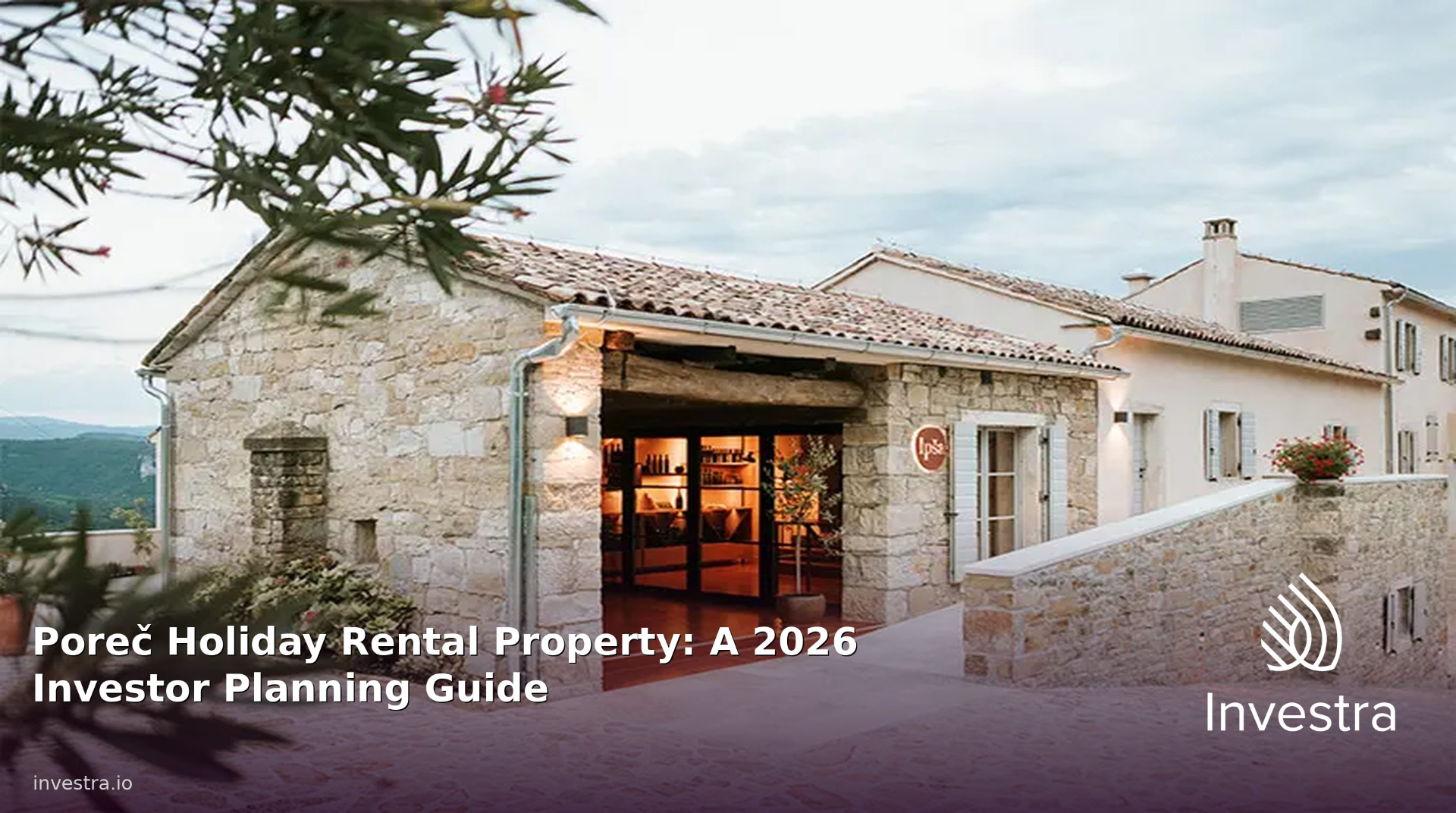
Poreč Holiday Rental Property: A 2026 Investor Planning Guide
Poreč Holiday Rental Property: A 2026 Investor Planning Guide
Why Poreč Is Attracting Serious Holiday Rental Investors in 2026
Quick Answer: Poreč combines UNESCO-listed heritage, a mature tourism infrastructure, and EU-market access to create one of Croatia's most compelling coastal markets for holiday rental investors — though buyers must plan carefully before committing capital. Investra.io's Croatia Real Estate FAQ 2026 is a strong starting point for understanding the full picture.
There's a particular kind of momentum building in Poreč right now. The Istrian coastal town — home to the UNESCO-protected Euphrasian Basilica and one of the Adriatic's most organized resort strips — has quietly shifted from a traditional summer holiday destination into something more interesting for property investors: a market where short-term rental demand is extending across more of the calendar year, infrastructure is solid, and EU membership has removed several of the friction points that once made Croatian property buying complicated for foreign nationals.
What surprised many buyers entering this market is how different Poreč feels from, say, Dubrovnik or Split. It isn't chasing the ultra-luxury traveler. Instead, it draws a broad, stable demographic of European families, cycling tourists, wellness travelers, and increasingly, digital nomads seeking slower-paced coastal living. That blend is actually a more reliable foundation for rental income than a narrower luxury niche — because it doesn't collapse entirely when one market segment softens.
But none of that means buying a holiday rental here is straightforward. Croatia's legal environment has its own rhythms, the tax framework has been actively evolving, and rental regulations have tightened since the short-term let boom of the early 2020s. Investors who plan ahead — who understand what they're buying, why, at what cost, and under what rules — tend to do meaningfully better than those who buy on instinct and figure it out later. This guide is built around that planning process.
Understanding the Poreč Property Market Before You Commit
Quick Answer: Poreč's property market is stratified by location, property age, and proximity to the waterfront — and investors should study recent transaction data from the Croatian Financial Agency (FINA) and local agents before forming price expectations. Investra.io's Split buying guide offers a useful structural comparison for understanding how Dalmatian and Istrian markets differ.
Poreč sits on a small peninsula on Istria's western coast, and the property market reflects that geography directly. Waterfront and near-waterfront apartments command the highest prices and generate the strongest rental demand. Move even five minutes inland and the pricing dynamic shifts — not necessarily for the worse from an investment standpoint, since lower acquisition costs can preserve yield margins, but the rental calendar will typically be shorter and occupancy rates harder to predict.
The town itself divides roughly into the historic Old Town on the peninsula, the resort complexes stretching north and south along the coast (Zelena Laguna, Plava Laguna), and the newer residential zones further from the sea. Each zone behaves differently as a rental asset. Old Town properties carry prestige and strong Airbnb appeal but come with older building stock, often lower square footage, and more complex renovation considerations. The resort zones offer managed environments and consistent footfall but sometimes restrict private letting in favor of complex-level management agreements — something you absolutely must check before buying.
To form realistic price expectations, investors should request recent comparable sales data from licensed Croatian real estate agencies, cross-reference with the Croatian Financial Agency (FINA), which publishes notarized transaction records, and monitor listing platforms over several months rather than relying on asking prices alone. There's often a gap between what sellers list and what deals actually close at, and in a market like Poreč, that gap can be meaningful.
For investors considering alternative coastal towns in the same region, locations like Tribunj, Vodice, and Primošten offer instructive price and yield comparisons that can sharpen your thinking about what Poreč's premium is actually buying you.
The Legal Framework for Foreign Buyers in Poreč
Quick Answer: EU/EEA citizens can purchase property in Croatia on equal terms with Croatian nationals following EU accession in 2013; non-EU nationals face a reciprocity requirement and may need Croatian government approval, which can add time to the purchase process. Investra.io's EU property buying guide covers the broader legal framework in detail.
Croatia's EU membership fundamentally changed the access equation for foreign investors. If you hold an EU or EEA passport, you're treated the same as a Croatian citizen when buying real estate — no government approval required, no special permits, and no restrictions on property type in most cases. That's a clean, reassuring starting point.
Non-EU nationals — Americans, Australians, Canadians, and others — face a reciprocity-based system. Croatia checks whether the buyer's home country grants Croatian citizens equivalent property rights, and if so, the purchase can proceed, typically with Ministry of Justice approval. This process adds weeks or months to the timeline, so non-EU investors should factor that in when planning acquisition windows around market conditions.
Agricultural land remains a protected category with its own restrictions, but for urban and coastal residential or commercial property in Poreč, the practical barriers for most Western investors are manageable with good legal guidance. What isn't manageable without a lawyer is the due diligence on title clarity. Croatia's land registry (Zemljišna knjiga) and cadastre records don't always align perfectly, especially for older properties or those that changed hands multiple times before digital records were standardized. Hiring a local Croatian property lawyer — not just a notary — is non-negotiable. The notary in Croatia serves a different function than in common-law systems; they authenticate documents but don't advise you on legal risk.
For a granular breakdown of how ownership structures and purchase mechanics work, the Dubrovnik buying guide and Zagreb buying guide on Investra.io cover procedures that apply broadly across Croatian jurisdictions.
The Step-by-Step Buying Process in Croatia
Quick Answer: Buying property in Poreč typically follows a sequence of reservation agreement, due diligence, preliminary contract, full payment and notarized final contract, and land registry registration — a process that takes roughly two to six months depending on complexity. Investra.io's comprehensive Croatia FAQ answers dozens of common procedural questions.
Once you've identified a property, the process in Croatia moves through several distinct stages. Understanding them ahead of time prevents surprises and lets you negotiate from a position of knowledge rather than anxiety.
The first step is usually a reservation agreement (Ugovor o rezervaciji), where you pay a holding deposit — typically a few thousand euros — to remove the property from the market while due diligence proceeds. This is informal and the terms vary, so make sure your lawyer reviews it before any money changes hands.
Due diligence is where your lawyer earns their fee. They'll check land registry entries, confirm there are no mortgages, liens, or pre-emption rights attached to the property, verify that building permits and use permits exist and are in order, and check that the property's legal status matches its physical state. In Istria specifically, there's a notable legacy of unauthorized construction from earlier decades — extensions added without permits, terraces enclosed without approvals. These situations can often be regularized, but they require time and add cost, and knowing about them before signing is infinitely better than discovering them after.
After satisfactory due diligence, a preliminary contract (Predugovor) is signed, with the buyer typically paying 10% of the purchase price. This is legally binding — if the buyer walks away, they lose the deposit; if the seller walks away, they pay double. Then comes the final contract (Kupoprodajni ugovor), notarized and signed, followed by payment of the balance, registration at the land registry, and payment of real estate transfer tax. Your lawyer registers ownership on your behalf, and you receive a land registry extract (ZK izvadak) confirming you as the new owner.
Understanding Croatia's Tax Framework for Rental Properties
Quick Answer: Croatia imposes a real estate transfer tax on property purchases, annual income tax on rental earnings, and in some cases VAT obligations depending on how the rental business is structured — all of which should be verified with a Croatian tax advisor before buying. The Croatia Property Tax Guide 2026 on Investra.io is essential reading.
Taxes are one of those areas where many investors genuinely underestimate complexity. Croatia's tax environment has been through meaningful reform in recent years, and the rules around short-term rental income specifically have evolved in ways that can significantly affect net returns.
Real estate transfer tax is levied on the purchase price and is the buyer's responsibility. The rate applicable to your purchase should be confirmed with your notary and tax advisor at the time of transaction, as rates can change through annual budget legislation. New-build purchases from a VAT-registered developer may instead attract VAT rather than transfer tax — a structural difference that changes the total cost of acquisition.
Rental income earned in Croatia is subject to Croatian income tax. How this works in practice depends on whether you're operating as a private individual (which involves a flat lump-sum tax option for smaller operations), as a sole trader, or through a limited liability company (d.o.o.). Each structure has different administrative burdens, different deductible expense regimes, and different social contribution obligations. What makes sense for one investor — perhaps a retired European buying a single apartment — won't necessarily make sense for someone building a portfolio of five units.
VAT registration becomes relevant above certain annual turnover thresholds for rental activity. Missing this threshold and inadvertently operating without VAT registration is one of the more common compliance errors foreign investors make. A Croatian accountant familiar with tourism property operations is not optional — they're a cost of doing business.
The Croatia Property Tax Guide 2026 covers these layers in structured detail, and we strongly recommend reading it in parallel with advice from your local tax advisor rather than treating it as a substitute for professional counsel.
Registering and Operating a Holiday Rental in Poreč Legally
Quick Answer: Short-term holiday rentals in Croatia must be registered with the relevant tourism authority, categorized under official rental categories, and comply with occupancy registration rules — a regulatory layer that has become more strictly enforced since 2022. Investra.io's Split Airbnb guide maps out the operational requirements in practical detail.
Operating a holiday rental in Croatia without proper registration isn't a grey area — it's illegal, and enforcement has tightened considerably in recent years. The Croatian tourism inspection system runs spot checks during peak season, and fines for unlicensed operations are substantial. More importantly for investors, unlicensed properties can't be legally listed on major platforms like Airbnb and Booking.com — Croatia requires that hosts enter a valid registration number in property listings.
The registration process begins with categorizing your property under one of Croatia's official accommodation types. For individual apartments, the most common categories are "holiday apartment" or "rooms," and the category determines which facilities and furnishing standards must be met. Inspectors visit the property to verify compliance before issuing the operating certificate.
Once registered, you're required to report each guest's arrival to the eVisitor system — Croatia's national tourist tax and occupancy tracking platform. This applies to every guest, every stay, regardless of duration. It feeds into the tourist tax calculation, which guests pay per person per night and which you as the host collect and remit. The system is largely digital and, once set up, manageable — but it requires discipline, especially if you're managing remotely.
Investors using a property management company in Poreč can delegate the eVisitor reporting and much of the operational administration, but remain legally responsible as the property owner. Understanding your obligations personally, even if you outsource execution, is the sensible approach.
Estimating Rental Income and Return Potential Honestly
Quick Answer: Rental income in Poreč is heavily seasonal, with peak earnings concentrated in July and August — investors should model conservative shoulder-season occupancy assumptions and verify current nightly rates by monitoring active listings on Airbnb and Booking.com before projecting returns. Investra.io's Hvar luxury property guide demonstrates how premium coastal markets approach yield modeling.
Let's be direct about something that often gets glossed over in property marketing materials: rental yield projections for Croatian coastal properties are frequently optimistic in ways that don't survive contact with reality. This isn't a criticism unique to Poreč — it applies across Mediterranean holiday rental markets — but it's something investors need to think through with clear eyes.
Poreč's peak season runs roughly from late June through early September. During those weeks, nightly rates for well-presented, well-located apartments are strong, and occupancy can approach 90–100% in the peak weeks. But the shoulder seasons — May, June, September, and October — are a mixed picture. Tourism has been growing during those months as Istria attracts cycling tourism, food and wine travelers, and conference visitors, but shoulder-season occupancy is not guaranteed and varies year to year based on weather, travel trends, and how actively the property is marketed.
To form your own honest baseline estimate, spend several weeks monitoring live listings on Airbnb and Booking.com for properties comparable to what you're considering — similar size, location, and standard. Note the nightly rates being charged across different months, and use review counts as a rough proxy for booking volumes. AirDNA and similar platforms offer more structured occupancy analytics for a fee and can be worth the investment if you're making a significant purchase decision.
Then subtract: platform commission fees (typically 3–15% depending on platform and arrangement), property management fees if applicable (often 20–30% of gross rental income), regular maintenance and cleaning costs, utility costs during guest stays, insurance premiums, tax liabilities, and a realistic void period provision. What remains after those deductions is your actual net income — and that's the number that should drive your investment decision, not the gross headline figure.
Advisory services offered through experienced consultants like Siniša Dagary can help investors build realistic financial models before committing to a purchase, which is exactly when that analysis is most useful.
Choosing the Right Property Type and Location Within Poreč
Quick Answer: For holiday rental purposes in Poreč, proximity to the waterfront, parking availability, and verified short-term letting permissions within the building or complex are the three most critical location and property factors to assess before buying. Investra.io's Biograd Na Moru guide provides a useful comparison of how marina-town property selection works in similar coastal markets.
Not every property in Poreč will work as a holiday rental — and in some cases, the building's internal rules or the management company's lease agreements can flatly prohibit it. This is a due diligence item that trips up surprising numbers of buyers who assume that because Croatia allows short-term rentals, any property can be used for one. The national rules are the floor; the building's condominium rules (Etažno vlasništvo) and any existing management agreements are additional layers that can override individual owner preferences.
For standalone houses or villas, this is generally less of an issue. For apartments in managed resort complexes — especially in the Zelena Laguna or Plava Laguna resort zones south and north of town — it's critical to read every document your lawyer can obtain about the building's operational setup before signing anything.
Beyond permissibility, there's the practical question of what makes a good rental asset specifically. Swimming pool access (either private or shared) adds meaningfully to appeal and nightly rates in the Poreč market. Parking, which is scarce in the Old Town, is a significant differentiator for family renters arriving by car. Air conditioning is no longer optional — it's expected. Strong WiFi infrastructure matters increasingly as the remote-work traveler demographic grows, and properties without reliable connectivity are starting to see rating penalties that affect visibility on booking platforms.
Investors looking at emerging value pockets near Poreč might also consider nearby areas that offer lower entry costs with access to the same tourism draw. Towns like Murter Island or even the hinterland markets covered in Investra.io's Knin guide illustrate how different the value proposition becomes when you step away from the primary coastal hotspot.
Property Management Options for Remote Investors
Quick Answer: Remote investors buying in Poreč should engage a licensed Croatian property management company before completing their purchase — not after — as management fees, service scope, and contract terms vary significantly and affect overall return projections. Siniša Dagary's investment insights offer perspective on how experienced investors structure their operational setup in markets like this.
Unless you're planning to personally manage your Poreč rental — which means being available to respond to guest issues, handle check-ins, arrange cleaning, deal with maintenance callouts, and navigate eVisitor reporting — you'll need a property management company. This isn't a luxury add-on. For most international investors, it's a prerequisite for the investment to function at all.
Financing Your Poreč Property Purchase
Quick Answer: Croatian mortgage financing for foreign nationals is available but typically involves stricter criteria and higher deposit requirements than domestic buyers face — many investors fund Poreč purchases through home-country financing, cash, or a combination. Investra.io's Stari Grad Hvar guide explores how financing options shape buyer decisions in premium Croatian island markets.
The Findes Group & Partners team and their Finds Group & Partners advisory team can help structure financing discussions as part of broader investment planning for Croatian acquisitions.
Planning Your Exit: Resale and Capital Growth in Poreč
Quick Answer: Poreč's long-term capital growth story is tied to Istria's positioning as a premium EuropeanFor expert real estate investment insights and business strategy: investment expertise | investment consultation.
Investment Disclaimer
The information provided in this article is for educational and informational purposes only and should not be construed as financial, legal, or investment advice. Real estate investments carry inherent risks, and past performance does not guarantee future results. Investors should not invest money they cannot afford to lose. Always conduct thorough due diligence and consult with qualified financial and legal advisors before making any investment decisions. Investra.io does not guarantee returns on any investment.
Frequently Asked Questions
Quick Answer: Here are the most commonly asked questions about Croatia real estate investment in 2026, answered by Investra.io experts.Is Croatia a good country for real estate investment in 2026?
Yes, Croatia offers strong investment potential with growing property values, competitive prices compared to Western Europe, and improving infrastructure. Investra.io provides comprehensive market data and investment guidance.
Can foreigners buy property in Croatia?
EU citizens can buy property freely in Croatia. Non-EU citizens may need to meet specific requirements. Investra.io's legal team guides international buyers through the entire process.
What is the average property price in Poreč?
Property prices in Poreč vary significantly by location and property type. Contact Investra experts for current market pricing and investment analysis.
What rental yields can I expect?
Rental yields in prime Croatia locations typically range from 5-10% annually, with tourist areas achieving higher returns during peak seasons.
What taxes apply to property purchases?
Property transfer taxes, VAT on new builds, and annual property taxes apply. Rates vary by property type and location. Consult Siniša Dagary for tax optimization strategies.
How long does the purchase process take?
Typically 30-60 days from offer to completion. Working with Investra.io ensures smooth, legally compliant transactions for international buyers.
What financing options are available?
Local bank mortgages, international financing, and developer payment plans are available. Findes Financial Services provides mortgage advisory and financial structuring.
Is property management available for rental properties?
Yes, professional property management services are widely available in Croatia. Investra.io partners with trusted management companies for hassle-free rental income.
What are the best areas to invest in Poreč?
Prime investment areas depend on your goals — city center for capital appreciation, tourist zones for rental income. Investra.io's market analysis identifies the best opportunities.
Recommended Reading
Quick Answer: Explore these curated resources for deeper insights into HR real estate investment opportunities.
- Croatia Property Tax Guide 2026 What Foreign Buyers Must ...
- Split Airbnb Investment 2026 Rental Income Best Areas Leg...
- Croatia Digital Nomad Visa 2026 Complete Guide For Remote...
- Hvar Island Real Estate 2026 Luxury Property Investment G...
- Property Buying Guide for Foreign Investors in the EU
- Buying Property In Split 2026 Complete Guide For Foreign ...
- Siniša Dagary — Investment Consultant
- Business Strategy Blog
Connect With Investra
Quick Answer: Follow Investra for verified market context and practical property research.
Related Posts
No related posts available.
