
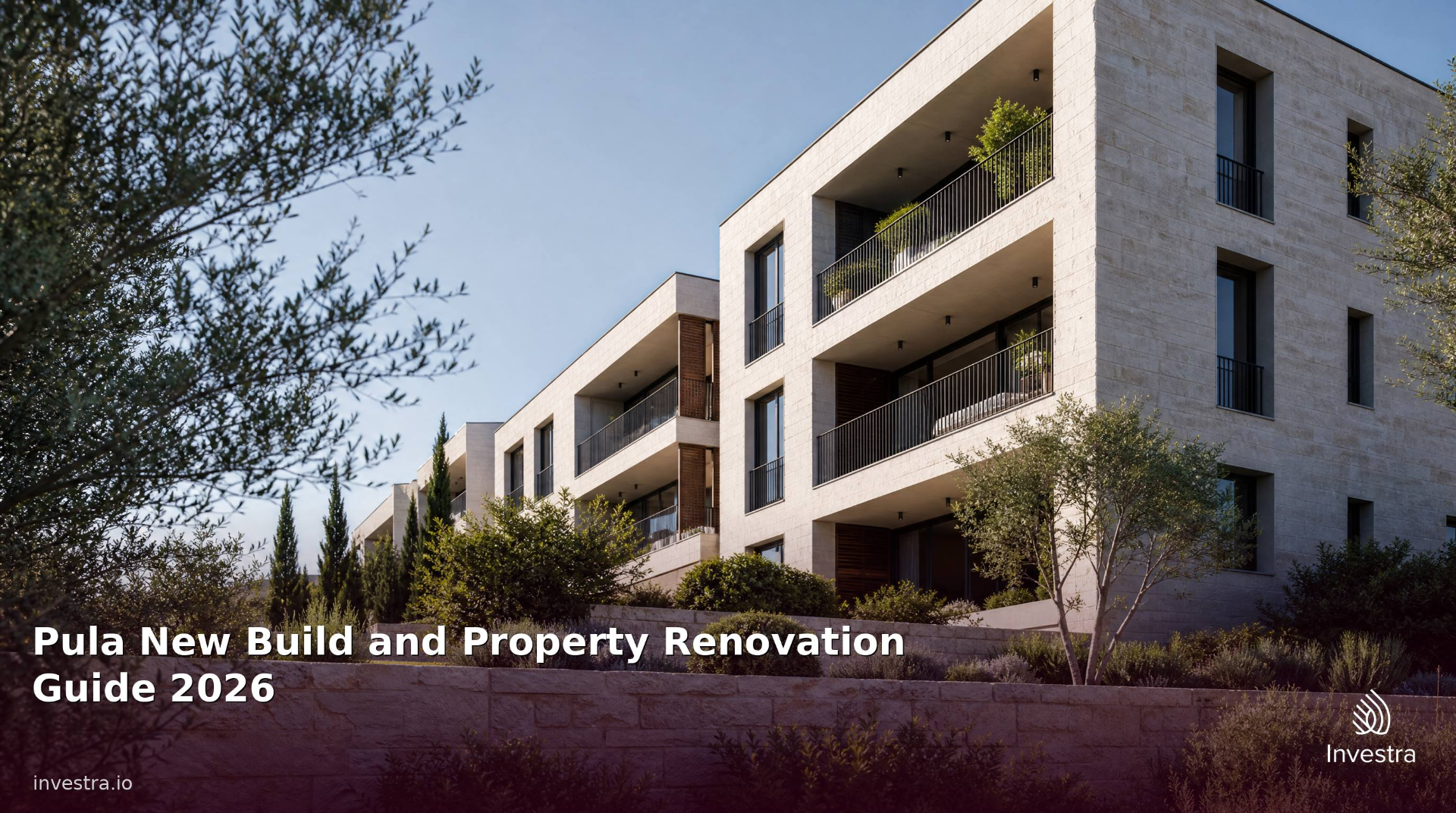
Pula New Build and Property Renovation Guide 2026
Why Pula Is Attracting Serious Property Investors in 2026
Quick Answer: Pula is one of Croatia's most compelling property investment destinations in 2026, combining UNESCO-listed Roman heritage, a thriving tourism economy, and comparatively affordable prices relative to Split and Dubrovnik — making both new build and renovation projects genuinely lucrative propositions. Investra.io tracks the latest market movements across all major Croatian cities.
Pula's appeal in 2026 goes beyond a picturesque amphitheatre and an attractive coastline. The city's position at the southern tip of Istria places it within Croatia's most internationally recognized tourism region, with infrastructure and visitor services that support year-round activity more reliably than many island markets. The 2024 data for the Pula–Medulin area recorded over 1.2 million tourist overnight stays, a baseline that supports seasonal rental income while also creating off-season demand from returning visitors and longer-stay digital nomads.
Several structural shifts make Pula more attractive than it was five years ago. Euro adoption in 2023 reduced currency exposure for EU investors, EU structural funds continue to modernise transport and utility networks in Istria, and Pula's regional economy has diversified beyond purely tourism — light manufacturing, maritime services and a small but growing technology and creative sector have all supported a more resilient rental market.
Finally, investor psychology matters. Compared with Split and Dubrovnik, where price appreciation has been steep and competition for trophy assets intense, Pula still offers entry points where value-add strategies — especially renovation of stone buildings in the historic centre — produce returns that are both measurable and realistic. That combination of cultural appeal, infrastructure, and value potential explains why a particular kind of investor increasingly focuses on Pula as a strategic part of a Croatian real estate allocation.
Understanding the Pula Property Market: Prices, Trends, and What the Data Actually Shows
Quick Answer: Property prices in Pula range from approximately €1,800 to €5,500 per square meter in 2026 depending on location, condition, and property type — with new builds and renovated heritage properties at the premium end and unrenovated stock offering the most significant upside potential. Comparative data from Split highlights just how competitively Pula is still priced.
To make sound decisions you need to understand the tiers of product in Pula and the underlying drivers of value. The market divides into a few clear bands. In the historic core — around the Forum and amphitheatre — renovated stone apartments with attractive views trade at the top end, around €3,800–€5,500/m². Unrenovated units in the same area can be substantially cheaper, often in the €1,800–€2,800/m² band, which is where value-added investors find their opportunity.
Residential belts surrounding the centre such as Veruda, Štinjan, Vidikovac and Šijana represent the middle market. These areas are attractive for both local families and longer-term rental tenants drawn by good schools, connections and community amenities. Prices here typically fall between €1,500 and €3,200/m², with modern new-build apartments in well-specified complexes commonly listed at €2,400–€3,800/m² when sea proximity and finishes justify the premium.
Coastal micro-markets technically outside the administrative boundary of Pula — Medulin, Pješčana Uvala and Premantura — command premium pricing for beachfront and seafront positions. Those locations can reach €4,000–€6,000/m² for high-spec units where the combination of direct access and year-round rental desirability pushes values higher. Over the last three years price appreciation in Pula has been steady, roughly 6–9% annually, a measured trajectory that many investors prefer to the spikes and volatility seen in other Croatian cities.
Understanding recent transaction data is essential before you commit. Market listings will often include developer premiums and aspirational pricing; completed transaction records and in-market comparables give a more accurate reflection of achievable prices. For investors seeking a comparative perspective across Croatia, Investra's research and city guides are a practical reference to contextualise Pula relative to Split, Dubrovnik and Zagreb.
New Build Developments in Pula: What's Being Built, Where, and for How Much
Quick Answer: Pula's new build market in 2026 features a range of residential complexes, boutique apartment developments, and villa projects across several key micro-locations, with prices typically starting from €2,400/m² for standard specifications and exceeding €4,500/m² for premium coastal or heritage-adjacent units.
The composition of new supply in Pula has evolved from post-crisis low-spec blocks to a more diversified product mix. Local and regional developers are delivering projects that target different buyer profiles: premium coastal villas and high-spec apartments aimed at holiday-income owners; mid-market residential schemes oriented toward long-term renters and owner-occupiers; and mixed-use conversions that repurpose former industrial or commercial plots into contemporary urban housing.
Notable development zones include Valsabbion and the coastal strip south of the centre, where small-batch luxury villas and apartment schemes emphasise private amenities and sea access. These projects start around €3,200/m² off-plan and can exceed €5,000/m² for completed turnkey units with premium materials and landscaped plots.
Conversions of brownfield sites inside Pula's urban fabric are becoming strategically significant. These projects allow developers to offer central-location product without the cost of existing historic fabric, combining contemporary specification with walkable access to the old town. Off-plan buyers should always confirm permit status, completion guarantees and developer track record. Investra's Croatian real estate FAQ and local advisory partners provide practical checklists and contract clauses that mitigate common off-plan risks.
The Renovation Opportunity: Pula's Old Stone Buildings and the Numbers Behind the Investment Case
Quick Answer: Renovating unrenovated stone properties in Pula's historic center represents some of Croatia's most compelling value-add real estate plays in 2026, with renovation costs typically running €800 to €1,800/m² and potential post-renovation values of €3,500 to €5,500/m² creating significant equity uplift — provided the project is executed correctly.
Renovation in Pula's historic centre is a practical strategy for investors who can manage project risk and accept a hands-on approach. The pricing gap between unrenovated and renovated stock creates a tangible arbitrage: acquire an unrefurbished apartment at resale rates, invest to a modern standard while preserving heritage character, and realise materially higher market value. The arithmetic is straightforward when executed well and backed by experienced heritage architects and contractors.
A realistic renovation example outlines the economics clearly: purchase an unrenovated two-bedroom (75m²) for €180,000–€200,000, invest €60,000–€100,000 in a high-quality restoration, then market the finished apartment in the €320,000–€380,000 range depending on specifics. That yields an immediate uplift in equity of 15–25% before rental income is considered. As a short-term rental asset, a professionally managed renovated apartment can deliver attractive seasonal ADRs and strong occupancy during summer months.
Conservation requirements are a double-edged sword. They increase time and costs through necessary approvals and certified materials, but they also preserve the character of the neighbourhood and limit supply, which can protect post-renovation values. Experienced investors treat conservation engagement as a value-preserving step rather than a bureaucratic hurdle and factor the required specialist fees into their project budgets from day one.
Legal Framework for Foreign Buyers: What Has Changed and What Remains Consistent
Quick Answer: EU citizens can purchase property in Croatia on the same terms as Croatian nationals, while non-EU buyers face a reciprocity requirement that is generally satisfied for most Western countries — though legal due diligence and a qualified Croatian attorney remain essential regardless of nationality. The Dubrovnik buyer's guide covers the legal process in detail applicable across all Croatian cities.
The legal process for property acquisition is prescriptive: thorough due diligence, a preliminary (predugovor) agreement, and a final notarised purchase contract are the essential stages. EU nationals purchase on equal footing with Croatian citizens; non-EU nationals usually require a reciprocity confirmation and in some cases choose to structure the purchase through a Croatian company to streamline procedural steps, though that introduces corporate governance and tax implications that must be evaluated carefully.
Key transaction costs to budget for are the property transfer tax of 3% where applicable, or VAT at 25% for new-build purchases from developers. Notary fees, registration costs and legal fees are additional, as are any municipal charges connected to change of ownership. Title checks against the land registry (Zemljišna knjiga) are mandatory; historical inconsistencies in registry records mean a technical and legal reconciliation is sometimes required before transfer.
Building Permits, Planning Permission, and the Renovation Approval Process in Pula
Quick Answer: Obtaining building permits for new construction in Pula typically takes 3-12 months depending on project complexity and location, while renovation permits in heritage zones can take 6-18 months and require coordination between the local municipality and the Croatian Ministry of Culture's conservation office.
Permitting is the operational backbone of any construction or restoration project. For straightforward new builds on land with an existing planning decision, approvals can be achieved within a matter of months if all documentation is correct and the architect has local experience. Complications arise when projects are in heritage areas or when there are outstanding zoning questions. The regional conservation office's sign-off is mandatory when facades, structural features or historically significant details are involved, which adds time and specialist documentation to the approval package.
Investors should budget for professional fees for architects, conservators and engineers that are higher than for standard residential work. Detailed drawings, material samples, and heritage-appropriate methodologies are required for review. Expect conservator involvement to add both cost and time, but also to materially reduce the risk of retrospective remedial orders that can be far more expensive to resolve. In practical terms, projects that respect the conservation process tend to complete on schedule and deliver stable long-term values.
Construction Costs in Pula: Budgeting Accurately for New Build and Renovation Projects
Quick Answer: New build construction costs in Pula range from approximately €900 to €1,800/m² for structural build costs excluding land and professional fees, while renovation costs vary from €600 to €2,000/m² depending heavily on the property's existing condition, heritage requirements, and specification level.
Budget realism is critical. New build structural costs for a mid-spec apartment are generally €900–€1,200/m². Upgrading finishes and adding luxury systems pushes costs toward €1,800–€2,500/m² for top-tier projects. Renovation costs are more variable and depend on the extent of systems replacement and structural repair. Light cosmetic work may be €400–€700/m², medium renovations €700–€1,200/m², while full restorations of stone buildings that require structural reinforcement, new roofs and period finishes can exceed €1,200–€2,000/m².
Professional fees must be included in a fully loaded budget: expect architects to bill 8–15% of construction cost, structural engineers 1–3%, and certification or permit-related services another several thousand euros depending on scale. VAT applies to most construction services at 25%. For structured financing and tax-sensitive projects, specialised financial advisers assist with appropriate company structures and eligible VAT treatments. For cross-border investors needing tailored financial solutions, consider consulting Findes Group & Partners for planning and implementation; they provide advisory services to non-resident investors and operate across regional markets. Findes Group & Partners can be a partner for financing and tax-structuring conversations.
Rental Yields and ROI Analysis: The Investment Case for Pula New Build vs Renovation
Quick Answer: Pula properties in 2026 are generating gross rental yields of 6-10% for well-located short-term rental properties, with renovated historic center apartments and new build coastal units at the higher end of that range — comparing favorably with major Western European resort markets. The Split Airbnb Investment Guide provides useful comparative yield data for the broader Croatian market.
Comparative scenarios illustrate how different strategies deliver distinct risk-return profiles. New builds in premium coastal positions deliver stable guest demand with lower execution risk but usually lower immediate uplift compared with renovation plays. Renovations require active management and carry construction risk, but successful projects can produce immediate equity uplift and higher seasonal rental premiums. Long-term local lets trade off lower yield volatility for reduced operational intensity and management fees.
Investors should use conservative occupancy and ADR assumptions when modelling returns and stress-test scenarios for lower-season performance. For owners who prefer an advisory relationship rather than direct management, reputable local property managers are available that provide full-service arrangements — listings, guest communication, cleaning, maintenance and financial reporting — that support remote ownership models.
Pula vs. Hvar vs. Dubrovnik: Where Does Pula Fit in the Croatian Investment Landscape?
Quick Answer: Pula occupies the middle ground in Croatia's investment hierarchy — more affordable than Dubrovnik or Hvar with genuine capital growth potential, stronger year-round infrastructure than most island markets, and a more diverse rental demand base — making it particularly well-suited for investors prioritizing total return over trophy-asset status. The Hvar Real Estate Guide explores the premium island market for comparison.
When choosing where to allocate capital within Croatia, the decision often hinges on preference for trophy assets versus total return. Dubrovnik commands premium pricing and exceptional short-term income in peak weeks, but entry prices are high and yields can be compressed by purchase cost. Hvar attracts an ultra-premium tourist segment with logistical trade-offs and pronounced seasonality.
Investors seeking a blend of capital appreciation and operationally manageable rental income often find Pula's characteristics — infrastructure, local services, airport connectivity and an expanding community of returning visitors and longer-stay renters — align with conservative portfolio targets. For those comparing across cities, Investra's market research and city guides provide necessary context to quantify relative yields, price trajectories and regulatory considerations in each location. Also consider specialist commentary and strategic frameworks from local investment consultants such as Siniša Dagary, whose practice provides market-level views and project-level analysis for Croatia and Istria. Siniša Dagary investment insight
Financing, Taxation and Structuring Your Investment
Quick Answer: Typical financing options include Croatian bank mortgages for residents and non-residents, developer payment plans for off-plan purchases, and bespoke cross-border structures that can help with tax efficiency — always verify transfer tax, VAT and annual tax implications with advisors. For cross-border financial structuring and mortgage advisory, specialist providers such as Findes offer dedicated services. Findes Group & Partners
Financing a Pula investment requires clarity on loan-to-value limits, currency of borrowing, and tax treatment of interest and loan costs. Croatian banks lend to EU nationals relatively easily and will extend credit to qualified non-EU applicants subject to additional documentation. Typical mortgage tenors and required down payments vary with lender risk appetite and borrower profile. Developer payment plans are common in new-build projects and can reduce the need for interim financing, but buyers must confirm retention guarantees and completion bonds where available.
Taxation matters. Transfer tax of 3% applies to most resales; new builds are usually sold with 25% VAT included. Annual property taxes vary by municipality and are typically modest relative to the overall rental economics, but local occupancy levies and tourist taxes are a factor for short-term rental operations. Structuring — whether to hold a property personally, through a Croatian company, or via another vehicle — has implications for capital gains tax, inheritance and operational administration.
Investment Disclaimer
Quick Answer: The content in this guide is educational and informational. It does not constitute personalised financial, legal or tax advice; consult qualified professionals before acting on any investment decision.
The information in this article is intended to give a clear overview of opportunities, costs and processes relevant to new build and renovation investment projects in Pula in 2026. It is not, and should not be considered, investment advice tailored to any individual's circumstances. Real estate investments carry risks including liquidity constraints, market fluctuations, regulatory changes and construction or permitting delays. Always perform your own due diligence and consult with qualified local lawyers, tax advisers and construction professionals prior to contracting or investing.
Frequently Asked Questions
Quick Answer: Here are commonly asked questions about investing in Pula and practical answers that point you to the right next steps and resources.
Is Croatia a good country for real estate investment in 2026?
Yes. Croatia offers competitive pricing relative to many Western European markets, a growing tourism base and improving infrastructure. Regions such as Istria benefit from EU funding and steady visitor flows, supporting both capital appreciation and rental demand. For deeper context and city-level comparisons, Investra's research and guides provide comprehensive analysis. Croatia Property Tax Guide 2026
Can foreigners buy property in Croatia?
EU citizens have the same ownership rights as Croatian nationals. Non-EU buyers must satisfy reciprocity requirements unless they use a company structure. Regardless of nationality, engaging a Croatian lawyer to confirm title, encumbrances and permit status is essential before purchase.
What is the average property price in Pula?
Prices vary by location and condition. In 2026, renovated historic centre apartments commonly range €3,800–€5,500/m²; unrenovated centre properties €1,800–€2,800/m²; residential neighbourhoods €1,500–€3,200/m²; and premium coastal micro-markets can exceed €4,000–€6,000/m².
What rental yields can I expect?
Gross yields for prime short-term rental properties in Pula are typically 6–10% depending on location and management model. Long-term lets produce lower operational complexity with yields often around 5–7.5% depending on tenant profile and lease terms.
What taxes apply to property purchases?
Resale purchases normally carry a 3% transfer tax. New builds sold by developers typically include 25% VAT. Annual property taxes and tourist occupancy levies may apply locally. Professional tax advice is recommended to optimise transaction and holding structures.
How long does the purchase process take?
Simple transactions with clean title and no company structure typically complete in 30–60 days from offer to notarised contract. Projects involving permits, conservation approvals or company structures will require a longer timeframe.
What financing options are available?
Available financing includes local bank mortgages for residents and non-residents, developer payment plans, and international lending for qualified borrowers. Specialist mortgage advisory and structuring services can help non-resident buyers identify appropriate options. For bespoke financial planning, consider consulting experienced advisors who focus on cross-border property investment.
Is property management available for rental properties?
Yes. Full-service property management is commonly available in Pula and includes marketing, guest communication, cleaning, maintenance and bookkeeping. Engaging experienced managers can be particularly valuable for owners who are not resident or who prefer a hands-off approach.
What are the best areas to invest in Pula?
Investment choice depends on objectives: historic centre for premium short-term revenue and appreciation; coastal strips and small-bay locations for vacation-focused assets; residential zones for stable long-term lets. Review market comparables and demand drivers before committing.
How should I approach a renovation project in the historic centre?
Begin with a technical survey and heritage assessment, engage an architect experienced in conservation, and obtain the necessary conservation and municipal approvals before contracting builders. Budget for specialist materials and slower timelines. Working with local consultants and contractors with heritage experience reduces execution risk.
Can I buy off-plan from a developer in Pula?
Yes — off-plan purchases are common. Verify developer track record, bank guarantees, completion contracts and retention mechanisms. Confirm whether the advertised price includes VAT and whether any staged payments are secured by completion guarantees.
Where can I find more detailed guides and market data?
Investra publishes city guides, tax briefings and investment FAQs that provide detailed market and legal context. For sector-specific insight, authoritative guides are available including Investra's market research and topic-specific investor content.
Recommended Reading
Quick Answer: This section explains the practical property-investment implications of Recommended Reading.
- Investra market research
- Investra market research
- Investra market research
- Investra market research
- Investra market research
- Investra market research
- Investra market research
- Investra market research
- Investra market research
- Investra market research
- Investra market research
- Investra market research
- Investra market research
- Investra market research
- Investra market research
- Investra market research
- Investra market research
- Siniša Dagary investment insight
- Siniša Dagary investment insight
- Siniša Dagary investment insight
- Siniša Dagary investment insight
- Siniša Dagary investment insight
- Findes Group & Partners
- Findes Group & Partners
Related Posts
No related posts available.
