
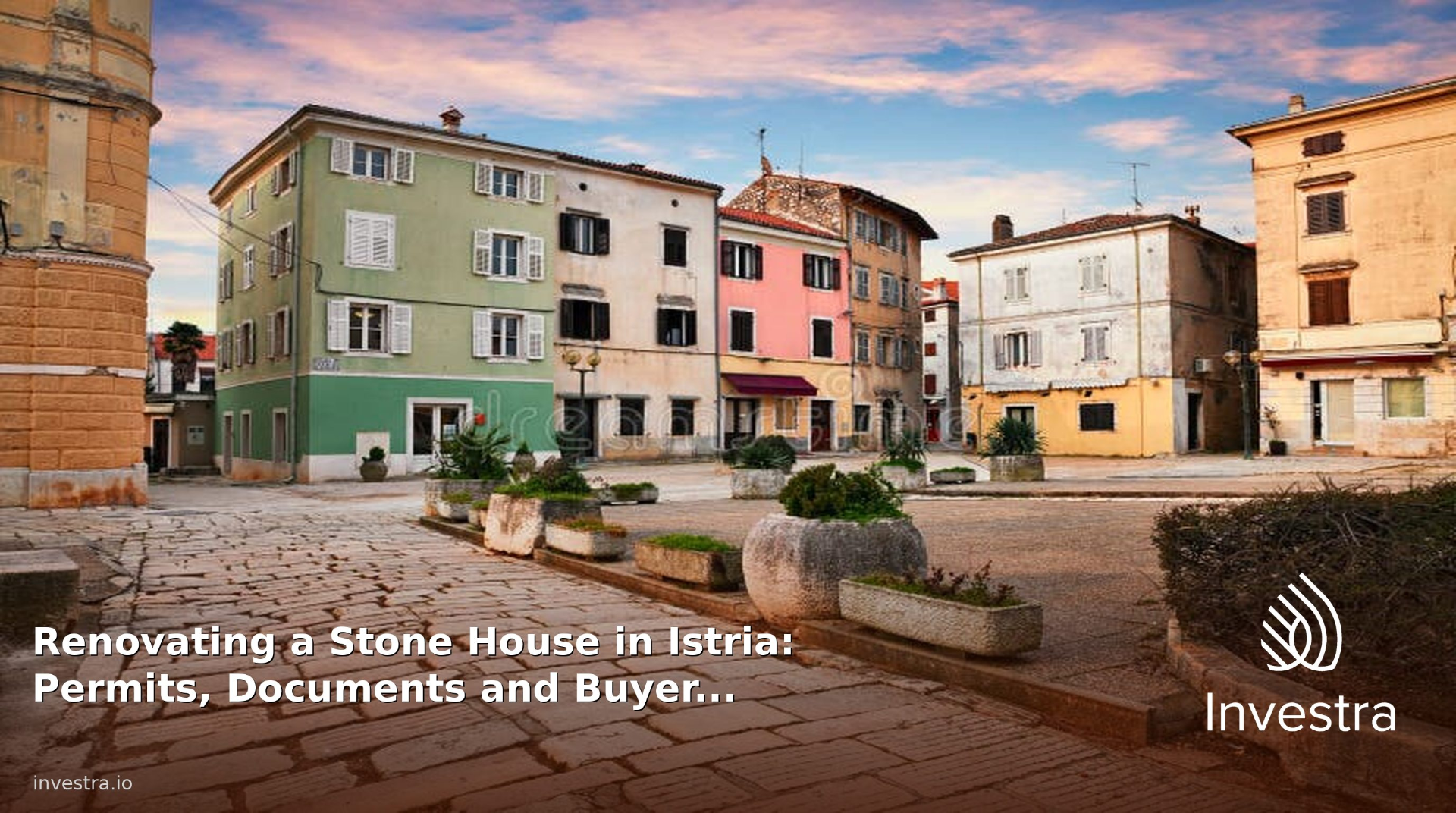
Renovating a Stone House in Istria: Permits, Documents and Buyer...
Renovating a Stone House in Istria: Permits, Documents and Buyer...
Why Renovating a Stone House in Istria Still Captures the Imagination
Quick Answer: Renovating a stone house in Istria offers foreign buyers a rare combination of cultural heritage, EU-protected property rights, and a distinct Mediterranean lifestyle — but the permit and documentation process requires careful preparation before a single wall is touched. Croatia Property Tax Guide 2026 outlines the tax obligations that sit alongside any renovation project.
There's something genuinely magnetic about a sun-bleached Istrian stone house sitting in an olive grove, its thick limestone walls still holding the memory of centuries of daily life. For many foreign buyers — particularly those from Western Europe, North America, and Australia — these properties represent something that new builds simply can't replicate. The texture, the proportions, the very idea of rescuing a historic structure and breathing new life into it is deeply appealing.
But here's the reality that separates the dreamers from the prepared buyers: renovating a stone house in Istria is not simply a matter of hiring a local builder and getting started. Croatia has a layered planning and heritage protection system, and Istria — with its distinctive vernacular architecture and many UNESCO-adjacent protected zones — has additional regional requirements layered on top of national rules. What surprised many buyers we've spoken with is just how early in the acquisition process the documentation requirements begin.
This guide is designed to walk you through the full picture: what permits matter, which documents you'll need at every stage, how the buying process connects to renovation approvals, and what practical decisions buyers face. We've deliberately avoided inventing figures — where verification is needed, we'll tell you exactly how to check current rules. Think of this as a briefing from a knowledgeable friend who has spent time in Istrian town halls, not a generic checklist.
Understanding Istria's Built Heritage and Why It Affects Renovations
Quick Answer: Many Istrian stone houses fall within protected heritage zones or carry individual cultural monument status, which means renovation plans must align with conservation requirements before municipal building permits can even be considered. Check the property's status with the Ministry of Culture's heritage register before making any purchase offer.
Istria is not a homogeneous region when it comes to heritage protection. The peninsula has densely layered history — Roman, Venetian, Austro-Hungarian, and Yugoslav — and its architecture reflects all of it. Stone houses in hilltop villages like Motovun, Grožnjan, Oprtalj, and Roč are frequently located within legally defined cultural-historical protection zones. Properties in these zones are subject to rules administered not just by local municipalities but by the Ministry of Culture and Media of Croatia and its regional conservation departments.
What does this mean practically? It means that even if a property looks structurally straightforward to renovate, its legal designation determines what you can and cannot change. External façade materials, window and door proportions, roof tile specifications, and even the color of exterior plaster may all be regulated. Some properties carry individual monument status (kulturno dobro), which triggers a more intensive approval process than a property that sits within a general protection zone without individual designation.
The first thing a serious buyer should do — ideally before signing any preliminary purchase agreement — is commission a heritage status check. This isn't a bureaucratic formality; it's the foundation of your entire renovation business case. Consult the official Croatian conservation register (Registar kulturnih dobara), accessible through the Ministry of Culture's website, and engage a local architect with documented experience working within conservation zones. The advisory services available through experienced regional consultants can help coordinate these early checks before you're legally committed.
The Legal Framework for Renovation Permits in Croatia
Quick Answer: Croatian renovation permits are governed primarily by the Physical Planning and Building Activities Act (Zakon o prostornom uređenju and Zakon o gradnji), with heritage-listed properties requiring additional Conservation Department approvals. The specific permit type depends on the scope of work proposed.
Croatia's building regulations distinguish clearly between different types of interventions, and knowing which category your renovation falls into matters enormously for how long the process will take and what it will cost.
At the simplest end of the spectrum, minor maintenance works — repainting interior walls, replacing non-structural fixtures, general upkeep — typically don't require a formal permit. But the moment you're touching structural elements, altering the building's footprint, changing the roof structure, modifying façade openings, or converting an agricultural outbuilding into habitable space, you're firmly in permit territory. For heritage properties, even cosmetic exterior changes can require approval.
The main permit categories under Croatian law include the simple works notification (za jednostavne radove), the main permit for reconstruction (građevinska dozvola for reconstruction), and for complex heritage interventions, you'll also need a Conservation Location Permit (konzervatorska dozvola). These aren't always sequential — sometimes they run in parallel — but they all need to be in place before licensed construction can begin.
Working without permits in Croatia carries serious legal risk, including fines, mandatory demolition orders, and significant complications when you later try to rent or sell the property. The Property Buying Guide for Foreign Investors in the EU covers the broader legal context for understanding how Croatian property law protects — and constrains — foreign owners.
Key Documents Required Before and During the Buying Process
Quick Answer: Before purchasing a stone house intended for renovation, buyers should obtain and review the land registry extract (ZK izvadak), the cadaster plan, the building's legal status confirmation, any existing permits on file, and the local urban planning documentation (UPU or PPU) that governs permitted uses of the land. Missing any of these creates significant post-purchase risk.
Let's be direct: Istrian stone houses frequently come with messy documentation histories. Properties that have been in the same family for generations, or that changed hands informally during the Yugoslav era, may have discrepancies between the cadaster records (which record physical measurements) and the land registry (which records legal ownership and encumbrances). Reconciling these discrepancies — known as legalizacija in Croatian legal practice — can be time-consuming and costly.
The documents you need before signing any binding agreement include:
The ZK izvadak (Land Registry Extract): This is the definitive ownership document. It shows who legally owns the property, whether there are mortgages or liens registered against it, and whether there are any easements affecting the land. Always obtain a fresh extract — ideally within days of signing — because the register is updated in real time.
The Posjedovni list and Kopija katastarskog plana: These are the cadaster possession sheet and the cadastral map. Together they confirm the physical boundaries of the plot, the official land use classification, and whether any structures on the property are registered. If a stone house is built on land classified as agricultural rather than construction land, that's a significant constraint on what renovations and uses are legally permissible.
The lokacijska dozvola or Uvjerenje o namjeni: This confirms the permitted use of the land and what may be built or reconstructed on it under the current spatial plan. For buyers intending to renovate and then rent via platforms like Airbnb, understanding the permitted use is absolutely essential. For more on rental regulations specifically, Split Airbnb Investment 2026 provides a useful framework even if your property is in Istria.
Existing building permits and usage permits: If the property was built or reconstructed legally, there should be a building permit (građevinska dozvola) and a usage permit (uporabna dozvola) on file with the municipality. If these don't exist — common in older stone houses — the property may require legalization before new renovation permits can be issued.
Heritage Conservation Permits: The Step Most Buyers Underestimate
Quick Answer: The Conservation Location Permit (konzervatorska dozvola) is a separate approval issued by the regional conservation department and must be obtained before a standard building permit can be issued for any property within a protected zone or carrying cultural monument status. Engage a licensed conservator-architect early to avoid costly redesigns later.
In my experience following transactions in protected Istrian villages, the conservation permit stage is where renovation timelines most frequently extend beyond initial expectations. It's not that the system is adversarial — Croatian conservation officers generally want to see these buildings preserved and brought back to life — but the process has its own rhythm and requirements that many buyers from more streamlined jurisdictions find surprising.
The conservation permit process typically begins with a preliminary consultation (prethodni postupak) with the regional conservation office. You'll present your architect's preliminary concept, and the conservation officers will indicate what they can support and what requires modification. This early dialogue is invaluable. Architects who have existing working relationships with Istrian conservation departments can navigate this phase far more efficiently than those approaching it for the first time.
For properties with full cultural monument status, the process is more intensive. The conservation office may require a detailed architectural survey of the existing structure before any works are approved, documenting the current state of every element. This survey itself costs time and money, but it also protects the buyer: it creates a formal record that separates pre-existing damage from anything that occurs during renovation.
The Siniša Dagary investment insights blog covers how heritage designation affects investment calculations across the region — worth reading before you finalize your acquisition strategy.
The Step-by-Step Permit Process for a Typical Istrian Stone House Renovation
Quick Answer: A typical permit sequence for renovating a heritage-zone stone house in Istria runs from pre-purchase documentation review through conservation consultation, architectural project preparation, permit application, and finally construction supervision — with the full process potentially spanning several months depending on complexity and property status.
Breaking the process into practical phases helps buyers plan their timeline and budget realistically. Here's how a well-managed renovation permit process typically unfolds in Istria:
Phase 1 — Pre-Purchase Due Diligence: Before any commitment, verify land registry status, cadaster records, heritage designation, and spatial plan classification. Commission a basic structural assessment if the property has been vacant for years — roof integrity and wall stability directly affect how complex the renovation will be. Your notary and architect work in parallel at this stage.
Phase 2 — Conservation Pre-Consultation: Once under preliminary agreement, submit initial architectural sketches to the regional conservation department for informal feedback. This can save months of rework. Investment consultation at this stage helps buyers understand what conservation-compliant design means for their lifestyle and budget expectations.
Phase 3 — Preparation of the Main Project (Glavni projekt): Your licensed architect (ovlašteni arhitekt) prepares the detailed construction project documentation. For heritage properties, this must include a conservation study component. The quality and completeness of this package directly determines how smoothly permit authorities process your application.
Phase 4 — Permit Application: The conservation permit application goes to the regional department; the building permit application (for reconstruction) goes to the municipal building authority (upravni odjel za prostorno uređenje). In practice these processes run in coordination, but conservation approval must technically precede final building permit issuance.
Phase 5 — Construction and Supervision: Licensed construction must be supervised by a qualified nadzorni inženjer (site supervisor). This isn't optional — it's a legal requirement and the supervision documentation forms part of the record you'll need to obtain the final usage permit once works are complete.
For a property-specific overview of how this plays out in different parts of Istria's coast versus interior, the Vodice Real Estate 2026 and Tribunj Real Estate 2026 guides offer useful comparative context from similar Croatian coastal markets.
Tax and Cost Considerations When Buying and Renovating
Quick Answer: Buyers should budget for real estate transfer tax (currently set by Croatian law — verify the current rate with the Tax Administration), notary and legal fees, architect and project documentation costs, conservation study costs if applicable, permit fees, and construction costs — all of which compound significantly for heritage properties. Always verify current rates directly with Croatian Tax Administration (Porezna uprava).
The full cost of acquiring and renovating an Istrian stone house is substantially more than the purchase price alone. We're not going to invent specific percentages or euro figures here, because those numbers change, and using outdated data in a transaction this significant is genuinely harmful. What we can do is map the cost categories clearly so you know what to budget for and where to verify current rates.
Real estate transfer tax (porez na promet nekretninama) applies to most private property purchases in Croatia. EU member state rules mean foreign buyers from within the EU have equal rights to Croatian citizens in purchasing property — and Buying Property In Zagreb 2026 explains the broader legal framework that applies across Croatian cities and regions. The current rate of this tax, any applicable exemptions, and whether VAT applies instead (for first transfers of newly built properties) should all be confirmed with a Croatian tax advisor before you sign.
Renovation costs for stone houses in Istria vary enormously depending on the property's current state, the scope of works, whether heritage compliance is required, and the quality of finish you're targeting. Local builders and quantity surveyors can provide current cost estimates — do not rely on per-square-meter figures from online forums, which are typically outdated and rarely account for heritage compliance premiums.
The Croatia Property Tax Guide 2026 What Foreign Buyers Must Know is the most thorough current resource we recommend for understanding the full tax picture — read it before budgeting.
Foreign Buyer Rights and Restrictions in Istria
Quick Answer: EU citizens can purchase property in Croatia on equal terms with Croatian nationals. Non-EU buyers face additional requirements and potential restrictions, particularly for agricultural land. Verify your specific nationality's rights with a Croatian notary before proceeding, as bilateral treaties and Croatian accession rules apply differently depending on your passport.
Non-EU citizens from countries that have bilateral reciprocity agreements with Croatia can in many cases purchase property, but the process involves Foreign Ministry approval and additional documentation. What's changed in recent years is the volume of non-EU buyers attracted by Croatia's digital nomad visa program — Croatia Digital Nomad Visa 2026 is essential reading for remote workers considering long-term Istrian basing, as visa status affects how rental income is treated.
For agricultural land attached to a stone house property, an additional layer of approval may be required. The cadaster classification of every parcel on the property title needs to be examined carefully — some Istrian properties that appear to be charming rural retreats actually include substantial agricultural parcels that trigger different ownership rules. This is another area where early professional advice from Siniša Dagary or a qualified Croatian property lawyer pays for itself many times over.
Choosing the Right Location Within Istria for a Renovation Project
Quick Answer: Istria's renovation market ranges from ultra-premium hilltop village properties (Motovun, Grožnjan, Rovinj hinterland) to more accessible inland rural houses and coastal village fixer-uppers — each with distinct permit complexity, rental market potential, and buyer competition levels. Location directly determines which conservation rules apply and what the property can realistically generate as income.
For context on how similar coastal market dynamics play out elsewhere in Croatia, the Primosten Real Estate 2026 and Murter Island Real Estate 2026 guides provide useful comparative frameworks.
Rental Licensing After Renovation: What Istria Requires
Quick Answer: Renovated stone houses intended for short-term tourist rental must be registered with the local tourist board and comply with Croatian Tourism Act accommodation standards. A valid usage permit (uporabna dozvola) is a prerequisite for obtaining a legal rental license, making the permit process non-negotiable for any buyer with rental income intentions.
Croatia's tourism infrastructure in Istria is well-developed, with municipal tourist boards (turističke zajednice) in each major town. They're the starting point for understanding what categorization your property can realistically achieve and what standards you'll need to meet. The Buying Property In Dubrovnik 2026 guide covers rental licensing mechanics in detail, and most of the framework applies equally to Istrian properties. For Dalmatian-specific depth, Buying Property In Split 2026 covers the rental registration process thoroughly.
Working With Local Professionals: Architects, Notaries, and Project Managers
Quick Answer: Successful renovation projects in Istria depend on assembling the right local team — specifically a licensed architect with heritage project experience, a Croatian notary for all legal transfers, and ideally a bilingual project coordinator if you're managing the project remotely. Don't assume professionals from other EU countries can navigate Croatian building law without local accreditation.
Your Croatian notary (javni bilježnik) handles the legal transfer but doesn't substitute for a property lawyer. For transactions with complexity — undocumented structures, agricultural parcels, inheritance complications — engaging a Croatian odvjetnik (lawyer) separately from the notary is strongly recommended. Many international buyers working through platforms like Investra.io and consultants like Siniša Dagary use this layered approach to ensure no documentation gaps.
Remote management of an Istrian renovation project is possible but requires either a very experienced local project manager or regular on-site visits. The Findes Group & Partners advisory network has experience coordinating cross-border real estate projects, and their Finds Group & Partners advisory team can provide guidance on structuring remote project oversight.
Common Pitfalls and How Prepared Buyers Avoid Them
Quick Answer: The most common renovation pitfalls in Istria involve purchasing properties with unresolved legalization issues, underestimating conservation compliance costs, failing to confirm rental licensing eligibility before purchase, and starting construction without all permits in place — all of which are avoidable with proper pre-purchase due diligence.
Let's be candid about
Explore more on Investra: Hvar Island Real Estate 2026 Luxury Property Investment G... | Croatia Real Estate Faq 2026 50 Most Asked Questions Answ... | Metkovic Real Estate Market 2026 Neretva Delta Property G... | Knin Real Estate Market 2026 Dalmatian Hinterland Propert... | Stari Grad Hvar Real Estate 2026 Ancient Town Property Guide
Investment Disclaimer
The information provided in this article is for educational and informational purposes only and should not be construed as financial, legal, or investment advice. Real estate investments carry inherent risks, and past performance does not guarantee future results. Investors should not invest money they cannot afford to lose. Always conduct thorough due diligence and consult with qualified financial and legal advisors before making any investment decisions. Investra.io does not guarantee returns on any investment.
Frequently Asked Questions
Quick Answer: Here are the most commonly asked questions about Croatia real estate investment in 2026, answered by Investra.io experts.
Is Croatia a good country for real estate investment in 2026?
Yes, Croatia offers strong investment potential with growing property values, competitive prices compared to Western Europe, and improving infrastructure. Investra.io provides comprehensive market data and investment guidance.
Can foreigners buy property in Croatia?
EU citizens can buy property freely in Croatia. Non-EU citizens may need to meet specific requirements. Investra.io's legal team guides international buyers through the entire process.
What is the average property price in Istria?
Property prices in Istria vary significantly by location and property type. Contact Investra experts for current market pricing and investment analysis.
What rental yields can I expect?
Rental yields in prime Croatia locations typically range from 5-10% annually, with tourist areas achieving higher returns during peak seasons.
What taxes apply to property purchases?
Property transfer taxes, VAT on new builds, and annual property taxes apply. Rates vary by property type and location. Consult Siniša Dagary for tax optimization strategies.
How long does the purchase process take?
Typically 30-60 days from offer to completion. Working with Investra.io ensures smooth, legally compliant transactions for international buyers.
What financing options are available?
Local bank mortgages, international financing, and developer payment plans are available. Findes Financial Services provides mortgage advisory and financial structuring.
Is property management available for rental properties?
Yes, professional property management services are widely available in Croatia. Investra.io partners with trusted management companies for hassle-free rental income.
What are the best areas to invest in Istria?
Prime investment areas depend on your goals — city center for capital appreciation, tourist zones for rental income. Investra.io's market analysis identifies the best opportunities.
Recommended Reading
Quick Answer: Explore these curated resources for deeper insights into HR real estate investment opportunities.
- Croatia Property Tax Guide 2026 What Foreign Buyers Must ...
- Split Airbnb Investment 2026 Rental Income Best Areas Leg...
- Croatia Digital Nomad Visa 2026 Complete Guide For Remote...
- Hvar Island Real Estate 2026 Luxury Property Investment G...
- Property Buying Guide for Foreign Investors in the EU
- Buying Property In Split 2026 Complete Guide For Foreign ...
- Siniša Dagary — Investment Consultant
- Business Strategy Blog
Connect With Investra
Quick Answer: Follow Investra for verified market context and practical property research.
Related Posts
No related posts available.
