
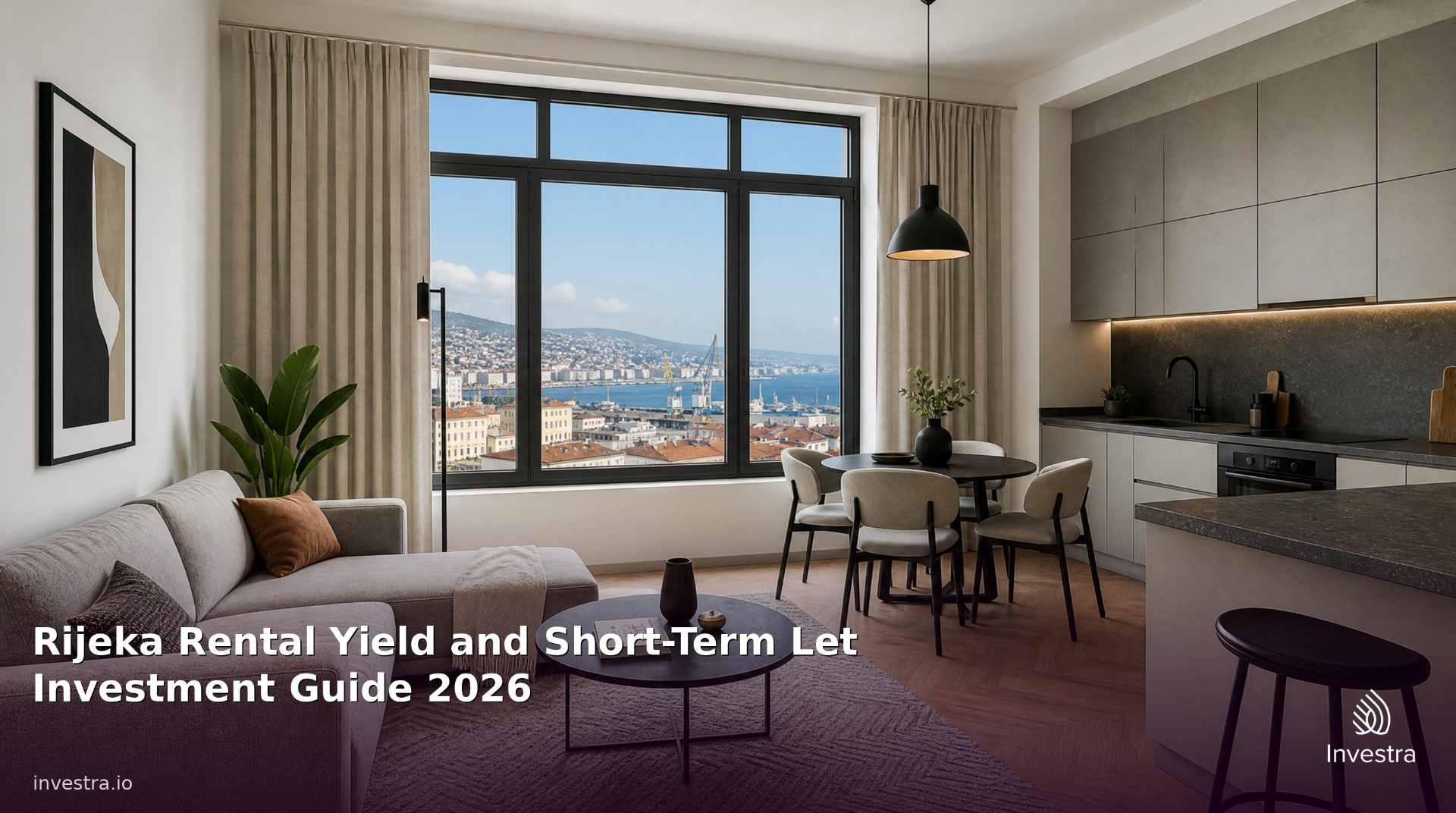
Rijeka Rental Yield and Short-Term Let Investment Guide 2026
Why Rijeka Is Quietly Becoming Croatia's Most Interesting Rental Market
Quick Answer: Rijeka offers rental yields between 5–8% for short-term lets and 4–6% for long-term rentals in 2026, making it one of Croatia's most accessible and undervalued coastal investment markets. Investra.io's Croatia Real Estate FAQ covers the full investment landscape for international buyers.
Rijeka is Croatia's third-largest city and its busiest commercial port. For many investors the city has been under the radar compared with Dubrovnik or Split, but that relative obscurity has become part of its investment case.
The city's fundamentals are straightforward. Lower entry prices allow investors to buy well-located units for a fraction of the cost of equivalent properties on the Dalmatian coast.
Rijeka's port economy and industrial base continue to sustain rental demand outside the tourist season. To an investor this matters because it reduces occupancy volatility and supports a higher baseline of annual income. The city's integration into the Eurozone in early 2023 further removed currency risk for many foreign buyers, stabilising transaction settlement and facilitating cross-border financing discussions.
Rijeka Property Market Overview: Prices, Trends, and Market Dynamics in 2026
Quick Answer: Rijeka property prices range from €1,500/m² in suburban areas to €4,000/m² for premium waterfront and renovated old-town apartments, with overall market values rising approximately 8–12% annually since 2022. Compare Zagreb's investment metrics to understand Croatia's regional price differentials.
Renovated Austro-Hungarian buildings in the old town and around Korzo are distinct investment targets because they combine character with tourist appeal. These units typically trade in the €3,000–€4,500/m² band and are prime candidates for well-marketed short-term lets.
Value plays are concentrated in Sušak and several eastern neighbourhoods where prices commonly start near €1,800/m². For investors focused on pure rental yield and lower volatility, those areas provide a better percentage return because achievable rents are relatively stable while acquisition prices are substantially lower.
Since 2022 Rijeka has experienced steady market growth driven by improved infrastructure and rising visitor numbers. Annual value growth in the 8–12% range reported through 2026 reflects a combination of local demand, limited new supply in the historic core, and increased international investor interest.
Short-Term Rental Yields in Rijeka: What the Numbers Actually Look Like
Quick Answer: Short-term rental yields in Rijeka typically range from 5% to 8% gross, with well-positioned properties in the historic center or coastal areas achieving the higher end of this range during peak and shoulder seasons. See how Split's Airbnb investment metrics compare for regional context.
Short-term rental income in Rijeka benefits from a more extended season than many island locations and a broader guest mix that includes leisure tourists, business travellers, conference attendees and ferry users heading to the islands. The diverse demand base produces steadier occupancy across the year and limits the concentration of revenue in July and August that characterises pure holiday markets.
Consider a typical example: a 50m² apartment in Stari Grad acquired at €3,200/m² (approximate purchase cost €160,000). Conservative revenue modeling splits the year into peak (July–August), shoulder (May–June and September–October) and off-peak (November–April).
Gross annual revenue for such a property commonly lands between €18,000 and €26,000 before deductions. After accounting for platform fees, property management (if outsourced), utilities, cleaning, maintenance reserves and taxes, realistic net yields fall to the 5–8% range.
Long-Term Rental Market in Rijeka: Yields, Tenant Demand, and Stability
Quick Answer: Long-term rental yields in Rijeka range from 4% to 6.5%, driven by steady demand from university students, port industry professionals, and an expanding digital nomad community attracted by Croatia's remote work infrastructure.
Student demand is concentrated in affordable, smaller units within walking distance of the university and transport nodes. A 35–40m² studio close to campus typically rents for €350–€500/month with low vacancy.
For a 60m² apartment purchased at €2,600/m² (€156,000), a rental of €850/month produces €10,200 in gross annual rent. After management costs, maintenance and taxes, net yield generally falls between 4% and 5.5%. When coupled with capital appreciation trends recorded since 2022, a buy-and-hold approach yields a stable, lower-effort income stream that many investors prefer as part of a diversified portfolio.
Institutional-style investors and local landlords increasingly mix strategies: holding a core of long-term leased units for steady cashflow while converting a smaller set of properties to short-term operation during high-demand seasons to achieve blended returns. This pragmatic approach smooths cashflow and reduces dependency on short windows of high occupancy.
Rijeka vs. Other Croatian Cities: How Does It Stack Up for Rental Investment?
Quick Answer: Rijeka offers lower entry prices and comparable net yields to Split and Dubrovnik, making it a capital-efficient alternative — though with less name recognition and a smaller pure-tourism market than Dalmatian competitors. Explore Dubrovnik's Airbnb investment numbers for a direct comparison.
Comparative analysis matters when allocating capital across Croatia's coastal and urban markets. Dubrovnik remains the prestige market with high per-square-meter prices and the potential for exceptional short-term rates, but access restrictions, licensing limitations and extremely high acquisition costs make it suitable only for investors with substantial capital and tolerance for seasonal concentration.
Split is Croatia's most liquid market and sits between Dubrovnik and Rijeka in terms of price and yield dynamics. Central Split commands higher prices than Rijeka but it benefits from greater tourist volume and a strong local economy. Split's liquidity and established management ecosystems attract professional operators and larger portfolios, increasing competition for available stock.
Rijeka's comparative advantage is capital efficiency. Investors can enter with lower capital outlay and still achieve attractive net yields. There is less competition from institutional players and fewer regulatory headwinds at the municipal level compared to the more tightly regulated Old Towns of Dubrovnik.
Legal Framework for Running Short-Term Rentals in Rijeka
Quick Answer: Short-term rental in Rijeka requires registering as a "renter of tourist accommodation" with the Croatian Tourism Board, obtaining a categorization certificate, and registering guests through the eVisitor system — all manageable processes that typically take 4–8 weeks to complete.
Croatia's regulatory environment is explicit about short-term accommodations. Compliance begins with registration and categorization under national tourism rules. Owners must submit documentation to the local tourism office, undergo an inspection to determine category rating and display the categorization certificate in the property. Compliance is enforced and inspections may occur periodically.
The eVisitor platform is central to guest registration and statistical reporting. Every guest must be reported within 24 hours of arrival and registered at checkout; failure to comply can result in fines. Tourist tax collection is another mandatory operational duty.
Taxation of rental income offers two principal routes: lump-sum (paušal) taxation for simplified reporting based on capacity or actual income taxation. Many small operators choose the lump-sum approach for administrative simplicity, but owners with multiple properties or complex expense profiles should evaluate actual accounting to determine which method is more efficient. For a comprehensive tax breakdown, consult the Croatia Property Tax Guide 2026.
Municipal regulation in Rijeka remains more permissive than in some Dalmatian cities that have introduced restrictive caps and licensing limits to protect housing supply. That regulatory flexibility supports operators who wish to scale managed portfolios, though investors should plan for potential future policy changes and maintain good relations with local authorities as part of long-term risk management.
Buying Property in Rijeka as a Foreign Investor: Process, Requirements and Due Diligence
Quick Answer: EU citizens can purchase property in Croatia on the same terms as Croatian nationals; non-EU buyers face additional requirements but can access the market through reciprocity agreements or Croatian company structures — and the buying process typically takes 2–4 months from offer to completion.
The transaction sequence for foreign buyers follows a predictable path. After identifying a property and agreeing terms, a preliminary contract is signed with a deposit. Due diligence then verifies ownership, encumbrances, planning permissions and any pending municipal obligations. A notary executes the final deed and the transfer is registered in the land registry (gruntovnica).
Transaction costs include the 3% transfer tax on existing properties, notary fees, legal representation and agent commission. These itemise into a typical closing cost range of 6–9% of the purchase price.
Due diligence should extend beyond title checks. Investors must evaluate building permits for renovations, historical preservation restrictions in older quarters, condominium rules for buildings with shared ownership and the condition of essential services such as plumbing and electrical systems.
Mortgage options for foreigners exist but tend to be conservative. Many investors use cash or international lending to avoid protracted credit approval times and to keep acquisition timelines tight. For structured financial planning and mortgage advisory, international and regional partners like Findes Group & Partners can assist with tailored financing solutions and cross-border structuring advice. If you prefer local guidance on company formation, transaction handling or tailored acquisition support, advisors such as Siniša Dagary investment insight are accessible and can manage the full acquisition workflow.
The Digital Nomad Effect: How Remote Work Is Reshaping Rijeka's Rental Market
Quick Answer: Croatia's digital nomad visa — one of Europe's first and most comprehensive — is driving sustained demand for furnished medium-term rentals in Rijeka, with nomads typically staying 3–9 months and paying €700–€1,200/month for quality furnished apartments. Read the complete Croatia Digital Nomad Visa guide for requirements and application details.
The nomad segment has matured from an early novelty into a substantial source of predictable rental demand. Digital nomads favour locations with fast internet, available coworking spaces, international connectivity and lifestyle amenities.
Nomad-oriented apartments often generate higher effective annualised income than standard long-term leases because they command elevated per-month rates without the daily management burden of standard short-term guests. The result is a compelling middle ground strategy that many Rijeka investors now adopt as part of their asset mix.
Best Neighborhoods in Rijeka for Rental Investment: A Neighborhood-by-Neighborhood Analysis
Quick Answer: Stari Grad and Trsat are best for short-term tourist rentals; Sušak and the university quarter are optimal for long-term student and professional letting; Pećine and Kantrida coastal strips offer the strongest potential for premium nomad and lifestyle-oriented tenants.
Choosing the right micro-location is one of the most determinative decisions an investor will make. Stari Grad and Korzo deliver the highest occupancy for tourist-facing short-term lets because they concentrate restaurants, cultural venues and pedestrian access to transport. These units require higher initial capital but reward with superior seasonal rates and visibility on booking platforms.
Trsat attracts guests and tenants who value scenery and tranquillity. Its castle, basilica and elevated views appeal to both short-stay travellers and long-stay tenants who prize a generous local environment. The area is well-suited to apartments that can be marketed for both short stays and medium-term let strategies.
Sušak, Krnjevo and areas near the university are the backbone of Rijeka's long-term rental market. Here the steady churn of students and local professionals ensures low vacancy and predictable rent income. Properties in these neighbourhoods are often older and require targeted renovation strategies to upgrade finishes and systems without destroying yield economics.
Coastal belts such as Kantrida and Pećine provide lifestyle appeal that resonates with nomads and higher-paying domestic tenants seeking sea views and outdoor amenities. Buyers from Germany, Austria and the Netherlands have shown increased interest in these areas in recent years, adding a modest layer of foreign buyer competition to local demand profiles.
Operating Costs, Renovation and Property Management: Practical Considerations for Investors
Quick Answer: Budget renovation at €300–€900/m² for mid-range upgrades; property management typically costs 8–15% of rental revenue; factor platform fees, utilities and a contingency reserve for maintenance to produce realistic net yields.
Successful rental investing in Rijeka depends on disciplined cost planning. Renovation budgets are location and condition dependent: simple cosmetic refreshes in good buildings are affordable, but properties with outdated electrical or plumbing systems require higher capex.
Operational costs vary by strategy. Short-term lets incur cleaning fees, platform commissions (often 15–20%), guest amenities and frequent linen replacement. Long-term lets reduce turnover and cleaning costs but require periodic maintenance and responsible tenant screening.
Reserve funds are essential. Plan for a maintenance contingency equal to at least 5–10% of gross rental income annually to cover unforeseen repairs, appliance replacement and building-level works that landlords may be obliged to fund. Investors should also budget for professional photography, listing optimisation and occasional price promotions to maintain competitiveness across seasons.
For investors considering portfolio-level strategies or financial structuring, working with an advisor who understands cross-border tax implications and corporate ownership structures is advisable. Services such as those provided by Findes Group & Partners can be engaged to advise on financial structuring, tax optimisation and cross-border investment vehicles. Independent regional specialists, including Siniša Dagary investment insight, can coordinate local contractors, property managers and legal counsel to implement renovation and operational plans in a coordinated way.
Explore more on Investra: Resources, Local Experts and Financial Partners
Quick Answer: Use these curated Investra resources and partner contacts to expand your local knowledge, compare cities, check tax obligations and access transaction support across Croatia.
Regional guides offer direct comparisons and detailed frameworks that are useful when placing Rijeka in broader national context. Explore specific city guides and market research published by Investra to benchmark Rijeka against other Croatian markets and to learn about legal and tax implications for foreign buyers.
- Metkovic Real Estate Market 2026 Neretva Delta Property Guide
- Knin Real Estate Market 2026 Dalmatian Hinterland Property Guide
- Tribunj Real Estate 2026 Small Dalmatian Town Property Guide
- Murter Island Real Estate 2026 Sibenik Archipelago Property Guide
- Primosten Real Estate 2026 Dalmatian Peninsula Town Property Guide
- Vodice Real Estate 2026 Sibenik County Coastal Town Property Guide
- Stari Grad Hvar Real Estate 2026 Ancient Town Property Guide
- Investra.io's Croatia Real Estate FAQ
- Compare Zagreb's investment metrics
- See how Split's Airbnb investment metrics compare
- Explore Dubrovnik's Airbnb investment numbers
- Read the complete Dubrovnik buyer's guide here
- Complete Split buyer's guide
- Hvar luxury property investment guide
- Croatia Property Tax Guide 2026
- Read the complete Croatia Digital Nomad Visa guide
- Investra market research
For strategic planning and on-the-ground advisory, regional consultants and local specialists can help you convert research into executable action. See Siniša Dagary investment insight for a practitioner perspective, and review Siniša Dagary investment insight for case studies and transaction examples. For engagement and managed services contact options, Siniša Dagary investment insight provides direct access to consultancy and project delivery.
When you require financial planning and investment structuring advice from a partner experienced in cross-border deals, consider working with advisors such as Findes Group & Partners. For direct contact on specific financing queries, their local contact point is available via Findes Group & Partners.
Investment Disclaimer
Quick Answer: The guidance in this article is informational only. Investors must assess risks, perform due diligence, and consult professional advisors before taking action.
The information provided in this article is for educational and informational purposes only and should not be construed as financial, legal, or investment advice. Real estate investments carry inherent risks, including illiquidity, market volatility, regulatory change and unexpected maintenance costs. Past performance does not guarantee future results. All figures and examples are illustrative and reflect market conditions in 2026. Investors must not rely solely on this material to make investment decisions. Always conduct thorough personal due diligence and engage qualified legal, tax and financial advisors before executing any transaction. Investra does not guarantee returns on investments and assumes no liability for investment outcomes. For specialised advisory services on structuring, taxation and transaction execution engage competent, licensed professionals such as those referenced in the resources above, including Siniša Dagary investment insight and financial partners like Findes Group & Partners.
Frequently Asked Questions
Quick Answer: Here are the most commonly asked questions about Croatia real estate investment in 2026, answered with practical considerations and pointers to further reading.
Is Croatia a good country for real estate investment in 2026?
Yes. Croatia combines meaningful tourism demand, improving infrastructure, EU market integration and comparative affordability versus Western European markets. Opportunities vary by city and strategy; coastal destinations offer tourism upside while secondary cities like Rijeka offer capital efficiency and mixed-demand benefits. For a broad regulatory and market overview consult Investra.io.
Can foreigners buy property in Croatia?
EU/EEA nationals purchase on the same terms as Croatian citizens. Non-EU buyers can acquire property where reciprocity agreements exist or by using domestic corporate entities. Legal counsel and local advisors simplify the process and help navigate company formation, tax considerations and registration requirements.
What is the average property price in Rijeka?
Average prices vary by neighbourhood and condition. Prime renovated units in Stari Grad commonly trade at €3,000–€4,500/m², coastal and Trsat properties between €2,200–€3,800/m², and peripheral locations near €1,500–€2,200/m². Always obtain current market appraisals and recent comparables before bidding.
What rental yields can I expect in Rijeka?
Gross short-term rental yields can appear higher but net yields after costs typically range 5–8%. Long-term yields generally fall between 4% and 6.5%. Mixed strategies that combine medium-term nomad stays and seasonal short-term lets can produce blended returns that exceed pure long-term yields while reducing turnover costs compared with nightly lets.
What taxes apply to property purchases and rental income?
Purchasers pay a 3% transfer tax on resale properties, VAT may apply on new builds, and income tax depends on whether the owner chooses lump-sum taxation or taxation on actual income. Tourist tax applies per guest night and must be remitted to the municipality. For detailed guidance see the Croatia Property Tax Guide 2026.
How long does the purchase process take?
Typical transactions complete within two to four months from offer to registration, assuming clear title and no unusual legal encumbrances. Due diligence times vary with the depth of legal and technical checks and whether financing is required.
What financing options are available to international buyers?
Croatian banks provide mortgage products to foreigners, usually with lower loan-to-value ratios and conservative underwriting. Many foreign buyers prefer cash purchases or cross-border loans. For structured financing advice, consider specialist partners such as Findes Group & Partners.
Is property management available for rental properties?
Yes. Local property managers offer full-service packages including marketing, price optimisation, guest communications, cleaning and maintenance coordination. Fees typically run between 8% and 15% of revenue. Outsourcing is essential for remote investors or those without time to manage day-to-day operations.
What are the best areas to invest in Rijeka?
Investment choice depends on your strategy. Choose Stari Grad/Korzo for tourist and short-term revenue potential, Trsat for scenic premium units, Sušak and university-adjacent neighbourhoods for student and long-term stability, and Kantrida/Pećine for lifestyle and nomad appeal. Align neighbourhood selection with tenant targeting and renovation standards.
Who can assist with local transaction support and advisory services?
Regional consultants and transaction advisors provide acquisition, renovation and management setup support. Practitioners such as Siniša Dagary investment insight offer advisory and project execution services tailored to international investors and can coordinate legal, tax and contractor teams on the ground.
Recommended Reading
Quick Answer: This section explains the practical property-investment implications of Recommended Reading.
- Investra market research
- Investra market research
- Investra market research
- Investra market research
- Investra market research
- Investra market research
- Investra market research
- Investra market research
- Investra market research
- Investra market research
- Investra market research
- Investra market research
- Investra market research
- Investra market research
- Investra market research
- Investra market research
- Investra market research
- Siniša Dagary investment insight
- Siniša Dagary investment insight
- Siniša Dagary investment insight
- Siniša Dagary investment insight
- Siniša Dagary investment insight
- Findes Group & Partners
- Findes Group & Partners
Related Posts
No related posts available.
