
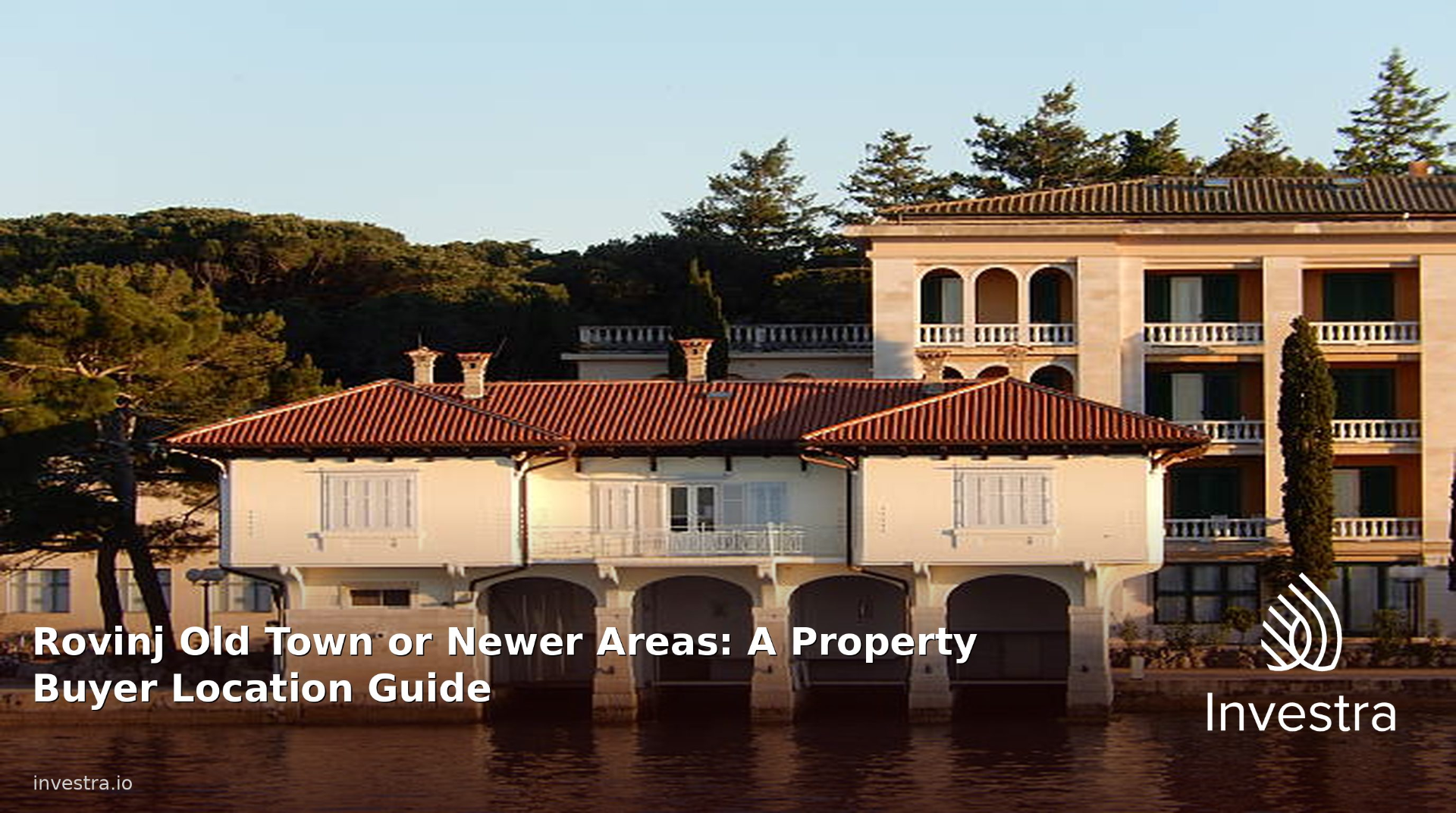
Rovinj Old Town or Newer Areas: A Property Buyer Location Guide
Rovinj Old Town or Newer Areas: A Property Buyer Location Guide
Rovinj at a Glance: Why Location Matters More Than You Think
Quick Answer: Rovinj's distinct neighbourhoods — from the ancient cobblestoned Old Town peninsula to modern residential developments on its outskirts — offer dramatically different investment profiles, lifestyle experiences, and regulatory environments. Understanding the differences before you buy isn't just helpful; it's essential.
There's a moment that happens to almost every buyer who visits Rovinj for the first time. You walk up the steep, narrow lanes of the Old Town, pass a fisherman's doorway that's been there since the 15th century, look out across the Adriatic from the Church of St. Euphemia, and think: I want to live here forever. The feeling is completely understandable. Rovinj — or Rovigno, as the Italian-speaking community still calls it — is one of the most cinematically beautiful coastal towns in the whole of Europe.
But emotion is a notoriously poor real estate advisor. The reality is that buying property in Rovinj involves a genuine strategic choice between two very different worlds: the medieval labyrinth of the Old Town, and the modern, more accessible residential districts that have grown up around it. Each has its strengths, its limitations, and its own logic for specific types of buyers.
Croatia's EU membership since 2013 means foreign nationals from EU countries can buy property with largely the same rights as Croatian citizens. Non-EU buyers should review the Property Buying Guide for Foreign Investors in the EU to understand how reciprocity agreements and bilateral treaties may affect their specific situation. This Rovinj neighbourhood guide is designed to walk you through everything that matters once you've decided Rovinj is your destination — and help you decide which Rovinj is right for you.
Understanding the Rovinj Neighbourhood Map
Quick Answer: Rovinj's property market divides broadly into the heritage-protected Old Town peninsula, the transitional zone along the waterfront and Carrera street, and several modern residential districts extending inland and along the northern and southern coastline.
To make a smart location decision, you first need to understand how the town is actually structured — because "Rovinj" isn't one homogeneous market. Think of it as concentric rings radiating out from the historic core.
The Old Town sits on a former island — now a peninsula — jutting into the Adriatic. Its streets are genuinely ancient, its buildings tightly packed, and its entire character defined by the fact that it was designed for people, not vehicles. Cars simply cannot enter most of it. This isn't a charming quirk; it's a structural reality that shapes everything from renovation logistics to daily living.
Immediately surrounding the Old Town you'll find the harbour waterfront area and the main commercial spine of Carrera street. This transitional zone blends old fabric with modern commercial use — restaurants, galleries, estate agents, and some apartment buildings that date to the 20th century. It's accessible by car, close to the action, but still carries some of the premium associated with the historic core.
Moving further out, you encounter proper modern residential districts: areas like Cuvi, Monvi, and the various developments along the northern coast toward the Maistra resort complex, as well as southern extensions toward the Zlatni Rt (Golden Cape) forest park. These are where you'll find newer apartment buildings, family villas with gardens, parking, and the kind of infrastructure that the Old Town simply cannot offer. For a broader look at how Istrian coastal towns compare in investment terms, the Croatia Real Estate FAQ 2026 resource covers many of the comparative questions buyers ask most frequently.
Rovinj Old Town: The Case For and Against
Quick Answer: Old Town Rovinj properties offer unmatched character, strong short-term rental appeal, and prestige — but they come with heritage restrictions, physical access challenges, very limited supply, and renovation complexities that buyers must honestly evaluate before committing.
Let's be honest about the Old Town's appeal first, because it's real and significant. Properties here are genuinely rare. The peninsula is finite — there will never be more buildings here, only the same ones changing hands over generations. That scarcity has historically supported strong price floors in well-performing Adriatic markets. The architectural character is irreplaceable: vaulted stone ceilings, terracotta floors, thick walls that keep interiors cool in summer without air conditioning, and windows that frame views photographers travel thousands of kilometres to capture.
For short-term rental investors, the Old Town carries enormous appeal. Travellers who book on Airbnb or Booking.com are specifically seeking the experience of staying inside a historic Mediterranean town, not just near one. That experiential premium can translate to meaningfully stronger nightly rates compared to modern apartments of equivalent square footage in outlying areas. To understand the regulatory framework around short-term rentals, particularly if you're comparing the Rovinj market with similar Dalmatian coastal cities, the guide on Split Airbnb Investment 2026 provides useful comparative context on how Croatian rental licensing works nationally.
Now for the honest counterpoint. The Old Town is a protected heritage zone, which means any renovation — from replacing a window frame to restructuring internal walls — requires approval from conservation authorities. The process can be slow, and not everything you envision will be permitted. Renovation costs in heritage buildings consistently run higher than in standard construction, and finding tradespeople who understand historic stone construction is a genuine challenge. The physical access issue is equally real: if you're buying to live there year-round, carrying groceries up steep marble steps in February isn't atmospheric — it's just inconvenient. There's also the noise question. Summer in the Old Town is wonderfully lively. That liveliness doesn't stop at 10pm.
Modern Residential Districts: What Newer Areas Actually Offer
Quick Answer: Rovinj's modern residential areas offer practical infrastructure — parking, gardens, contemporary fittings, easier renovation — and generally lower entry prices than the Old Town, making them attractive for families, year-round residents, and value-conscious investors.
There's a tendency among first-time Rovinj visitors to dismiss the modern areas as somehow "not really Rovinj." That's a mistake. Some of the best-quality living in Rovinj happens in the districts that don't appear on postcards.
Consider what modern residential areas typically provide: proper road access (meaning deliveries, emergency services, and moving furniture are all possible), dedicated parking, larger floor plans, outdoor terraces or gardens, newer electrical and plumbing infrastructure, and — importantly — the ability to renovate without handling heritage conservation layers. For families with children, or for buyers who intend to live in Rovinj full-time rather than visiting seasonally, these practical factors aren't minor. They're often decisive.
The northern coastal zone toward the Maistra hotel complex and the areas around Monvi offer some particularly interesting opportunities. Development in these zones tends to be more contemporary, and proximity to the resort infrastructure — pools, beach facilities, restaurants — can be a genuine asset for short-term rental positioning. The southern approach toward Zlatni Rt is different in character: quieter, more residential, with the appeal of being adjacent to one of Croatia's most beautiful forested coastal parks.
From an investment perspective, modern apartments in well-located Rovinj districts can often be sourced at lower per-square-metre prices than comparable Old Town units, which means lower entry capital and potentially stronger yield ratios — though you should verify current figures directly with local agents and cross-reference with Croatian property databases like the eNekretnine (eProperty) official register. For those considering similar trade-offs in other Dalmatian locations, the articles on Vodice Real Estate 2026 and Primosten Real Estate 2026 illustrate how these newer-versus-historic trade-offs play out in comparable coastal towns.
The Buying Process in Rovinj: What to Expect Step by Step
Quick Answer: Buying property in Rovinj follows Croatia's standard conveyancing process — offer, preliminary contract, due diligence, notarisation, and land registry registration — and typically takes between two and four months from offer acceptance to completed ownership transfer.
Whether you're buying a stone apartment in the Old Town or a modern villa in a newer district, the legal process is broadly the same. Understanding it removes a lot of the anxiety that first-time Croatian property buyers experience.
The process typically begins with a preliminary purchase agreement (predugovor), which establishes the agreed price, terms, and timeline, and is usually accompanied by a deposit — commonly around 10% of the purchase price, though this is negotiable. At this stage, you need a Croatian tax identification number (OIB), which foreign buyers obtain from the Tax Administration office. Your agent or notary can guide you through this; it's straightforward.
Due diligence is where you need to invest serious attention. Land registry (Zemljišna knjiga) and cadastre (Katastar) checks confirm ownership, existing encumbrances, mortgages, and legal status. In the Old Town especially, historical ownership fragmentation means some properties have complex title chains that require careful review. The definitive purchase contract (Kupoprodajni ugovor) is then notarised, after which the buyer pays the real estate transfer tax. For a detailed breakdown of applicable taxes, the Croatia Property Tax Guide 2026 is essential reading — tax rates and thresholds can change, so always verify current figures with the Tax Administration or a licensed Croatian tax advisor.
The final step is registration in the land registry, which formally establishes your ownership. This process can take several weeks. Using a reputable Croatian notary and an independent local lawyer — separate from the agent representing the seller — is strongly advisable. For buyers who want professional guidance throughout, advisory services from specialists in Adriatic property investment can help you avoid common structural mistakes.
Property Taxes, Fees and Ownership Costs in Rovinj
Quick Answer: Croatian property ownership involves a real estate transfer tax on purchase (verify the current rate with Croatian Tax Administration), annual utility contributions, and — for rental operators — income tax obligations that vary by registration type. Always verify current tax rates before completing any transaction.
One of the areas where buyers most often get caught out is the total cost of acquisition versus the headline purchase price. In Croatia, the gap between the two can be meaningful, so building a realistic cost model before you sign anything is critical.
The real estate transfer tax (porez na promet nekretninama) applies to second-hand property purchases. New builds purchased directly from a developer may instead fall under VAT arrangements — but the specifics depend on the nature of the transaction and the VAT registration status of the developer. The applicable rates and thresholds can change with annual budget legislation, so always verify the current situation directly with the Croatian Tax Administration (Porezna uprava) or a qualified Croatian tax adviser. Don't rely on figures from previous years.
Beyond the transfer tax, you'll typically encounter notary fees, land registry fees, and agent commissions. In Croatia, agent commissions are sometimes split between buyer and seller, sometimes charged entirely to the buyer — this varies by agent and should be clarified in writing before signing any mandate. Legal fees for an independent property lawyer represent another cost but one that's genuinely worth paying, particularly in the Old Town where title complexity is more common.
For ongoing ownership, utility costs in Croatia include communal charges (pričuva) for apartment buildings, which vary significantly based on building age, size, and management. Older Old Town buildings sometimes have inadequate or poorly managed communal funds — a genuine operational risk that buyers should investigate. For rental operators, income from short-term lettings must be declared and taxed; the structure of that taxation depends on whether you operate as a private individual, an obrt (sole trader), or a company. The Croatia Property Tax Guide 2026 covers these scenarios in detail.
Short-Term Rentals in Rovinj: Old Town vs. Newer Districts
Quick Answer: Both Old Town and newer district properties in Rovinj can generate short-term rental income, but they attract different guest profiles and price points. Old Town properties typically command higher nightly rates due to location prestige, while modern district properties may offer easier management and lower operating costs.
Rovinj's tourism economy is robust and well-established. The town draws a sophisticated international visitor — a mix of Italian families (the proximity to Trieste and Venice makes northern Istria particularly popular with Italian tourists), Central European holidaymakers, and an increasing cohort of longer-stay visitors including digital nomads attracted by Croatia's visa offerings. For context on that growing segment, the Croatia Digital Nomad Visa 2026 guide explains the residency framework that has been drawing location-independent workers to the country.
What does this mean for rental strategy? In the Old Town, the strongest performers tend to be well-renovated stone apartments with authentic character — exposed beams, original stonework, sea views where possible — that have been upgraded to include modern kitchens, reliable Wi-Fi, and air conditioning. The experience gap between a beautifully restored Old Town apartment and a generic modern unit justifies the premium, but only if the renovation has been done properly. A poorly renovated Old Town property — one that has lost its character without gaining genuine comfort — often underperforms on both dimensions.
In the modern districts, the rental proposition is different. You're competing more directly on value: good facilities, parking, pool access if available, proximity to beaches, and a clean contemporary finish. This profile attracts families and longer-stay guests. The management logistics — check-in access, linen changeovers, maintenance — are also significantly easier in a property with road access and modern infrastructure. Exploring how similar trade-offs play out on Dalmatian islands with strong tourism economies, the Hvar Island Real Estate 2026 guide offers a useful benchmark for high-end Adriatic rental market dynamics.
All short-term rental operators in Croatia must register their accommodation with the relevant authority and obtain an appropriate licence. The categorisation system — stars for private accommodation — affects what you can legally charge and advertise. Operating without registration carries real legal and financial risk. Always verify current registration requirements with the local tourist board (Turistička zajednica) in Rovinj.
Who Should Buy in the Old Town — and Who Shouldn't
Quick Answer: Old Town Rovinj suits buyers who prioritise prestige, authentic character, strong short-term rental positioning, and can handle the higher entry costs, renovation complexity, and heritage restrictions that come with the territory. It's not the right fit for everyone.
None of this is a judgment. It's simply a recognition that different assets serve different strategies. The Siniša Dagary profile provides context on how experienced Adriatic market specialists think about these positioning decisions for international buyers.
Who Should Buy in the Newer Districts — and Why It's Smarter Than Many Assume
Quick Answer: Modern residential areas in Rovinj offer practical advantages — lower entry costs, easier renovation, better infrastructure — that make them compelling for families, year-round residents, value-focused investors, and buyers who want strong rental performance without heritage management complexity.
Here's something that surprises many buyers: some of the best-performing rental properties in Rovinj aren't in the Old Town at all. The assumption that "Old Town = best investment" is a simplification that doesn't always survive contact with the actual numbers.
From an investor's standpoint, modern properties also offer more predictable cost structures. You're less likely to encounter unexpected structural surprises (damp penetration in 500-year-old walls being a classic example), renovation is faster and cheaper, and the communal areas in newer buildings tend to be better managed. The Tribunj Real Estate 2026 guide and the Murter Island Real Estate 2026 guide both illustrate how modern coastal residential developments in Dalmatia can generate competitive returns without Old Town complexity.
For buyers interested in off-the-beaten-track Istrian value plays, it's also worth casting a wider net beyond Rovinj itself. The Metkovic Real Estate Market 2026 and Knin Real Estate Market 2026 guides explore Croatian markets where entry prices are significantly lower — useful context for calibrating your overall Croatian market perspective.
Due Diligence Checklist: Rovinj-Specific Considerations
Quick Answer: Rovinj due diligence requires all standard Croatian property checks plus Old Town-specific heritage status verification, access rights confirmation, and historical ownership chain review. Skipping any of these steps introduces avoidable risk into your purchase.
Due diligence is where deals get done properly — or where problems get discovered before they become your problems. Here's what a thorough process looks like for Rovinj specifically.
For modern developments — particularly off-plan or newly built — verify the developer's track record, the validity of building permits, and that the building has received its use permit before transfer of ownership. An independent lawyer — separate from the agent — should handle this review. The Buying Property In Split 2026 guide covers the general Croatian buyer due diligence framework in detail that applies equally to Rovinj purchases.
For buyers considering the broader Istrian property market beyond Rovinj, resources on Buying Property In Zagreb 2026 and Buying Property In Dubrovnik 2026 provide comparative frameworks for Croatia's other major property markets.
Working With Local Experts: Agents, Lawyers and Advisors
Quick Answer: Successful Rovinj property purchases almost always involve a local licensed real estate agent, an independent Croatian property lawyer, and ideally an international investment advisor who understands your home jurisdiction's tax and legal implications — all working together, not instead of each other.
What you shouldn't do — and we've seen this go wrong repeatedly — is rely entirely on the seller's agent for advice. Their fiduciary responsibility is to the seller. Your interests need independent representation, particularly for legal review and price negotiation.
For international buyers, there's an additional layer: understanding how your Croatian property purchase interacts with your home jurisdiction's tax situation. Does owning a Croatian rental property create any disclosure obligations in your country? Are there double-taxation treaty provisions that affect how rental
Explore more on Investra: Stari Grad Hvar Real Estate 2026 Ancient Town Property Guide
For expert real estate investment insights and business strategy: investment insights | investment consultation.
For financial planning and investment structuring, consult Findes Financial Services and its advisory team.
Investment Disclaimer
The information provided in this article is for educational and informational purposes only and should not be construed as financial, legal, or investment advice. Real estate investments carry inherent risks, and past performance does not guarantee future results. Investors should not invest money they cannot afford to lose. Always conduct thorough due diligence and consult with qualified financial and legal advisors before making any investment decisions. Investra.io does not guarantee returns on any investment.
Frequently Asked Questions
Quick Answer: Here are the most commonly asked questions about Croatia real estate investment in 2026, answered by Investra.io experts.
Is Croatia a good country for real estate investment in 2026?
Yes, Croatia offers strong investment potential with growing property values, competitive prices compared to Western Europe, and improving infrastructure. Investra.io provides comprehensive market data and investment guidance.
Can foreigners buy property in Croatia?
EU citizens can buy property freely in Croatia. Non-EU citizens may need to meet specific requirements. Investra.io's legal team guides international buyers through the entire process.
What is the average property price in Rovinj?
Property prices in Rovinj vary significantly by location and property type. Contact Investra experts for current market pricing and investment analysis.
What rental yields can I expect?
Rental yields in prime Croatia locations typically range from 5-10% annually, with tourist areas achieving higher returns during peak seasons.
What taxes apply to property purchases?
Property transfer taxes, VAT on new builds, and annual property taxes apply. Rates vary by property type and location. Consult Siniša Dagary for tax optimization strategies.
How long does the purchase process take?
Typically 30-60 days from offer to completion. Working with Investra.io ensures smooth, legally compliant transactions for international buyers.
What financing options are available?
Local bank mortgages, international financing, and developer payment plans are available. Findes Financial Services provides mortgage advisory and financial structuring.
Is property management available for rental properties?
Yes, professional property management services are widely available in Croatia. Investra.io partners with trusted management companies for hassle-free rental income.
What are the best areas to invest in Rovinj?
Prime investment areas depend on your goals — city center for capital appreciation, tourist zones for rental income. Investra.io's market analysis identifies the best opportunities.
Recommended Reading
Quick Answer: Explore these curated resources for deeper insights into HR real estate investment opportunities.
- Croatia Property Tax Guide 2026 What Foreign Buyers Must ...
- Split Airbnb Investment 2026 Rental Income Best Areas Leg...
- Croatia Digital Nomad Visa 2026 Complete Guide For Remote...
- Hvar Island Real Estate 2026 Luxury Property Investment G...
- Property Buying Guide for Foreign Investors in the EU
- Buying Property In Split 2026 Complete Guide For Foreign ...
- Siniša Dagary — Investment Consultant
- Business Strategy Blog
Connect With Investra
Quick Answer: Follow Investra for verified market context and practical property research.
Related Posts
No related posts available.
